

A call center coaching plan is a written routine for helping each agent improve. It sets a goal, picks the behaviors to work on, schedules short sessions, adds practice and tracks results. Build it in six steps: set a goal, find the gap, run the session, practice, set a cadence and measure. This guide shows each step.
TL;DR
- Start with one goal per agent, tied to behaviors you can hear on a call.
- Find coaching needs from several sources: scores, recorded calls, side-by-side listening and the agent's own view.
- Run every session the same way: self-assessment, specific feedback, practice, next steps.
- Coach on a fixed rhythm and write down each follow-up.
- Track outcomes (FCR, CSAT) and behaviors (scorecard items, coaching completion) together.
Table of Contents
- What a coaching plan is and what it should do
- Step 1: Set one clear goal per agent
- Step 2: Find what each agent needs
- Step 3: Run each session the same way
- Step 4: Add practice to every plan
- Step 5: Set a cadence and track follow-up
- Step 6: Measure what the plan changes
- A sample plan for one agent
- Our perspective
- Try the practice step with Call Flow
- FAQ
- Sources
What a coaching plan is and what it should do
Coaching is not training. Training teaches the job. Coaching improves how one person does it. Cornell research describes coaching as a developmental process where managers give one-on-one feedback and guidance, aimed at specific, short-term improvements rather than long-term career goals.
The same research lists what good coaching can produce: new knowledge and skills, clearer expectations, more initiative and learning from peers. It also says feedback works best when it is timely, individual and close to the work. That is the test for your plan. If feedback arrives weeks after the call, it will not change the next call.
A plan has five parts:
- A goal for each agent.
- A way to find the gap.
- A fixed session format.
- Practice between sessions.
- A cadence and a way to track follow-up.
If you also need the training side, see our call center training plan and the training manual template.
Step 1: Set one clear goal per agent
Pick one goal. Not five. Agents cannot fix everything at once, and you cannot coach everything in 30 minutes.
Write the goal as a behavior and a target. Compare these two:
- Weak: "Improve first-call resolution."
- Strong: "Ask two diagnostic questions before offering a fix on billing calls. Reach 85% on that scorecard item in six weeks."
The second one can be heard on a call. It can be scored. It tells the agent what to do.
Do not chase one metric
A single number can push agents the wrong way. An ICMI case from a U.S. bank shows this. The team built a scorecard around appropriate transfers, not just fewer transfers. Median transfer rates fell from 13.6% to 8.9% over six months, and the scorecard separated efficient resolution from simply ending calls fast.

Apply the same idea to your goals. If you coach on handle time, add a quality item next to it. If you coach on FCR, add a customer-experience item.
Use a shared scorecard
Agents should know what "good" looks like before the first session. Build the goal from scorecard items such as:
- Asks diagnostic questions
- Completes required account checks
- Explains the solution in plain words
- Confirms next steps before closing
Our guide to QA scorecard templates has examples you can adapt.
Step 2: Find what each agent needs
Do not guess from one metric. A low CSAT score tells you where to look. It does not tell you why.
TechTarget advises using several sources: QA form trends, recorded calls, side-by-side observation, customer feedback and operational data. The aim is to find recurring performance gaps and their causes, not to infer a training need from a number.
Use this checklist for each agent:
- Pull recent scores. Look at the last four to six weeks, not one bad day.
- Pick comparable calls. Review calls of the same type. A refund call and a technical call are not the same test.
- Listen live once. Sit beside the agent or listen in. You will hear things a recording hides, such as system delays.
- Ask the agent. "How do you think that call went?" often shows the real issue. Maybe the agent knew the answer but could not find it in the tool.
- Find a strong call. Note what the agent does well. You will use it in the session.
Write down one or two gaps. Then link each to a scorecard item. If a gap is a system or policy problem, fix that first. No amount of coaching will fix a broken knowledge base.
Look at the group too
If six agents miss the same item, you have a training or process issue, not six coaching issues. ICMI suggests breaking quality scores down to individual behaviors and using repeating behavior gaps to find training needs. Fix those with a team session or a shared scenario. Keep one-on-one time for personal gaps.
Step 3: Run each session the same way
A fixed format saves prep time. It also makes sessions feel fair. Agents know what comes next.
Johns Hopkins guidance on coaching gives a clear sequence: clarify roles and the goal, plan an observation, then debrief starting with the person's own self-assessment. Then give specific feedback, demonstrate if helpful, reflect, agree next steps and plan the next observation.
Here is that sequence as a call center session of 20 to 30 minutes:
| Minutes | Part | What you do |
|---|---|---|
| 0–3 | Set the goal | Restate the one behavior you are working on. |
| 3–8 | Self-assessment | Play a call clip. Ask the agent what went well and what they would change. |
| 8–15 | Feedback | Name one strength and one gap. Use exact moments from the call. |
| 15–22 | Practice | Model the better way, then have the agent try it in a role-play. |
| 22–28 | Next steps | Agree on one action. Write it down. |
| 28–30 | Schedule | Set the date of the next review. |
Make feedback specific
Bad: "You need more empathy."
Better: "At 2:10 the customer said the outage cost them a day of work. You moved straight to the fix. Next time, say what you heard first, then fix it."
The better version names a moment, a behavior and a replacement. If you need short scripts for quick feedback between sessions, see our instant coaching feedback guide.
Step 4: Add practice to every plan
Talking about a skill is not the same as doing it. Agents need reps in a safe place, before they try it on a live customer.
Role-play is the usual method. It works if it is short, tied to a real call type and scored against the same scorecard you use for live calls. ICMI's 2026 deployment guidance makes a related point: learning sticks when reinforcement sits inside the work, backed by supervisor coaching, floor support and short refreshers tied to real call types and QA rubrics.
Manual role-play has a cost. It takes a manager's time, and agents may feel watched. Many teams use AI role-play for the repetitions and keep the manager's time for feedback. Our article on aligning scorecards with AI role play covers how to keep practice scores in line with QA scores.
Good practice scenarios for a coaching plan:
- The exact call type from the agent's goal (for example, a billing dispute)
- A customer who is upset at the start
- A customer who gives vague answers, so the agent must ask good questions
- A call where the agent must say no and offer another option
Step 5: Set a cadence and track follow-up
How often should you coach? No single number fits every team. A new hire in the first weeks needs more contact than a veteran with steady scores. A workable default is below. Treat it as a starting point and adjust to your volume and staffing.
| Agent group | Formal session | Quick touchpoint |
|---|---|---|
| New hires (first 30 days) | Weekly | Daily check-in of 5 minutes |
| Agents with a open gap | Weekly or every two weeks | Short feedback after a flagged call |
| Steady performers | Every two to four weeks | Recognize good calls as they happen |
The schedule matters less than keeping it. Block the time on the calendar. Treat a cancelled session like a cancelled customer appointment.
Keep a simple coaching log
For each session, record five things:
- Date
- Goal or scorecard item
- Evidence used (call ID or clip)
- Action the agent agreed to
- Date to check it
At the next session, open with the last action. Did it happen? Did the score move? If not, change the approach, not just the pressure. Try a different example, more practice or a system fix.
A spreadsheet is enough to start. As you grow, a dashboard makes gaps easier to see. See training data visualization for what to chart.
Step 6: Measure what the plan changes
Track two kinds of numbers: outcomes and behaviors.
Outcomes show whether customers and the business benefit:
- First-call resolution (FCR)
- Customer satisfaction (CSAT)
- Quality score
- Agent turnover and time to full productivity
Behaviors show whether the plan is being done and whether it is working:
- Scorecard item scores for the target behavior
- Coaching completion rate (sessions held vs planned)
- Agent follow-through on action steps
- Calibration variance between reviewers
ICMI recommends this pairing: break quality scores into behaviors and track coaching completion, agent compliance and calibration variance. Calibration matters. If two reviewers score the same call differently, agents get mixed messages.
Do not read speed numbers alone. Fast calls are not always good calls. Look at quantity and quality together. For definitions and targets, see our guide to call center performance metrics and the CSAT playbook.
Review the plan every quarter
Ask three questions:
- Which goals did most agents hit? Retire them.
- Which goals stalled? Change the method.
- Which behaviors predict FCR and CSAT on your team? Weight them higher.
A sample plan for one agent
Here is a plan you can copy. Change the details to match your scorecard.
Agent: Billing support, 5 months in the role Starting point: Diagnostic questions item scores 60%. FCR on billing calls is below team average. Goal: Reach 85% on the diagnostic questions item in six weeks. Evidence: Four recorded billing calls, one live listen, the agent's own notes.
| Week | Action |
|---|---|
| 1 | Review two calls with the agent. Agree on a three-question opener. |
| 2 | Practice the opener in three role-plays. Score each one. |
| 3 | Check five live calls. Give feedback after one flagged call. |
| 4 | Session: compare week 1 and week 4 clips. Adjust the opener. |
| 5 | Practice a harder scenario: a customer who gives short answers. |
| 6 | Re-score. If the target is met, pick a new goal. If not, review the cause. |
Our perspective
We see the same problem in many coaching plans. The plan is sound, but the manager has no time to run it. Reviews pile up, practice never happens and agents wait weeks for feedback.
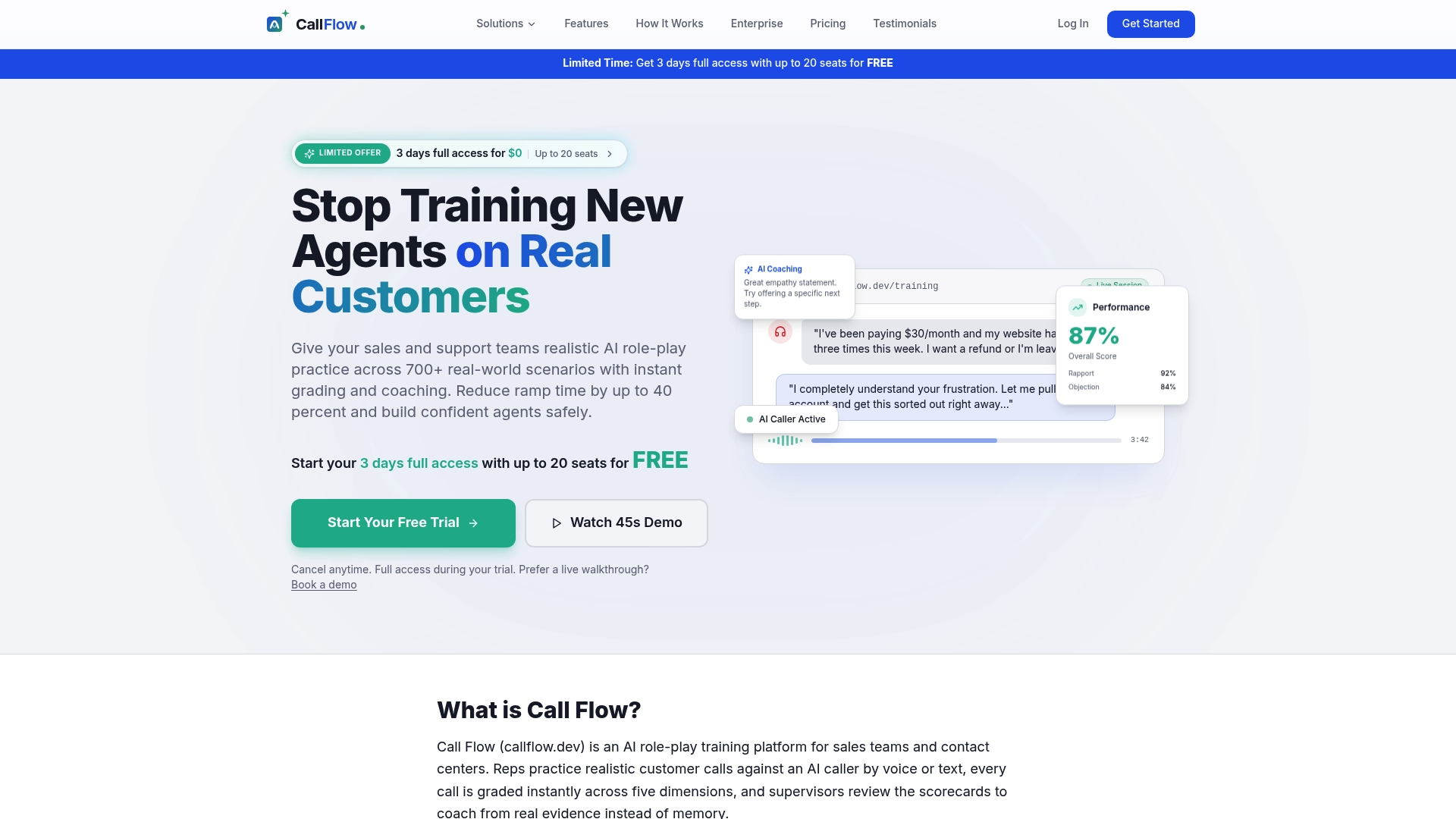
We built Call Flow to fix the practice and feedback part. Agents run realistic sales and support scenarios in voice or text. They get instant grading across five performance dimensions, with coaching notes they can act on at once. Managers use that time for what only a person can do: listen, explain and decide what comes next.
Our scoring is designed to match your existing QA standards, so practice results line up with how you grade live calls. Supervisors can review and override scores. You can also build custom scenarios from the exact call types in your agents' goals.
Our advice: keep the plan simple, make it specific and put practice in every cycle.
Costa
Try the practice step with Call Flow
Call Flow is an AI role-play platform for sales teams and contact centers. It gives agents scored practice calls, gives supervisors dashboards and skill analytics, and lets you create custom scenarios for your coaching goals. Plans are billed per team. Starter is $7.42 per month or $89 per year. Growth is $14.92 per month or $179 per year. Scale is $33.25 per month or $399 per year. You can try all features free first. See the plans and pricing, or look at the Business and Enterprise options for larger teams.
If you want to pilot practice with a small group first, our real-time call coaching pilot guide lays out a four to eight week plan.
FAQ
What should a call center coaching plan include?
Include a goal for each agent, the scorecard items behind it, how you found the gap, a session format, practice scenarios, a cadence and a log of follow-up actions. Add outcome and behavior metrics so you can see if it works.
How long should a coaching session be?
Twenty to thirty minutes is enough for one goal. Use the first minutes to restate the goal and hear the agent's self-assessment. Spend the rest on feedback, practice and next steps. Shorter touchpoints after flagged calls can be five minutes.
How many goals should one agent have?
One at a time. A single behavior is easier to practice, score and track. When the agent reaches the target, set the next goal from the scorecard.
How do I know if coaching is working?
Watch the target scorecard item first. It should move before FCR or CSAT does. Then check outcomes such as FCR, CSAT and quality scores over a few months. Also track coaching completion, so you know the plan was actually run.
Sources
- Cornell University: research on coaching in customer service
- ICMI: Tackling Transferred Calls Through Your Agent Scorecard
- TechTarget: 10 strategies to improve contact center agent performance
- ICMI: 3 Essential Call Center Quality Management Metrics
- Johns Hopkins Medicine: Coaching Definition and Best Practices
- ICMI: Why Your AI Pilot Succeeded, But Your Rollout Failed