

A coaching note records context, concrete evidence, impact, and a single next step with owner and deadline. That is the minimum. Anything less turns into a vague memory of a call instead of a document you can act on. Below, we break down the fields to include, give you copy-paste templates, and show how to turn a note into a tracked follow-up plan.
TL;DR:
- Use a brief note for minor, isolated behavior; formalize repeated issues, measurable customer impact, or any compliance concern, and retain evidence for audits.
- Assign one owner, deadline, and measurable target to each action; check corrective items within 48 to 72 hours, then review ongoing development weekly.
- Tie each observation to timestamped call evidence, a named scorecard criterion, and an affected KPI such as first call resolution, customer satisfaction, or handle time.
- Pair recognition with corrective feedback: positive feedback supports usefulness, while negative feedback builds accountability; matching both to development goals can encourage proactive behavior.
Table of Contents
- Anatomy of an effective coaching note
- Templates and short coaching-note examples you can copy
- Turning notes into action: follow-up, tracking, and cadence
- Linking coaching notes to QA standards and metrics
- Author perspective and practical tips from Costa (Call Flow)
- Perspective: when a short note is enough and when to formalize
- How Call Flow helps teams capture evidence and speed coaching notes
- FAQ
- Sources
Anatomy of an effective coaching note
A coaching note has five parts. Skip one, and the note loses value.
Context comes first: the date, call ID, queue, and scenario type. This makes the note searchable later, during an appraisal or an audit.
Observed behavior comes next. Write what happened, not what you assume happened. Use a timestamp or a short quote from the call. "At 2:14, the agent skipped the verification step" is useful. "The agent seemed rushed" is not.
Impact ties the behavior to an outcome. Did it affect first call resolution, customer satisfaction, handle time, or compliance risk? Name the metric.
Coach assessment is a short rating tied to your scorecard criteria, with one line of rationale. Keep it brief.
Next steps close the note: who owns the action, by when, and how you will know it worked.
Tone matters as much as structure. Research published in the Journal of the Academy of Marketing Science found that positive and negative feedback work through different mechanisms. Positive feedback builds a sense of usefulness, while negative feedback builds accountability. The same research recommends embedding feedback-based goal setting into regular personnel development so proactive behavior sticks. In practice, that means pairing one recognition note with one corrective note instead of defaulting to correction alone.
- Context: date, call ID, queue, scenario
- Observed behavior: timestamped evidence or direct quote
- Impact: metric affected (FCR, CSAT, AHT, compliance)
- Assessment: short rating against scorecard criteria
- Next step: owner, deadline, success measure
Pro Tip: Write the next step before you write the assessment. It forces you to coach toward an action instead of just describing a problem.
Templates and short coaching-note examples you can copy
Most managers need two templates: one for quick feedback, one for formal coaching.
- Quick note (2 to 4 lines): Use this for day-to-day recognition or minor corrections. Example: "Call #4471, 9/12. Agent confirmed account details before discussing billing, cutting verification time. Nice use of the opening script. Keep it up."
- Expanded note (formal coaching): Use this when a pattern needs correction. Include context, evidence, impact, expectation, and a measurement plan. Example: "Call #4502, 9/14, support queue. At 3:40, agent offered a refund without checking the return policy. This created compliance risk and extended average handle time by two minutes. Expectation: confirm policy before quoting a resolution. Measure: zero policy exceptions over the next 10 calls, reviewed Friday."
Map templates to scenarios you see most often. For onboarding ramp, focus the note on script adherence and confidence, something our 30 to 60 to 90 day training plan outlines in more detail. For objection handling, cite the specific objection and the phrase the agent used to respond. For compliance, always attach the exact policy clause referenced.
- Quick notes: recognition, minor corrections, daily cadence
- Expanded notes: repeated issues, compliance gaps, formal review
- Remote coaching: add a line on tone, since written notes lose vocal context that in-person coaching captures naturally
Turning notes into action: follow-up, tracking, and cadence
A note without a follow-up plan is just a record. Every note needs an owner, a deadline, and a way to measure success, written in SMART terms: specific behavior, a measurable target, and a date.

Set a cadence and stick to it by using a Looker Studio Marketing Dashboard to visualize coaching outcomes and trends effectively. Check in 48 to 72 hours after a corrective note to confirm the agent understood the expectation. Run short weekly checks on notes tied to ongoing development. Review quarterly trends to catch patterns a single note would miss, something a training dashboard makes easier to spot across a team.
Attach evidence to every formal note: a call clip, transcript excerpt, or QA score. Version the note if circumstances change, rather than rewriting history. Our agent performance dashboard approach works well for surfacing these patterns before they become SLA breaches.
- Assign one owner and one deadline per note, never a shared action
- Check in at 48 to 72 hours for corrective items
- Escalate to a formal performance improvement plan after repeated misses on the same behavior
- Store evidence (clips, transcripts, scores) alongside the note, not separately
Linking coaching notes to QA standards and metrics
Coaching notes carry more weight when they reference the same KPIs your QA process already tracks: QA score, first call resolution, CSAT, and average handle time. A generic note says "needs to improve closing." A QA-aligned note says "closing rate scored 2 out of 5 on the scorecard; missed the value recap step that ties to CSAT."
ICMI's operations standards call for documented coaching that links performance standards to customer expectations and feeds into appraisals. The COPC CX Standard goes further, requiring ongoing monitoring across transaction types and coaching actions that follow directly from monitoring results, not from memory or impression.
Documented, evidence-linked coaching notes make quarterly trend analysis and calibration possible across a team. This is the structure COPC's standard points toward when it asks organizations to tie coaching to formal review cycles.
- Reference the scorecard criterion by name, not just the overall score
- Cite the KPI affected (FCR, CSAT, AHT) in the impact line
- Keep standards language short: one reference per note is enough
- Use the same field structure every time so appraisals can pull from notes directly
Author perspective and practical tips from Costa (Call Flow)
A coaching note should take five minutes. Pull the call ID and metadata first. Write the observed behavior with a timestamp while it is fresh. Note the impact on one metric. Add a one-line assessment. Assign the next step before you move to the next call.
Teams using Call Flow for role-play practice report significantly faster ramp time and marked improvement in resolution rates, benefits we track because faster-ramped agents generate fewer repetitive corrective notes. Instant grading across performance dimensions means the evidence for a note is already scored before you sit down to write it, which cuts the guesswork out of the assessment line.
- Pull call metadata first, before writing anything else
- Write observed behavior while the call is still fresh
- Let instant grading supply the evidence, not memory
Pro Tip: Draft the next-step line before the assessment line. It keeps the note pointed at action instead of critique.
Perspective: when a short note is enough and when to formalize
A two-line note is enough when the behavior is minor and isolated. Formalize when the same issue repeats, when customer impact is measurable, or when compliance is involved. Keep at minimum the evidence and the outcome for anything that might reach an appraisal or an audit. Tracking trends matters more than logging every small moment, so resist the urge to document everything equally.
— Costa
How Call Flow helps teams capture evidence and speed coaching notes
Writing a strong coaching note depends on having clear evidence, and that is where most managers lose time digging through call recordings. Call Flow runs realistic role-play scenarios with instant AI grading across five performance dimensions, so the evidence and the score are ready before you open a blank note.
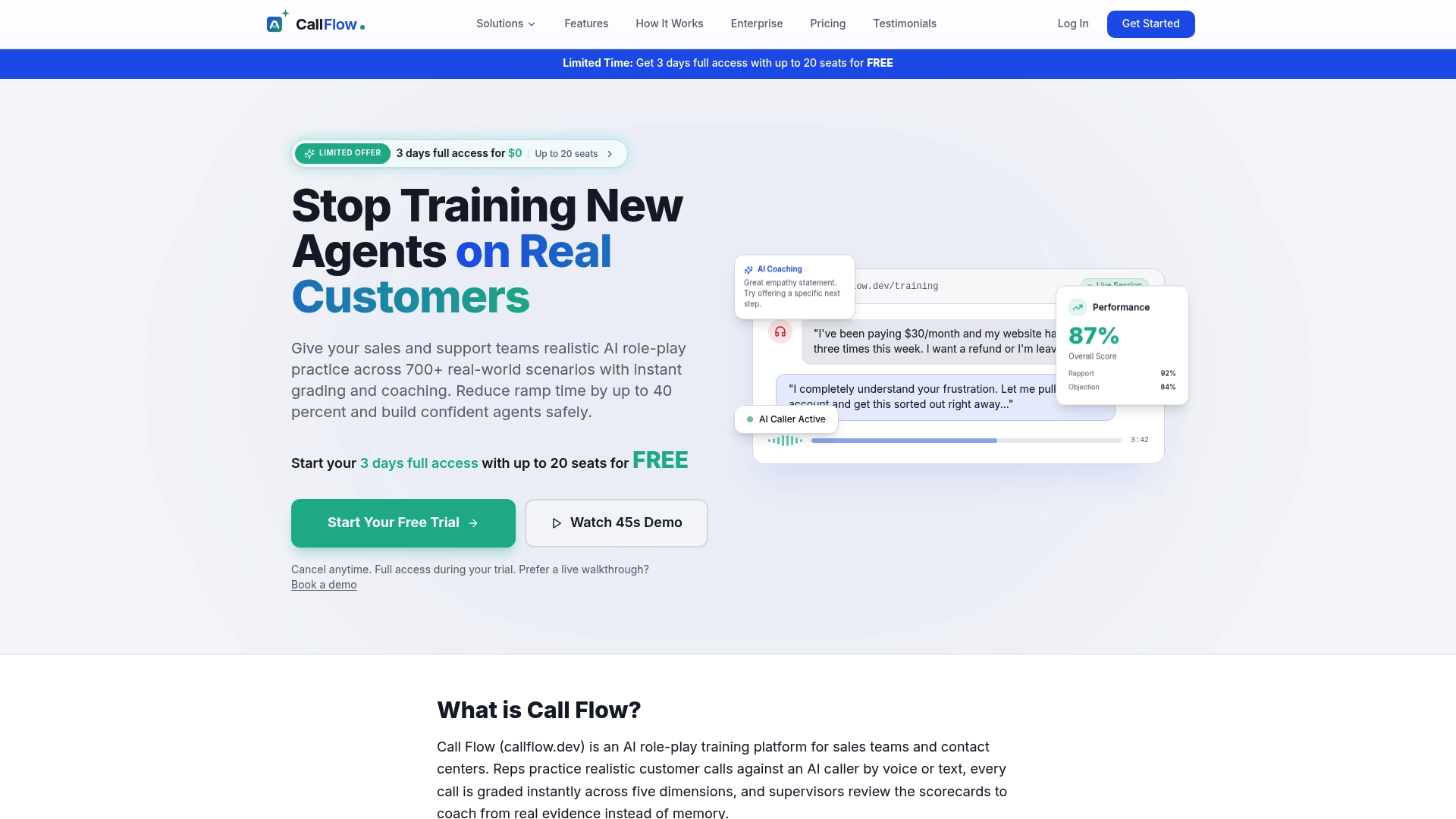
The feedback our platform generates maps directly onto the anatomy above: context from the scenario setup, observed behavior from the transcript, impact from the scoring dimensions, and a suggested next step from the coaching recommendation. Supervisor dashboards then track those notes over time, so trend review at the quarterly stage takes minutes instead of hours.
- Role-play scenarios generate timestamped, scored evidence automatically
- Instant grading supplies the assessment line without manual scoring
- Supervisor dashboards track notes and follow-ups across the team
Plans start at $7.42 per month on the Starter tier, with Growth and Scale tiers available as teams grow, and Business and Enterprise options for larger contact centers at Callflow. Every plan includes a risk-free trial, so you can test the workflow on a real team before committing.
FAQ
What should a coaching note always include?
A coaching note should always include context (date, call ID, queue), observed behavior with a timestamp or quote, the impact on a metric like FCR or CSAT, a short assessment, and a next step with an owner and deadline. Leaving out the next step is the most common gap that makes notes useless later.
How often should managers write coaching notes?
Write a quick note after any call worth flagging, whether positive or corrective, and reserve formal expanded notes for repeated issues or compliance concerns. ICMI's standards call for documented, regular coaching sessions rather than occasional check-ins.
Should coaching notes include both positive and negative feedback?
Yes. Research in the Journal of the Academy of Marketing Science found that positive feedback builds a sense of usefulness while negative feedback builds accountability, and both are needed to sustain improvement. A note that only corrects, or only praises, misses half the mechanism that drives behavior change.
How do I link coaching notes to QA scores?
Reference the specific scorecard criterion the behavior affected, not just the overall QA score, and name the KPI it influences, such as FCR or AHT. The COPC CX Standard expects coaching actions to follow directly from monitoring results so the link is traceable.
Can Call Flow help speed up writing coaching notes?
Yes. Call Flow generates scored, timestamped evidence from role-play sessions automatically, which fills in the evidence and assessment fields before a manager writes the note. Plans start at $7.42 per month with a risk-free trial included.