

This article gives you a ready-to-run bank of call center scenario examples, script excerpts, a five-step scoring framework, and a compact runbook for practice and debrief. Inside: six scenario groups covering onboarding through irate-caller de-escalation, plug-and-play phrasing templates, a session structure you can run in under an hour, and a short look at how AI role-play tools like Callflow can extend live practice between sessions.
TL;DR:
- Role-play training improves call handling speed, first-call resolution, call control, and empathy by simulating unpredictable customer emotions and problems.
- The five-step call flow—greet, identify, probe, propose, close—standardizes scoring and aligns with existing QA metrics, making feedback more targeted.
- Practice scenarios cover onboarding, billing disputes, technical issues, difficult customers, and escalations, each with specific coachable focus points and script excerpts.
- AI role-play tools like Callflow enable unlimited, instant feedback practice between live sessions, helping reduce ramp-up time and supplement traditional training methods.
- Implementing micro-sims weekly, focusing on one clear coaching point at a time, enhances skill development without requiring additional budgets or extensive scripting.
Table of Contents
- What Makes Call Center Scenario Examples Actually Work
- The 5-Step Call Flow That Anchors Every Scenario
- A Scenario Bank Organized by Training Objective
- Ready-to-Use Scripts for Key Moments in a Call
- How to Run a Role-Play Practice Session
- Where AI Role-Play Fits Alongside Live Practice
- A Trainer's Honest Take on What Actually Moves the Needle
- Pilot Callflow Without Disrupting Your Live Role-Play Program
- Sources
- FAQ
What Makes Call Center Scenario Examples Actually Work
Scenario practice beats slide decks because it trains judgment, not recall. Role-play's real purpose is developing an agent's agility with unpredictable emotions and messy, half-explained problems, not memorizing a script word for word, according to training frameworks built around mock call exercises. Product knowledge tells an agent what the refund policy is. Scenario practice teaches them how to say it to someone who's already angry before the call started.
That distinction shapes when you should reach for role-play instead of an e-learning module or a policy memo. Here's what scenario-based training typically improves, and where it earns its place in a training calendar:
- Faster ramp time. New hires who practice full calls before going live handle real interactions with less freezing and fewer dead-air moments.
- Better first-call resolution. Agents who've rehearsed a decision tree out loud make the call, rather than escalating out of uncertainty.
- Stronger call control. Practicing interruptions and redirection builds the muscle to steer a call back on track without sounding scripted.
- More consistent empathy. Saying an apology line under mild pressure in a training room makes it easier to say for real, under real pressure.
Use role-play at four points in the agent lifecycle: during onboarding to build the base call flow, during remediation when QA scores flag a specific weak spot, ahead of a new campaign launch when the product or promotion is unfamiliar, and as a recurring soft-skill refresher for tenured agents whose empathy scores have quietly slipped. Skip it, or keep it brief, when the gap is pure knowledge (a new SKU code, an updated hold-time policy) since a quick reference card solves that faster than a fifteen-minute mock call.
The 5-Step Call Flow That Anchors Every Scenario
Every scenario in this bank maps to the same five-step lifecycle, so scoring stays consistent no matter which situation an agent is practicing. That structure follows the standard mock-call framework used across training programs for everything from billing disputes to delivery complaints.
- Greet and verify. The agent opens warmly and completes identity verification (DPA/security check) before discussing account details. Behavioral indicator: agent confirms name, account, and at least two identifiers before proceeding.
- Identify the core concern. The agent lets the customer state the issue in their own words before jumping to a fix. Indicator: agent paraphrases the issue back accurately within the first thirty seconds.
- Probe and listen actively. The agent asks clarifying questions rather than assuming the first explanation is complete. Indicator: agent asks at least two follow-up questions before proposing anything.
- Propose a solution or alternative. The agent offers a concrete next step, with an alternative ready if the first option is rejected. Indicator: agent presents one primary solution and one fallback.
- Close and confirm resolution. The agent restates what was agreed, checks satisfaction, and offers further help. Indicator: agent recaps the resolution and asks a direct closing question.
Pro Tip: Score each step on a simple three-point scale (missed, partial, met) rather than pass/fail. It gives coaches something specific to discuss instead of a single blunt grade.
This five-step structure maps cleanly onto the QA categories most centers already track: verification maps to compliance, identifying and probing map to empathy and accuracy, proposing maps to ownership, and closing maps to resolution. That overlap matters. It means a scenario built around this rubric doesn't require a separate QA form. You're scoring the same dimensions supervisors already grade on live calls, just in a lower-stakes setting where mistakes don't cost you a real customer. Deep-knowledge training design also recommends building explicit constraints into each scenario, such as "must verify identity before discussing balance" or "cannot offer a refund above $50 without escalation," alongside a clearly marked emotional cue for whoever plays the customer (calm, frustrated, or hostile). That combination lets one exercise test both policy compliance and soft skills at the same time.
A Scenario Bank Organized by Training Objective
Each scenario below includes a quick setup, the customer's tone, two coachable focus points, and a short script excerpt an agent can build from. Common categories like delayed orders, wrong-item deliveries, refund disputes, and manager escalations show up consistently across customer service scenario guides, and the groupings below expand on that base list.
Group A: Onboarding and Basic Call Flow
Scenario 1: Routine Account Update Setup: The customer calls to update a mailing address. Tone: neutral, slightly rushed. Coachable focus: (1) completing full verification before making changes, (2) confirming the change back clearly. Script excerpt: "Before I update that, can I confirm your full name and the last four digits of your account number? ... Great, I've got your new address as 142 Birch Lane. Does that look right to you?"
Scenario 2: First-Time Caller Navigation Setup: A new customer isn't sure which department handles their question. Tone: confused, mildly apologetic. Coachable focus: (1) patient triage without sounding dismissive, (2) setting expectations for next steps. Script excerpt: "No worries at all, that's a common mix-up. Based on what you've described, this actually falls under billing. I can transfer you now, or if you'd rather, I can grab the details and have them call you back."
Group B: Billing and Refunds
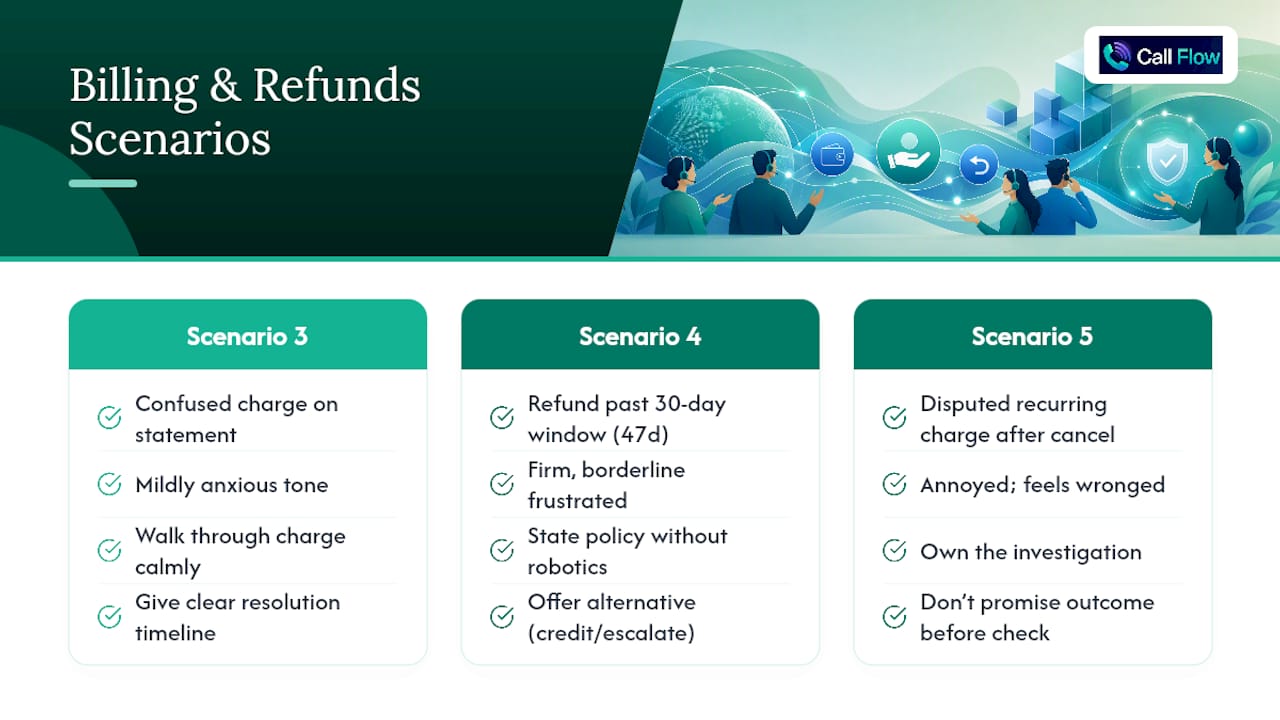
Scenario 3: Confused Charge on Statement Setup: The customer sees a charge they don't recognize. Tone: mildly anxious, not yet upset. Coachable focus: (1) walking through the charge without sounding defensive, (2) offering a clear resolution timeline. Script excerpt: "I can see that charge, and I understand why it looks unfamiliar. That's actually a prorated fee from your plan change on the third. Would you like me to send a breakdown by email?"
Scenario 4: Refund Request Past Policy Window Setup: The customer wants a refund on a purchase made 47 days ago; policy caps refunds at 30 days. Tone: firm, borderline frustrated. Coachable focus: (1) stating policy without being robotic, (2) offering an alternative when a straight "no" isn't the full answer. Script excerpt: "I want to be upfront with you. Our refund window is 30 days, so I can't process a full refund here. What I can do is apply an account credit for the amount, or connect you with a supervisor if you'd like to escalate this further."
Scenario 5: Disputed Recurring Charge Setup: The customer insists they canceled a subscription that's still billing them. Tone: annoyed, feels wronged. Coachable focus: (1) taking ownership of the investigation, (2) not promising an outcome before checking the account. Script excerpt: "I hear you. That's frustrating if you believed this was already canceled. Let me pull up the cancellation history right now so I can tell you exactly what happened."
Group C: Product Failures and Technical Troubleshooting
Scenario 6: Device Won't Power On Setup: The customer's product is unresponsive after a software update. Tone: mildly stressed, needs the device for work. Coachable focus: (1) structured troubleshooting instead of guessing, (2) managing time expectations if the fix takes several steps. Script excerpt: "Let's work through this together. First, can you hold the power button for ten full seconds? ... Okay, while that resets, I want to flag this might take three or four steps. I'll stay on the line the whole way."
Scenario 7: Recurring Technical Issue, Third Contact Setup: The same problem has been reported twice before and still isn't fixed. Tone: exasperated, skeptical of another fix attempt. Coachable focus: (1) acknowledging the repeat contact directly instead of ignoring it, (2) escalating proactively rather than waiting to be asked. Script excerpt: "I can see this is the third time you've called about this, and that's not the experience you should be having. I'm going to escalate this to our technical team directly instead of asking you to try the same steps again."
Group D: Difficult or Irate Customers
Scenario 8: Customer Raising Their Voice Setup: The customer is shouting about a missed delivery window. Tone: hostile, interrupting. Coachable focus: (1) keeping vocal tone steady without matching their volume, (2) moving from emotion to facts without dismissing the emotion first. De-escalation practice built around this scenario type emphasizes staying calm, acknowledging frustration, then pivoting to facts and ownership. Script excerpt: "I hear how frustrating this is, and you're right to expect better. Let me pull up your order right now so we can figure out exactly what happened and fix it."
Scenario 9: Customer Threatening to Cancel Service Setup: A longtime customer says they're canceling over a billing error. Tone: cold, disappointed rather than shouting. Coachable focus: (1) recognizing that quiet anger needs a different approach than loud anger, (2) offering a genuine remedy instead of a scripted retention pitch. Retention-focused mock calls show how dramatically tone shapes the outcome. A dismissive agent accelerates the cancellation, while an agent who acknowledges the account history and rebuilds trust often keeps the account and the relationship. Script excerpt: "You've been with us for six years, and this billing error shouldn't have happened. I want to fix the charge and make sure this doesn't repeat. Can I walk you through what I'm doing right now?"
Group E: Transfers, Escalations, and Ownership
Scenario 10: Customer Demands a Manager Immediately Setup: The customer skips explanation and asks for a supervisor right away. Tone: impatient, distrustful of frontline staff. Coachable focus: (1) not treating the request as a personal failure, (2) offering to try resolving it first without sounding like a stall tactic. Script excerpt: "I can absolutely get a supervisor on the line for you. Before I do, would it help if I take thirty seconds to see if I can resolve this myself? If not, I'll transfer you right away."
Scenario 11: Warm Transfer With Context Loss Risk Setup: The issue spans two departments and the customer has already repeated their story once. Tone: tired of repeating themselves. Coachable focus: (1) briefing the next agent before connecting the call, (2) telling the customer what's happening instead of going silent. Script excerpt: "I'm going to bring my colleague on the line, and I'll fill her in on everything you've told me first so you don't have to repeat it. One moment while I do that."
Group F: Channel Switching and Context Continuity
Scenario 12: Customer Moves From Chat to Phone Mid-Issue Setup: The customer started in chat, got disconnected, and now calls in with the same open ticket. Tone: mildly irritated at having to switch channels. Coachable focus: (1) locating prior chat history instead of asking the customer to restart, (2) confirming what's already been tried. Retail and support teams handling this kind of handoff often lean on omnichannel customer experience practices to keep context intact across channels. Script excerpt: "I can see your chat transcript from a few minutes ago, so I've got the full picture already. It looks like you'd already tried restarting the router. Let's pick up from there instead of starting over."
For a longer version of this bank formatted for direct printing or LMS upload, Callflow's customer service role-play scenarios collection offers sixteen ready-to-adapt setups in the same format.
Ready-to-Use Scripts for Key Moments in a Call
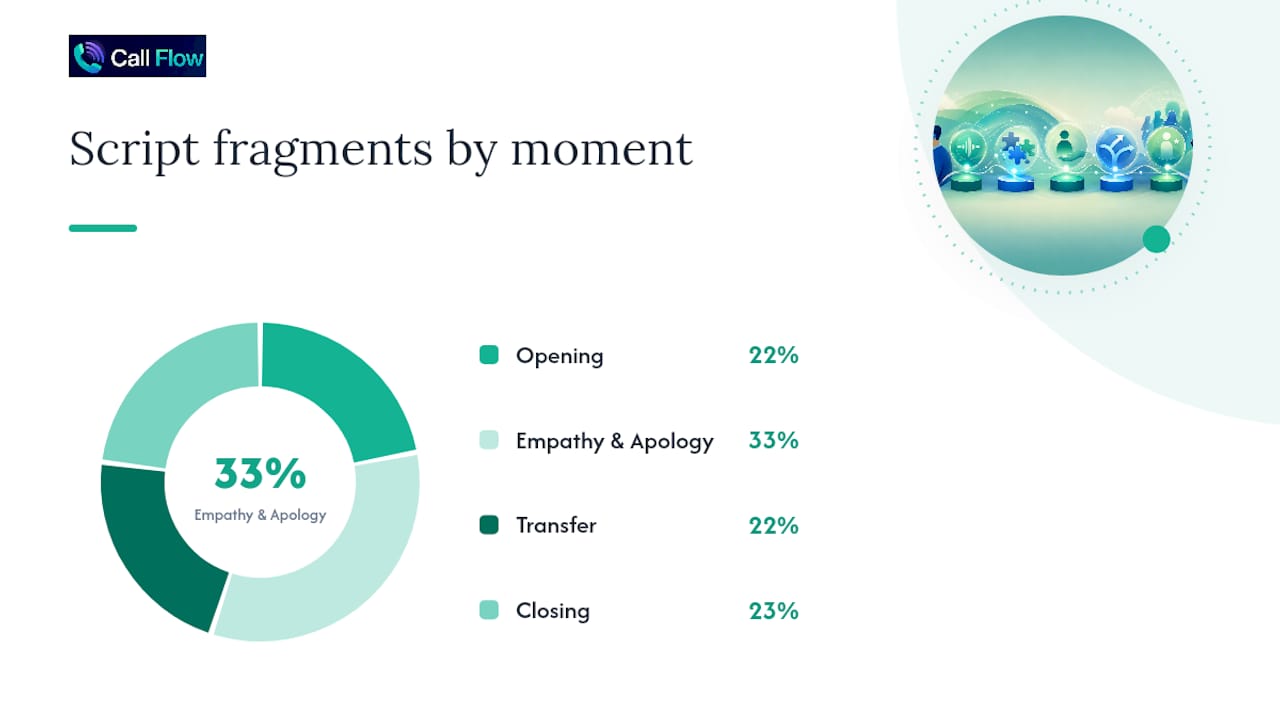
Trainers rarely need a full script. What they need is a handful of adaptable lines for the moments where agents freeze: the opening, the apology, the transfer, and the close. Published script banks exist for exactly this reason, and the fragments below are built to be localized to your own policy language.
Opening and verification:
- "Thanks for calling [company], this is [name]. Can I start by confirming your name and account number?"
- "I want to make sure I'm looking at the right account. Can you verify your date of birth and zip code on file?"
Empathy and apology, scaled to the situation:
- Calm customer: "I understand, and I want to get this sorted for you quickly."
- Frustrated customer: "That's a fair thing to be upset about, and I'm going to work through this with you right now."
- Angry customer: "I hear you, and you deserve a real answer. Let me pull up your account so I can give you one."
Transfer and escalation, without losing ownership:
- "I'm bringing in someone who specializes in this exact issue. I'll stay on the line to make the introduction."
- "This needs a manager's approval, but I'm not stepping away from your case. I'll follow up once it's approved."
Closing and next-step confirmation:
- "To recap, here's what we've agreed on: [summary]. Does that match what you were expecting?"
- "Is there anything else I can help with today, or did we get everything covered?"
Pro Tip: Have agents practice the apology lines out of order in drills, jumping straight from calm to angry, since real calls rarely escalate in a neat sequence.
How to Run a Role-Play Practice Session
A focused session runs in 30 to 60 minutes and needs three roles: the agent, someone playing the customer, and an observer scoring against the five-step rubric.
- Set the scene (2 minutes). Hand the customer-player the scenario card with persona, tone, and any hidden information they should reveal only if asked.
- Run the call (5 to 8 minutes). No pausing mid-call. Let mistakes happen; that's the point of practicing before a real customer is on the line.
- Score against the rubric (3 minutes). The observer rates each of the five steps as missed, partial, or met, noting one specific line or moment as evidence.
- Debrief with self-reflection first. Ask the agent three questions before offering any feedback: What went well? What would you change? What will you try on the next call? Trainer feedback layered on top of that self-assessment lands better than feedback delivered cold.
- Rotate roles. Everyone should play the difficult customer at least once. It builds empathy for what agents are actually up against.
For remote teams, record the session (with consent) so agents can watch their own tone back, which catches things live feedback misses. Scale this over time with short two-minute micro-sims dropped into weekly team huddles, rather than saving all practice for a quarterly training day.
| Session Element | Target | Why It Matters |
|---|---|---|
| Session length | 30 to 60 minutes | Long enough for a full call, short enough to fit weekly |
| Roles per session | 3 (agent, customer, observer) | Rotation builds both delivery and evaluation skills |
| Scoring scale | 3-point (missed/partial/met) per step | Specific enough to coach against without over-grading |
| Debrief order | Self-reflection first, then trainer feedback | Builds ownership before correction |
A guide on role-play scenarios that cut ramp time walks through variations on this session structure for teams running practice at scale.
Where AI Role-Play Fits Alongside Live Practice
Live role-play teaches presence and improvisation, but it's limited by scheduling: you can't put every agent through a mock call every week with a human partner. AI-integrated platforms fill that gap by giving automated feedback on empathy and resolution effectiveness right after a practice call, which frees supervisors for higher-value coaching instead of manual line-by-line QA review. This model applies to the exact five-step structure covered above, generating scoring across multiple performance dimensions immediately after each simulated call.
A sensible pilot: pick one team, run a baseline assessment on two or three of the scenarios above, then give agents two weeks of unlimited AI practice on the same scenario set. Track ramp time to full call handling, resolution rate on real calls, and whether AI scores track with your existing QA scores. That last check matters most. If the two disagree consistently, recalibrate before rolling out further. Full details on scoring dimensions are in Callflow's AI role-play training overview.
A Trainer's Honest Take on What Actually Moves the Needle
Three mistakes I see constantly: over-scoring every micro-detail until feedback sessions feel like interrogations, skipping the debrief because the clock ran short, and writing scenarios so scripted that agents just recite lines instead of thinking. None of these require a bigger budget to fix. They require restraint.
The quick wins are just as unglamorous. Run five-minute micro-sims instead of waiting for a full session. Give one focused piece of feedback per call, not five. Let agents coach each other occasionally instead of always defaulting to a trainer. None of this is complicated. It just has to actually happen every week, not once a quarter when someone remembers training exists.
— Costa
Pilot Callflow Without Disrupting Your Live Role-Play Program
Callflow isn't a replacement for the mock-call sessions and debriefs covered above. It's what fills the gap between them, giving agents unlimited practice reps on the same scenarios your team already runs, graded instantly instead of waiting for a supervisor's calendar to open up.
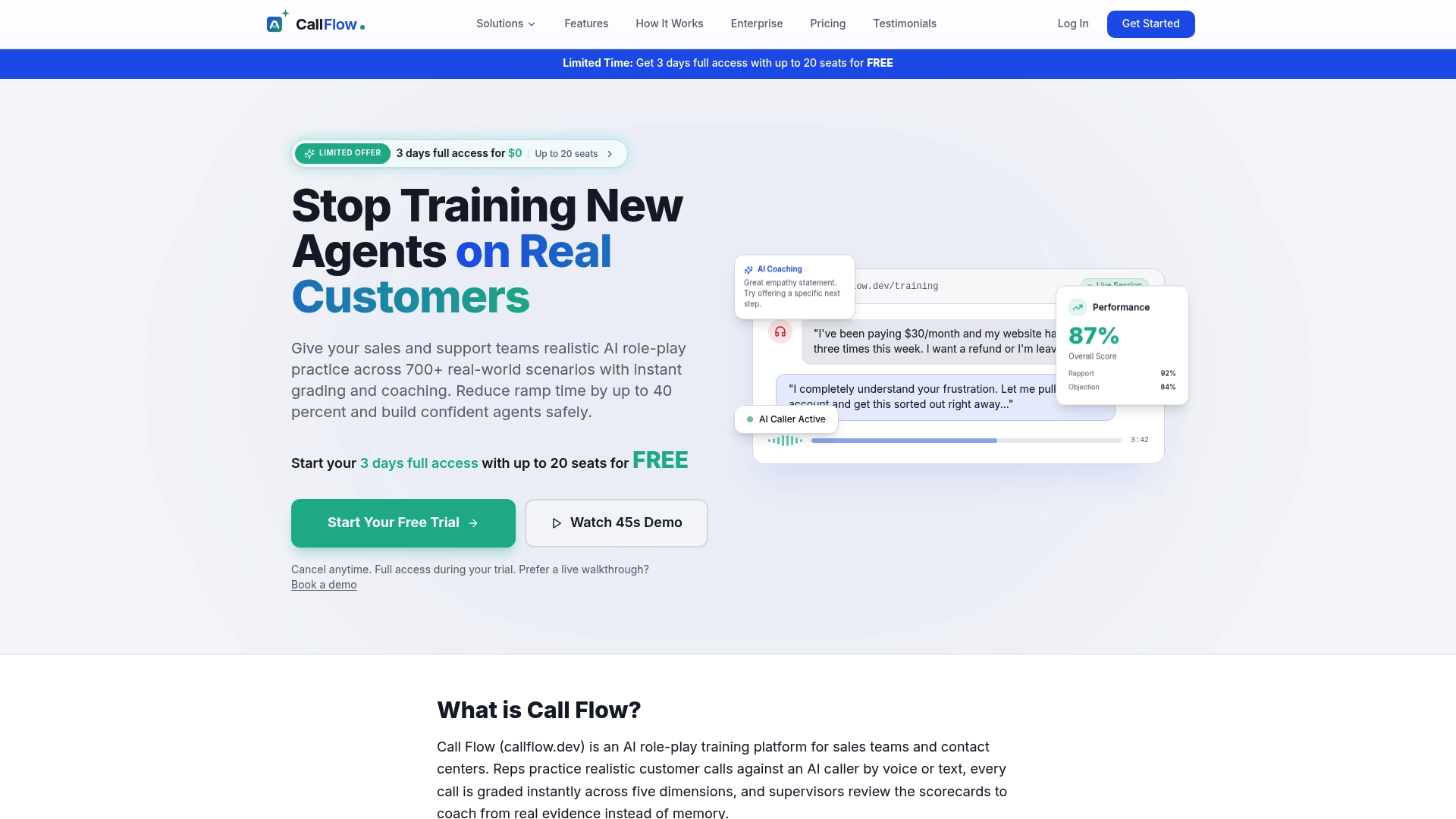
A workable pilot looks like this: pick one team, assign three to five scenarios from your existing bank, and give agents two weeks of practice access before comparing scores against your baseline QA data. Callflow's pricing page lists Starter plans from $7.42 per month, with Growth and Scale tiers available for teams that need more seats or scenario customization. Larger organizations evaluating a company-wide rollout can get pilot and proof-of-concept details through the enterprise team. Start with a risk-free trial, run it against two or three scenarios from this article's bank, and see whether your ramp-time numbers move before committing to anything larger.
Sources
A few resources are worth keeping on hand beyond this article. The mock call exercise PDF offers a structured, downloadable template for building your own scenario cards from scratch. Industry training modules like Pega Academy's customer service scenario walkthrough explain how AI scoring layers onto traditional scenario design. For phrasing specifically, the call center script collection covers openings, objections, and closings you can adapt to your own policy language.
- Mock Call Exercise 2 – Managing an Unhappy Customer Call
- Pega Academy customer service business scenario
- 88 free call center scripts to boost your customer satisfaction
- How to Respond to Common Customer Service Scenarios
FAQ
What Are Common Mock Call Scenarios?
The most common ones cover delayed orders, wrong-item deliveries, refund disputes, technical troubleshooting, and requests to speak with a manager, according to common customer service scenario lists. Most training programs also include at least one irate-customer scenario to practice de-escalation specifically.
Can You Give Examples of Role-Play Scenarios for Call Centers?
Yes. Strong examples include a confused billing charge, a customer demanding an immediate manager transfer, a device that won't power on after an update, and a long-time customer threatening to cancel over a service error. Each scenario in this article's bank pairs a setup and tone with a short script excerpt trainers can adapt directly.
What Are Examples of Difficult Customer Scenarios?
Difficult scenarios typically involve a customer raising their voice over a missed delivery, a repeat caller frustrated by an unresolved technical issue, or someone canceling service after a billing mistake. De-escalation practice for these situations focuses on staying calm, acknowledging the frustration, and pivoting to facts and ownership rather than matching the customer's energy.
How Do I Turn a Real Call Into a New Training Scenario?
Pull the transcript or recording, strip out identifying details, and note exactly where the agent struggled against the five-step call flow (greet, identify, probe, propose, close). Build the persona and emotional cue around what actually happened, then add it to your scenario bank so the next training cycle practices real gaps instead of hypothetical ones.
Does Callflow Replace Live Role-Play Training?
No. Callflow is built to run alongside human-led role-play, giving agents unlimited practice reps with instant grading between scheduled sessions. Pricing starts at $7.42 per month on the Starter plan, and teams can trial the platform risk-free before committing.