

A good QA scorecard has 10 to 15 line items in three or four sections. It uses yes/no for must-do items and a 1 to 5 scale for judgment calls. It adds up to 100 points. Below you will find a template you can copy today, a second version for sales calls, and the steps to score, calibrate, and coach with it.
TL;DR
- Group 10 to 15 observable questions into three or four sections: process, communication, resolution, and compliance.
- Use yes/no for non-negotiable items and a 1 to 5 scale for judgment items. Add an N/A option.
- Weight the sections by what your business needs most, then total to 100 points.
- Calibrate with several reviewers on the same calls, then coach from the scores.
- Build one scorecard per channel or call type. Do not force one form on every interaction.
Table of Contents
- What a QA scorecard is
- What to measure
- A call center QA scorecard template you can copy
- Choose a scoring scale
- Build your own scorecard in six steps
- How to score a call consistently
- Calibrate so scores mean the same thing
- Turn scores into coaching
- Common mistakes
- Perspective
- Practice against your scorecard with Call Flow
- FAQ
- Sources
What a QA scorecard is
A QA scorecard is a form. A reviewer uses it to grade a call, chat, or email against your standards. The result is a score and a set of notes the agent can act on.
It checks that agents follow brand standards, rules, and service procedures. The scorecard is only as good as its questions. Vague questions like "Was the agent professional?" give vague scores. Observable questions like "Did the agent state the next step and a time frame?" give scores two reviewers can agree on.
A scorecard serves three jobs:
- It tells you how a call went.
- It tells the agent what to do next time.
- It shows managers where the whole team is weak.
If your form does not do all three, change it.
What to measure
Start from your goals. Ask what a great call looks like for your customers and your business. Then turn each answer into something a reviewer can see or hear.
Most call center scorecards cover the same four areas:
- Communication: clarity, tone, active listening, pace.
- Customer connection: empathy, ownership, a personal close.
- Resolution: correct answer, complete answer, next steps, escalation when needed.
- Compliance and security: identity checks, required disclosures, privacy and payment rules.
Compliance deserves its own line items. Customer authentication before the agent shares or changes account data is a typical example. Rules for payment card or health data apply if your calls touch them.
If you track FCR and CSAT, map each scorecard section to the metric it should move. Resolution items relate to FCR. Connection items relate to CSAT. This keeps the form tied to results, not habit.
A call center QA scorecard template you can copy
This is a 100-point template for an inbound service call. It has four sections and 14 items. Adjust the points to your priorities.
| Section | Item | Scale | Points |
|---|---|---|---|
| Opening (10) | Greeted the customer and gave name and company | Yes/No | 4 |
| Opening (10) | Verified identity before discussing the account | Yes/No | 6 |
| Communication (25) | Spoke clearly and avoided jargon | 1 to 5 | 8 |
| Communication (25) | Listened without interrupting and confirmed understanding | 1 to 5 | 9 |
| Communication (25) | Kept a calm, positive tone | 1 to 5 | 8 |
| Connection (20) | Showed empathy that fit the situation | 1 to 5 | 10 |
| Connection (20) | Took ownership of the issue | 1 to 5 | 10 |
| Resolution (35) | Asked questions to find the real problem | 1 to 5 | 8 |
| Resolution (35) | Gave an accurate, complete answer | 1 to 5 | 12 |
| Resolution (35) | Managed holds and transfers well | Yes/No/N/A | 3 |
| Resolution (35) | Stated next steps and a time frame | Yes/No | 6 |
| Resolution (35) | Escalated when policy required it | Yes/No/N/A | 6 |
| Close (included above) | Recapped, asked if anything else was needed | Yes/No | 0 |
| Compliance | Gave required disclosures | Auto-fail if missed | Gate |
A few notes on how this works:
- Compliance is a gate, not a score. If the agent skips a required disclosure or fails identity checks, the call fails no matter what else went well. That is how we suggest you treat legal and security items.
- N/A matters. If a hold never happened, remove the item and calculate the percentage from the points that remain.
- The weights are an example. A team that sells high-value plans might move points from Opening to Discovery. A billing team might raise accuracy.
A sales call variation
Sales calls need different questions. Keep the same structure and swap the content.
| Section | Example items |
|---|---|
| Opening | Set an agenda. Confirmed the time available. |
| Discovery | Asked open questions. Uncovered the need, the timeline, and the decision process. |
| Value | Tied features to what the buyer said. Handled objections without arguing. |
| Next step | Agreed on a specific next step and date. |
| Compliance | Gave required pricing or recording disclosures. |
Discovery is where many sales scorecards are weakest. Our guide to scoring agent discovery shows how to turn it into observable questions.
Choose a scoring scale
Pick the scale per item, not per form.
- Yes/No fits rules. Did the agent verify identity? Did the agent give the disclosure? There is no gray area, so use binary.
- 1 to 5 fits skills. Empathy and clarity come in degrees. A five-point scale gives enough room without false precision.
- N/A fits behaviors that did not come up. Without it, agents lose points for things they could not do.
A hybrid form is the most practical. A 1 to 3 or 1 to 10 scale can work too. What matters is that every level has a written definition. For each item, write what a 1, a 3, and a 5 look like, with a short example. Reviewers who share definitions give similar scores.
Keep the form short. Fewer than about eight items can leave out important areas. More than about twenty tires reviewers and makes scoring drift. Ten to fifteen items is a good target. Use three or four sections with a few questions in each.
Build your own scorecard in six steps
Generic templates are a start. Your form should fit your calls. Planning guidance from contact center QA experts lines up with the steps below.
- Define what good looks like. Write down the outcomes you want: resolved issues, compliant calls, calm customers, booked next steps.
- Match forms to interaction types. Billing, tech support, retention, and outbound sales differ. Give each its own scorecard or its own section.
- Write observable questions. If two people could answer differently from the same recording, rewrite it.
- Weight by business priority. Put the most points where the business wins or loses. Total 100.
- Calibrate. Have reviewers score the same calls and compare. More on this below.
- Use the results for coaching and review the form often. Products, policies, and customer expectations change. Your scorecard should change with them.
Adapt the form to the channel
Phone, chat, and email need different items. Tone of voice and hold management belong on the phone form. Grammar, formatting, and response time belong on chat and email. Forcing one form across all channels punishes agents for things that do not apply.
You can also split by team. A tier-one team and an escalation team should not share the same weights. Escalation agents carry more resolution risk. Tier-one agents may need more points on opening and verification.
How to score a call consistently
A repeatable routine keeps scores fair. The process behind a free inbound-call scorecard is a good model:
- Review the recording or transcript.
- Score each item on a 1 to 5 scale.
- Mark items that did not apply as N/A.
- Add comments with a timestamp or a short quote.
- Calculate the percentage, leaving N/A items out of both the points earned and the points possible.
- Review the result with the agent.
- Compare results month over month.
Here is a worked example. An agent earns 68 points on the items that applied. The hold item was N/A, so the possible total is 97, not 100. The score is 68 divided by 97, or about 70%.
Comments carry as much value as the number. "Empathy: 2" teaches little. "At 2:14 the customer said she was worried about the late fee. The agent moved straight to the policy" teaches a lot.

Some teams roll item scores into one overall quality score per agent and track it over time. A sample customer service scorecard uses the same approach and pairs it with recurring one-on-one reviews.
Calibrate so scores mean the same thing
Two reviewers can hear the same call and score it ten points apart. Calibration fixes that.
A simple routine:
- Pick five calls, including at least one hard edge case.
- Have each reviewer score them alone, before any discussion.
- Compare item by item, not just totals. Totals can match while the reasons differ.
- Discuss each gap and rewrite the definition that caused it.
- Repeat.
Do this weekly when you launch a new form. Move to monthly once reviewers agree consistently. If your new scorecard is meant to match existing QA standards, calibration is how you prove it does.
If you are testing machine scoring next to human reviewers, run the same checks. Our six-step automated call scoring pilot shows how managers compare the two before they trust either.
Turn scores into coaching
A score alone changes nothing. Coaching changes behavior.
- Keep it regular. A short weekly or biweekly review beats a long quarterly one.
- Start with a strength. Name one thing the agent did well, with the moment in the call.
- Pick one or two fixes. Do not hand over a list of ten.
- Use the recording. Play the exact moment. Ask the agent how they would handle it again.
- Write notes someone can act on. See our examples of coaching notes managers can copy.
Track results at team level too. If half the team loses points on the same item, the problem is training or process, not individual effort. A good performance dashboard makes that pattern visible in minutes.
Soft skills need the same discipline. Empathy is a good example. You can teach it and score it. Read how to score role plays like live calls.
Common mistakes
- Too many items. Long forms produce tired reviewers and noisy scores.
- Vague wording. "Good rapport" cannot be scored. "Used the customer's name at least once" can.
- Equal weights for unequal items. A missed disclosure and a missed greeting are not the same.
- No auto-fail rule. Compliance misses need a clear consequence.
- One form for everything. Match the form to the call type.
- Never recalibrating. Drift builds slowly, then breaks trust.
- Scoring without coaching. Scores are a measurement. Improvement comes from the conversation after.
Perspective
We see the same pattern in many contact centers. The scorecard is fine. The problem is what happens between two reviews.
A reviewer scores a call, the agent hears the feedback days later, and the next live call is the first chance to try something new. That loop is slow and it puts customers in the practice seat.
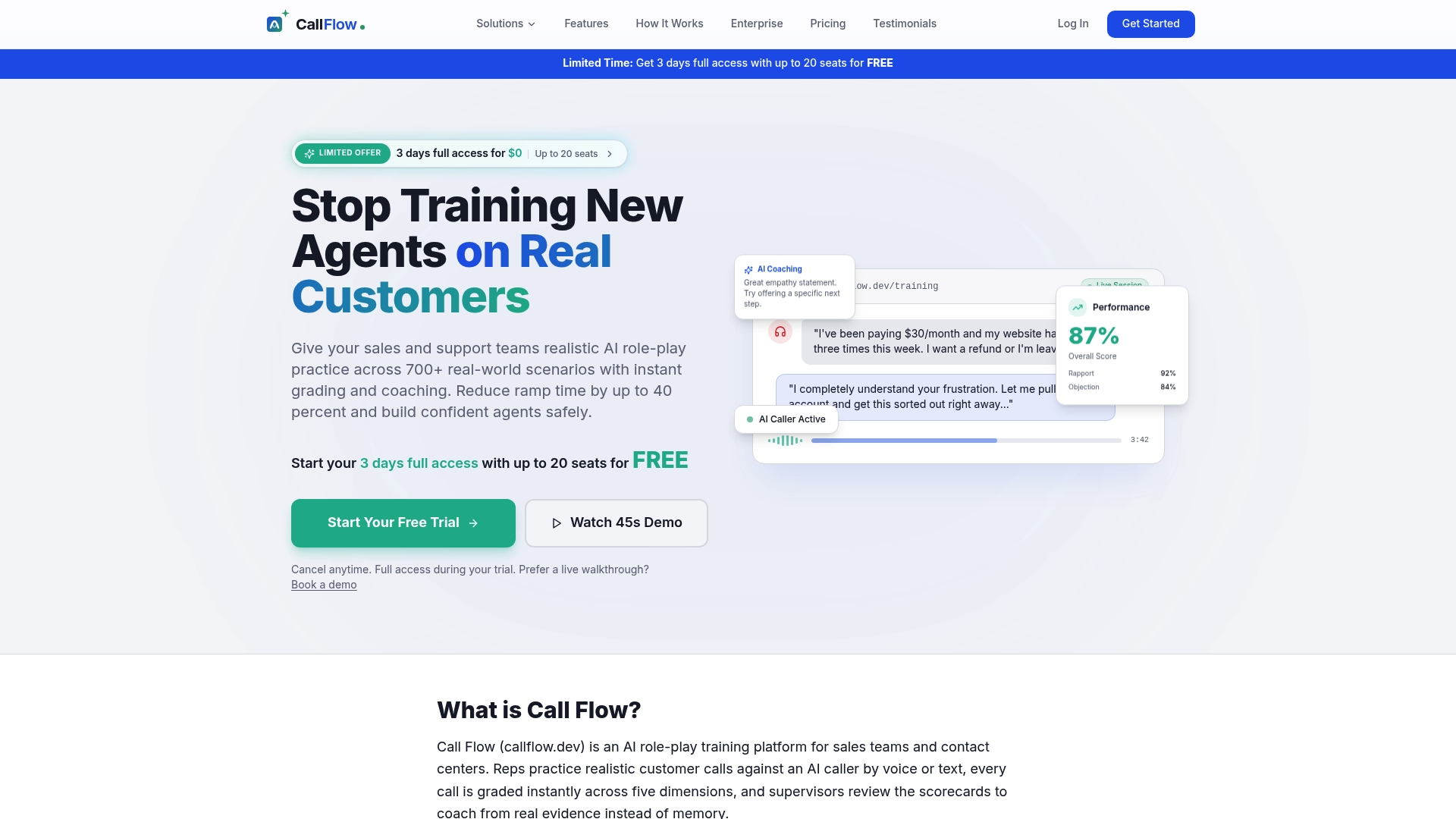
We built Call Flow to shorten it. Agents practice realistic scenarios in voice or text, and the platform grades each run right away across five performance dimensions. The feedback comes with coaching, so the agent can try again the same hour. Supervisors can review and override scores, and the scoring is built to align with the QA standards you already use.
Your scorecard defines the standard. Role play lets agents reach it before the call counts. We report faster ramp time and better resolution rates from teams that practice this way, and we think a scorecard works best when it is used for practice as well as for audits.
Costa
Practice against your scorecard with Call Flow
A scorecard tells you where agents fall short. Call Flow gives them a place to fix it. Agents run realistic customer scenarios, get instant grading and coaching, and repeat until the skill sticks. You can build custom scenarios from your own scorecard items, and supervisors get dashboards and skill analytics.
Plans are published and flat-rate. On our pricing page, Starter is $7.42 per month or $89 per year. Growth is $14.92 per month or $179 per year. Scale is $33.25 per month or $399 per year. Larger teams can look at Business and Enterprise plans. You can try the full feature set in a risk-free trial first.
For a wider view of how scoring, practice, and metrics fit together, read how to align call quality standards to scorecards and the CSAT playbook for contact-center leaders.
FAQ
How many questions should a QA scorecard have?
Aim for 10 to 15 items. Fewer than about eight usually leaves gaps. More than about twenty tires reviewers and makes scoring inconsistent. Group the items into three or four sections so the form is easy to scan.
Should I use a 1 to 5 scale or yes/no?
Use both. Yes/No suits rules like identity checks and disclosures. A 1 to 5 scale suits skills like empathy and clarity. Add N/A for behaviors that did not come up, and write a definition for each score level.
How often should we calibrate?
Calibrate weekly when you launch a new scorecard. Move to monthly once your reviewers agree consistently. Have everyone score the same five calls alone, then compare item by item and fix any unclear definitions.
Do chat and email need a different scorecard?
Yes. Phone calls need items for tone of voice and hold handling. Chat and email need items for grammar, formatting, and response time. Separate forms keep agents from losing points for things that do not apply to their channel.
How do I improve QA scores?
Share the scorecard with agents so they know the standard. Coach one or two items at a time using recorded moments. Let agents practice those skills in role play before the next live call. Then compare scores month over month.
Sources
- Free QA scorecard for inbound customer service calls
- Customer service QA scorecard sample
- Contact center quality assurance guide