

A call center training plan is a role-specific, milestone-driven curriculum that moves agents from day one through certification and into continuous coaching. Start by auditing 2–4 weeks of recent call recordings and QA scorecards to identify skill gaps before you build anything. That training needs analysis is step one. The eight core components of a solid program are needs analysis, 30–60–90 milestones, blended delivery, nesting, a QA feedback loop, an LMS and knowledge base, defined KPIs, and ongoing coaching. Get those eight in place and you have a repeatable system, not a one-time event.
Table of Contents
- What does a call center training plan actually cover?
- Why structured training produces measurable business results
- How to build a call center training program step by step
- Which training methods actually transfer skills to the floor?
- What materials and tools does your training stack need?
- What are the best practices for call center training?
- A copyable week-by-week training plan template
- Does AI role-play actually improve outcomes?
- Key Takeaways
- The part most training plans get wrong
- Callflow cuts ramp time without adding headcount
- Useful sources and further reading
What does a call center training plan actually cover?
Call center training covers four distinct areas: onboarding new agents, building channel-specific skills, teaching tools and systems, and maintaining compliance. Each area applies to different roles at different times, so scope matters before you design anything.
Roles and what each one needs:
- Outbound sales agents need objection handling, pitch structure, compliance scripts (TCPA, DNC), and AI cold calling practice.
Some training is one-time onboarding: system access, compliance modules, brand standards. The rest is ongoing. Refresher training runs quarterly or when products change. Cross-training happens when agents move between queues. Certification cycles keep skills current. Coursera's Introduction to Customer Service structures foundational content into weekly modules covering communication, active listening, problem-solving, and time management — a useful reference when you map your own curriculum weeks.
Why structured training produces measurable business results
Generic, unstructured training costs more than it saves. Agents who lack clear milestones take longer to reach target performance, and the gap shows up directly in your KPIs.
Business benefits tied to specific metrics:
- Lower attrition at 30, 60, and 90 days correlates with programs that include nesting and clear exit gates. Programs shorter than four weeks tend to skip nesting, which raises early attrition.
Stat to know: AI-assisted training programs have been reported to reduce onboarding time by up to 50% and improve CSAT scores, according to Supportbench's analysis of AI-integrated contact center programs.
Zendesk's training guide notes that workforce engagement management (WEM) and AI tools surface coaching opportunities that manual review misses, which means your QA team spends time on high-impact gaps rather than random sampling. That shift alone changes how fast you can iterate curriculum. See the CSAT improvement case study for a concrete example of training-driven score gains.
How to build a call center training program step by step
Follow this sequence. Skipping steps, especially the needs analysis and pilot, is the most common reason programs fail to produce measurable results.
- Define role-specific objectives and 30–60–90 milestones. Each objective needs a measurable outcome. "Agents will handle tier-1 billing calls independently" is measurable. "Agents will understand billing" is not. FreJun's guide recommends eight core components anchored to a 30–60–90 ramp with QA-driven iteration at each milestone.
Which training methods actually transfer skills to the floor?
The method determines how much of the training sticks. Passive reading and slide decks produce low retention. Active practice, especially role-play and simulation, produces behavior change.
Modalities and when to use each:
- Instructor-led training (ILT): Best for foundations, compliance, and anything requiring live Q&A. Use in Weeks 1–2.
- E-learning modules: Best for product knowledge, compliance acknowledgment, and self-paced review. Use throughout, but never as the only method. Salesforce's training guide warns against passive read-only programs that lack interaction or assessment.
- Live shadowing: Best for observing real call handling before agents take live calls. Use in Week 3.
- Role-play and simulation: Best for objection handling, de-escalation, and any high-stakes call type. Use from Week 2 onward, with increasing complexity.
- AI role-play simulation: Best for high-volume practice without supervisor availability constraints. Agents get instant scoring and can repeat scenarios until they pass. Use from Week 3 into nesting.
- Microlearning: Best for post-nesting reinforcement and refresher training. Short modules (3–5 minutes) on a single skill, delivered weekly.
Three sample role-play scenarios:
- Billing dispute: Customer calls angry about an unexpected charge. Agent must verify the account, explain the charge clearly, and offer a resolution within policy, all while staying calm and empathetic.
- Technical escalation: Customer has already called twice without resolution. Agent must acknowledge the frustration, own the issue, and set a realistic resolution timeline.
- Outbound objection: Prospect says "I'm not interested." Agent must use a soft pivot to uncover the real objection without being pushy.
Pro Tip: Design every role-play scenario to map directly to a line on your QA scorecard. If your scorecard scores "empathy acknowledgment" and "resolution ownership," write those behaviors into the scenario rubric. Agents practice exactly what gets evaluated, and behavior transfer happens faster.
Indeed's list of 20 customer service training ideas recommends mixing ILT, webinars, role-play, and games to maintain engagement across a multi-week program. Variety also helps surface which agents struggle with specific call types before they hit the floor.
What materials and tools does your training stack need?
You need two categories: training materials and technology. Both must be versioned, accessible, and tied to your QA criteria.
Essential materials:
- Curriculum outlines with weekly learning objectives and assessment criteria
- Call flow scripts and decision trees for each call type
- Knowledge base articles agents can search during live calls
- Assessment rubrics for quizzes and role-play sign-offs
- Compliance modules (TCPA, FDCPA, HIPAA where applicable) with acknowledgment tracking
Core technology:
- LMS (Learning Management System): Hosts e-learning modules, tracks completion, and stores quiz scores. Options include TalentLMS, Docebo, or a contact-center-specific platform.
- Call recording and analytics: Provides raw material for needs analysis and QA coaching. Most CCaaS platforms include this.
- QA tooling: Scores calls against your rubric, flags coaching opportunities, and feeds data into your dashboard.
- Workforce management (WFM): Schedules training time without breaking service levels. Zendesk's guide specifically recommends factoring training into WFM schedules so coaching time does not erode coverage.
- EPSS (Electronic Performance Support System) or agent assist: Provides in-call guidance and knowledge base search at the point of need, reducing AHT for newer agents.
- AI role-play platform: Enables high-volume practice with instant scoring. Callflow's AI mock call practice platform delivers configurable scenarios, instant grading across five performance dimensions, and supervisor dashboards for cohort tracking.
Keep materials in a single, searchable location. Version-control every script and call flow so agents always access the current document. Outdated materials in circulation are a direct cause of QA score variance.
What are the best practices for call center training?
Use this checklist to audit your current program or build a new one.
Best practices:
- Conduct a needs analysis before writing any content. Generic materials are the top cause of low engagement and poor transfer.
- Set measurable objectives for every module. Vague goals produce vague results.
- Use blended delivery. Mix ILT, e-learning, role-play, and microlearning across the program.
- Enforce exit gates. Do not advance agents who have not met the criteria. Build a remediation path instead.
- Include nesting. Supervised live calls before full independence are non-negotiable for quality.
- Measure weekly during the first 90 days. Weekly data catches problems before they become attrition.
- Update the knowledge base and scripts whenever products or policies change. Stale content is a QA liability.
- Calibrate QA scores across trainers and supervisors monthly. Inconsistent scoring undermines the feedback loop.
- Collect agent feedback at the end of each training stage. Agents notice pacing problems and content gaps faster than managers do.
- Use microlearning for post-nesting reinforcement. Short, frequent practice maintains skills better than quarterly refreshers.
- Assign a dedicated training lead. Programs without clear ownership drift.
- Pilot before full rollout. A 4–6 agent pilot catches structural problems at low cost.
Common failure modes and fixes:
| Failure mode | Corrective action |
|---|---|
| No nesting stage | Add 1–2 weeks of supervised live calls before full independence |
| No exit gates | Define pass/fail criteria for each stage; build a remediation path |
| Generic materials | Run a needs analysis; rewrite content to match role-specific QA criteria |
| No QA feedback loop | Schedule weekly QA reviews; feed results into curriculum updates |
| Trainers who are SMEs but not teachers | Run a train-the-trainer session; give SMEs a facilitation guide and rubric |
On trainer selection: the best SME is not automatically the best trainer. Choose trainers who can explain a process clearly, give specific feedback, and stay patient with repetition. Prepare them with a facilitation guide, a session agenda, and the QA rubric they are training toward. A one-day train-the-trainer session before each new cohort pays for itself in consistency.
A copyable week-by-week training plan template
Use this as a starting point. Adjust durations based on role complexity and your QA baseline.
8-week plan
| Week | Focus | Deliverables | Exit gate |
|---|---|---|---|
| 1 | Foundations: brand, communication, call flow basics | Complete compliance modules, pass orientation quiz | Quiz ≥80% |
| 2 | Product knowledge: common call types, CRM navigation | Product knowledge quiz, CRM demo | Quiz ≥80% |
| 3 | Process and tools: ticketing, KB search, screen share | Live tool demo, role-play scenario 1 | Role-play sign-off |
| 4 | Role-play intensive: objection handling, de-escalation | Role-play scenarios 2–3, peer feedback | Role-play sign-off |
| 5 | Nesting begins: supervised live calls | multiple supervised calls, supervisor scorecard | QA ≥80% on 5 calls |
| 6 | Nesting continues: coaching and correction | Weekly QA review, coaching session | Rolling QA ≥85% |
| — | Near-independence: reduced supervision | Solo calls with spot checks | QA ≥85% over consecutive calls |
| 8 | Certification: final assessment and graduation | Final quiz, role-play certification, QA review | All gates passed |
Supportbench's 8-week training schedule pairs AI tool milestones with stage transitions and reports measurable improvements in FCR and onboarding time for programs that follow a structured weekly cadence.
4-week compact plan
| Week | Focus | Exit gate |
|---|---|---|
| 1 | Foundations + product knowledge | Quiz ≥80% |
| 2 | Tools + role-play (2 scenarios) | Role-play sign-off |
| 3 | Nesting: supervised live calls | Rolling QA ≥80% |
| 4 | Near-independence + certification | QA ≥85%, final quiz passed |
Assessment rubric elements to include:
- Quiz pass threshold (recommend ≥80% for foundations, ≥85% for product and process)
- Role-play scoring criteria mapped to QA scorecard lines (greeting, empathy, resolution ownership, closing)
- Rolling QA threshold for nesting exit (recommend ≥85% over five consecutive calls)
- Graduation criteria: all quizzes passed, all role-play sign-offs complete, rolling QA at or above floor
Running a pilot cohort: select 4–6 agents for the first run. Assign a dedicated trainer. Collect feedback at the end of each week using a short survey (5 questions max). Measure ramp time and QA scores against your baseline. Adjust pacing and content before the second cohort. This process is how you catch a module that runs 90 minutes when agents need 45, or a role-play scenario that does not match real call types.
Does AI role-play actually improve outcomes?
The evidence points in one direction. Callflow reports 147% faster ramp time and a 129% improvement in resolution rates for contact center teams using AI role-play with instant scoring. Those figures are directional benchmarks, not universal guarantees. Your results will depend on baseline performance, program design, and how consistently agents use the platform.
What the data does support is the mechanism. Agents who practice high-volume scenarios with immediate, specific feedback correct errors faster than agents who wait for a weekly coaching session. The rapid desensitization approach Callflow documents shows agents reaching first-dial readiness in 98 minutes using simulated practice, compared to multi-day traditional prep.
How to integrate AI role-play into your existing stages:
- Introduce it in Week 3, after product knowledge is in place. Agents need context before they can practice scenarios meaningfully.
- Use it during nesting as a supplement to supervised calls, not a replacement.
- Assign specific scenarios by call type and QA gap. Do not give agents open-ended practice without a target behavior.
- Track scenario completion and scores in the supervisor dashboard. Feed results into weekly coaching sessions.
One BPO team compressed onboarding from 24 days to 9 by replacing passive e-learning with AI role-play and simulated practice in the first two weeks. That is a meaningful compression, and it required a deliberate pilot to validate the approach before scaling.
Pilot before you commit. Run AI role-play with one cohort, measure ramp time and QA scores against your previous cohort, and review agent feedback. Two weeks of pilot data is enough to decide whether to expand.
Key Takeaways
A structured call center training plan with a needs analysis, 30–60–90 milestones, exit gates, and weekly KPI tracking is the fastest path from hire date to target floor performance.
| Point | Details |
|---|---|
| Start with a needs analysis | Audit 2–4 weeks of call recordings and QA data before writing any content. |
| Use a 30–60–90 milestone structure | Set measurable exit gates at 30, 60, and 90 days to track ramp and catch gaps early. |
| Include nesting | Supervised live calls before full independence reduce early attrition and protect floor quality. |
| Measure weekly for 90 days | Track ramp time, QA score, FCR, and attrition by cohort; feed results back into curriculum updates. |
| Callflow accelerates ramp | AI role-play with instant scoring delivers 147% faster ramp time and supports continuous coaching at scale. |
The part most training plans get wrong
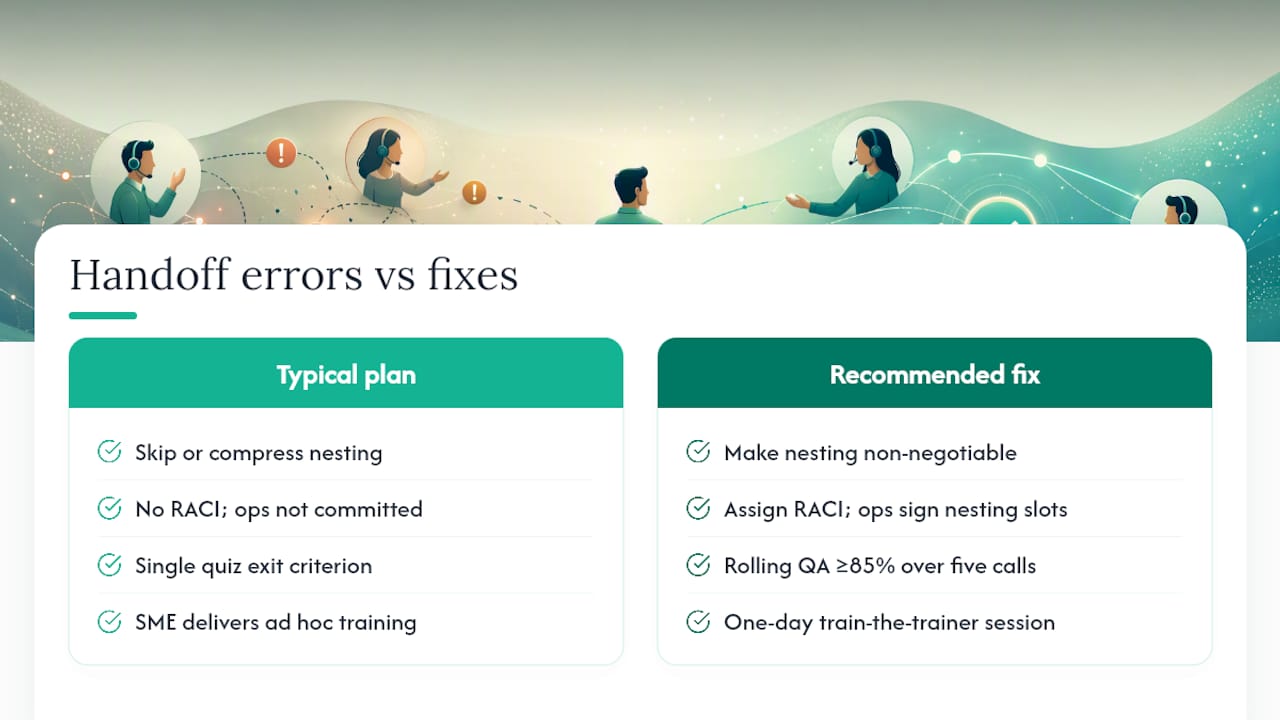
Most contact center training programs fail at the same point: the handoff from classroom to floor. Managers spend weeks building curriculum, then skip or compress nesting because operations needs bodies on the phones. The result is agents who passed every quiz but freeze on a real call. QA scores drop. Attrition spikes at 45 days. And the training program gets blamed for a problem that was actually a scheduling decision.
The fix is not a better curriculum. It is making nesting non-negotiable in your program governance. When you assign RACI and get operations to sign off on nesting slots before training starts, you remove the pressure to skip it mid-program. The exit gate criteria matter too. A rolling QA threshold of ≥85% over five consecutive calls is harder to waive than a single quiz score, and it gives supervisors a defensible standard when operations pushes back.
The other thing most guides understate: trainer preparation. An SME who knows the product inside out can still deliver a confusing training session if they have no facilitation structure. A one-day train-the-trainer session, a session agenda, and a rubric tied to QA criteria will do more for your program quality than any new technology.
Callflow cuts ramp time without adding headcount
Agents who practice more before their first live call perform better on it. That is the premise behind Callflow's AI role-play platform, which gives contact center teams configurable scenarios, instant grading across five performance dimensions, and supervisor dashboards that track every agent's progress by cohort.
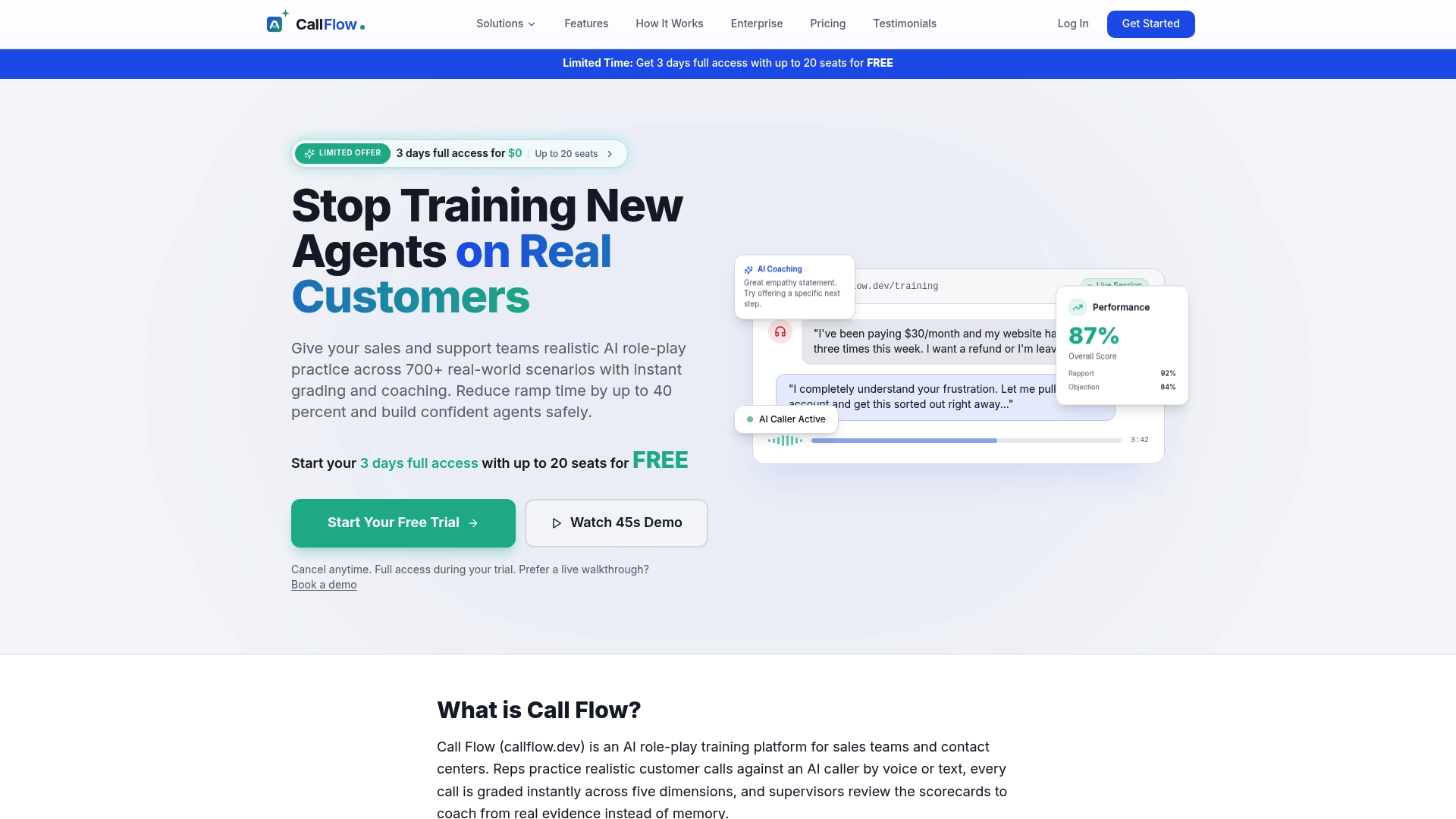
The practical difference for training coordinators: you can run high-volume practice in Week 3 and Week 4 without pulling supervisors off the floor for every session. Agents get specific, scored feedback after each scenario. Supervisors see which agents need coaching on which behaviors before nesting starts. Callflow's data shows 147% faster ramp time and a 129% improvement in resolution rates for teams using the platform consistently.
Start with a two-week pilot. Scope it to one cohort, one call type, and two or three scenarios. Set a ramp-time target and a QA baseline before you begin. After two weeks, compare results against your previous cohort. If the data supports it, expand. If it does not, you have lost two weeks, not a quarter. Start a free trial or review the full coaching tools suite to see how it fits your current program.
Useful sources and further reading
Use these resources to go deeper on specific components of your contact center training plan.
-
Call center training: The essential guide for 2026 — Zendesk: Covers core training components, blended curriculum design, and how WEM and AI tools surface coaching gaps. Good reference for materials checklists and scheduling guidance.
-
Call Center Training: Complete Guide 2026 — FreJun: Detailed breakdown of the eight core program components, 30–60–90 structure, and QA-driven iteration. Useful for program governance and milestone design.
-
Call Center Training: A Complete Training Plan + Weekly Schedule — Supportbench: Provides a full 8-week schedule with AI integration milestones and reported outcome data. Download or adapt the weekly template directly.
-
Call Center Training Program Outline: 6-Phase Build — Justcall: Phase-by-phase structure with explicit exit gates and remediation rules. Use this to build your gating criteria and remediation paths.
-
20 Training Ideas for Effective Customer Service — Indeed: Practical activity ideas across modalities. Useful for adding variety to multi-week programs and reducing engagement drop-off.
-
Customer Service Training — Salesforce: Covers hard and soft skill balance, EPSS use, and delivery method selection. Good reference for avoiding passive-only program design.
-
Introduction to Customer Service — Coursera: Modular course covering empathy, active listening, and problem-solving. Use as a reference for structuring foundational content weeks.
-
How to improve call center training — Hivedesk: Practitioner-level guidance on program length, nesting, and the attrition risk of programs under four weeks. Essential reading before you set your ramp timeline.