

Give short, actionable feedback immediately after an observed behavior. Do this for most skill corrections, and delay only when the task needs deep reflection. A systematic review found verbal face-to-face feedback produces moderate-to-large gains in task performance, and platforms that provide instant feedback report substantially faster ramp time compared to delayed review.
TL;DR:
- A systematic review found verbal feedback delivered in person improved task performance with an effect size near 0.7, although evidence quality varied across studies.
- Ask the coachee to assess the moment first, then use GROW to set a goal, describe reality, explore options, and secure one next step.
- Save immediate corrections for observable mechanics and fluency; when judgment, strategy, distress, or incomplete evidence complicates the assessment, schedule a fuller conversation within 24 hours.
- Give newer reps more explanation, experienced reps shorter prompts, and tie each correction to one metric, such as discovery quality or objection resolution.
- Keep coaching touches under five minutes, add a daily block of ten to fifteen minutes, and reserve weekly or biweekly sessions for broader patterns.
Table of Contents
- Why immediate feedback works: the research behind the rule
- Coaching frameworks that keep instant feedback structured
- Scripts and a checklist managers can use today
- When delayed feedback works better than instant
- How Call Flow puts instant feedback into practice
- Matching feedback to how each rep learns and performs
- Getting instant feedback to work across a sales team
- How technology enables feedback across multiple dimensions at once
- Keeping reps engaged with frequent feedback instead of fatigued by it
- Balancing instant touches with scheduled coaching sessions
- Starting instant coaching this week
- Try Call Flow to put instant coaching feedback on autopilot
- FAQ
- Sources
Why immediate feedback works: the research behind the rule
Memory of a specific action fades fast. A rep forgets why they stumbled on a pricing objection within hours, not days. Feedback given while the moment is still fresh attaches to a real memory. Feedback given a week later attaches to nothing.
The evidence backs this up. A systematic review of face-to-face feedback in workplace tasks found a moderate-to-large improvement in performance compared with no feedback, with an effect size near 0.7 in studies with less bias. That is a large jump for a conversation that takes two minutes.
Verbal face-to-face feedback shows an effect size around 0.7 for task performance improvement, according to the same review, though the reviewers flagged mixed evidence quality across studies.
Three channels carry this kind of high-information feedback well:
- Face-to-face conversation, which allows real-time back-and-forth and shared problem-solving.
- Audio or video review, which lets a coachee hear or see the exact moment in question.
- AI-assisted elaborated feedback, which explains the "why" behind a score instead of just a pass or fail mark.
The common thread is specificity. Vague praise or vague correction does not move performance. Feedback that names the exact behavior and its exact effect does.
Coaching frameworks that keep instant feedback structured
A two-minute feedback conversation still needs a shape, or it turns into rambling. The GROW model is a coaching framework that keeps things on track even when time is short.
Here is how GROW compresses into a short exchange:
- Goal: name what the call or task was supposed to achieve.
- Reality: recognize what actually happened, in plain terms.
- Options: ask the coachee what they could try differently.
- Wrap: get a one-line commitment to the next attempt.
The Five Rs model, built around review, reflect, research, revise, and reinforce, works well as a short reinforcement loop for skills that need repeated practice rather than a single fix.
- Review the specific moment together, right after it happens.
- Reflect by asking the coachee what they noticed first.
- Reinforce with a brief follow-up the next time the skill comes up.
One rule from coaching guidance matters more than any model: let the coachee speak first. A coaching approach that prompts self-assessment before the manager adds a single targeted insight increases ownership and lowers defensiveness.
Scripts and a checklist managers can use today
Theory helps, but a manager mid-shift needs exact words. Here are three scripts that fit inside five minutes, adapted from ready-to-use coaching feedback examples:
- Corrective: "On that call, you jumped to pricing before confirming the need. Next time, ask one more question first. Can you try that on the next call?"
- Reinforcing: "You handled that objection by restating the customer's concern before answering. That kept the call calm. Keep doing that."
- Coaching-question sequence: "What were you going for in that moment? What did you notice about how the customer reacted? What would you change next time?"
Three micro-routines make this repeatable without adding meetings:
- Squeeze in a thirty-second comment right after a call ends, before moving to the next task.
- Block ten to fifteen minutes daily for short one-on-one coaching touches.
- Send a one-line written follow-up after the verbal conversation so the point sticks.
A simple checklist keeps each feedback moment consistent:
- Observation: what exactly happened.
- Impact: what effect it had on the call or the customer.
- Suggestion: one change to try next time.
- Confirmation: the coachee repeats back what they heard.
- Follow-up: a date or trigger for checking progress.
This structure works for a scheduled coaching session and for a hallway comment. The content changes, the shape does not.
When delayed feedback works better than instant
Instant feedback is the default, not the rule for every situation. Some signals call for a pause instead.
- The task is complex and involves multiple steps or long-term strategy, not a single observable action.
- The coachee is visibly upset, defensive, or distracted, and will not absorb input well right now.
- The manager needs to review data or recordings before giving an accurate assessment.
- The skill being built is higher-order, like account strategy or negotiation planning, rather than a fluency skill like objection handling.
Research on feedback timing in learning environments suggests immediate feedback tends to help with acquisition and fluency, while delayed feedback can support complex problem-solving and transfer to new situations. A meta-analytic review of computer-based feedback found elaborated, explanatory feedback produced larger learning gains than correctness-only feedback, and that timing effects shifted depending on task difficulty.
Pro Tip: When a correction involves judgment calls rather than mechanics, give a same-day heads-up that a longer conversation is coming, then schedule it within 24 hours.
How Call Flow puts instant feedback into practice
AI role-play training gives a concrete example of instant feedback working at scale. A rep runs a short role-play scenario, gets graded across multiple performance dimensions in seconds, and then a manager adds a one-to-two-minute human coaching touch on top of the AI score.
The reported outcomes give managers a target to aim for: Some platforms report faster ramp time and notable improvement in resolution rates when instant grading replaces delayed review cycles.
Teams using instant, multi-dimensional grading report substantially faster ramp time, reflecting how much time gets saved when a rep does not wait days to learn what went wrong.
Managers can borrow the underlying habits even without adopting a platform:
- Run short, low-stakes practice reps on a regular cadence, not just during onboarding.
- Calibrate scoring criteria across managers so feedback stays consistent.
- Use a data dashboard or simple tracker to catch trends across a team, not just individual moments.
A real-time call coaching pilot run over four to eight weeks is a practical way to test this before committing to a bigger rollout.
Matching feedback to how each rep learns and performs
Instant feedback lands differently depending on who receives it. A new rep needs more explanation attached to each correction. A tenured rep often needs just the flag and a nudge, since they already have the mechanics.
Performance metrics should shape the feedback too. A rep weak on discovery questions needs feedback that isolates that one dimension, not a general comment about the whole call. A rep strong on rapport but weak on closing needs the opposite emphasis.
Three practical adjustments make instant feedback fit the individual:
- Match the explanation length to experience: more context for newer reps, shorter flags for experienced ones.
- Tie each piece of feedback to one specific metric, like talk-to-listen ratio or objection resolution, instead of a vague overall impression.
- Track which dimension each rep struggles with most, and weight coaching time toward that dimension rather than spreading it evenly.
Some reps respond better to hearing feedback out loud, others to reading it. Offering a short written note alongside the verbal comment covers both without adding much time. The goal stays the same across every learning style: specific, attached to a metric, and delivered close to the moment it happened.
Getting instant feedback to work across a sales team
Rolling out instant feedback across a sales team runs into a few predictable snags. Managers worry it will feel like constant monitoring. Reps sometimes brace for criticism instead of hearing a correction. Call volume makes it hard to catch every moment worth coaching.
A few adjustments solve most of this:
- Frame early feedback sessions around reinforcement, not just correction, so reps associate the habit with recognition too.
- Keep each touchpoint under five minutes so it never competes with quota time.
- Use short role-play reps or call snippets instead of trying to review every live call, which keeps the workload realistic for managers.
- Calibrate what "good" looks like across the management team first, so reps are not getting conflicting signals from different coaches.
The biggest challenge is usually consistency, not willingness. A manager who gives sharp feedback on Monday and skips it the rest of the week teaches reps to tune it out. Building the ten-to-fifteen-minute daily block mentioned earlier solves this more reliably than trying to catch every moment live.
How technology enables feedback across multiple dimensions at once
A human coach, no matter how sharp, usually focuses on one or two things per call: tone, maybe pacing. Grading a call across five or six dimensions at the same time, consistently, call after call, is hard to do by ear alone.
This is where AI-assisted grading adds something a manual review cannot easily match. A platform can score discovery quality, objection handling, tone, compliance language, and closing technique on the same call, instantly, and hand a manager a breakdown instead of a single impression.

Elaborated feedback that explains the reasoning behind a score, rather than a plain pass or fail mark, tends to produce stronger learning outcomes in computer-based environments. That principle applies directly here: a rep who sees why a call scored low on discovery, not just that it did, has something concrete to act on.
For regulated contact centers, latency matters too. Real-time agent assist tools built for low-latency environments show how technical response time affects whether "instant" feedback actually feels instant to the person using it.
Keeping reps engaged with frequent feedback instead of fatigued by it
Frequent feedback can backfire if it starts to feel like constant correction. A few habits keep engagement high instead.
- Balance every corrective comment with a specific piece of recognition, not a generic compliment.
- Let reps request feedback on a specific moment themselves, which turns the exercise from something imposed into something they asked for.
- Share quick wins across the team, like a rep who improved a specific metric after one coaching touch, to show the habit pays off.
- Keep sessions short and predictable so they never feel like a surprise audit.
Gamified elements, like tracking improvement on a single metric over a few weeks, help too. Reps who see a number move after a specific correction tend to stay engaged with the process longer than reps who only hear general praise.
Balancing instant touches with scheduled coaching sessions
Instant feedback handles the small corrections. It does not replace a longer, scheduled coaching conversation where a manager and rep look at trends over weeks, not just one call.
The two work best together on a rhythm: quick corrections after individual moments, paired with a weekly or biweekly session that steps back and looks at patterns. A manager who only does instant touches risks missing the bigger strategic gaps. A manager who only does scheduled sessions misses the chance to fix something while it is still fresh.
A simple split works for most teams: keep instant feedback focused on mechanics and fluency, like objection phrasing or call opening. Save the scheduled session for strategy, like account planning or long-term skill goals. This matches the research pattern: immediate feedback suits acquisition and fluency, while more reflective sessions suit complex, higher-order work.
Starting instant coaching this week
Three steps get this moving fast. Observe one call or role-play today. Give a two-minute piece of feedback right after, using the observation, impact, suggestion structure. Then schedule a short follow-up, even just a line in a calendar reminder, to check whether the correction stuck.
Watch for short-term signals rather than waiting for a quarterly review: a rep repeating the suggested phrasing on the next call, a metric ticking up after one coaching touch, or a rep bringing up the feedback unprompted. Calibrate your own scoring against another manager's occasionally, so your "good" and theirs match.
— Costa
Try Call Flow to put instant coaching feedback on autopilot
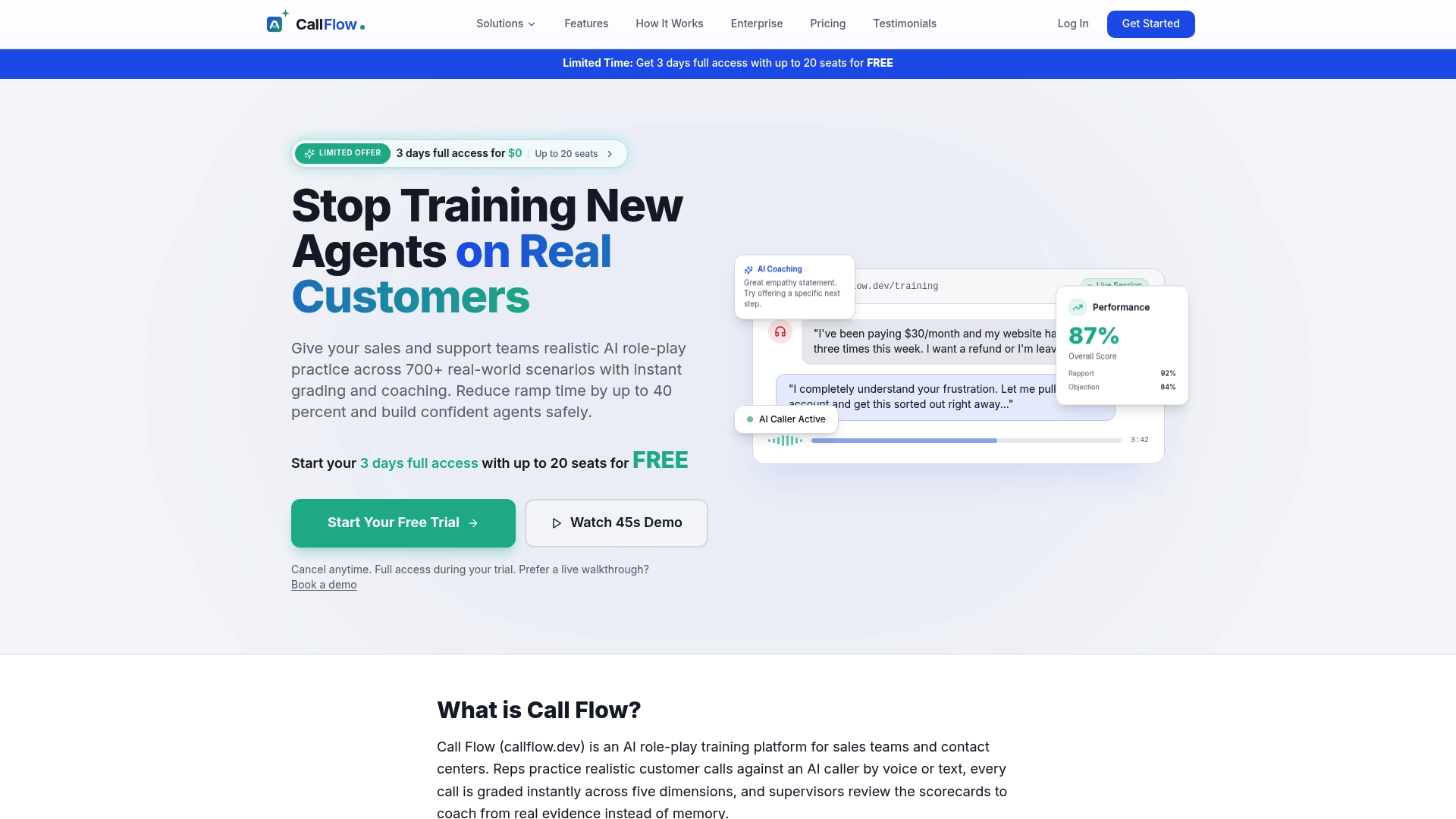
Call Flow pairs AI role-play scenarios with instant grading across multiple performance dimensions, so every rep gets a specific, actionable score within seconds of finishing a practice call.
- Start with a short pilot on one team before rolling out company-wide.
- Calibrate scoring criteria against your own QA standards early.
- Track ramp time and resolution rate improvements against your baseline.
A timing and rollout roadmap is a useful starting point for managers testing this out. Pricing starts at $7.42 per month on the Starter plan, with Growth and Scale plans available as teams expand, and custom Enterprise pilots for larger rollouts.
FAQ
Can you provide an example of coaching feedback?
A concrete example: "On that call, you answered the pricing question before confirming the budget. Next time, ask about budget first, then quote a number." This follows the observation, impact, suggestion structure covered earlier in this piece.
What is the 70/30 rule in coaching?
Coaching guidance generally favors a model where the coachee does most of the talking, often framed as a majority-minority split, with the manager asking questions and adding one targeted insight rather than dominating the conversation. Definitions of the exact split vary across coaching programs, so treat it as a principle rather than a fixed ratio.
What are some positive feedback examples for training?
Specific, metric-tied recognition works best: "Your talk-to-listen ratio improved and you let the customer finish their point before responding." A good example names the exact behavior and the exact effect, the same specificity that makes corrective feedback effective.
What are the five R's of feedback?
The Five Rs are review, reflect, research, revise, and reinforce. The model turns a single feedback comment into a repeatable loop that supports durable skill-building rather than a one-off correction.
Sources
- Objective verbal face-to-face feedback and workplace task performance (BMJ Open systematic review)
- A coaching approach to feedback (GROW model and coaching principles)