

In this article, real time call coaching means AI-powered simulated role-play coaching. It gives agents realistic practice calls plus instant AI grading and coaching. It does not mean live, in-call prompts during a real customer conversation. Training leaders should pilot this method when they need faster ramp and measurable behavior change. Call Flow is one option built around this model, with a trial available for evaluation.
TL;DR:
- Simulation training's effectiveness increases with task complexity, emphasizing the need to sequence scenarios from simple to challenging for optimal results.
- A four to eight-week pilot measuring ramp time, first-call resolution, and AI score trends provides a clear evaluation of impact before scaling.
- Repetition, calibrated scoring, and manager involvement are crucial to ensure behavior transfer and meaningful improvements in coaching outcomes.
- Call Flow reports that participating teams experience 147% faster ramp time and a 129% boost in first-call resolution, though these figures are vendor-stated.
- Cost-effective plans start at $7.42 per month with a risk-free trial, enabling teams to assess simulation-based coaching without extensive upfront investment.
Table of Contents
- How AI-powered simulated call coaching works
- Why realism and progressive difficulty matter
- Business benefits and outcomes you can expect
- Pilot and rollout checklist for a low-risk evaluation
- Measuring and proving ROI from simulation-based call coaching
- A training leader's take on what actually works
- How Call Flow supports a real time call coaching pilot
- FAQ
- Sources
How AI-powered simulated call coaching works
The platform presents a scenario. The agent responds. The scenario branches based on that response, the way a real call branches when a customer objects or asks an unexpected question. This is the core mechanic behind most tools in this category, including AI role-play training products built for sales and contact-center teams.
Scenarios run in voice or text mode, depending on what the team needs to practice. After each simulated call, the system scores the agent across several performance dimensions at once: things like discovery questions, objection handling, tone, and compliance language. The score and the feedback arrive right away, not at the next weekly review.
That immediate loop is the point. An agent practices, sees the gap, and can repeat the same scenario before the mistake becomes a habit. Managers still have a role here:
- Review flagged calls and confirm the AI score matches what a human QA reviewer would give.
- Assign specific scenarios to specific skill gaps instead of running one generic script for everyone.
- Pull scores into existing dashboards or an LMS so practice data sits next to real call data.
Scenario libraries like the ones described in sales role-play game formats give trainers a starting set rather than building every script from scratch.
Why realism and progressive difficulty matter
A field-based study across two Fortune 50 call centers found that simulation training beat traditional role-play on both call accuracy and processing speed. The gap between the two methods widened as the tasks got harder.
One finding worth building a program around: simulation training's advantage over role-play grows with task complexity, which means a flat, one-level scenario set wastes the method's main strength.
The practical lesson is to sequence scenarios on purpose. Start agents on short, low-complexity calls. Move them into branching, multi-objection conversations only once the basics are solid. A 2024 academic abstract describes using ChatGPT to enhance sales role-play practice, which supports the direction of this approach, though it stops short of a full enterprise ROI study. Treat early-stage academic work as a signal, not a guarantee. Pair it with enterprise pilot data before committing a training budget. Realism and difficulty progression are design choices, not features you get automatically by buying software.

Business benefits and outcomes you can expect
Simulation-based coaching tends to produce a consistent set of outcomes when it is run with repetition and manager follow-up, not as a one-time exercise.
- Faster ramp time for new hires, since agents practice high-stakes conversations before they reach a live customer.
- Higher first-call resolution as agents build muscle memory for common objection paths.
- More consistent conversation quality across a team, since every agent practices against the same scored rubric.
- Potential revenue lift when practice scores connect to sales outcomes, not just training completion.
A 2026 podcast interview describing a 6,000-person sales organization using an AI role-play platform reported revenue growth of 7% to 30% in the deployments discussed. The key detail for planning a program: practice frequency and AI scoring predicted outcomes better than simple completion counts, with manager involvement acting as a multiplier rather than an optional extra.
Call Flow, as one vendor in this space, states that its own customers have seen 147% faster ramp time and a 129% improvement in resolution rates. Those are the brand's own reported figures, not independent findings, and worth confirming against your team's baseline during a pilot.

Pilot and rollout checklist for a low-risk evaluation
A short, well-scoped pilot tells you more than a long one with vague goals. Run it in stages:
- Pick a cohort of 10 to 20 reps, mixing new hires and a few tenured agents for comparison.
- Select a scenario set that matches real call types your QA team already scores, starting simple and adding complexity over the run.
- Set the pilot length at 4 to 8 weeks, long enough for repeat practice but short enough to review quickly.
- Record baseline numbers before day one: current ramp time, first-call resolution, and existing QA scores.
- Connect simulation scores to your QA rubric so an AI score and a human QA score mean the same thing.
- Set a reporting cadence, weekly is typical, and export scores into the dashboards your managers already check, similar to the setup described in training data visualization guidance.
- Run a calibration session with managers before the pilot starts, so everyone agrees on what a passing score looks like.
- Review results against baseline at week 4 and again at the end, using ramp time and FCR as the primary decision metrics.
- Decide on scale, extend, or stop based on whether behavior changed, not just whether reps logged sessions.
Pro Tip: Gate progression to harder scenarios on a minimum score, not on time spent, so reps cannot advance without actually improving.
Measuring and proving ROI from simulation-based call coaching
The biggest measurement trap is rewarding completion instead of behavior change. A rep who finishes ten sessions with no score improvement has not transferred anything to real calls.
- Compare a pilot cohort against a similar group that trains the old way, where staffing allows it.
- Track ramp time and first-call resolution before and after the pilot, using the same definitions your QA team already uses.
- Watch AI score trends over the pilot window, not just the final score, since the trend shows whether practice is working.
- Connect score trends to business KPIs like conversion or revenue per rep where that data exists.
- Use a reporting cadence tight enough to catch problems early, typically weekly, with a sample size large enough that one outlier rep does not skew the read.
Mismatched QA scoring is the second common pitfall. If the AI rubric and the human rubric disagree, neither score means much to a manager making a coaching decision. Calibrate both before the pilot starts, not after you've already reported results to leadership.
A training leader's take on what actually works
Start narrower than feels comfortable. A ten-person pilot with calibrated scoring beats a company-wide rollout with none. Two traps show up again and again: giving beginners branching, high-complexity scenarios before they've mastered the basics, and measuring session counts instead of score improvement.
Involve managers from day one, not after the pilot ends. Calibration sessions take an hour and save weeks of disputed scores later. Repetition is the mechanism, not a nice-to-have: one pass through a scenario teaches little, five passes with feedback teach a habit.
— Costa
How Call Flow supports a real time call coaching pilot
Call Flow is an AI role-play platform built for sales and contact-center training. It runs realistic practice scenarios in voice and text, grades each call instantly across multiple performance dimensions, and puts the results on a supervisor dashboard where managers can review and calibrate scores against existing QA rubrics.
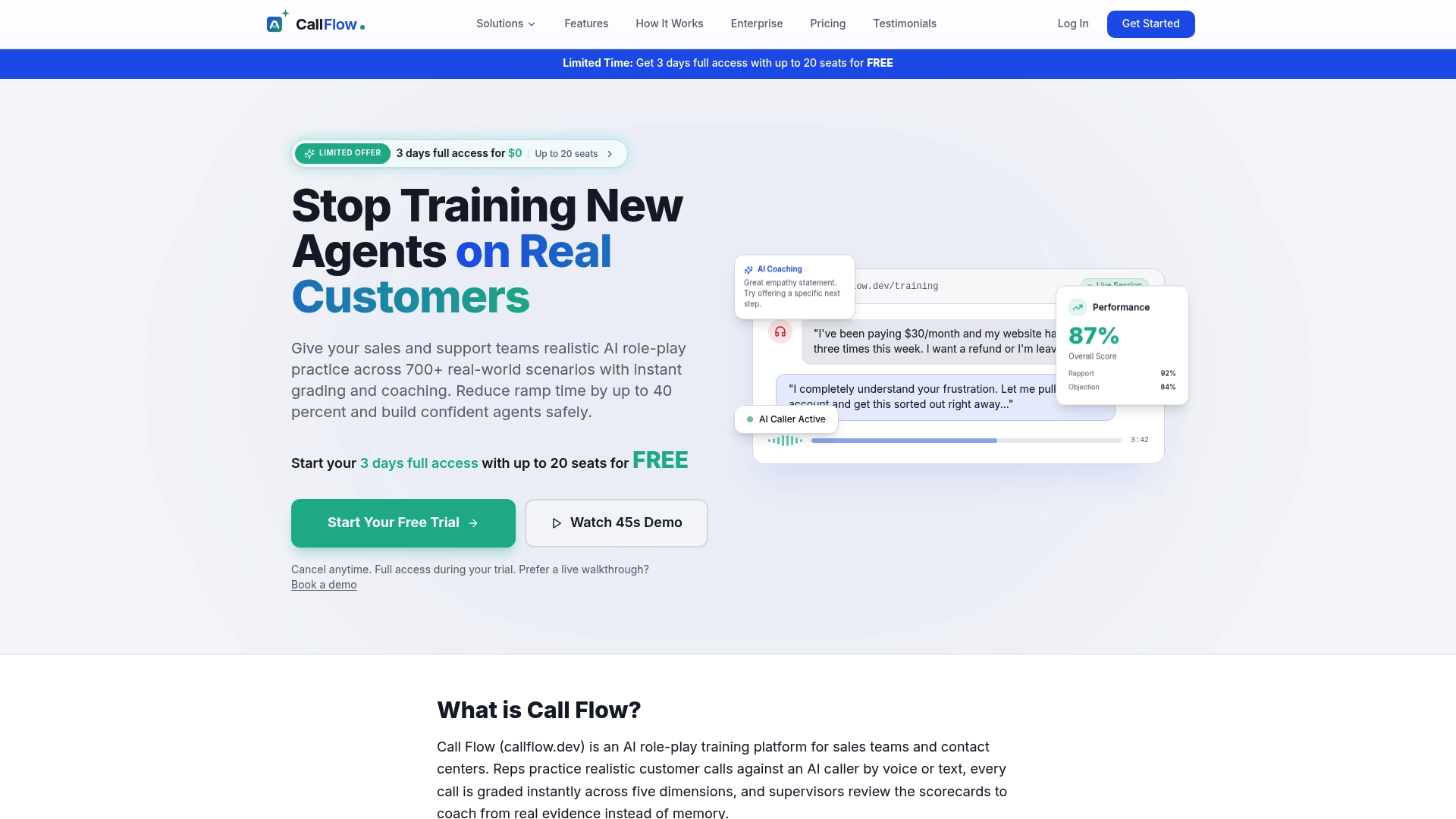
Call Flow reports that its customers have seen 147% faster ramp time and a 129% improvement in first-call resolution, figures the company attributes to its own deployments rather than independent research. The platform includes a large scenario library spanning sales and support use cases, so a team can start a pilot without building scripts from zero.
Plans run from Starter at $7.42 per month up through Scale at $33.25 per month, with annual pricing available on the same page. Teams with custom onboarding needs can review the Business and Enterprise options. Every plan includes full access during a risk-free trial, which is the fastest way to test the pilot checklist above against your own baseline numbers.
FAQ
What does "real time call coaching" mean in this context?
It refers to AI-powered simulated role-play training, where an agent practices realistic calls and receives instant AI grading and feedback right after each session. It does not refer to tools that listen to live customer calls and feed prompts to an agent mid-conversation.
How long should a pilot run before deciding to scale?
A pilot of 4 to 8 weeks is usually enough to see a meaningful shift in ramp time and first-call resolution against a recorded baseline. Shorter pilots rarely capture enough repeat practice to show real behavior transfer.
Does simulation training actually outperform traditional role-play?
A field-based study across two Fortune 50 call centers found simulation training beat role-play on call accuracy and processing speed, with the advantage growing as task complexity increased. That gap is the main reason to sequence scenarios from simple to complex rather than running one fixed script.
How much does Call Flow cost to try?
Call Flow's Starter plan is $7.42 per month or $89 billed annually, with Growth and Scale tiers above that. Every plan includes a risk-free trial with full feature access, so a team can test a pilot before committing to a paid tier.
What metrics should a training team track during a pilot?
Ramp time, first-call resolution, and AI score trends across the pilot window are the core metrics, compared against a recorded baseline. Where sales data is available, connecting score improvement to conversion or revenue per rep gives a clearer read on business impact.
Sources
- The Impact of Simulation Training on Call Center Agent Performance: A Field-Based Investigation
- ChatGPT-enhanced role play in sales education (abstract)
- How AI role play boosts revenue for B2B leaders — The Emblazers podcast