

Call quality standards are the measurable benchmarks, both technical (audio clarity, latency) and behavioral (tone, resolution), that define what a "good" call sounds and performs like. The single best immediate step for any QA team is building a calibrated scorecard with weighted categories and numeric targets, then testing agents against it before problems reach customers. This guide covers the metrics, monitoring tools, and a sample scorecard to get there.
TL;DR:
- Building a calibrated scorecard with weighted categories and clear ties to business outcomes is crucial for effective call quality assessment.
- Call quality metrics like MOS scores and network conditions (jitter, packet loss, latency) must be monitored together with behavioral KPIs such as CSAT and FCR.
- Regular calibration, at least monthly, is essential to prevent score drift and ensure reviewers score calls consistently across shifts and call types.
- Real-time monitoring tools that flag issues during calls, such as poor network or device problems, enable agents to fix problems before customer dissatisfaction occurs.
- Prioritizing targeted micro-training based on specific scorecard weaknesses yields faster improvements than broad, annual training overhauls.
Table of Contents
- Call Quality Standards, QA, QC, and QM: Getting the Terms Straight
- What Are Call Quality Metrics? MOS, Latency, and the KPIs That Matter
- How Do You Build a Calibrated QA Scorecard?
- How Do You Monitor Call Quality in Real Time?
- How Role-Play Training Closes Call Quality Gaps
- A Sample QA Scorecard You Can Adapt
- How Often Should You Calibrate QA Standards?
- Regulatory Compliance for Call Quality and Recording
- How VoIP and WebRTC Are Reshaping Call Quality Standards
- Why Do Calls Sound Bad? Common Causes and Fixes
- What Should QA Teams Prioritize First?
- Sources
Call Quality Standards, QA, QC, and QM: Getting the Terms Straight
Call quality standards are the specific, documented benchmarks a contact center holds every interaction against: talk time targets, required disclosures, tone expectations, resolution rates. They are the rulebook. Quality Assurance (QA) is the process of checking calls against that rulebook. Quality Control (QC) is the narrower, often automated layer that flags obvious defects, like a dropped call or a missing compliance script. Quality Management (QM) sits above both: the full system of scorecards, coaching, training, and reporting that keeps standards enforced and current.
Confusing these terms creates real operational damage. A manager who treats QC output (a script-adherence flag) as if it were a full QA score ends up coaching agents on compliance while ignoring empathy, tone, or resolution quality entirely.
Standards only matter once they're written into something agents can be graded against. That means:
- A scorecard with weighted categories tied to business priorities.
- Service level agreements (SLAs) that define acceptable response and resolution windows.
- A clear link between each scorecard item and a business outcome it's supposed to protect.
That last point is where most QA programs fail. A scorecard item like "used positive language" needs to trace back to something measurable, usually CSAT. An item like "verified caller identity" traces back to compliance risk. An item like "resolved on first contact" traces back to FCR and, downstream, to cost per call. If a scorecard row can't be connected to an outcome, it probably doesn't belong on the scorecard.
What Are Call Quality Metrics? MOS, Latency, and the KPIs That Matter
Call quality metrics split into two layers: the technical signal quality of the call itself, and the business outcomes that signal quality is supposed to protect.
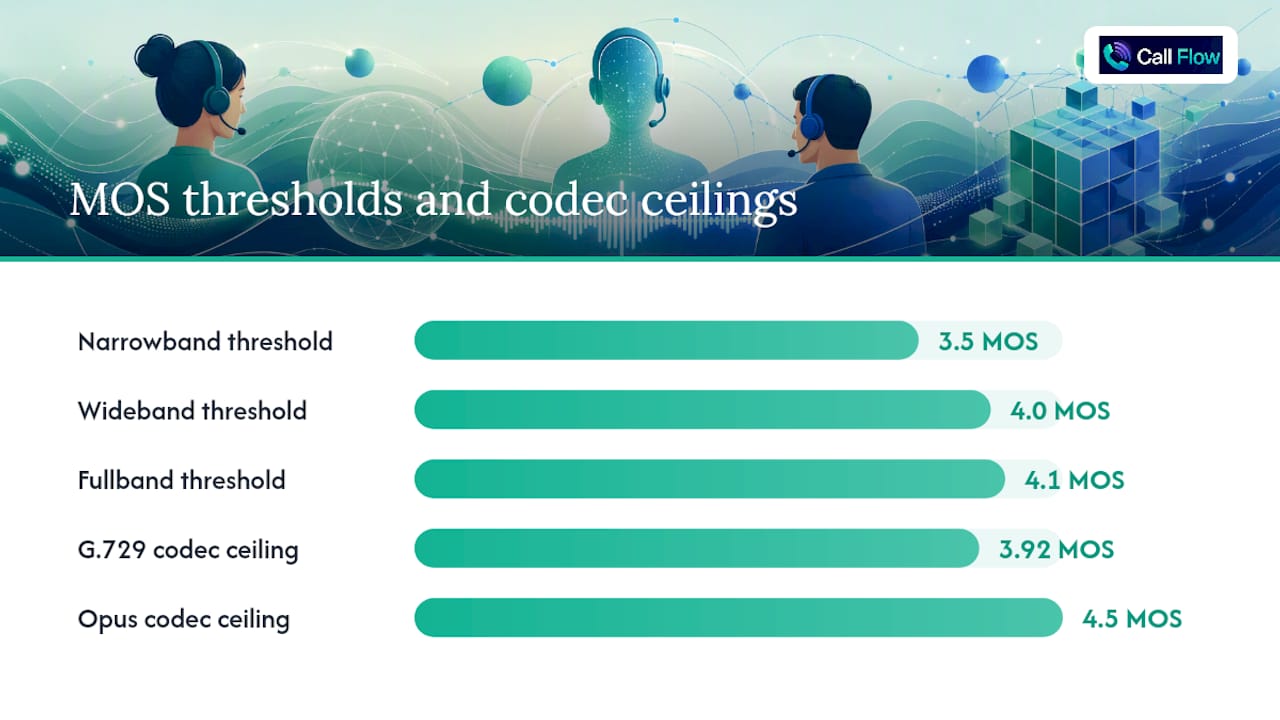
Mean Opinion Score (MOS) is the industry's primary single number for perceived voice quality, scored on a 1 to 5 scale. A score near 4.0 is considered toll quality, the same clarity users expect from a traditional landline. Anything from 3.5 to 4.0 is acceptable for business use; below 3.5, callers start noticing distortion or dropouts.
ITU-T and ETSI technical guidance sets objective listening-quality thresholds by bandwidth:
| Audio band | MOS-LQOF threshold | Transmission Rating (R-factor) |
|---|---|---|
| Narrowband | Above 3.5 | Above 85 |
| Wideband | Above 4.0 | Above 100 |
| Fullband | Above 4.1 | Above 120 |
Codec choice sets a hard ceiling on what's achievable. G.711 tops out near 4.1 MOS, G.729 caps around 3.92, and Opus can reach roughly 4.5 under good conditions. No amount of network tuning gets a G.729 call past its codec ceiling.
Network conditions do the rest of the damage. Jitter, the variation in packet arrival timing, forces jitter buffers to work harder and can introduce the same choppy artifacts as packet loss once it exceeds about 30 milliseconds.
Pro Tip: If MOS scores drop but nothing changed on your network, check codec negotiation first. A carrier-side change that silently downgrades the codec will tank MOS without touching bandwidth.
None of this matters in isolation from the numbers leadership actually watches: Customer Satisfaction (CSAT), Average Handle Time (AHT), First Call Resolution (FCR), and abandonment rate. A call can score a perfect 4.5 MOS and still fail the customer if the agent never resolves the issue. Technical and behavioral metrics have to sit on the same scorecard, not in separate reports nobody cross-references.
How Do You Build a Calibrated QA Scorecard?
A scorecard only works if the weights reflect what actually drives outcomes, and if two different reviewers scoring the same call land on roughly the same score; for help crafting effective voice prompts, consider professional IVR phone system voice over services. Here's how to build one that holds up.
- List the behaviors that matter, grouped into categories. Typical groups: opening/greeting, compliance/disclosures, listening/empathy, resolution, closing.
- Assign weights by business impact, not by what's easiest to grade. Compliance items often carry pass/fail weight (a single miss can zero the call); resolution and empathy usually carry the largest point shares, since problem resolution and agent helpfulness are what customers rank highest in service experience.
- Set a sampling plan. Use stratified sampling across shifts, call types, and tenure levels rather than grabbing whichever calls are easiest to pull, and size the sample to give a reasonable confidence interval on the monthly average score.
- Run calibration sessions. Have multiple QA reviewers score the same recorded calls independently, then compare. Score gaps above a few points on the same call signal an unclear rubric, not a training issue.
- Set score thresholds tied to action. For example: below 70% triggers immediate coaching, 70 to 85% triggers a development plan, above 85% is coaching-optional.
Calibration isn't a one-time setup step. Run it on a recurring cadence, because rubrics drift as new products, scripts, and edge cases show up.
How Do You Monitor Call Quality in Real Time?
Monitoring splits into three layers: what happens during the call, what automated tools score afterward, and what the network itself is telling you. Miss any one layer and problems surface only after a customer already complained.
Automated speech analytics can flag talk-over, dead air, and sentiment shifts at scale, scoring thousands of calls a QA team could never review manually. But automated scoring drifts without oversight; industry practice is to pair automated tagging with regular human calibration to catch systematic bias before it poisons a month of reporting.
Real-time, user-facing diagnostics catch a different category of problem. Microsoft's guidance for Azure Communication Services recommends surfacing mute, poor-network, and device flags to agents and supervisors during the call itself, using Pre-Call checks and live media statistics, rather than waiting for a post-call report. An agent who's alerted mid-call that their mic is muffled can fix it before the customer says a word about it.
Network-level diagnostics close the loop. RTP and RTCP-XR metrics report per-call MOS, jitter, and loss directly from the media stream. Build dashboards with rolling 7 and 30-day trends rather than reacting to single-call spikes, since one bad call is noise but a pattern across a shift is signal.
When agent-side quality tanks unpredictably, check the obvious suspects before blaming the carrier:
- VPNs and client-side security software can reroute or inspect voice packets, adding latency and causing packet reordering; temporarily disabling the VPN isolates the cause quickly.
- Wi-Fi versus ethernet matters more than most teams assume, especially for home-based agents.
- Headset quality and driver issues get misdiagnosed as network problems constantly.
Route every flag, automated or user-reported, into a ticketing and coaching workflow. A diagnostic that nobody acts on is just a log file.
How Role-Play Training Closes Call Quality Gaps
A scorecard tells you an agent is weak on de-escalation or missing disclosures. It doesn't fix it. That happens through short, repeated practice cycles with immediate feedback, not a quarterly training deck nobody remembers by Friday.
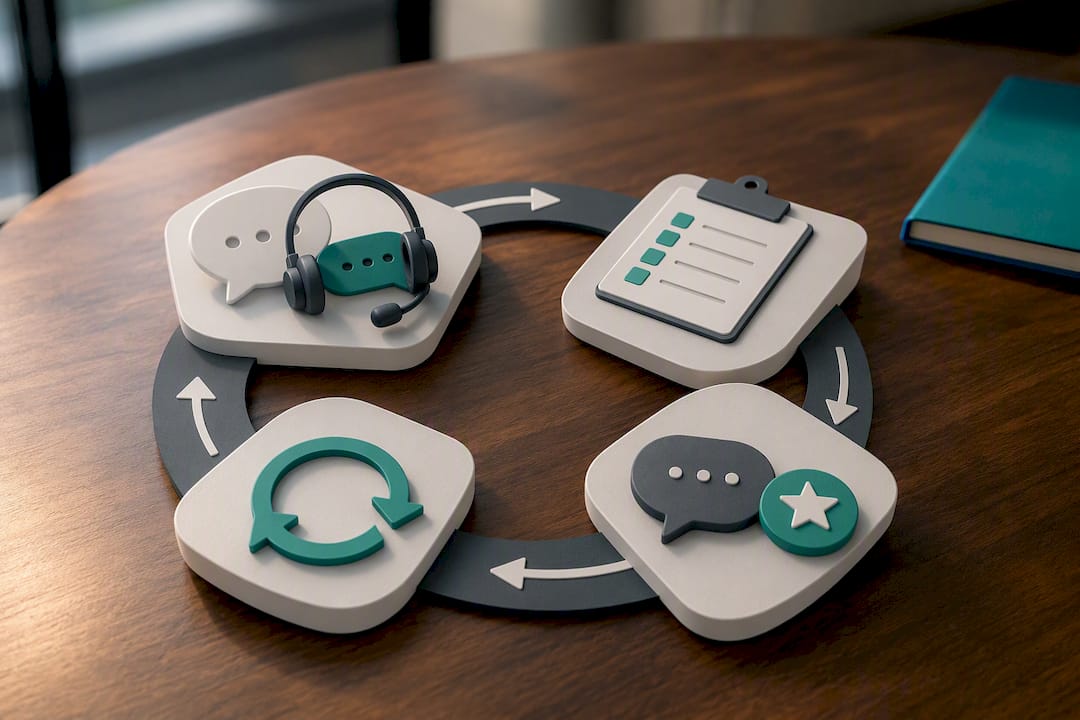
The most effective coaching cycles work backward from specific scorecard failures. If a QA review flags empathy as the recurring gap, generic "be more empathetic" coaching rarely moves the number. Practical programs tie specific scorecard failures to targeted micro-training, often through role-play scenarios built around exactly the situation the agent struggled with, which shifts behavior faster than generic coaching sessions ever do.
This is the gap Callflow is built to close. The platform runs configurable role-play scenarios that mirror real customer interactions, then grades the attempt instantly across five performance dimensions instead of making agents wait days for a supervisor review.
Teams using structured AI role-play training have reported faster ramp time and improved resolution rates, according to Callflow's own performance data. Whether those exact gains transfer to a given team is worth testing directly.
Pro Tip: Don't roll out role-play training broadly on day one. Pull the three lowest-scoring scorecard categories from last month's QA data and build scenarios around those specifically. Targeted practice beats generic practice every time.
If a QA review shows resolution and compliance are the weak categories, measure training ROI against those exact KPIs, not overall agent satisfaction. A risk-free trial makes it straightforward to test whether ramp time actually drops before committing budget.
A Sample QA Scorecard You Can Adapt
A generic scorecard needs enough structure to be defensible in a coaching conversation, but not so many categories that scoring takes longer than the call itself. Here's a practical starting template with typical weights and score bands.
Reading the scorecard is where the real coaching happens. An agent scoring low across empathy and closing but fine on resolution often has a tone issue worth addressing through tone of voice coaching rather than technical retraining.
For leadership reporting, aggregate scores by category rather than a single blended number. That distinction is what turns a QA report into an actual action plan instead of a health check nobody reads twice.
How Often Should You Calibrate QA Standards?
Calibration sessions should run monthly at minimum, with a full scorecard review each quarter to catch rubric drift as products, scripts, and customer expectations shift. Skipping calibration is how two reviewers end up scoring the same call ten points apart without anyone noticing for months.
Certain signals mean don't wait for the scheduled review:
- A sudden CSAT drop with no obvious cause, especially if it lines up with a script or system change.
- MOS variance that jumps outside its normal range on a specific team, shift, or carrier route.
- Sample bias, like a QA team unconsciously pulling more calls from agents already flagged as struggling, which skews the whole picture.
- A spike in escalations or callbacks for issues the scorecard rates as "resolved."
The loop that keeps standards trustworthy runs QA findings into coaching, coaching into training content, and persistent technical patterns into IT remediation. A scorecard that never changes anything downstream isn't a quality program; it's paperwork.
Regulatory Compliance for Call Quality and Recording
Call recording and quality monitoring sit inside a real legal framework, not just an internal policy choice. Federal law under the Electronic Communications Privacy Act generally requires only one-party consent to record a call, but many states require all-party consent, meaning every participant on the line needs to be notified before recording starts. A national contact center handling calls across state lines should default to the strictest standard among the states it serves rather than assuming federal rules alone cover it.
Industries carrying additional regulatory weight need extra layers. Financial services calls often fall under recordkeeping requirements tied to consumer protection rules. Healthcare-adjacent calls need HIPAA-conscious handling of any recorded protected health information. Debt collection calls fall under Fair Debt Collection Practices Act disclosure requirements that overlap directly with QA compliance scorecard items.
None of this is optional groundwork for a QA program; it's the floor the program sits on. Every scorecard's compliance category should map directly to the specific disclosure and consent language your legal team has approved for your jurisdiction and industry, not a generic template pulled from a training vendor. Retention policies matter too: recorded calls used for QA and dispute resolution typically need defined retention windows, and access to those recordings should be logged and restricted to people with a legitimate reason to review them.
Build the compliance review into calibration sessions, not as a separate audit that happens once a year. A scorecard item that's technically correct but legally outdated is a liability sitting in plain sight.
How VoIP and WebRTC Are Reshaping Call Quality Standards
Traditional telephony had one job: carry a voice signal reliably. VoIP and WebRTC introduced flexibility, browser-based calling, easy scaling, remote agents, but they also introduced a whole new category of quality problems that legacy phone systems never had to deal with.
Packet-based transmission means voice quality now depends on network conditions that fluctuate call to call: congestion, routing, jitter, and packet loss all vary in ways a dedicated phone line never did. That's precisely why ITU-T and ETSI publish specific MOS and R-factor thresholds for VoIP transmission: the old assumption of consistent audio quality no longer holds by default.
WebRTC pushed this further by moving calling into the browser, no dedicated hardware, no dedicated network path. That's a massive win for deployment speed and remote-agent flexibility, but it also means call quality now depends on whatever network the agent happens to be on at home, whatever browser version they're running, and whatever else is competing for bandwidth on that connection.
Practical VoIP best practices respond directly to this shift: configuring Quality of Service (QoS) rules to prioritize voice traffic, using jitter buffers to smooth out arrival timing, segmenting voice traffic onto its own VLAN, and preferring ethernet over Wi-Fi wherever agents work from fixed locations. None of these are optional extras for a VoIP-based contact center; they're the baseline infrastructure that determines whether your MOS targets are even achievable before a single agent picks up a call.
Why Do Calls Sound Bad? Common Causes and Fixes
Most call quality complaints trace back to a short list of repeat offenders, and diagnosing them in the right order saves hours of wasted troubleshooting.
Packet loss is usually the first suspect, and for good reason: even 1% packet loss costs roughly 0.4 MOS points. Congested networks, weak Wi-Fi signals, and overloaded routers are the usual causes. Switching an agent from Wi-Fi to ethernet often resolves this instantly.
Jitter shows up as choppy, inconsistent audio rather than dropped words entirely. It's a timing problem, packets arriving unevenly, and jitter buffers are the direct fix, though buffers set too aggressively introduce their own latency.
Latency past roughly 150 milliseconds one-way starts producing the awkward talk-over pattern where both parties think the other has finished speaking. VPNs and security middleboxes are frequent, underdiagnosed culprits here, since they reroute and inspect voice packets in ways that add delay without any obvious network symptom. Disabling the VPN as a diagnostic test isolates this cause quickly.
Codec mismatches cap quality before the network even becomes a factor. A call negotiated down to a low-bandwidth codec will never reach toll quality, no matter how clean the network path is.
Headset and device issues get misattributed to the network constantly. A worn-out headset microphone or an outdated driver produces symptoms that look identical to jitter on a supervisor's monitoring dashboard.
The troubleshooting order that actually works: check the codec first, then packet loss and jitter via network metrics, then agent-side hardware and VPN status, and only escalate to carrier-level investigation once the first three are ruled out.
What Should QA Teams Prioritize First?
The conventional advice on call quality treats technical metrics and behavioral scorecards as separate disciplines, one for IT, one for QA. That split doesn't hold up. Teams that keep these metrics in different reports miss the pattern that a "problem agent" is sometimes just an agent working on a bad connection.
What's overrated is the annual training overhaul. Ripping up the training program once a year and rebuilding it from scratch produces a burst of activity and very little measurable change, because it never connects to the specific scorecard categories actually failing that month. What works better, and what the research on targeted role-play consistently supports, is smaller and faster: pull last month's lowest-scoring category, build a scenario around it, run it this week.
If there's one place to start, it's the scorecard itself. Get the weights right, calibrate reviewers against each other, and only then invest in monitoring tools or training platforms. A well-run manual scorecard with bad weights will mislead a team faster than any technology gap will.
— Costa
Sources
- ITU technical guidance (2025) on Listening Quality objectives
- Azure Communication Services: manage call quality
- VoIP MOS score — what it is, good scores & how to improve | SIPSymposium