

Three actions raise CSAT faster than anything else: fix first-contact resolution, give agents the context and authority to solve problems on the spot, and recover fast when a score drops. Fixing handoffs and routing shows up in scores within a few weeks. Structural changes like coaching programs and self-service expansion take longer to move the needle.
- Improve first-contact resolution (FCR) by routing tickets to the right skill on the first attempt.
- Give agents authority to waive fees, issue credits, or escalate without a supervisor loop.
- Route every low score to a recovery workflow within 24 to 48 hours.
Quick fact: the fastest CSAT gains tend to come from reducing customer effort and closing issues on the first contact, not from shaving seconds off response time, according to Gorgias.
Key Takeaways
CSAT improves fastest when contact centers fix first-contact resolution and agent authority before investing in broader training or automation.
| Point | Details |
|---|---|
| Fix structural issues first | Address handoffs, policy walls, and outdated knowledge bases before adding training programs. |
| Segment CSAT by intent | Track recovery CSAT separately from standard CSAT to reveal true performance drivers. |
| Recover detractors within 48 hours | Route low scores to senior agents for service recovery, per SurveyMonkey. |
| Tie coaching to QA scorecards | Build scorecards around top detractor themes and coach against specific flagged behaviors. |
| Practice scenarios before live calls | Callflow's role-play and instant grading help agents build resolution skills faster than shadowing alone. |
Table of Contents
- What's Actually Holding Your CSAT Score Down?
- How Do You Measure CSAT Correctly?
- What Tactics Actually Move a CSAT Score?
- How Training and Coaching Raise CSAT Scores
- Where Should AI and Automation Fit Into CSAT?
- What Should a CSAT Dashboard Actually Track?
- Your 30 to 90 Day CSAT Improvement Plan
- Why Employee Engagement Drives CSAT More Than Most Leaders Admit
- How Do You Collect Customer Feedback Beyond the Survey?
- How Managing Expectations Improves Customer Satisfaction
- What Do Successful CSAT Turnarounds Actually Look Like?
- What CSAT Advice Gets Wrong
- Give Agents a Way to Practice Before the Real Call
- Sources
What's Actually Holding Your CSAT Score Down?
Most low CSAT scores trace back to a handful of repeat offenders. Before you build a new training program or buy new software, audit these first.
- Handoffs and context loss. Every transfer forces the customer to repeat themselves. Reopen rate and escalation rate both spike when this happens, and customers notice the friction even if the resolution eventually lands.
- Policy walls. Agents who need three approvals to issue a $20 credit will lose the customer before the credit clears.
- Outdated knowledge bases. If your KB hasn't been touched in six months, agents are improvising answers, and improvised answers are inconsistent answers.
- Speed over resolution. Average handle time (AHT) targets that punish agents for staying on a call push them to close tickets before the issue is actually fixed, which shows up later as a reopened ticket and a lower score.
Run this checklist before touching anything else:
- Pull your reopen rate by intent for the last 90 days.
- Check escalation rate by team and by channel.
- Read the last 50 low-score comments verbatim, not just the number.
How Do You Measure CSAT Correctly?
CSAT is calculated as the percentage of satisfied respondents (those who select "very satisfied" or "somewhat satisfied") divided by total responses, multiplied by 100, according to Medallia. Keep the question itself short: "How satisfied were you with this interaction?" on a five-point scale, with one optional comment field. Anything longer drops response rates without improving signal quality.
Trigger the survey immediately after resolution, not days later, and cap how often the same customer gets asked. Over-surveying inflates opt-outs and skews your sample toward extremes.
Segmentation matters more than the topline number:
- By channel (phone, chat, email each carry different baseline expectations).
- By intent (billing disputes score differently than password resets).
- By lifecycle stage (a new customer's tolerance differs from a five-year account's).
- By recovery status: track recovery CSAT (interactions following a service failure) separately from standard CSAT, since Botpress found this split reveals different performance patterns and helps prioritize fixes.
Pair CSAT with FCR, time to resolution, reopen rate, and response time. A CSAT number without those companions indicates an issue but not the cause.
What Tactics Actually Move a CSAT Score?
Work through these in order. The first three are structural; they take longer to set up but produce the biggest sustained lift. The rest are quicker wins you can layer on top.
- Increase first-contact resolution. Route by skill, not by availability. Give agents ownership of a ticket end to end instead of passing it through a queue, and pre-populate their screen with account history, so they aren't asking the customer to repeat context.
- Shorten total resolution time. Triage incoming tickets by complexity before they hit a queue. Automate answers for routine intents (order status, password resets) so human time goes to harder problems, and set SLA thresholds based on actual complexity instead of fixed targets.
- Strengthen QA and coaching. Build scorecards that map to your top detractor themes and sample low-scoring interactions automatically to surface coaching opportunities, an approach Gorgias recommends for targeting training where it matters.
- Personalize interactions. Simple signals, like knowing a customer already tried self-service or contacted support twice this week, cut down on repeat questions and make the interaction feel attended to.
- Optimize surveys and close the loop. Trigger automatic follow-ups for any score below your threshold and route those cases to senior agents for service recovery within 24 to 48 hours, a timeline SurveyMonkey ties directly to relationship recovery.
- Improve self-service for high-volume intents. If 30% of your ticket volume is password resets or order tracking, a well-indexed help center removes friction before it ever becomes a support interaction.
- Support customers on their preferred channel. Smart routing that keeps a conversation on the channel the customer started on, instead of forcing a phone call, reduces the effort a customer has to spend getting help.
Pro Tip: Pull your last 20 detractor comments and count how many mention "had to explain again" or "transferred." If it's more than a third, your handoff process is your single biggest lever, not your training program.
How Training and Coaching Raise CSAT Scores
Scripts don't fix judgment calls. What raises CSAT is training agents to handle ambiguity, empathy included, and to make a resolution decision without waiting for a supervisor. That's a skill built through repetition, not a slide deck.
The strongest programs close the loop between QA scores and coaching. When a scorecard flags a pattern (tone, accuracy, resolution steps skipped), that pattern should generate a specific coaching session within days, not at the next quarterly review.
Callflow was built around that gap. It gives agents realistic role-play scenarios that mirror actual customer calls, grades performance instantly across five dimensions, and hands supervisors a dashboard showing where each agent needs work.
Agents who rehearse a difficult scenario before they hit it live make fewer judgment errors on the real call. Instant feedback on tone, accuracy, and resolution steps shortens the gap between a mistake and the correction, which is where most training programs lose momentum.
A workable rollout looks like this:
- Pick three to five scenarios tied to your actual top detractor themes.
- Build a scoring rubric before you start, not after.
- Set a weekly cadence for supervisors to review flagged calls, not a monthly one.
Where Should AI and Automation Fit Into CSAT?
Automation raises CSAT when it removes friction. It hurts CSAT the moment it adds a new obstacle between the customer and a resolution.
Use automation for intent triage and routine answers, gathering account context before a human ever picks up the conversation. That's the pattern Botpress recommends: AI should assist employees and collect context, leaving judgment-heavy interactions to humans.
- Automatic QA and sentiment analysis flag coaching opportunities without waiting for a manual review cycle.
- Knowledge base hygiene matters as much as the automation itself. Index it around your top ticket intents and keep it current, or agents (and any bot pulling from it) will give stale answers.
- Always build a fallback: complex or emotional issues route to a human agent immediately, no forced bot loop first.
If you're evaluating automation vendors for a smaller team, a side-by-side comparison of AI customer service tools is a useful starting point for matching tool capability to your actual ticket mix.
What Should a CSAT Dashboard Actually Track?
Run two different reviews on two different cadences. A weekly operational dashboard should show CSAT by channel and intent, reopen rate, and any detractor cases still open past 48 hours. A monthly strategic review should look at trend lines, recovery CSAT performance, and whether coaching interventions from QA scorecards are actually changing agent behavior.
- Tag every ticket by intent, product area, agent, and channel so root-cause analysis doesn't require guesswork later.
- Define your recovery CSAT cohort clearly (any interaction following a service failure) and automate alerts the moment a score in that cohort drops below threshold.
- Assign clear ownership for each metric, and watch for gaming. If agents start avoiding surveys for hard cases, your CSAT number will look better while the underlying experience gets worse.
Your 30 to 90 Day CSAT Improvement Plan
Practitioner-tested sequencing (audit, then quick wins, then coaching, then iterate) produces measurable CSAT movement inside 30 days, according to Gorgias. Here's how to lay it out:
- Week 1: Run a baseline audit of current CSAT by channel and intent. Shorten your survey to one question plus a comment field. Identify your top three ticket intents by volume.
- Weeks 2 to 4: Ship one or two automations against those top intents. Start short weekly coaching cycles tied to QA scores. Begin scoring calls against a rubric linked directly to CSAT themes.
- Month 2: Expand automation coverage to secondary intents. Publish knowledge base updates for the gaps your audit surfaced. Run targeted training on the specific behaviors your scorecards flagged.
- Month 3: Formalize governance: assign metric owners, review results against your Week 1 baseline, and decide what scales and what gets cut.
Why Employee Engagement Drives CSAT More Than Most Leaders Admit
An agent who feels disengaged sounds disengaged, and customers pick up on that tone faster than any script can mask it. CSAT and employee engagement move together because both are downstream of the same conditions: clear authority, manageable workload, and a sense that the job is doable without constant escalation.

Making agent-level CSAT visible to the agents themselves speeds up behavior change, since agents see the direct consequences of their choices instead of hearing about them secondhand in a review, a pattern Parloa has documented in coaching rollouts. That visibility works both ways: agents who see their scores trending up stay engaged, and agents who see them trending down without support burn out fast.
Turnover is where this compounds. A contact center that churns 30% of its agents every year is perpetually staffed with people still climbing the learning curve, and undertrained agents produce lower CSAT almost by definition. Internal culture, recognition for good recoveries, transparent metrics, and management that treats a policy wall as a problem to fix rather than a rule to enforce, shows up directly in the customer experience. You cannot coach your way to a higher CSAT score with a team that dreads coming to work.
How Do You Collect Customer Feedback Beyond the Survey?
CSAT surveys tell you what score a customer gave. They rarely tell you why, especially when the comment field gets left blank, which happens more often than most dashboards admit.
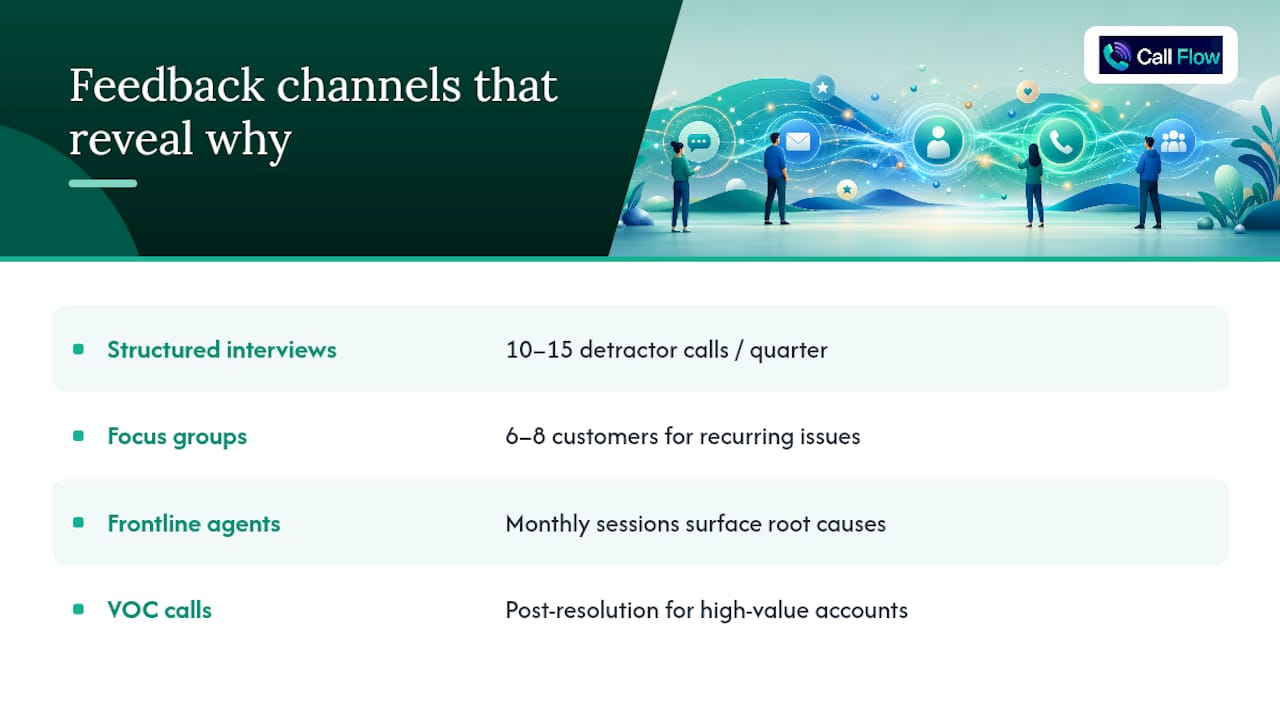
Structured interviews with a small sample of recent detractors, ten or fifteen calls a quarter, surface patterns that a five-point scale can't capture. Ask open questions: "Walk me through what happened before you called." You'll hear about the three self-service attempts that failed before the phone call, information no survey question was built to catch.
Focus groups work well for recurring, complex issues, like a confusing billing structure that generates repeat contacts across many customers. Bringing six to eight of those customers into one conversation often surfaces the actual friction point faster than sifting through hundreds of individual comments.
Don't overlook your own agents as a feedback channel. They hear the unfiltered version of customer frustration daily, and a short monthly session asking frontline agents "what's the complaint you're tired of hearing" routinely surfaces root causes that never make it into a formal ticket tag. Combine that with post-resolution voice-of-customer calls for your highest-value accounts, and you get a feedback loop that catches what the survey misses.
How Managing Expectations Improves Customer Satisfaction
A satisfied customer isn't necessarily one who got the fastest resolution. It's one whose experience matched, or beat, what they expected walking in. That distinction changes how you should think about CSAT.
Setting a realistic expectation up front, "this typically takes two to three business days," beats overpromising and delivering late every time, even when the actual resolution time is identical. Customers forgive a wait they were warned about far more readily than a wait they weren't.
This is why the wording on your status pages, hold messages, and automated confirmations matters as much as your actual resolution speed. If your intake bot promises a callback in one hour, and the real average is four, you've manufactured a CSAT problem out of a communication gap, not a service failure.
Train agents to set expectations explicitly during the call itself: "I'm escalating this to our billing team, and you should hear back by Thursday." That single sentence does more for the eventual CSAT score than shaving ten minutes off average handle time, because it converts an unknown wait into a bounded one.
What Do Successful CSAT Turnarounds Actually Look Like?
The pattern across successful CSAT initiatives tends to follow the same shape: a narrow diagnostic phase, a small number of targeted fixes, then measurement against the original baseline.
It needs a policy rewrite and a one-page agent reference, and the CSAT lift shows up in exactly the segment that was broken. Teams that segment CSAT by intent before intervening consistently outperform teams that apply a blanket fix, because the blanket fix spends resources on segments that were never the problem.
Recovery CSAT often tells the real turnaround story better than the topline score. A team that gets its detractor follow-up time down from a week to under 48 hours typically sees recovery CSAT climb well before the standard CSAT average moves, since recovered customers who felt heard tend to stay loyal even after an initial failure, according to Botpress. That's the metric to watch first if you want early proof that your intervention is working, before the slower-moving topline number catches up.
What CSAT Advice Gets Wrong
Most CSAT advice treats every low score as a training problem. It isn't. A huge share of what tanks CSAT is structural: a policy that requires three sign-offs for a $15 credit, a knowledge base that hasn't been updated since a product launched, a routing rule that guarantees a transfer. No amount of empathy coaching fixes a policy wall.
That said, the industry has also swung too far toward dismissing training as a soft investment with no measurable return. That's backwards. The reason training gets underfunded is that most programs never measured anything beyond a completion checkbox. Tie training to specific coachable behaviors identified from QA scorecards, and to resolution and CSAT outcomes, and it becomes one of the most defensible line items in a contact-center budget, not one of the softest.
Prioritize the structural fixes first: routing, authority, knowledge base hygiene. Then invest in coaching that's actually tied to the behaviors your data flagged, not generic soft-skills training. The leaders who get this sequencing backwards spend a quarter on workshops before they've fixed the transfer loop that's driving the complaints in the first place.
Give Agents a Way to Practice Before the Real Call
The tactics above only work if agents can execute them under pressure, and most contact centers train for that with a slide deck and a shadow shift, then hope the first live call goes fine. Callflow closes that gap with realistic role-play scenarios that mirror your actual top ticket intents, graded instantly across five performance dimensions instead of waiting for a supervisor's weekly review.
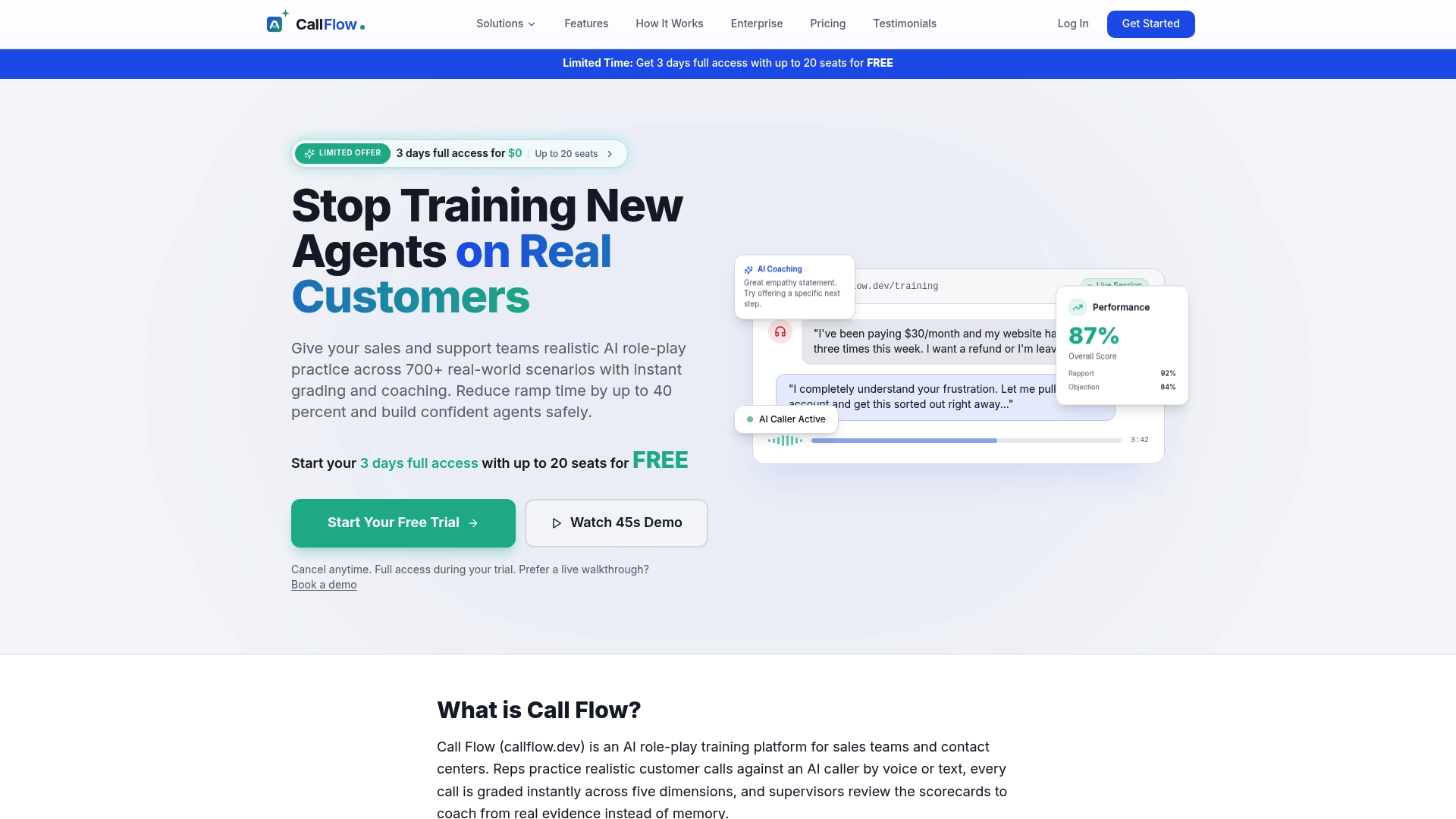
That maps directly onto the levers covered here: role-play practice builds first-contact resolution skill, and instant grading turns QA feedback into same-day coaching instead of a quarterly conversation. If your CSAT plan includes a training component this quarter, try Callflow's AI mock call practice risk-free and see how quickly a new agent's scores catch up to your top performers.