

Sales playbook adoption is the share of your reps who use the playbook in real customer conversations, not the share who have read it. A playbook only pays off when it changes what a rep says and does on a call. The fastest way to get there is to make reps practice the plays, get scored on them, and get coached on the gaps. Reading alone does not do it.
This guide is for sales managers, contact center leaders, training directors, HR teams and team leaders. It shows how to define adoption, measure it, find out why it stalls, and build a rollout that sticks.
- ✓Realistic role-play scenarios
- ✓Instant grading and coaching
- ✓Feedback across multiple performance dimensions
TL;DR
- Adoption is behavior on live calls. A well-written playbook that sits unused is not adopted.
- Measure it with a simple usage rate per play and compare it with outcomes. Low use means a rollout or content problem. High use with no result change means reps are going through the motions.
- Playbooks fail when they live away from the work, when nobody teaches reps how to use them, and when they are never practiced.
- Role-play with instant scoring turns a document into a skill. Our platform gives that practice and feedback on five performance dimensions.
- Review the playbook on a fixed schedule. Retire plays nobody uses.
Table of Contents
- What sales playbook adoption means
- Why reps do not use the playbook
- How to measure sales playbook adoption
- A rollout plan that gets reps to use the playbook
- Build adoption into onboarding
- Keep reps engaged after launch
- What each role should watch
- Turn the playbook into practice with Callflow
- Our perspective
- FAQ
- Sources
What sales playbook adoption means
A sales playbook is a documented set of plays, processes and messaging that tells your team how to find, qualify and close deals. Salesforce lists the benefits it can bring: faster training for new reps, less guesswork, a consistent customer experience and more accurate forecasting.
Those benefits only show up if reps act on the playbook. One practitioner view holds that a playbook creates value only when it changes rep behavior at the moment of a sales interaction. The same source warns that a dormant playbook can be worse than none, because leaders assume the process is being followed when it is not.
So adoption has three layers:
- Awareness. Reps know the play exists and where to find it.
- Skill. Reps can run the play out loud, under pressure, with a real person on the other end.
- Behavior. Reps use the play on live calls, and the buyer responds.
Most teams stop at layer one. A 2026 research review describes the chain from knowledge to skill, to behavior, to execution, to buyer response, to commercial results. Each link can break. Your job is to find the broken link.
The same review adds a balance. Formal selling systems help when they clarify effective behaviors and are reinforced. Too much standardization can hurt a rep's ability to adapt to the buyer. A good playbook gives reps a strong default, not a script to recite.
Why reps do not use the playbook
The reasons are usually practical, not attitude problems.
The playbook lives far from the work
A sales leader writing on playbook design points to a structural gap: the playbook sits in a drive folder while the work happens in Slack, email and the CRM. Reps drift back to old habits within weeks. If finding the right play takes more than a few minutes during an active deal, nobody opens it.
If your reps work across many tools, look at how information flows between them. This piece on automating a sales process without automating the mess helps you map where guidance should surface in the workflow.
Nobody taught reps how to use it
One class summary names the top reason playbooks fail: no one is taught how to use them. A launch email and a one-hour meeting do not build skill. Reps need to hear the play, say it, get corrected and say it again.
One document does too many jobs
A playbook that tries to be an onboarding manual, an operations guide and a live call aid does none of them well. Split the content by use:
- Learn: the full process, personas and objections, used in onboarding and practice.
- Do: short, scannable plays used during a call.
- Review: the metrics and rules managers use to coach.
Practice is missing
Knowing what to say is different from saying it well to a frustrated customer. Without practice, reps freeze on a hard objection and fall back on habit. This is where adoption is won or lost.
How to measure sales playbook adoption
You cannot manage adoption by feel. Track a few numbers and look at them together.
| Measure | What it tells you | How to get it |
|---|---|---|
| Play usage rate | Share of reps using a play in a period | CRM tags, call review, practice records |
| Play completion rate | Whether reps work through the steps of a play | Checklists or scored calls |
| Win rate or resolution rate per play | Whether the play changes outcomes | CRM and QA data |
| Skill score per dimension | Where reps are weak | Scored practice and call QA |
| Ramp time | How fast new hires reach target | HR and sales ops data |
Read usage and outcomes together
One practitioner benchmark treats a completion rate below 40% as a sign the play is not being used. Above 80% with no difference in outcomes suggests reps are ticking boxes with no real change in behavior. Treat these as rough starting points, not laws. Set your own baseline in the first month and compare against it.
Here is a worked example. Say you launch a new discovery play for a team of 20 reps.
- Month one: 6 of 20 reps use it in two or more deals. That is 30% usage. The play is not landing.
- You run a short practice round and a coaching session on the three weakest steps.
- Month two: 15 of 20 reps use it. That is 75% usage. Now compare win rate between users and non-users.
If win rate does not move even at high usage, the play itself needs work. If usage stays low, the rollout needs work. Two different problems, two different fixes.
Run a simple audit
A RevOps knowledge page suggests a 30-day, non-punitive audit using three colors. Green means the play was used in at least two deals that month. Yellow means it was used once or attempted and dropped. Red means not used. Keep the audit about learning. If reps fear it, they will log usage that did not happen.
Be careful with the link to quota
Some studies show a strong gap. A 2025 survey of 208 North American B2B sales leaders found that among organizations where more than 60% of sellers were on track for quota, 62% reported consistent process adherence versus 32% occasional. Another source reports quota attainment of 49% for teams with embedded, measured guidance versus 15% for teams with guidance in documents and separate tools. Both are associations. They show a pattern worth testing in your own data, not proof that a playbook alone caused the result.
A rollout plan that gets reps to use the playbook
Follow this order. Each step has a common failure and a fix.

Step 1: Pick a small set of plays
Do not launch 40 plays. Start with the three to five moments that decide deals or customer satisfaction: opening a call, discovery, the most common objection, and the close or resolution step. For a contact center, that might be de-escalation, verification and the wrap-up.
Where it goes wrong: Teams write for completeness. Reps get overwhelmed and use none of it.
Step 2: Build plays with your reps
Ask your best performers and your newest hires what they say on real calls. Pull the most common objections from recent lost deals or low-scoring calls. Plays built from real conversations sound like your team, and reps are more willing to use what they helped shape.
Where it goes wrong: Enablement writes the plays alone and they sound like marketing copy.
Step 3: Put the play where the work happens
Turn long pages into short cards or checklists. Link them from the CRM or the call tool reps already use. Keep each play short enough to scan during a call.
Where it goes wrong: The best content sits three clicks deep in a shared drive.
Step 4: Teach it with practice, not a slide deck
Have every rep run each play out loud before they use it on a customer. Our platform is built for this step. It runs realistic AI role-play in voice or text, mimics actual customer interactions and grades each session instantly across five performance dimensions, with coaching feedback. Reps can repeat a scenario until the play feels natural, and they do not need a manager or a teammate free to play the customer.
If you want to start small, this one-week deliberate practice pilot shows how a manager can set up short, repeatable practice rounds.
Where it goes wrong: A one-time training session with no repetition. Skills fade without practice.
Step 5: Coach to the play
Managers should use the same plays and the same scoring language in one-to-ones. When a rep misses a step, point to the exact step and have them practice it again. Our supervisor dashboards and skill analytics show who is struggling on which dimension, so coaching time goes where it matters. Supervisors can also review and override scores, so the scoring stays aligned with your own QA standards.
Where it goes wrong: Coaching is generic, such as "be more confident," and never ties back to the playbook.
Step 6: Review adoption every month
Look at usage, outcomes and skill scores by play. Keep what works. Fix or drop plays that nobody uses. Share a short win story from a rep who used a play well. Peer examples spread faster than instructions.
Where it goes wrong: Leaders measure once at launch and never again.
Build adoption into onboarding
New hires are your best adoption opportunity. They have no habits to unlearn, and they need the playbook the most.
The core idea is to make the playbook the spine of onboarding. Each week, new reps learn a play, practice it, get scored and then use it on live work with support. Our own guides cover this in depth. See the 30-60-90 playbook for shortening sales onboarding for sales teams. For service teams, see the 90 day agent onboarding checklist and our guide to AI role play in call center onboarding.
We also publish an analysis of simulation-based learning that sits behind our 147% faster ramp time figure for teams using simulation.
Tie onboarding to a skills framework so everyone knows what good looks like. A sales competency model gives you the skills, the levels and the way to assess them, and it makes playbook goals measurable.
Keep reps engaged after launch
Adoption fades when the playbook feels like a chore. A few habits help.
- Short, frequent practice. Ten minutes a few times a week beats one long session a quarter.
- Visible progress. Reps want to see their scores improve. Scoreboards, streaks and challenges make practice feel like a game. Our guide to gamification for sales leaders shows how to set that up.
- Fresh scenarios. Update practice cases when objections, products or policies change. Our platform lets you create custom scenarios, so practice stays close to your real calls.
- Live support. A pilot of real-time call coaching can bridge practice and live calls for a team that is ramping.
- Cross-team plays. If you also want reps to sell more to existing customers, a cross-sell training playbook shows how to run it.
Keep the playbook current
Set a review rhythm and an owner. A quarterly review works for most teams, with faster updates when pricing, products or competitors change. At each review:
- Check usage by play. Retire anything under your threshold for two cycles.
- Compare win or resolution rate for users and non-users.
- Add new objections from recent calls.
- Update the practice scenarios to match.
- Tell the team what changed and why.
A playbook that changes without notice teaches reps to ignore it. A playbook that changes with clear notes teaches them it is alive.
What each role should watch
| Role | Focus |
|---|---|
| Sales manager | Ramp time, play usage, win rate by play |
| Contact center leader | First-call resolution, customer satisfaction, QA scores |
| Training director | Skill scores by dimension, practice completion, progress over time |
| HR | Ramp time and early turnover, since reps who feel prepared tend to feel more confident in the job |
| Team leader | Weekly usage, coaching notes, who needs a practice round |
Pick two or three numbers per role. Too many dashboards bring the same problem as too many plays.
Turn the playbook into practice with Callflow

A playbook tells reps what to do. Practice teaches them how to do it. Our platform gives your team realistic call scenarios in voice or text, instant grading across five performance dimensions, and coaching feedback after every session. Supervisors get dashboards and skill analytics, and scoring is calibrated to match your existing QA standards. Teams can start with a free, full-feature trial.
Plans are billed monthly or annually. Starter is $7.42 per month or $89 per year. Growth is $14.92 per month or $179 per year. Scale is $33.25 per month or $399 per year. See the plans and pricing, or look at the Business and Enterprise options for larger teams.
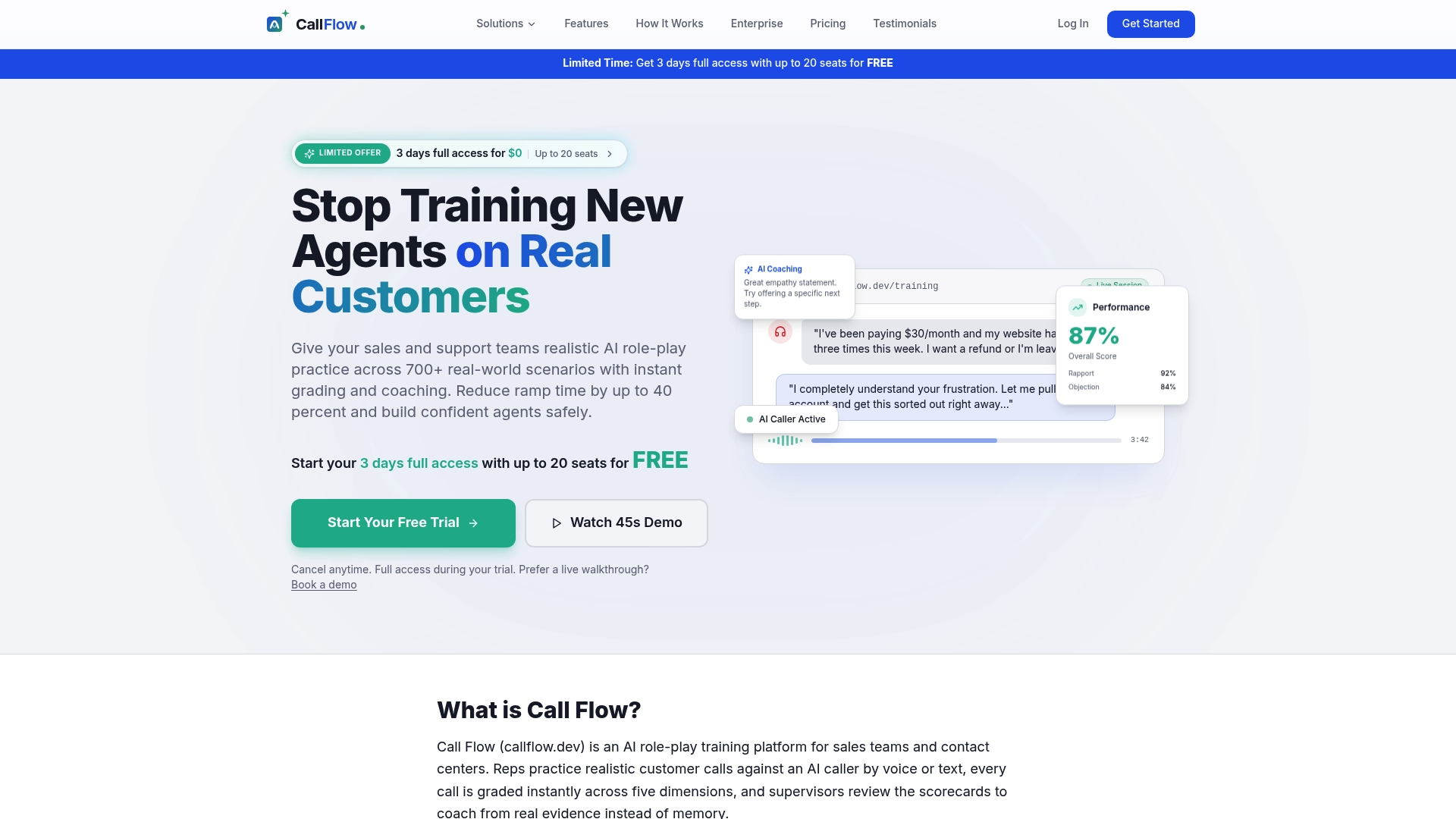
You can also see how a scenario works on our site. Try a service call with an escalated customer to see how practice maps to a play.
Our perspective
Most playbook programs fail in the gap between knowing and doing. A rep can read a play and still stumble on the first hard call. We built Callflow around that gap.
Our view is simple. Adoption is a skill problem first. Reps need a safe place to say the words out loud, hear how they land and try again. They need feedback right away, not a week later in a review. That is why we grade each session instantly across five dimensions and give coaching tips tied to what the rep actually said.
Managers need the same clarity. Our scoring is calibrated to match your QA standards, and supervisors can review and override results. The score means the same thing in practice and in call review. Then the playbook, the practice and the coaching all point at one standard.
Teams using our approach report results such as 147% faster ramp time and a 129% improvement in resolution rates. Those are our figures from our platform. We share them because they show what happens when practice becomes part of the routine.
Start small. Pick three plays, run them through practice for a few weeks and watch usage and outcomes. You will know quickly if the playbook is working.
Costa
FAQ
What is a good sales playbook adoption rate?
There is no universal number. One practitioner guide treats usage below 40% as a sign a play is not in use. Use that as a warning level, then set your own baseline in the first month. Track it against win or resolution rate to see if usage is changing results.
How long does it take for reps to adopt a new playbook?
Plan for weeks, not days. Launch day does not change behavior. Expect a first read of usage after 30 days, then keep reinforcing through practice and coaching over the next quarter. New hires can adopt it faster when the playbook is built into their onboarding.
Why do sales reps ignore the playbook?
Usually because it is hard to find during a call, it was never taught, or it was never practiced. A playbook stored in a separate folder loses out to the tools reps already use. Short plays, placed in the workflow and rehearsed in role-play, fix most of this.
Does a sales playbook improve performance?
It can, when it is clear and reinforced. A 2026 research review says gains depend on clarifying effective behaviors and supporting them over time. Measure your own usage and outcomes rather than assuming a result.
How do contact centers apply playbook adoption?
The same logic holds. Define plays for key moments such as verification, de-escalation and resolution. Practice them with realistic customer scenarios, score them against your QA standards and coach on the weak steps. Track first-call resolution and customer satisfaction next to usage.
Sources
- Sales Playbook Guide: Examples & Templates for Success, Salesforce
- Are Your Sales Playbooks Actually Working? How to Measure Adoption
- Do Sales Playbooks Improve Sales Performance? What Research Says
- Sales Playbook Execution: 5 Design Decisions
- Class Summary: Creating and Implementing a Sales Playbook
- Sales Enablement Challenges: The One Root Cause
- How do you design playbook governance without turning it into policing