

Simulation-based learning, in the sales and contact-center context, means AI-driven role-play: agents practice realistic customer conversations against an AI persona and get instant, rubric-based scoring. Fielded well, it cuts ramp time, raises first-contact resolution, and turns practice into a measurable input rather than a guess. Call Flow reports 147% faster ramp time and 129% improvement in resolution rates among teams using it. It fits any team that needs repeatable, gradable practice at a volume live coaching can't match.
TL;DR:
- Realistic scenarios based on actual lost deals and QA failures maximize engagement and relevance for sales and support reps.
- Training shows measurable results, including faster ramp times, improved resolution rates, and savings in coaching hours within three months.
- Successful rollout requires high-impact, targeted scenarios, seamless system integrations, and ongoing scenario updates aligned with current sales challenges.
- AI role-play enhances learning by allowing practice anytime, providing instant feedback, and scaling volume beyond traditional manager-led coaching.
- Combining simulation with manager coaching and gamification increases motivation, while data-driven KPIs link practice frequency to revenue and customer satisfaction improvements.
Table of Contents
- What Is Simulation-Based Learning for Sales Teams?
- Does Simulation Training Actually Improve Performance?
- How Do You Roll Out Simulation-Based Learning at Scale?
- What KPIs Prove Simulation-Based Learning Works?
- What Are the Biggest Risks in Simulation-Based Learning Adoption?
- Which Simulation Methods Fit Sales and Contact-Center Training?
- How Does Simulation Training Compare to Traditional Role-Play?
- What Makes a Simulation Scenario Actually Work?
- What Technology Do You Need to Run This Well?
- Where Else Does Simulation-Based Learning Apply?
- How Do You Keep Trainees Engaged in Simulation Training?
- A Practitioner's View on Where Simulation Training Actually Pays Off
- Call Flow: Practice, Score, and Coach at Scale
- Sources
What Is Simulation-Based Learning for Sales Teams?
In this context, simulation-based learning is not the mannequin-and-monitor training used in nursing schools. It's AI role-play: an agent talks or types through a multi-turn conversation with an AI buyer or caller, and a scoring system grades the exchange against a rubric immediately afterward.
The scenarios aren't generic. Strong programs build them from real CRM data, call recordings, and QA failure points, then map them to the sales methodology the team already uses, whether that's MEDDIC, Sandler, or a homegrown objection-handling framework. A scenario for a renewals rep looks nothing like one for a tier-one support agent, and the persona, objections, and success criteria should reflect that.
Platform capabilities typically include a scenario editor for building and customizing conversations, an AI counterpart that adapts its tone and objections in real time, automated scoring across several performance dimensions, supervisor dashboards for tracking team progress, and integrations back into the systems managers already use. AI role-play training works because it removes the two constraints that make live role-play rare: someone else's time, and the awkwardness of practicing in front of a peer.
Does Simulation Training Actually Improve Performance?
The evidence holds up. Simulation-based learning increases active participation because learners must make real-time decisions instead of passively absorbing a script, according to a review of active learning outcomes. That distinction, deciding versus watching, is why simulation transfers to live calls better than a slide deck ever could.
A 2008 field study published in Management Science found that call center agents trained with simulation outperformed those trained with traditional role-play on both call accuracy and processing speed, with the gap widening on more complex tasks. That's a meaningful signal for any team handling more than simple scripted calls.
Reported outcome: Some AI role-play platforms report substantial reductions in ramp time and lifts in resolution rates, according to their performance data.
Industry reporting backs the mechanism: AI role-play scales practice volume well beyond what manager-led coaching can sustain, and it frees managers to spend their limited time on higher-value coaching instead of repeating the same objection-handling drill twenty times a week, per Training Magazine's analysis.
What to expect on a realistic timeline:
- Weeks 1 to 4: practice volume rises sharply as reps run scenarios on their own schedule, without waiting for a manager.
- Weeks 4 to 8: measurable score improvement across rubric dimensions, especially on objection handling and discovery questions.
- Months 2 to 3: ramp time compression becomes visible in CRM data, and coaching hours per rep start to drop.
How Do You Roll Out Simulation-Based Learning at Scale?
Start with outcomes, not scenarios; for example, consider leveraging tools like the Poised AI Communication Coach to enhance conversational coaching. Pull QA scores and lost-deal notes to identify where reps actually struggle, then build your first scenario bank around those gaps rather than a generic "objection handling 101" set.
- Pick your highest-impact scenarios first. Use CRM and QA signals to find the two or three moments where deals or calls most often go wrong.
- Template every scenario the same way: persona, objective, trigger conditions, scoring rubric, and a defined success threshold.
- Check your integrations before launch. CRM for context, conversation intelligence for real-call grounding, xAPI or an LRS for practice data, LMS for assignment tracking, and single sign-on for adoption.
- Run a pilot with one team and one clear metric. Thirty to sixty days is usually enough to see a directional signal.
- Set governance early: who owns scenario updates, how often managers review dashboards, and what data privacy controls apply to recorded practice sessions.
- Iterate before you scale. Fix rubric gaps and persona weirdness in the pilot, then roll out to additional teams in stages.
Authoring works best as a small team effort. Scenario banks built by frontline QA, a sales subject-matter expert, and an enablement designer together produce noticeably higher transfer than scenarios written by a training team in isolation, according to Call Flow's scenario design research.
Pro Tip: Require a certification threshold, a minimum rubric score, before a new hire takes their first live call. Pilot data shows this single gate reduces early-call failures and protects initial CSAT.
What KPIs Prove Simulation-Based Learning Works?
Practice volume means nothing on its own. The KPIs that matter connect directly to revenue or service outcomes:
- Ramp time: days or weeks from hire to full productivity.
- Time-to-first-sale: how long until a new rep closes their first deal.
- First contact resolution (FCR) and average handle time (AHT) for support teams.
- CSAT trends tied to cohorts who completed specific scenario tracks.
- Practice volume and rubric score improvement, tracked weekly per rep.
The strongest measurement method compares pre and post cohorts: reps who trained with simulation against a comparable group who didn't, observed over a consistent window, typically 60 to 90 days, so seasonal or pipeline noise doesn't distort the read. Integrating practice data via xAPI into a learning record store and correlating it against CRM outcomes lets enablement teams show, not just claim, a causal link between practice frequency and closed deals.
A useful threshold: if a cohort's average rubric score rises 15 points or more alongside a visible drop in ramp time, that's a strong enough signal to expand the program past pilot.
Sample size matters here. A pilot of five reps won't produce a defensible number. Aim for at least 20 to 30 reps per cohort before drawing conclusions.
What Are the Biggest Risks in Simulation-Based Learning Adoption?
Generic scenarios are the most common failure mode. If every rep practices the same three canned objections regardless of their product line or region, engagement drops fast and managers write the whole program off within a quarter. Scenarios built from actual lost deals and QA failure points hold attention because reps recognize the situation.
The second risk is positioning. Framing AI role-play as something that replaces manager coaching, rather than something that multiplies it, kills adoption almost immediately. Managers who feel threatened will quietly discourage their teams from using the tool. Research on AI and human coaching makes the case clearly: AI handles volume and consistency, humans handle nuance and trust.
Before you pilot, check these:
- Rubrics score specific, observable behaviors, not vague categories like "professionalism."
- Feedback tells the rep exactly what to change on the next attempt, not just a score.
- Recorded voice and text sessions have a defined retention and access policy.
- Managers know their role is to review trends and coach on them, not to babysit the software.
Which Simulation Methods Fit Sales and Contact-Center Training?
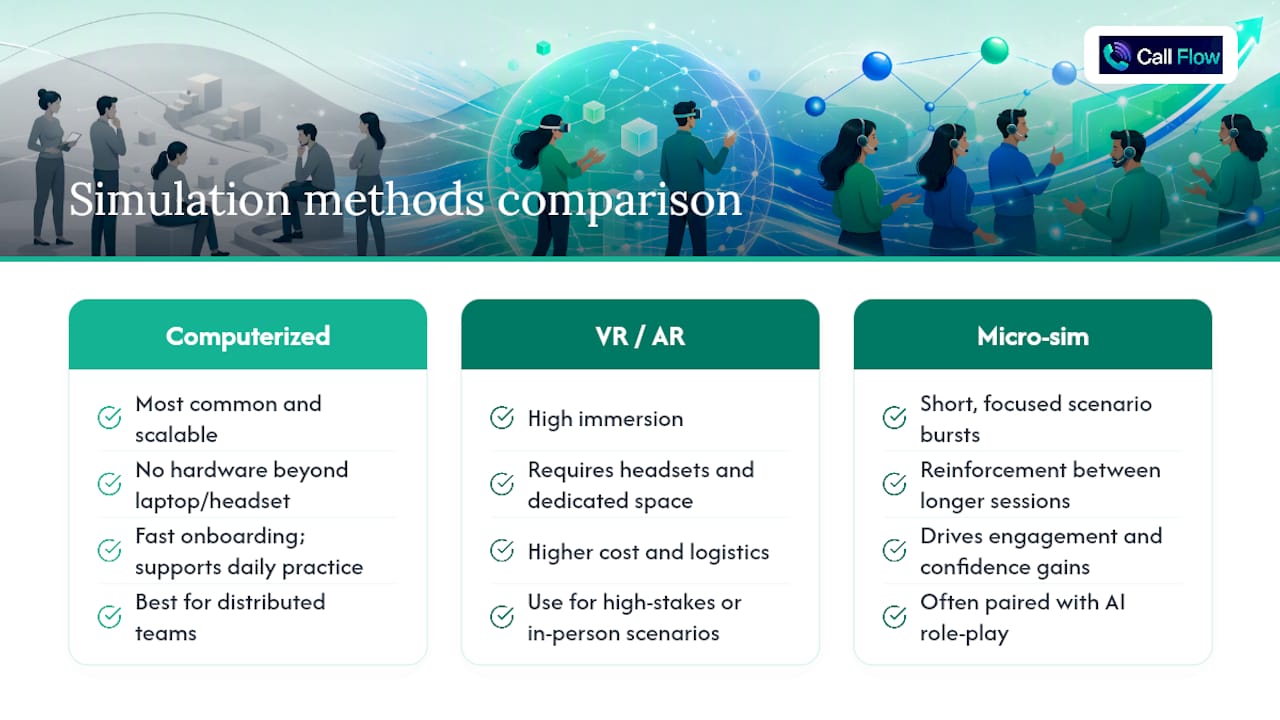
Computerized simulation, text or voice conversations against an AI persona, is the most common and most scalable method for sales and contact-center teams. It requires no hardware beyond a laptop or headset, which makes it viable for distributed teams and fast onboarding cycles.
Virtual reality and augmented reality sit at the high-immersion end of the spectrum. A 2025 study on VR environments for sales training found that immersive setups improved engagement and showed real potential for skill transfer, particularly for scenarios involving body language or spatial product demonstrations. The trade-off is cost and logistics: headsets, dedicated space, and IT support don't scale the same way a browser-based tool does.
Micro-simulations, short, focused scenario bursts rather than full call replays, work well for reinforcement between longer training sessions. An Advantexe case study on a national sales meeting that combined micro-simulations with competitive AI role-play reported strong engagement and confidence gains among participants applying new strategy at scale.
For most sales and contact-center buyers, computerized voice and text simulation delivers the best ratio of realism to deployment speed. VR and AR are worth evaluating for specific high-stakes or in-person scenarios, but they rarely replace the daily practice cadence a text or voice platform supports.
How Does Simulation Training Compare to Traditional Role-Play?
Traditional role-play, two colleagues practicing a call script, has a built-in ceiling: it needs two people's calendars to align, and most reps find it awkward enough that they avoid it whenever possible. It also produces no consistent scoring, since one manager's "good call" is another's "needs work."
Simulation-based learning removes both constraints. A rep can run a scenario at 7 a.m. before a shift or between calls, with no scheduling required. The 2008 Management Science field study comparing the two methods found simulation training produced better call accuracy and faster processing speed than role-play training, with the advantage growing on harder tasks.
Classroom training, lectures and slide decks, still has a place for compliance content and product knowledge. It's simply the wrong tool for behavioral skills like objection handling, tone control, or de-escalation, where a rep needs to practice the behavior itself, not memorize a fact. Simulation and classroom training aren't competitors so much as different tools for different learning objectives; the mistake is using a lecture format to try to build a conversational skill.
What Makes a Simulation Scenario Actually Work?
A scenario built from a real lost deal will always outperform one written from a generic template, because reps recognize the pattern and the stakes feel real. Pull specifics from CRM notes, call transcripts, and QA scorecards before writing a single line of scenario dialogue.
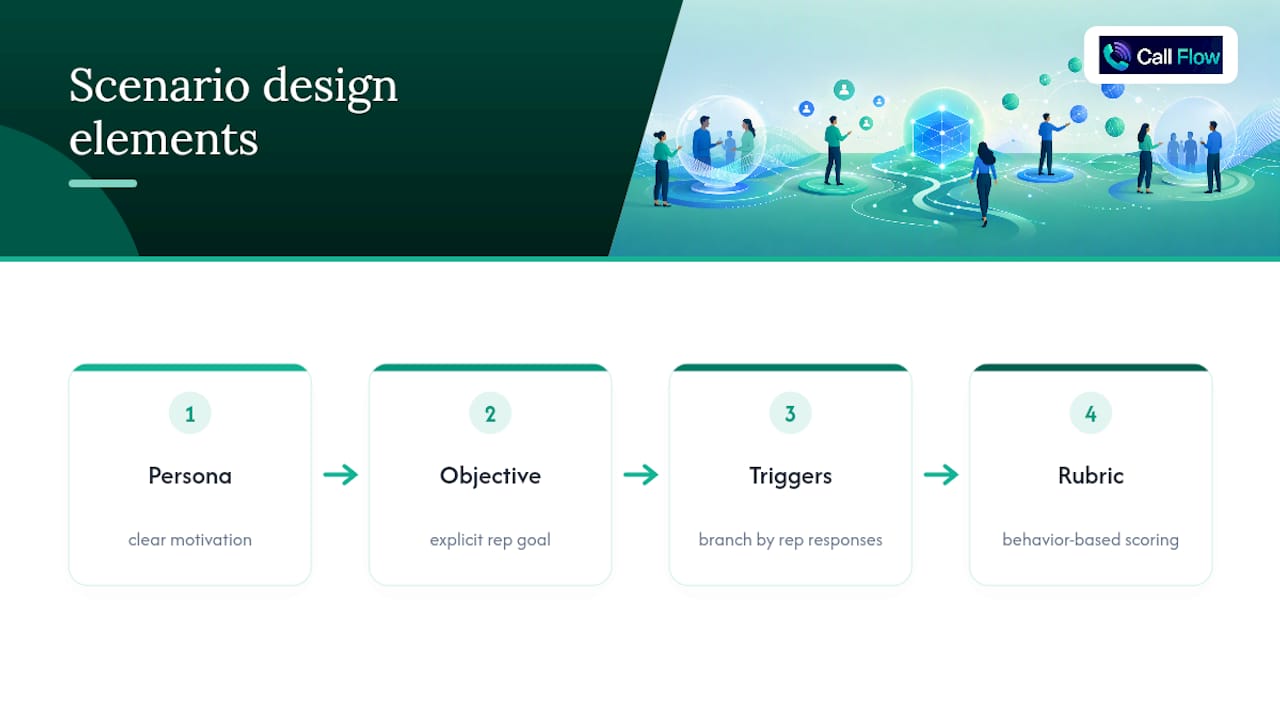
Every scenario needs four fixed elements: a persona with a clear motivation, an explicit objective for the rep, trigger conditions that branch the conversation based on what the rep says, and a rubric that scores specific behaviors rather than a vague overall impression. Skip any of these four and the scenario either feels flat or produces scores nobody trusts.
Customization matters more than volume. Ten sharp, role-specific scenarios beat fifty generic ones. A renewals team needs scenarios about churn risk and pricing pushback; a new-logo sales team needs scenarios about competitive displacement and multi-stakeholder objections. Building both sets from the same template guarantees at least one team disengages.
Refresh scenarios quarterly at minimum. Sales objections shift with pricing changes, new competitors, and product updates, and a scenario bank that goes stale for a year stops reflecting what reps actually hear on calls. Practical scenario templates that separate persona, trigger, and rubric into distinct fields make quarterly updates far faster than rewriting full scripts from scratch.
What Technology Do You Need to Run This Well?
At minimum, a simulation platform needs a scenario editor, an AI conversational engine that can hold a multi-turn exchange, and a scoring system that grades multiple performance dimensions automatically. Anything less turns into a glorified script reader.
Integration depth determines whether the program proves its value or just generates a feel-good usage report. A platform that connects to your CRM can pull real account context into scenarios and push readiness scores back for manager visibility. Conversation intelligence integration lets you ground scenarios in actual call patterns instead of guesses. An xAPI connection into a learning record store, paired with your LMS, lets enablement teams correlate practice frequency directly against closed-deal or resolution data.
Deployment format matters for adoption. Voice and text modes should both be available, since some reps prepare better by typing through logic before trying it out loud, while others need the vocal delivery practice that text can't provide. Single sign-on removes the last-mile friction that kills pilot participation faster than almost anything else. Microsoft's internal Agent J.ai deployment scaled personalized coaching across thousands of sellers, and much of that scale depended on tight integration into existing seller workflows rather than a standalone tool nobody opened twice.
Mobile access rounds out the requirements list. Reps who can run a five-minute scenario between meetings on a phone will practice more than reps who need a desktop and a quiet room.
Where Else Does Simulation-Based Learning Apply?
Sales and contact centers are the sharpest use case, but the same mechanics, realistic scenario, AI counterpart, instant scoring, apply anywhere a job depends on a conversation going well.
Retail and hospitality teams use scenario practice for upselling conversations and de-escalating unhappy customers before those situations happen live on the floor. Financial services firms use it for advisors practicing compliance-sensitive conversations, where getting the wording wrong carries real regulatory risk. Recruiting and HR teams use it to prep hiring managers for difficult conversations, from compensation negotiations to layoffs, where tone matters as much as content.
Customer success teams, distinct from sales, use simulation to practice renewal conversations and expansion pitches with existing accounts, where the relationship history changes the right approach every time. Even internal leadership development programs borrow the same model for practicing performance reviews and conflict conversations, since the skill being built (staying calm, reading the room, adjusting on the fly) is identical to what a sales rep needs on a cold call.
The common thread across every one of these: a conversation with real stakes, unpredictable responses, and a skill that only improves through repetition nobody wants to schedule with a live partner every time.
How Do You Keep Trainees Engaged in Simulation Training?
Engagement collapses fastest when scenarios feel disconnected from the rep's actual job. The fix isn't more scenarios, it's better-targeted ones, built from the specific deals and calls that rep's team actually handles.
Immediate, specific feedback keeps reps coming back. A score with no explanation feels like a grade from a black box; a score paired with "you skipped the discovery question about budget timing" feels like coaching. That specificity is what makes reps trust the system enough to keep practicing voluntarily.
Gamification adds a second engagement layer once the core feedback loop works. Leaderboards, streaks, and team-based challenges turn solitary practice into something reps talk about with each other, which matters more than it sounds. Practical gamification tactics for learning and development point to short, visible competitions, weekly leaderboard resets rather than one long season, as more sustainable than a single big contest that burns out after the first month.
Manager visibility closes the loop. When a manager references a rep's simulation score in a one-on-one, it signals the practice actually matters to someone, not just to a dashboard. Reps who believe their manager is watching tend to log noticeably more voluntary practice sessions than reps who suspect the tool is a compliance checkbox nobody reviews.
A Practitioner's View on Where Simulation Training Actually Pays Off
Most vendors sell simulation-based learning as a replacement for coaching time. That framing is backwards, and it's why some pilots quietly die after a quarter. The real value shows up when you treat AI role-play as a volume engine that feeds better information into the coaching conversations managers already have.
The programs that stick share one habit: they build scenarios from specific lost deals and QA failure points, not from a generic curriculum someone downloaded. If a rep keeps losing the same objection on renewal calls, that objection becomes a scenario within a week, not a quarter.
On cadence, protect manager time deliberately. Let the platform absorb repetitive drilling, and reserve manager attention for the moments a score reveals a pattern worth a real conversation. That division of labor is what makes the whole approach sustainable past the pilot.
— Costa
Call Flow: Practice, Score, and Coach at Scale
Callflow gives sales and contact-center teams a way to turn practice into a measurable, repeatable system instead of an occasional role-play session nobody has time for. Reps run realistic voice or text scenarios against an AI counterpart, get instant grading across five performance dimensions, and see exactly what to fix before their next attempt.
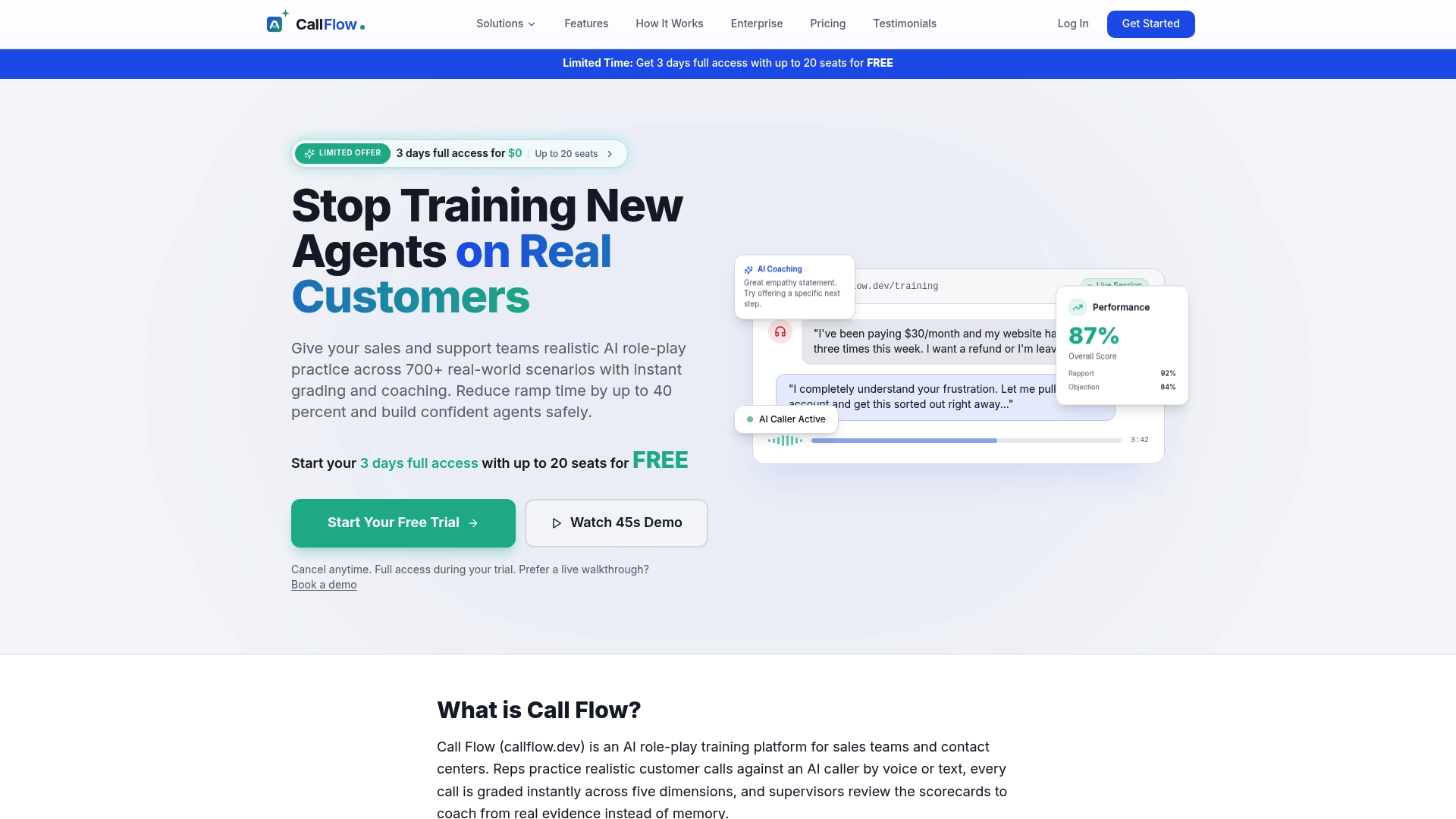
Supervisor dashboards give managers a live read on team readiness without sitting in on every call, and a scenario builder lets you customize practice around your own lost deals and QA gaps rather than a generic template. Gamification features, leaderboards and streaks, keep practice volume high without manager prompting.
If you're evaluating whether AI role-play fits your team, start with Call Flow's risk-free trial and run it against your own onboarding cohort before committing to a full rollout.
Sources
- Simulation-based learning shifts passive listening to active decision-making (PMC review)
- The Impact of Simulation Training on Call Center Agent Performance (2008)
- Why AI-Powered Role Play Belongs in Sales Enablement (Training Magazine)
- How Microsoft built an AI coach to scale personalized sales training (Microsoft)