

A complete agent onboarding checklist guarantees every new agent is legally verified, tech-enabled, and on a documented 90-day ramp with clear owner signoffs. It covers paperwork and compliance, technology access, phased training, risk and E&O policy, marketing setup, and centralized recordkeeping. Managers own each item on a timeline, and the first 90 days become the adjustment window where fit gets tested on both sides.
TL;DR:
- Proper license verification and license transfer confirmation must be completed before day one to prevent delays in onboarding.
- All technology accounts should be set up and tested before agents start, with a designated owner resolving issues within one business day.
- The 90-day onboarding process should be divided into three phases, including observation, supervised practice, and independent production, with bi-weekly check-ins.
- Centralized documentation, sign-off tracking, and a clear delegation matrix are essential to avoid missed paperwork and compliance failures.
- Role-play simulation during the supervised phase can accelerate skill development and reduce ramp time through immediate feedback and performance measurement.
Table of Contents
- Administrative and compliance paperwork: step-by-step items and timelines
- Technology and systems access: accounts, security, and provisioning order
- Training plan and 90-day ramp: milestones, bi-weekly check-ins, and metrics
- Policies, risk and E&O: how to use carrier materials and document acknowledgments
- Production and marketing setup: profiles, templates, and lead handoff
- Templates, the onboarding hub and sign-off tracking
- Why simulation and role-play shorten ramp time
- Manager perspective: quick rules to avoid common onboarding mistakes
- Try a simulation-based training pilot to accelerate ramp
- Sources
- FAQ
Administrative and compliance paperwork: step-by-step items and timelines
Paperwork sets the legal foundation for everything else. Miss a deadline here and the rest of onboarding does not matter.
Start with license verification before day one. Confirm active status with the state licensing board and process any license transfer if the agent is moving firms. Create the agent's profile in your CRM and HR system on the same day.
- Verify license status and complete any required state board transfer.
- Have the employee complete Form I-9 Section 1 by their first day; the employer or an authorized representative must complete Section 2 within three business days of the employee's first day of work for pay.
- Collect W-9s for independent contractors and confirm 1099 classification and commission payment details.
- Gather signed documents: the independent contractor agreement, policy acknowledgments, and a record-retention signoff.
- File everything in a centralized, audit-ready location with a retention schedule.
The USCIS handbook for employers (M-274) explains exactly how to record document titles, issuing authority, and expiration dates in Section 2, along with rules for authorized representatives and photocopy retention. Follow it line by line rather than improvising a shortcut version.
Pro Tip: Assign one compliance owner to review every I-9 before it gets filed. A second set of eyes catches missing dates before they become penalties.
Technology and systems access: accounts, security, and provisioning order
Every account an agent needs should be created, secured, and tested before they need it, not after.
- Set up company email, CRM login, MLS access, transaction management, e-signature, and shared drive or intranet access.
- Require multifactor authentication on every account and recommend a password manager for credential storage.
- Set an acceptable device policy and capture written consent for any call or activity monitoring tied to the role.
- Introduce tools in order of daily use: email and CRM first, then MLS and transaction software, then marketing platforms.
- Assign one person per tool to run a short training session instead of handing over a login and a manual.
Feature dumping backfires. Firms that use phased exposure and have new agents shadow live calls before working independently see stronger early confidence than firms that hand over every system at once.
Name an access owner who resolves login and permission issues within one business day. Slow access in week one sets the tone for the whole ramp.
Pro Tip: Test every login yourself before the agent's first day. A broken MLS credential on day one costs more trust than it seems to.
Training plan and 90-day ramp: milestones, bi-weekly check-ins, and metrics
A 90-day ramp works when it is broken into three distinct phases with a person accountable for each.
- Days 0 to 30: Setup and observation. The agent completes paperwork, learns the tools, and shadows experienced agents on calls and client meetings.
- Days 30 to 60: Supervised practice. The agent handles real activities such as calls, listing input, and first client interactions, with a coach reviewing outcomes.
- Days 60 to 90: Independent production with monitored KPIs, moving toward full ownership of their pipeline.
Run a bi-weekly check-in with a short agenda: CRM hygiene, number of prospecting calls, listings entered, and a review of any client interactions gone wrong. NAR's onboarding guidance treats these 90 days as a two-sided commitment: the brokerage provides structure and coaching, and the agent shows up and engages.
A NAR-recommended onboarding structure includes a new-agent manual, a centralized resource hub, and a defined 90-day acclimation period built around staged training. This gives managers a documented reference point rather than a verbal understanding of what "on track" means.
Required modules for this phase: compliance and E&O highlights, transaction workflow, client safety procedures, marketing tool usage, and MLS input standards. Build a simple ready-for-production checklist covering license status confirmed, tools tested, quiz scores passed, and a supervisor signoff before an agent works a lead unsupervised.

Policies, risk and E&O: how to use carrier materials and document acknowledgments
Your office policy manual should cover fair housing, ethical standards, brokerage procedures, and disciplinary steps, and every agent should sign an acknowledgment confirming they read it.
- Use your E&O carrier's annual questionnaire and training materials to identify current risk areas and build those topics into onboarding early.
- Deliver required training through a mix of recordings, live sessions, and short quizzes to respect contractor scheduling and independence.
- Store every signed acknowledgment and quiz result in the same centralized file as other onboarding documents.
- When a required item is missing, flag it immediately and set a short remediation deadline rather than letting it slide into the next quarter.
NAR's guidance on E&O and compliance strategies describes carrier questionnaires as something close to a map of current risk behaviors, worth reviewing before you finalize your training topics for the year.
Pro Tip: Ask your E&O carrier for their onboarding checklist template. Most carriers already publish one, and it saves you from building your risk training from scratch.
Production and marketing setup: profiles, templates, and lead handoff
Before an agent can generate or accept a lead, a short list of assets needs to be live.
- Public profile: headshot, written bio, company website page, and MLS or IDX listing profile.
- Association listings updated to reflect the agent's new brokerage affiliation.
- A starter marketing kit: email signature, listing presentation template, social media templates, and compliance-approved copy from a marketing automation checklist.
- CRM lead routing rules set so new leads reach the agent automatically, with a defined response time expectation.
- A staff member assigned to help build these assets, with profiles and templates live within the first two weeks.
Templates, the onboarding hub and sign-off tracking
Build a small set of reusable documents once, and every future hire benefits.
- An editable onboarding checklist listing each item, its owner, and its due date.
- A new-agent manual covering policies, systems, and expectations in plain language.
- An independent contractor agreement template and a policy acknowledgment form.
- Sample marketing templates ready for a new agent's name and photo.
Store all of it in one shared drive or intranet with version control, and consider automated reminders for anything past due. Firms that centralize documents and assign a compliance reviewer report fewer follow-up emails and less missing paperwork. Build a simple delegation matrix so everyone knows who completes each item and who to escalate to when something stalls, and set a clear retention period for every file.
Why simulation and role-play shorten ramp time
Deliberate practice with immediate feedback builds skill faster than lecture-style training, and that principle applies directly to sales and service calls.
- Role-play simulation lets a new agent practice objection handling and client conversations before a real client hears their mistakes.
- Instant feedback across multiple performance dimensions gives a coach specific things to fix instead of a vague impression.
- A short pilot, run during the days 30 to 60 supervised practice phase, is enough to see whether simulation speeds up readiness.
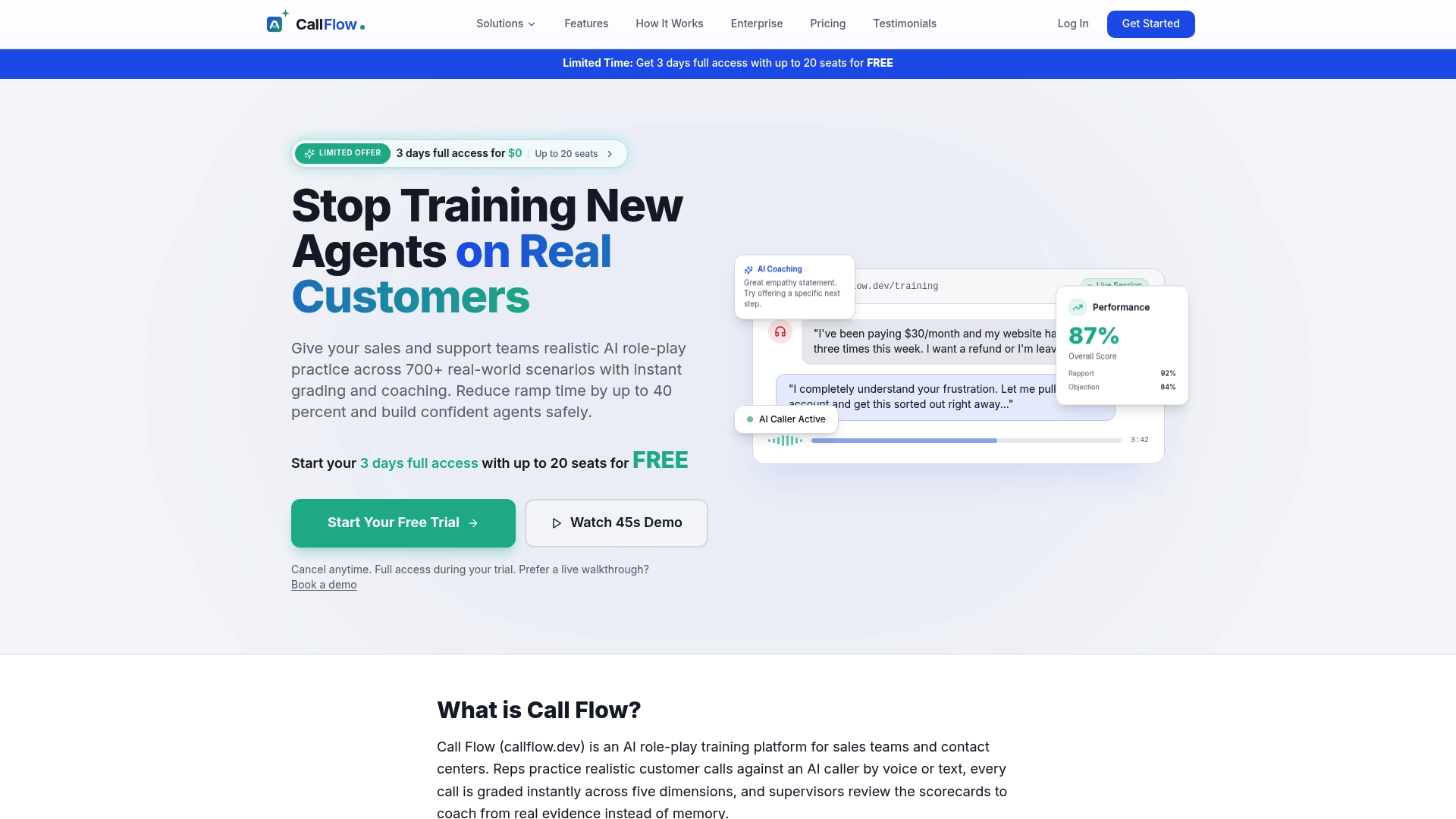
Some platforms are built for this purpose: they offer instant AI grading, a scenario library covering sales and support conversations, and free trial access for teams to test before committing.
Pro Tip: Measure call confidence and first-client outcomes before and after a two-week simulation pilot. That comparison tells you more than any vendor claim.
Manager perspective: quick rules to avoid common onboarding mistakes
Most onboarding failures come from rushing structure, not from a lack of effort. Handing over every tool on day one overwhelms instead of preparing. Treat the 90 days as a real process with bi-weekly check-ins, not a formality you rush past. Centralize documentation and enforce signoffs, because a missing signature is far easier to catch in week one than in an audit a year later.
— Costa
Try a simulation-based training pilot to accelerate ramp
Simulation practice maps directly onto the days 30 to 60 supervised phase of your ramp, giving agents a safe place to fail before they face a real client. Call Flow offers plans starting at $7.42 per month for Starter, with Growth and Scale tiers available for larger teams, plus a free trial to test the fit.
- Run a two-week pilot with one small team before rolling it out further.
- Track call confidence, first-client outcomes, and time to independent production as your success metrics.
- Compare pilot results against your existing 30-60-90 milestones before deciding to expand.
FAQ
What should be on a new agent onboarding checklist?
A complete checklist covers license verification, Form I-9 and tax paperwork, signed policy acknowledgments, technology provisioning, a 90-day training ramp, E&O risk training, and marketing setup. NAR recommends organizing all of it around a new-agent manual and a centralized resource hub.
How long does agent onboarding typically take?
A structured onboarding ramp typically runs 90 days, split into setup and observation, supervised practice, and independent production phases. NAR's guidance treats this window as a mutual adjustment period for both the agent and the brokerage.
When must Form I-9 Section 2 be completed?
The employer or an authorized representative must complete Section 2 within three business days of the employee's first day of work for pay. The employee must complete Section 1 by their first day, and original documents must be examined unless the optional remote procedure applies.
How can brokerages reduce E&O claims during onboarding?
Brokerages can use their E&O carrier's questionnaires and training materials to identify current risk behaviors and build those topics into early training. Documenting every acknowledgment and quiz result also creates a clear audit trail if a claim arises later.
Can role-play training speed up new agent ramp time?
Simulation and role-play practice give agents a low-risk way to rehearse client conversations before they matter, which fits naturally into the supervised practice phase of onboarding.