

The fastest, repeatable way to shorten sales onboarding is to front-load pipeline activity and active learning, then measure time-to-first-win instead of module completion. Assign territory and tool access before day one, send 2-3 hours of preboarding, and put reps into role-play or live coaching (a tool like Call Flow works well here) inside their first week. Everything else in a ramp program is secondary to that sequence.
TL;DR:
- Assign territory and tool access before day one to eliminate onboarding delays caused by waiting for IT and CRM setup.
- Start call activity and CRM logging within the first week, as delaying these steps significantly extends the ramp-up time.
- Focus onboarding modules on active practice, including live demos and role-plays, instead of passive learning or lengthy slide presentations.
- Use AI-driven role-play and immediate coaching to reduce time-to-first-meeting and deal by up to 40 percent, instead of relying solely on traditional feedback.
- Track early pipeline activity metrics such as time-to-first-activity, time-to-first-meeting, and time-to-first-deal to predict and accelerate ramp progress.
Table of Contents
- What Quick Wins Cut Time-to-First-Activity This Week?
- How Does a 30-60-90 Timeline Compress Ramp?
- What Core Pillars Belong in Every Onboarding Module?
- Which Tools Actually Speed Up Sales Training?
- Which KPIs Actually Predict Faster Ramp?
- What Does a 90-Day Manager Checklist Look Like?
- Why Does AI Role-Play Compress Ramp Faster Than Traditional Coaching?
- How Should Onboarding Change by Role or Experience Level?
- What Are the Most Common Onboarding Pitfalls?
- How Do You Keep Learning Going After Day 90?
- How Do You Collect and Act on New-Hire Feedback?
- Costa's Manager-Tested Trade-Offs and What Actually Moves the Needle
- Run Your Own Velocity Pilot With Call Flow
- Sources
What Quick Wins Cut Time-to-First-Activity This Week?
Most onboarding delays are self-inflicted. Managers wait on IT tickets, CRM access, and territory assignments while new hires sit through slide decks. None of that builds pipeline.
Here are five moves that shrink time-to-first-activity without adding headcount or budget:
- Assign territory and tool access before day one. Every login and account handoff a rep waits for after starting is a day added to ramp.
- Send 2-3 hours of lightweight preboarding focused on day-one tasks, not company history. Reps who arrive with this groundwork hit the ground running faster than those who start cold.
- Start call activity and CRM logging in week 1, not week 3. Waiting until "training is done" to make the first call is the single biggest ramp killer.
- Run one paired shadow session in the rep's actual sales context during week 1. Watching a senior rep work a real account beats a scripted demo every time.
- Measure time-to-first-win and coach to it daily. If a rep hasn't logged a real activity by day 3, that's a manager problem, not a rep problem.
None of these require new software or an enablement rebuild. They require a manager willing to move access, activity, and coaching earlier than habit dictates.
How Does a 30-60-90 Timeline Compress Ramp?
That split feels aggressive to managers used to a slower cadence, but structured programs built this way reduce time-to-first-deal by about 40% compared to knowledge-first onboarding.
The logic is simple: reps learn your product fastest by using it against real objections, not by memorizing a deck. Engineering an early win, even a small one, builds confidence that compounds through the rest of ramp.
A workable phase breakdown looks like this:
- Days 1-30 (Foundation + First Activity): Territory live, CRM logging active, first 20 to 30 outbound touches completed, first discovery call booked by week 2.
- Days 31-60 (Pipeline Build): First meeting booked (target: within 30 to 45 days of start), role-play cadence at 2 to 3 sessions weekly, manager 1:1 debriefs after every live call.
- Days 61-90 (First Deal + Certification): Time-to-first-deal target inside 60 to 90 days, full pipeline management ownership, certification checklist completed.
These are targets, not guarantees. A complex enterprise sale will push first-deal timing later than a transactional motion, but the sequencing (activity before mastery) holds across both.
What Core Pillars Belong in Every Onboarding Module?
Five modules cover what a rep actually needs, and each one should be built for practice, not passive consumption.
- Product: Fewer slides, more live demos the rep runs themselves within the first week.
- ICP and personas: Real account examples, not generic buyer personas pulled from a template.
- Sales methodology: One framework, taught through role-play against real objections, not a workbook.
- Tools and CRM: Hands-on logging from day one, not a tutorial video watched once.
- Manager 1:1s and certification: A weekly cadence with clear pass/fail criteria tied to observed calls, not attendance.
Certification should be behavioral: can the rep run discovery, handle three common objections, and log a clean CRM entry without help? If yes, they're certified for that module. If no, they repeat it, not move forward on a calendar deadline.
Pro Tip: Build every module around one graded role-play at the end. If a rep can't perform the skill live, the module isn't finished, no matter how many slides they've clicked through.
Which Tools Actually Speed Up Sales Training?
A cluttered tech stack slows ramp more than it helps. Every extra tool a new rep has to learn adds cognitive load that competes directly with selling skills. Before adding anything, audit what's already there and cut what isn't essential to the first 90 days.
Two categories consistently move the needle once the basics are clean:
- Role-play and live AI coaching speed pattern recognition by giving reps repeated practice against realistic objections with immediate, specific feedback, rather than waiting days for a manager to review a call recording.
- CRM hygiene enforced from day one prevents the data mess that makes coaching harder in month three.
If you're piloting a new tool, keep the test tight: one cohort, one clear success metric (time-to-first-meeting or first-deal), and a 30-day window. Structured workflows for a low-friction pilot, like the ones used in scaling SaaS operations, apply directly here: fewer moving parts, one owner, one metric.
Which KPIs Actually Predict Faster Ramp?
Track outcomes, not completion. A rep who finishes every training module but hasn't logged a real call by day 10 is behind, regardless of what the LMS dashboard says.
Four metrics matter most:
- Time-to-first-activity: first meaningful call or email logged.
- Time-to-first-meeting: first qualified discovery call booked.
- Time-to-first-deal: first closed deal, the clearest signal ramp is working.
- Ramp-to-quota: weeks until the rep hits full quota attainment.
Cohort tracking matters here: compare each new hire class against the last one, not against a static benchmark that never updates.
The number that matters: structured onboarding built around early pipeline activity and live coaching has been linked to time-to-first-deal reductions near 40% compared to knowledge-front-loaded programs.
If time-to-first-meeting stalls past 45 days, increase live coaching frequency before adding more content. If reps hit activity targets but conversion lags, shorten preboarding and add a second role-play session weekly.
What Does a 90-Day Manager Checklist Look Like?
Consistency beats improvisation. Here's a compact sequence to run every cohort through:
- Preboarding: accounts provisioned, CRM access granted, playbook sent 3 to 5 days before start.
- Week 1: territory live, first calls logged, paired shadow session completed.
- Weeks 2-4: role-play cadence established, first meeting booked, debrief after every live call.
- Weeks 5-8: pipeline ownership increasing, certification checklist in progress.
- Days 81-90: first deal closed or in late stage, full certification, forecast-eligible handoff to standard pipeline review.
| Phase | Manager Action | Success Signal |
|---|---|---|
| Preboarding | Send access + 2-3 hr playbook | Rep ready to log activity day 1 |
| Weeks 1-4 | Daily activity check, weekly debrief | First meeting booked |
| Weeks 5-8 | Role-play cadence, certification progress | Pipeline growing, checklist near complete |
| Days 81-90 | Final certification, handoff review | First deal closed, forecast-eligible |
Why Does AI Role-Play Compress Ramp Faster Than Traditional Coaching?
Reps learn selling skills the same way athletes learn technique: through repetition with immediate correction. A manager reviewing a call recording three days later can't fix a stumble in real time. AI conversation intelligence and live coaching close that gap, and structured use of these tools has been tied to ramp-time reductions of 20 to 40% by scaling coaching without adding manager headcount.
Call Flow applies this directly: configurable scenarios mirror real objections, instant grading covers five performance dimensions, and coaching feedback lands immediately instead of days later. Reported outcomes include 147% faster ramp time and a 129% improvement in resolution rates among teams using it.
- Run a 30-day pilot with one cohort.
- Track time-to-first-meeting and role-play completion rate weekly.
- Compare against the prior cohort's ramp timeline before scaling further.
How Should Onboarding Change by Role or Experience Level?
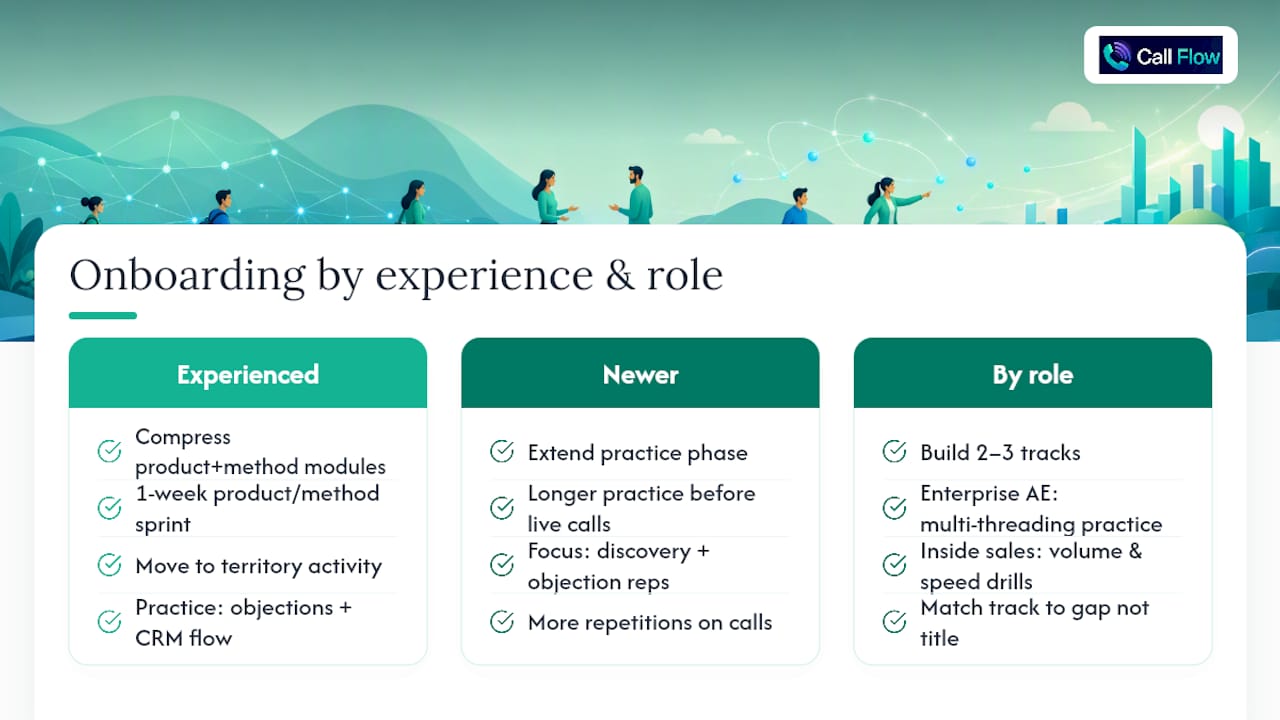
A senior rep hired from a competitor and a first-year associate straight out of a sales development role need the same milestones but a completely different path to get there. Treating them identically wastes the experienced hire's time and rushes the new one past skills they haven't built yet.
For experienced hires, compress the product and methodology modules into a single week and move straight to territory activity. Their gap usually isn't sales skill, it's product fluency and your specific process. Skip the foundational role-play scenarios they've already mastered elsewhere and focus practice sessions on your objection set and your CRM workflow.
For newer reps, extend the practice phase before increasing pipeline load. They need more repetitions on discovery calls and objection handling before a live call carries real risk to a real account. A structured skills assessment early in onboarding helps you place each hire on the right track instead of guessing based on resume history.
Role also matters. An account executive selling into enterprise accounts needs deeper multi-threading and stakeholder-mapping practice. A transactional inside sales rep needs volume and speed drills instead. Build two or three onboarding tracks, not one, and assign reps to the track that matches their actual gap, not their job title alone.
The manager's job here is diagnostic: run one graded role-play in week 1 to see what a rep actually knows before assuming what a resume claims.
What Are the Most Common Onboarding Pitfalls?
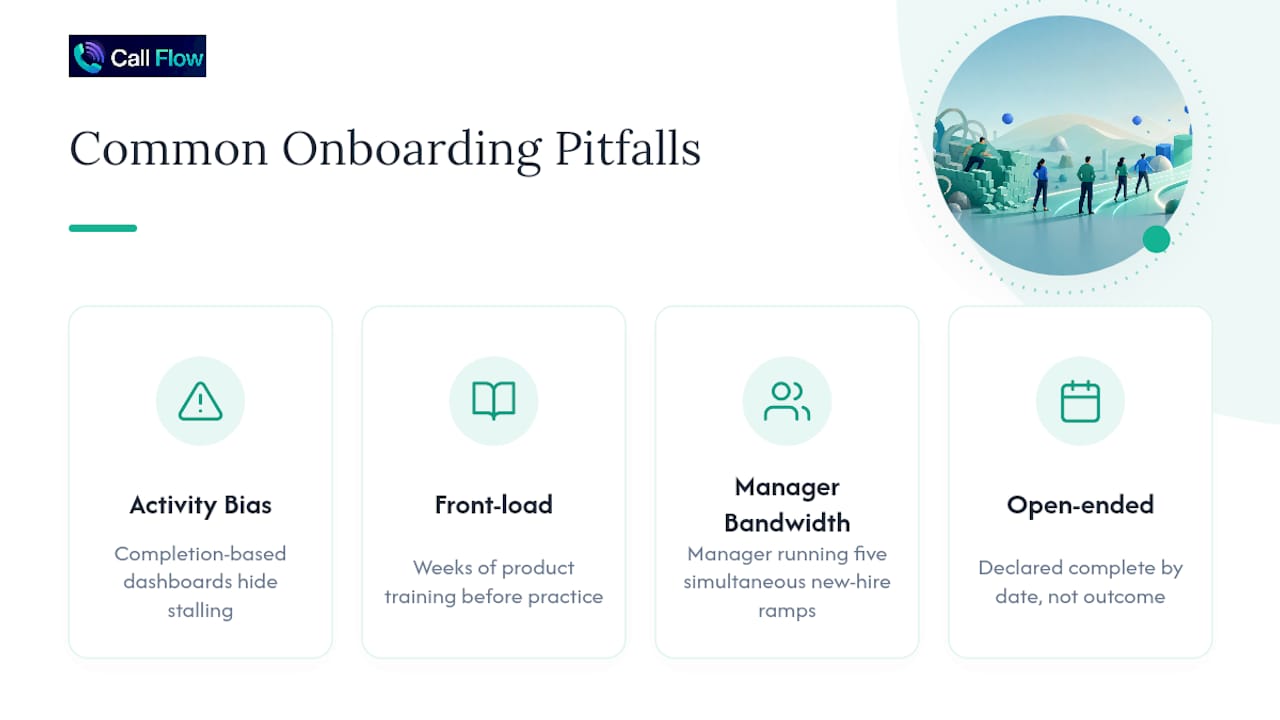
The biggest pitfall is mistaking activity for progress. A rep who completes every training module on schedule but hasn't made a real call yet isn't ramping, they're stalling, and a completion-based dashboard hides that problem until it's expensive.
A second common failure is front-loading knowledge before any practice. Weeks of product training followed by a sudden expectation to sell creates a confidence gap that shows up as hesitation on real calls. Reps forget most of what they were told without applying it, and passive shadowing without active role-play makes the forgetting curve worse, not better.
Manager bandwidth is the third recurring problem. A manager running five simultaneous new-hire ramps alongside a full pipeline of their own will default to the path of least effort: fewer live debriefs, later feedback, longer gaps between coaching touches. That gap is exactly where AI-assisted coaching earns its keep, by surfacing the highest-value moments so a manager's limited time goes where it matters most instead of getting spread evenly across every call.
Finally, watch for programs that never end. Extend structured coaching through months 3 to 6 for any rep who hasn't hit full productivity, rather than declaring the program complete on a calendar date regardless of outcome.
How Do You Keep Learning Going After Day 90?
Ramp doesn't end when onboarding does. A well-structured 60 to 90 day formal program still needs 3 to 6 months of in-deal coaching afterward to fully stick, and skipping that tail is where a lot of early gains quietly erode.
Keep a standing weekly or biweekly coaching cadence for every rep still short of full quota attainment, even after formal onboarding closes. Rotate role-play scenarios to match whatever deal types are actually live in the rep's pipeline right now, not whatever the original 90-day curriculum assigned months earlier.
Microlearning works better than another full-day workshop for ongoing training. Short, focused sessions tied to a specific skill gap reduce overload and improve retention, especially for hybrid or remote teams who can't easily gather for a half-day refresher.
Certification shouldn't be a one-time event either. Recertify methodology and objection-handling skills quarterly, especially after a product launch or a shift in competitive positioning. A rep certified in January on a pitch that changed in April is operating on outdated muscle memory.
How Do You Collect and Act on New-Hire Feedback?
New hires notice onboarding gaps faster than anyone, precisely because they're the ones hitting them in real time. The mistake most managers make is waiting for an exit interview or a formal 90-day survey to ask what wasn't working.
Build feedback into the weekly debrief instead of treating it as a separate event. After every live call review, ask the rep directly: what felt unclear going in, and what did you wish you'd known before that call? That question surfaces gaps in the preboarding material or module sequencing while there's still time to fix them for the current cohort, not just the next one.
Track feedback by cohort the same way you track KPIs. If three consecutive new hires flag the same confusing step in the CRM module, that's a signal to fix the module, not a coincidence to ignore. Pair qualitative comments with the hard metrics: a rep who reports feeling behind and is also missing time-to-first-meeting targets confirms the problem is real, not just a perception issue.
Close the loop visibly. When a new hire's feedback leads to a changed preboarding email or an added role-play scenario, tell them. That signal (their input actually changed something) is often what separates a rep who stays engaged through a rough first quarter from one who quietly starts job hunting.
Costa's Manager-Tested Trade-Offs and What Actually Moves the Needle
Every manager faces the same tension: depth versus speed, and never enough bandwidth to give both. The programs that actually compress ramp don't solve that tension, they just make a deliberate choice and stick to it, usually favoring speed on activity and depth on coaching.
Two adjustments matter more than any curriculum redesign. First, make role-play and debrief sessions calendar non-negotiables, not "when time allows" add-ons that get bumped by pipeline fires. Second, debrief within hours of a live call, not days later, since feedback loses most of its value once the rep can't recall the specific moment you're coaching against.
— Costa
Run Your Own Velocity Pilot With Call Flow
Every tactic in this playbook (early role-play, fast feedback loops, coaching that scales past one manager's calendar) is exactly what Call Flow was built to run. Configurable scenarios cover product pitches and objection handling from week 1, instant grading across five performance dimensions replaces the multi-day wait for a manager's call review, and supervisor dashboards let you track time-to-first-meeting and time-to-first-deal by cohort without building a spreadsheet from scratch.
Teams running this approach report gains like 147% faster ramp and a 129% jump in resolution rates, and you don't need to commit budget to find out if it works for your team. Start a risk-free trial, run one 30-day cohort against your usual ramp timeline, and measure the difference yourself. Get started with Call Flow and pick your first pilot cohort this week.
Sources
- Sales Onboarding Checklist for Field Sales Teams - SPOTIO
- The Sales Onboarding Velocity Framework: Reducing Time-to-First-Deal by 40% – Ken Lundin