

A single 60–90 minute trigger-led working session, paired with a 14-day joint CSM+AE discovery cadence, produces named accounts, booked meetings, and measurable cross-sell pipeline — without adding headcount or overhauling your sales process.
The playbook has four components: a three-trigger framework (usage signal, stakeholder change, support pattern) that tells reps exactly when to act; a joint CSM+AE script that opens the conversation without a pitch; a set of diagnostic discovery questions that qualify the opportunity; and a one-page follow-up brief that goes into the CRM before the meeting ends.
Run the session, assign three named accounts per AE, and schedule the joint discovery call before the room breaks.
Three actions you can run today:
- Pull a list of accounts showing at least one active trigger (usage spike, new executive hire, or three or more support tickets in 30 days) and assign one to each AE.
- Pair each AE with their CSM counterpart and send the joint brief template via Slack or email.
- Block a 60-minute working session this week using the agenda in Section 6.
Key Takeaways
Effective cross-sell training requires a trigger-based process, joint CSM+AE execution, and measurable proficiency gates — not more product knowledge.
| Point | Details |
|---|---|
| Use the three-trigger framework | Flag usage spikes, stakeholder changes, and support patterns before any outreach begins. |
| Run joint CSM+AE sessions | Joint plays convert at roughly 31% versus single-digit rates for AE cold outreach. |
| Enforce CRM fields | Require signal source, exec sponsor, and three discovery answers before any opportunity enters forecast. |
| Measure a small A/B test | Split your team into two cohorts, run 30 days, and compare conversion rates before rolling out broadly. |
| Callflow accelerates proficiency | Configurable AI role-play scenarios and instant grading help reps reach pass thresholds before their first live cross-sell call. |
Table of Contents
- Why cross-sell training moves the needle on revenue and retention
- What reps must be able to do after cross-sell training
- Ten practical strategies for teaching cross-selling
- Ready-to-run role-play scenarios, scripts, and scoring rubrics
- Sample curriculum and timeline options
- How to measure training impact with KPIs and A/B tests
- Common mistakes that kill cross-sell programs — and how to fix them
- Tools and templates that support cross-sell skill transfer
- How Callflow accelerates cross-sell skill development
- What actually matters when you run the first session
- Callflow's pilot offer for trainers ready to run a program
- Sources
Why cross-sell training moves the needle on revenue and retention
Cross-selling is not a volume play. Reps who pitch every customer on every product generate noise, not pipeline. Focused cross-sell training changes the behavior: reps learn to read signals, qualify before pitching, and bring the CSM into the conversation at the right moment.
The business case is straightforward. Joint CSM+AE cross-sell plays convert at roughly 31%, compared to single-digit rates for AE cold outreach into the same accounts. That gap is not a product or pricing difference. It is a process difference, and training is what installs the process.
Three metrics tell you whether training is working:
- Cross-sell conversion rate (signal-sourced vs. AE cold): the primary proof of training lift.
- Cross-sell ACV ratio: cross-sell deal value as a percentage of base contract; a rising ratio means reps are qualifying better, not just closing more.
- Time-to-first-expansion: how many days from signal detection to a signed order; shorter means the trigger-to-action loop is tightening.
Training also reduces churn risk. A rep who opens an expansion conversation with a diagnostic question — "What's the biggest friction point your team hits after the onboarding phase?" — signals that the company is paying attention. That posture builds retention value before a single product is mentioned.
What reps must be able to do after cross-sell training
Competencies fall into two categories: practical skills and behavioral habits. Both are assessable during role-play, and both need a pass threshold before a rep goes live.
Practical competencies:
- Signal recognition: identify a usage spike, a new stakeholder, or a support pattern from CRM data within 60 seconds of reviewing an account.
- Diagnostic questioning: open with three open-ended questions before naming a product. Salesforce guidance is direct: diagnose the need first, then present the complementary solution.
- Diagnostic framing (not demo framing): describe the outcome the product delivers, not its features. "Your ops team stops re-entering data manually" beats "the integration syncs in real time."
- Joint CSM+AE choreography: the CSM opens, the AE asks discovery questions, the CSM vouches. Reps must be able to execute each role and switch roles during practice.
- Executive escalation: when a new VP or C-suite contact appears, reps must know how to reframe the conversation at a business-outcome level, not a feature level.
Behavioral competencies:
- Service-first language: no "I wanted to reach out about an opportunity" openers.
- Social proof usage: reference a named peer company or use-case, not a generic claim.
- Objection handling without pressure: acknowledge, ask a follow-up question, do not push.
Ten practical strategies for teaching cross-selling
These strategies belong in your session design, your coaching conversations, and your reinforcement cadence. Use them in order — the first five build the foundation; the last five sharpen execution.
- Use one highly relevant recommendation. One well-timed, well-qualified suggestion outperforms three generic ones. Contextual offers that feel like natural completions to the customer's current situation build trust; a list of add-ons signals quota pressure.
- Time offers around product milestones. The 30-day mark after onboarding, a usage spike, or a renewal window are the three highest-receptivity moments. Train reps to check for these before any outreach.
- Use social proof with specificity. "A company similar to yours in logistics cut manual reconciliation time by 40% after adding this module" lands differently than "many customers find this useful." Require reps to have one named peer example ready before the call.
- Segment by behavior, not by account size. A small account with high engagement is a better cross-sell candidate than a large account that barely logs in. Train reps to read usage data, not just ARR.
- Lead with diagnostic questions, not a demo. Playbooks that guide discovery raise multi-service quote rates in practitioner examples. The script is simple: ask what friction the customer still feels, then connect the product to that friction.
- Keep the CSM in the room. The CSM's relationship is the asset. An AE who bypasses the CSM loses the trust signal that makes the 31% conversion rate possible.
- Enforce the three-question rule. Reps must ask and document three discovery questions before the opportunity enters the CRM. No exceptions. This prevents premature pitching and keeps the pipeline clean.
- Simplify the product story. Training Industry guidance is clear: use real-world examples, not product minutiae. One concrete before-and-after story per product is enough.
- Reinforce with short drills, not long sessions. A 15-minute weekly drill on one competency compounds faster than a quarterly half-day. Build the reinforcement cadence into the calendar before the first session ends.
- Instrument signals in the CRM before training starts. Reps cannot practice signal recognition if the signals are not visible. Make sure usage alerts, stakeholder-change notifications, and support-ticket thresholds are live in the CRM before day one.
Pro Tip: Use diagnostic framing in the first call and demo framing only in the second. Reps who demo too early lose the discovery advantage the CSM relationship provides. Hold the product story until the customer has named their own pain.
Ready-to-run role-play scenarios, scripts, and scoring rubrics
Three role-plays map directly to the three-trigger framework. Each drill has a setup, a verbatim starter script, and a scoring rubric. Run them in order: usage signal first (lowest stakes), then stakeholder change, then support pattern (highest friction).
Role-play 1: Usage signal trigger
The CSM flags it. The AE and CSM run a joint check-in call.

CSM opener (verbatim): "Hi [Name], I noticed your team has been using [Feature X] a lot more over the last few weeks — that's great to see. I wanted to check in and understand what's driving that, and whether there's anything we can do to support the momentum."
AE discovery opener (verbatim): "While we have you — what's the workflow that's creating that extra volume? I want to make sure we're set up to handle it as it grows."
Role-play 2: Stakeholder change trigger
Setup: A new VP of Operations joined the account 30 days ago. The CSM has not yet met them.
CSM intro (verbatim): "Hi [New VP Name], I'm [CSM Name] — I've been working with your team for the past year. I wanted to introduce myself and make sure you have a clear picture of how your team is using the platform today."
AE discovery opener (verbatim): "From your vantage point coming in fresh, what's the biggest operational gap you're trying to close in the next quarter?"
Role-play 3: Support pattern trigger
Setup: The account has logged five support tickets in 30 days, all related to the same workflow gap.
CSM vouch (verbatim, after AE presents the solution): "We've seen this exact pattern with a few other teams in [Industry]. Once they added [Module Y], the ticket volume dropped significantly and their team stopped having to work around the gap manually."
Scoring rubric:
| Criterion | Pass | Fail |
|---|---|---|
| Named customer pain | Rep states the specific pain before naming a product | Rep opens with product features |
| Three discovery questions asked | All three asked and documented | Fewer than three, or questions are closed-ended |
| No hand-off language | CSM stays in the call through close | CSM exits before AE presents |
| Social proof used | Named peer example or use-case cited | Generic claim ("many customers") |
| Service-first language | No quota-pressure phrases | "Opportunity," "reach out about," or similar |
Pass threshold: 4 of 5 criteria met to advance to live calls.
Exercise timing:
Pro Tip: Design scenarios with progressive difficulty — start with a cooperative customer persona, then add friction (skepticism, a competing vendor, a budget objection) in the second pass. Reps who only practice easy scenarios stall on the first real objection.
Sample curriculum and timeline options
Three program templates cover different training contexts. Pick the one that fits your team's schedule and maturity.
Template 1: 60-minute working session
This is the minimum viable program. It produces three named accounts per AE and a booked joint discovery call before the session ends.
| Time block | Activity |
|---|---|
| — | Trainer introduces the three-trigger framework; reps pull their account lists |
| — | Triage exercise: each rep flags three accounts with at least one active trigger |
| — | Role-play 1 (usage signal): pairs run the script, trainer scores |
| — | Debrief and scoring review |
| — | Each AE commits to three named accounts and books the joint discovery call |
Facilitator prep: Load the CRM trigger report before the session. Have the joint brief template ready to share.
Template 2: One-week bootcamp
Day 1 covers the trigger framework and diagnostic questioning. Day 2 runs all three role-plays with scoring. Day 3 introduces the joint brief and CRM hygiene requirements. Day 4 is a live call shadow with a CSM. Day 5 is a debrief and individual coaching session based on rubric scores.
Attendance: AEs and CSMs attend together on Days 1, 2, and 3. Day 4 is AE-only (shadowing). Day 5 is individual.
Template 3: Four-week blended reinforcement plan
Blended formats combining live instruction with self-directed practice are well-established for adult learners. This template uses the bootcamp as Week 1, then adds three weeks of reinforcement.
| Week | Focus | Format |
|---|---|---|
| 1 | Bootcamp (trigger framework, scripts, role-plays) | Live, in-person or virtual |
| 2 | Signal recognition drill + CRM field audit | 15-min async drill + manager check-in |
| 3 | Role-play 2 and 3 repeat with harder personas | Simulation platform or peer pairs |
| 4 | Live call review + individual coaching | Call recording review + 1:1 |
Quarterly refresher: Run the 60-minute working session every quarter to refresh account lists and re-score reps on the rubric. Reps who drop below the pass threshold go back to drills before live calls.
How to measure training impact with KPIs and A/B tests
Measurement starts before training, not after. If you do not have a baseline, you cannot prove lift.
Core KPIs to track:
- Cross-sell conversion rate (signal-sourced): the percentage of signal-triggered opportunities that close. Target: above 20% within 60 days.
- Cross-sell conversion rate (AE cold): track separately to show the joint-play advantage.
- Cross-sell ACV ratio: cross-sell deal value divided by base contract value. A rising ratio means better qualification.
- Time from signal to signed order: measures how fast the trigger-to-action loop runs.
- Joint discovery meetings booked per AE per week: a leading indicator of pipeline health.
Required CRM fields: signal source (usage, stakeholder, support), executive sponsor name, and three discovery answers. Enforce these as mandatory fields before any opportunity can enter the forecast stage. Without them, pipeline data is unreliable.
A/B test steps:
- Split your AE team into two cohorts of equal size and similar account mix.
- Train Cohort A with the full playbook. Cohort B continues with their current process.
- Run for 30 days. Measure cross-sell conversion rate and joint discovery meetings booked for each cohort.
- At 30 days, compare. If Cohort A's conversion rate is at least 10 percentage points higher, roll out to Cohort B.
- For statistical reliability, aim for at least 20 opportunities per cohort before drawing conclusions.
Measurement checklist for trainers:
- CRM trigger report is live before Day 1.
- Baseline conversion rate is pulled and saved before training starts.
- Required CRM fields are enforced (validation rule active).
- Weekly pipeline review includes signal-source filter.
- 30-day and 60-day check-ins are on the calendar.
Common mistakes that kill cross-sell programs — and how to fix them
Most cross-sell programs fail at the same points. Knowing the failure modes in advance lets you design them out.
Pitching during an escalation. A customer who just filed an urgent support ticket is not ready to hear about a new product. Train reps to close the service issue first, confirm the customer is satisfied, and only then — if a trigger still applies — open the expansion conversation. Make this a hard rule in the scoring rubric.
Product-first openings. Reps who open with "I wanted to tell you about [Feature Y]" signal quota pressure immediately. The fix is the three-question rule: no product name until three discovery questions are asked and answered.
An AE who runs the conversation solo loses that trust signal. Make the CSM vouch a mandatory rubric criterion — if it does not happen in role-play, it does not happen on the call.
No CRM validation. If reps can log an opportunity without filling in signal source and discovery answers, they will. Enforce the validation rule so incomplete records cannot advance to forecast.
Generic social proof. "Many customers find this useful" is not social proof. Require reps to have one named peer example — a company in the same industry with a specific outcome — before any live call.
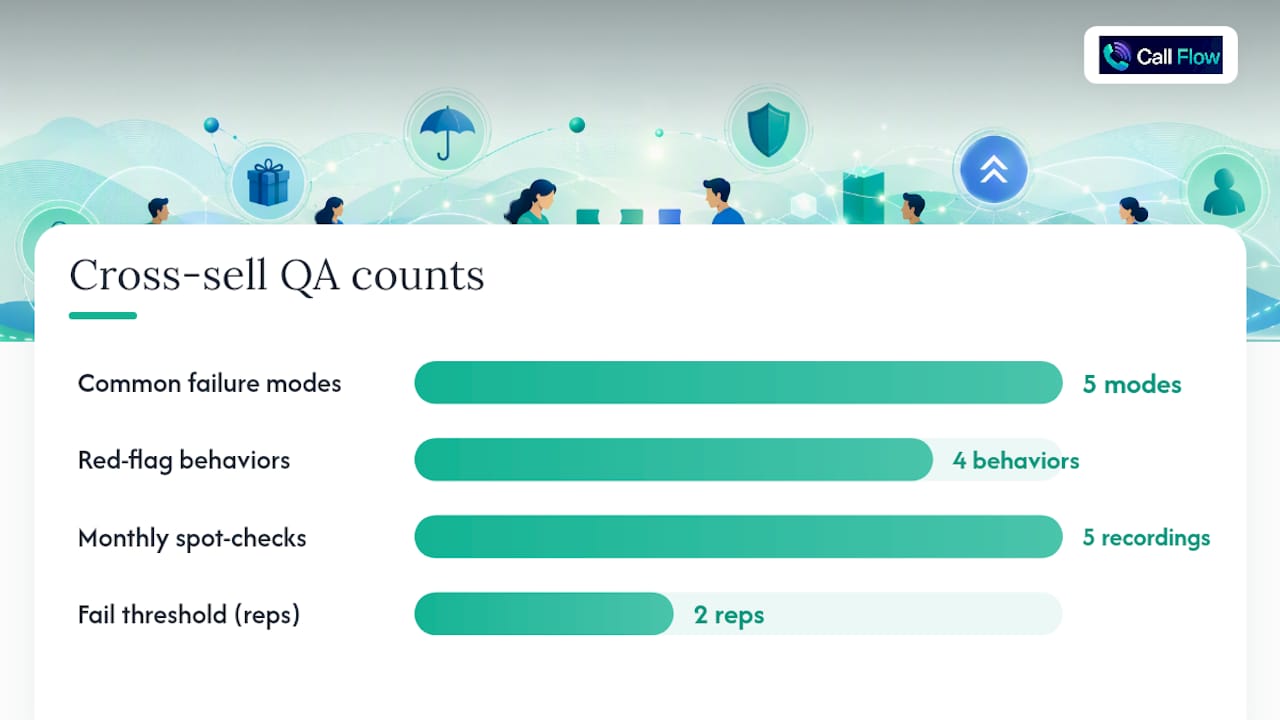
Red-flag behaviors to grade during role-play:
- Opening with a product name before asking a discovery question.
- Using closed-ended questions ("Do you need X?") instead of open-ended ones.
- Letting the CSM exit the call before the AE presents the solution.
- Failing to document discovery answers in the CRM after the call.
Trainer drift checklist (run monthly): spot-check five call recordings against the rubric. If more than two reps score below the pass threshold, run a 15-minute refresher drill before the next weekly meeting.
Tools and templates that support cross-sell skill transfer
The right tools reduce the gap between training and live performance. You need four categories working together.
Tool checklist:
- CRM signaling layer: usage alerts, stakeholder-change notifications, and support-ticket thresholds must be live and visible to reps. Instrumenting signals so cross-sells occur at receptive moments is a prerequisite for the playbook to work.
- Playbook and script library: a shared document with the joint brief template, the three role-play scripts, and the scoring rubric. Store it where reps can pull it up during a call.
- Recommendation engine or CRM field: a simple field that surfaces the one recommended product for each account based on trigger type. Keeps reps from improvising.
- Role-play simulation platform: the tool that lets reps practice at scale, get scored, and repeat without using live customer time.
Templates trainers should build before Day 1:
- Joint brief template (CRM fields: signal source, exec sponsor, three discovery answers, recommended product, next step).
- Slack DM template for CSM-to-AE handoff: "[Account Name] just hit [trigger]. I think there's a [product] conversation here. Can we run a joint call this week?"
- Scoring rubric (from Section 5) formatted as a shared Google Sheet or CRM checklist.
How to select a simulation platform:
- Configurable scenarios that match your actual trigger types and customer personas.
- Instant scoring across multiple performance dimensions (not just a pass/fail flag).
- Supervisor dashboard showing individual and team-level proficiency trends.
- Voice and text simulation modes so reps can practice both call and email conversations.
Integrating simulation into the curriculum:
- Use the platform for Role-plays 2 and 3 in Week 3 of the blended plan.
- Assign one async simulation drill per week during the reinforcement phase.
- Pull proficiency scores from the dashboard into the monthly coaching conversation.
- Use large-scale simulation to give reps repeated exposure to objections before they face them live.
How Callflow accelerates cross-sell skill development
Callflow maps directly to the playbook's needs. The platform provides configurable scenarios built around the three-trigger framework, instant AI grading across five performance dimensions, and a supervisor dashboard that shows proficiency trends at the rep and team level. Trainers can build the usage-signal, stakeholder-change, and support-pattern role-plays directly in the platform and assign them as async drills between live sessions.
The performance data is specific: Callflow reports 147% faster ramp time and a 129% improvement in resolution rates for teams using the platform. Reps reach measurable proficiency before their first live cross-sell call, which reduces the cost of early mistakes and shortens the time-to-first-expansion metric.
Pilot plan (30–60 days):
- Days 1–7: Configure three scenarios (one per trigger type). Set pass thresholds to match the rubric in Section 5. Assign to a pilot cohort of 8–12 reps.
- Days 8–21: Reps complete async drills. Supervisor reviews dashboard weekly. Flag any rep below the pass threshold for a live coaching session.
- Days 22–30: Run the 60-minute working session with the pilot cohort. Compare rubric scores from simulation to live-call performance.
- Days 31–60: Track cross-sell conversion rate and joint discovery meetings booked. Compare to the control cohort.
Integrate pilot results into the broader training rollout by using the simulation scores as a readiness gate: reps who pass the simulation rubric advance to live calls; those who do not complete one more drill cycle before going live.
What actually matters when you run the first session
Most trainers spend too much time on the framework and not enough time on the moment the room breaks. The framework is easy to teach. What is hard is getting each AE to leave with a specific name, a specific trigger, and a specific date on the calendar.
Start the session by telling the room exactly what they will walk out with: three named accounts, one joint discovery call booked, and one joint brief drafted. Not "a better understanding of cross-selling." A calendar invite. That specificity changes the energy in the room from passive learning to active preparation.
Before the room breaks, lock two things: the account list and the calendar invite. If an AE leaves without both, the session produced awareness, not pipeline. Awareness does not show up in the forecast.
One sentence worth keeping in mind for every cross-sell conversation your reps run: the customer should feel helped, not sold to. If the CSM vouch is genuine and the discovery questions are real, that feeling follows naturally. If the vouch is scripted and the questions are closed, the customer notices.
Callflow's pilot offer for trainers ready to run a program
Reps who practice on realistic scenarios before live calls reach proficiency faster than reps who learn on the job. Callflow gives you configurable cross-sell scenarios built around your actual trigger types, instant AI grading on every practice attempt, and a supervisor dashboard that shows you exactly where each rep stands before you send them into a live account.
The trial gives your team full access: build the three role-plays from Section 5, assign them as async drills, and pull proficiency scores before the first live call. No long-term commitment required.
Pilot checklist:
- Assign 8–12 seats to your pilot cohort.
- Configure one scenario per trigger type (usage signal, stakeholder change, support pattern).
- Instrument CRM signals before Day 1.
- Set a 30-day evaluation window and track conversion rate and joint meetings booked.
Start your Callflow trial at Callflow and run your first scored drill this week.