

A sales competency model is a role-specific, behavior-anchored standard that tells you which skills and observable actions a seller must show to perform the role today. It works because it replaces vague performance adjectives with proof you can point to in a call recording or a CRM entry.
Enablement teams need this now because inconsistent assessment costs you fair promotions, targeted coaching, and faster ramp. Forrester's Sales Competency Management Framework treats competencies as a lifecycle asset spanning hiring through optimization. The Sales Management Association's competency dictionary gives you standard definitions to start from, and a platform like Callflow can capture the practice evidence you need to rate people fairly.
Do this next:
- Pick one role to pilot (SDR, AE, or manager).
- Select several competencies from an existing framework.
- Run a 30-day pilot rating people against observable indicators only.
- No spreadsheet required to start. A notebook and five call recordings work fine.
Key Takeaways
A sales competency model only works when every rating ties to an observable behavior and a named evidence artifact, not a manager's impression.
| Point | Details |
|---|---|
| Start with one role | Pick a single role and 5 to 8 competencies before building anything company-wide. |
| Anchor every rating to evidence | Use call transcripts, CRM entries, or recordings, never a subjective adjective. |
| Set role-specific targets | An SDR and an enterprise AE need different proficiency targets on the same 0 to 4 scale. |
| Track outcomes, not activity | Monitor ramp time, win rate by gap, and forecast accuracy tied to competency scores. |
| Scale evidence capture with Callflow | Use Callflow's graded role-play sessions to generate consistent evidence for calibration without adding assessor hours. |
Table of Contents
- What Is a Sales Competency Model?
- What Core Sales Competencies Should You Include?
- How Do You Build a Role-Based Competency Map?
- What Observable Indicators Should You Track?
- How Do You Assess Competencies and Track Progress?
- How Do You Turn Competency Gaps Into Training?
- How Do You Roll Out and Govern the Program?
- What Does a Sample Competency Model Look Like?
- What Do Enablement Practitioners Actually Learn From Running This?
- How Do You Operationalize Assessment at Scale?
- Where Can You Learn More?
- Frequently Asked Questions
- Sources
What Is a Sales Competency Model?
A sales competency model defines the specific skills, behaviors, and proficiency targets a person needs to succeed in one sales role. Its job is to drive outcomes such as consistent hiring and promotion decisions, coaching priorities that managers actually agree on, and more predictable ramp times.
People often confuse four related terms. A competency framework is the enterprise-wide skill library (stable, generic). A competency model applies that framework to one role with specific targets. A skills matrix is the spreadsheet tool that scores people against the model. A role description just lists duties, with no proficiency scale attached.
Get the model right and you unlock:
- Promotion decisions based on demonstrated proficiency, not tenure or manager opinion.
- Coaching plans that target the two or three skills actually blocking a rep's next deal.
- Ramp timelines you can forecast because you know which gaps new hires typically show first.
What Core Sales Competencies Should You Include?
Most role-specific models pull from several competency families. OMG's research across Tactical, Mindset, and Will-to-Sell categories backs a version of this same structure, and its assessment data shows competency scores correlate with seller performance.
- Pipeline generation: prospecting, sequence execution. Observable example: rep logs 15+ personalized outreach touches weekly with response tracking in the CRM.
- Discovery and qualification: needs analysis, pain identification. Observable example: call transcript shows three or more open-ended questions before any pitch.
- Presentation and demo: value framing, technical translation. Observable example: demo recording shows the rep tailoring feature order to the buyer's stated priority.
- Objection handling and negotiation: reframing, concession strategy. Observable example: call notes show the objection named, addressed, and confirmed resolved before moving on.
- Closing and forecasting: next-step commitment, deal hygiene. Observable example: CRM stage changes match verbal next steps captured in call notes.
- Tools and process: CRM discipline, playbook adherence. Observable example: opportunity fields updated within 24 hours of a call, highlighting the importance of CRM proficiency for sales teams.
- Behavior and collaboration: rapport, self-management, teamwork. Research on emotional intelligence links social awareness to how well people read buyer signals and build trust. Observable example: peer feedback cites the rep sharing a winning talk track unprompted.
Pro Tip: Cap any single role's model at a modest number of competencies. Models with too many skills risk abandonment and low adoption.
How Do You Build a Role-Based Competency Map?
A single enterprise framework should never get applied identically to every role. An SDR and an enterprise AE share almost nothing in daily behavior, so build the map in four steps.
- Define the role boundary. Write one sentence describing what this role owns that no other role owns.
- Select 5 to 8 competencies from your framework that matter most for that boundary.
- Set a target proficiency level for each competency, specific to that role, not the whole department.
- Attach an evidence field to every competency so ratings tie to a specific artifact, not a manager's impression.
Forrester's Sales Competency Definition Process Model supports this same stepwise approach and stresses validating the map against actual role performance before rolling it out broadly.
A behavior-anchored 0 to 4 scale keeps ratings comparable across managers:
| Level | Label | What it looks like in practice |
|---|---|---|
| 0 | Not observed | No evidence found in calls or CRM in the review period. |
| 1 | Developing | Attempts the behavior inconsistently, often needs a script. |
| 2 | Proficient | Executes the behavior reliably in standard situations. |
| 3 | Advanced | Adapts the behavior to unusual or difficult scenarios. |
| 4 | Master | Coaches others and improves the playbook based on results. |
Set different targets by role: an SDR might need a 2 in discovery while an enterprise AE needs a 4. That's the one-size-fits-all trap most first attempts fall into.
What Observable Indicators Should You Track?
Vague adjectives like "strong communicator" produce inflated self-ratings and manager disagreements. The Alexander Group's research on competency models recommends grounding every rating in an observable behavior with a named evidence field, and that consensus shows up across most credible frameworks in the space.
Use this simple conversion formula: competency name → specific behavior → evidence field. "Discovery skills" becomes "asks three or more open questions before pitching" with the evidence field set to call transcript timestamp.
Where to find proof:
- Calls: transcript excerpts showing the behavior, timestamped.
- CRM: field updates, stage progression timing, note completeness.
- Sequence logs: touch cadence, response rates, personalization markers.
- Demo recordings: feature order, audience-specific framing.
- Deal notes: next-step language matched against actual stage movement.
Competency models must be grounded in observable behaviors, not subjective adjectives, with evidence fields like call transcripts or CRM entries backing every rating.
Pro Tip: Tie every single rating to one specific evidence artifact. If a manager can't point to the exact call or CRM entry that earned a rep a "3," the rating doesn't count yet.
How Do You Assess Competencies and Track Progress?
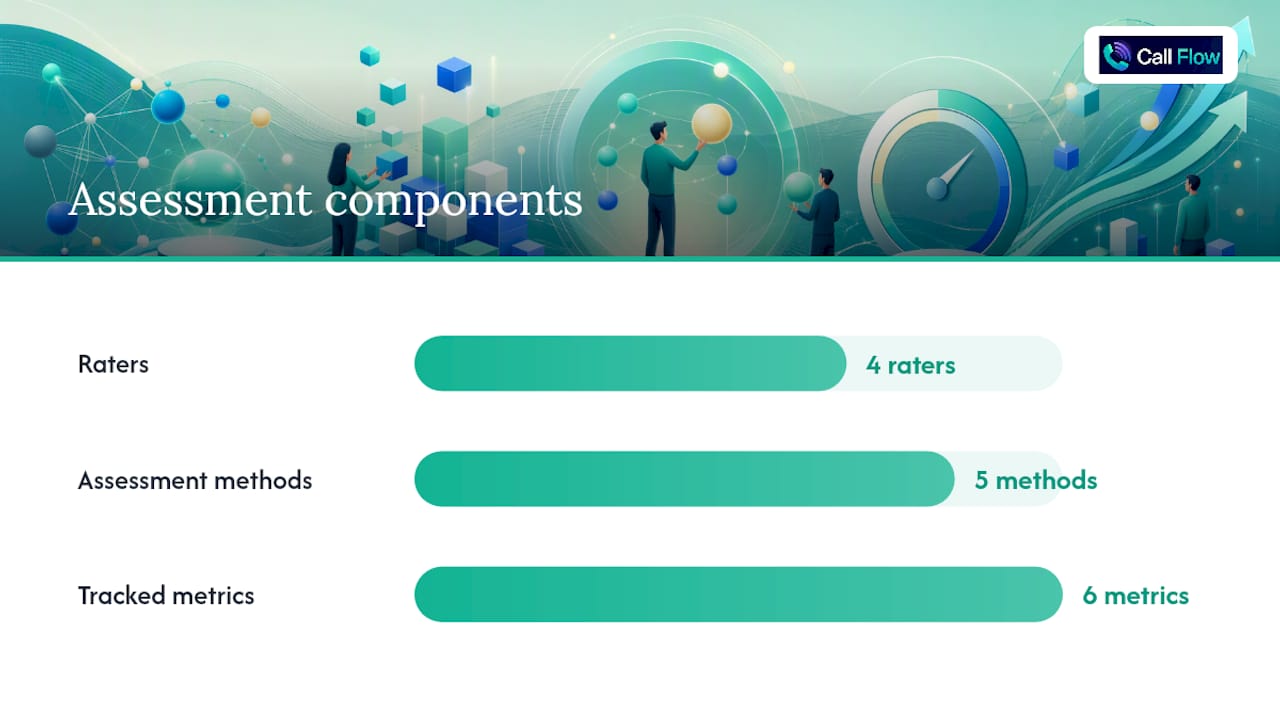
A rubric only works if you're clear on who rates whom. Most mature programs use four raters in combination: self-assessment (baseline awareness), manager rating (primary evidence review), peer input (behavior and collaboration), and a calibrated panel for final sign-off on promotion-relevant scores.
Assessment methods worth combining:
- Calibrated panel review for promotion or hiring decisions.
- Recorded-call review scored against your evidence-field checklist.
- CRM evidence audits pulled quarterly by role.
- Skill certification exercises for high-stakes competencies like negotiation.
- Simulated role-play scenarios for skills that rarely surface in real calls, like objection recovery under pressure.
Track these metrics because each maps to a business outcome managers already care about:
| Metric | What it tells you |
|---|---|
| Competency proficiency over time | Whether coaching investment is actually moving skill levels. |
| Ramp time | How fast new hires reach full-quota productivity. |
| Win rate by competency gap | Which skill deficits correlate with lost deals. |
| Conversion by stage | Where in the funnel a specific competency gap is costing you. |
| Forecast accuracy | Whether closing and forecasting competencies are actually solid. |
| Coaching frequency | Whether managers are using the model or ignoring it. |
Run the pilot for 30 days, calibrate quarterly across managers to keep ratings consistent, and refresh the whole model annually as your product or market shifts.
How Do You Turn Competency Gaps Into Training?
A competency matrix is only useful if gaps convert into action within days, not quarters.
- Pull the matrix output and rank gaps by business impact, not by how uncomfortable the conversation feels.
- Assign each gap a training format matched to how that skill is actually learned.
- Build a 30/60/90 path: days 1 to 30 close the most urgent single gap, days 31 to 60 reinforce with live practice, days 61 to 90 validate with a new evidence capture.
Training formats aren't interchangeable:
- Objection handling improves fastest through repeated role-play with immediate feedback, not reading a battle card once.
- Demo adaptation improves through shadowing top performers plus a documented playbook.
- Product knowledge improves through microlearning modules and short quizzes spaced over weeks.
A typical AE gap sequence looks like this: weeks 1 to 2 focus on discovery question depth, weeks 3 to 4 shift to demo adaptation based on what discovery surfaced, and weeks 5 to 6 tie it together with value articulation practice under simulated buyer pushback.
How Do You Roll Out and Govern the Program?
Ownership needs to sit with one person, usually in enablement, backed by a calibration council including sales leadership, HR, and two or three top performers who help validate what "advanced" actually looks like in practice.
- Pilot (30 days): one role, 5 to 8 competencies, evidence fields defined before day one.
- Expand (90 days): two to three additional roles, first calibration session run.
- Scale (180 days): full team coverage, quarterly calibration cadence locked in.
Budget for three cost drivers: tooling for capturing evidence, assessor time (the real hidden cost most teams underestimate), and content creation for the training paths gaps will require.
Watch for these red flags:
- Managers submitting ratings without citing evidence, a sign the model is becoming opinion-based again.
- Low manager participation in calibration sessions.
- Wide rating spread on the same rep between two managers, meaning your anchors need rewriting.
What Does a Sample Competency Model Look Like?
Here's a compact starting matrix you can paste directly into a spreadsheet. Each cell target reflects proficiency on the 0 to 4 scale described earlier.
For enterprise or channel sales motions, add rows for partner enablement or multi-stakeholder navigation. Import this into Excel or Google Sheets and apply conditional formatting so any cell below target highlights automatically, giving managers an instant gap view without extra reporting work.
What Do Enablement Practitioners Actually Learn From Running This?
The gap between what a competency model promises on paper and what survives contact with a real sales floor is usually about evidence discipline, not design elegance. A model with elegant proficiency scales still fails if managers skip the evidence field and rate from memory.

What tends to work: keep the model small enough that managers can hold it in their head, force an evidence field on every single rating with no exceptions, protect the calibration session from getting cancelled when the quarter gets busy, and build manager coaching time into quota expectations so it doesn't quietly disappear. Align executives early by framing the model around ramp time and win rate, the two numbers leadership already tracks.
How Do You Operationalize Assessment at Scale?
Evidence collection is the part of this whole process that breaks first. Managers run out of time to review calls, reps get inconsistent practice reps, and the calibration council ends up rating on memory instead of proof.

An AI role-play platform like Callflow gives you a faster way to generate the evidence your competency model actually needs. Every practice session gets recorded and instantly graded across multiple performance dimensions, so a rep's objection-handling attempt on Tuesday becomes a scored evidence artifact by Tuesday afternoon, not next month's calibration meeting. That matters most in three use cases: scalable demo practice for new hires before they touch a live buyer, objection handling labs where reps repeat a scenario until the rating hits target, and pre-hire simulation that gives you competency data before an offer goes out. Managers use the same recordings for calibration instead of relying on secondhand summaries.
Start with one role and one competency family. Try the AI mock-call practice tool on a free trial run through Callflow's no-cost practice access, score a handful of reps against your evidence fields, and decide from real data whether to expand before you commit budget to a full rollout.
Where Can You Learn More?
- The Sales Management Association's competency dictionary gives standardized definitions to jump-start your model.
- Forrester's framework report explains how to manage competencies across the full talent lifecycle.
- A sales skills matrix template shows the 0 to 4 scale and evidence-field structure in a ready-to-copy format.
- Callflow's coaching tools page covers how supervisor dashboards support ongoing competency tracking.
Frequently Asked Questions
What's the difference between a sales competency model and a job description? A job description lists duties. A competency model defines proficiency targets for specific skills within that role, backed by observable evidence, so you can actually measure whether someone meets the bar.
How many competencies should one role's model include? Keep it to 5 to 8. Programs that try to track 15 or more competencies per role tend to collapse under the reporting burden within two quarters.
How long does a pilot competency model take to show results? Most teams see usable calibration data within the 30-day pilot window, with ramp-time and coaching-frequency shifts becoming visible by the 90-day expansion mark.
Can one sales competency model work across different industries or motions? The core framework can stay generic, but role targets and evidence fields need adjusting for B2B SaaS, enterprise, or channel sales, since the observable behaviors that signal proficiency differ by motion.
Should competency scores feed into compensation or promotion decisions? Yes, once calibration is consistent across managers. Tying competency proficiency to promotion criteria is one of the main reasons the Sales Management Association recommends rigorous, evidence-based definitions in the first place.
Sources
- Introducing The Sales Competency Management Framework — Forrester
- Competency Models: An Essential Tool for Sales Transformations — Alexander Group
- Sales Skills Matrix Template (2026): Excel & Sheets by Role Level (SDR, AE, Manager) | Sprad Blog
- Sales and Sales Management Competency Dictionary For Use in Sales Organization Competency Model Development — Sales Management Association
- What is emotional intelligence — and why is it crucial in the workplace? — Harvard Gazette