
Use these role play scenarios, organized by sales stage, persona, and difficulty, to get reps call-ready faster and produce measurable gains in resolution and conversion. Organizations running AI-powered simulation training report ramp times cut by as much as 50% and a 40% lift in first-call resolution. Callflow customers see similar results in practice: 147% faster ramp time and 129% better first-call resolution.
Start with this shortlist:
- Cold open (prospecting)
- Gatekeeper navigation
- Discovery deep-dive
- Demo with a skeptical technical buyer
- Price objection
- "Send me info" deflection
- Competitor comparison
- Multi-stakeholder demo
- Contract negotiation
- Renewal at risk
- Angry customer escalation
- First-call resolution under time pressure
Key Takeaways
Role play scenarios only move performance when they're built from real calls, scored on consistent rubrics, and run through a measurable pilot before wider rollout.
| Point | Details |
|---|---|
| Build from real calls | Pull friction points from actual recordings instead of inventing hypothetical buyer objections. |
| Score on consistent dimensions | Rate discovery, objection handling, composure, and execution using the same three-level rubric across reps. |
| Run a time-boxed pilot | Test with 8 to 15 reps over 30 to 45 days and set a success threshold before you start. |
| Separate AI reps from manager coaching | Let AI handle on-demand volume; reserve manager time for nuanced judgment calls. |
| Use Callflow for scaled execution | Callflow's scenario builder and instant grading deliver the ramp-time and resolution gains this kit targets. |
Table of Contents
- Role Play Scenario Templates by Stage and Skill
- How Do You Turn Real Calls Into Realistic Role Play Scenarios?
- Building Rubrics and KPIs That Prove the Program Works
- Running a 30 to 45 Day Role Play Pilot
- The Manager Playbook for Effective Role Play
- Why Program Design Beats One-Off Workshops
- Put This Scenario Kit Into Practice With Callflow
- Sources
Role Play Scenario Templates by Stage and Skill
Every template below needs four things to work: a persona, a timebox, success criteria, and a script starter. Skip any one of those and the scenario turns into an unstructured chat instead of a rehearsal. This structure follows the same logic sales enablement teams use when they build scenarios from real calls rather than generic hypotheticals.
1. Cold open. Persona: a mid-level operations manager who answers her own phone and has 90 seconds before her next meeting. Timebox: 30 to 60 seconds. Success criteria: rep states a specific, relevant reason for the call and earns a next step without pitching features. Script starter: "Hi, this is [name] with [company] — I'll be quick. I noticed your team just..."
2. Discovery deep-dive. Persona: a director who gives short, guarded answers. Timebox: 5 to 7 minutes. Success criteria: rep asks at least three layered follow-up questions instead of moving to pitch after the first answer. This is where most reps fail. They ask one question, get a surface-level response, and jump straight to solution mode.
3. Demo with objection probes. Persona: a technical buyer who interrupts with skepticism and loops in a manager mid-demo. Timebox: 8 to 10 minutes. Success criteria: rep handles the interruption, re-anchors to the buyer's stated priority, and closes with a clear next step.
4. Objection handling. Build three variants here: price pushback, a named competitor comparison, and the classic "just send me some information." Timebox: 2 to 3 minutes each. Success criteria: rep acknowledges the objection before reframing, never argues, and asks a question that surfaces the real concern underneath.
5. Negotiation and close. Persona: a procurement lead pushing for a discount against a deadline. Timebox: 6 to 8 minutes. Success criteria: rep protects margin while offering a trade, not a concession.
6. Renewal at risk. Persona: a champion who has gone quiet after a rocky onboarding. Success criteria: rep uncovers the root cause before proposing a fix.
7. Support escalation. Persona: a frustrated customer demanding a supervisor. Timebox: 4 to 6 minutes. Success criteria: rep de-escalates tone within the first 30 seconds and resolves or sets a firm follow-up.
How Do You Turn Real Calls Into Realistic Role Play Scenarios?
The best scenarios come from calls that actually happened, not from a training manager's imagination. Pull a lost deal, a rocky renewal, or an escalation that went sideways, and mine it for the moment things went wrong.
- Find the friction point. Scan for a 60 to 90 second clip where the rep hesitated, missed a cue, or where the buyer's tone shifted. That's the teachable moment, not the whole call.
- Build the persona. Note the buyer's title, their visible pressures (budget cycle, a boss breathing down their neck, a bad past vendor experience), their go-to objections, and how they actually make decisions: committee, single approver, or someone who needs sign-off from finance.
- Convert it into a scenario. Turn the clip into a 90 to 180 second scenario with one clear success criterion. Don't try to fix five things in one drill.
Scenario design should always map back to your team's actual methodology, whether that's MEDDIC, SPIN, or something homegrown, so rubrics stay aligned with how reps are coached day to day.
Pro Tip: Keep a running "scenario bank" folder where any manager can drop a call recording with a one-line note on what went wrong. It turns real friction into fresh training material without waiting for a formal content review cycle.
Building Rubrics and KPIs That Prove the Program Works
Score every scenario against the same core dimensions so results are comparable across reps and cohorts:
- Discovery quality (depth and sequencing of questions)
- Objection handling (acknowledge, reframe, confirm)
- Composure under pressure (tone, pacing, recovery from interruptions)
- Execution (clear next step, correct information, no missed compliance language)
A simple three-level rubric (below expectation, meets expectation, exceeds expectation) per dimension is enough to spot trends without drowning managers in scoring complexity. Rubric gains translate directly into business signals: a rep who moves from "below" to "meets" on discovery typically shows up weeks later as better-qualified pipeline, since role play produces behavioral data that other training formats simply don't capture.
Track these pilot KPIs from day one: time-to-ramp, scenario completion rate, and early pipeline conversion among trained reps. Organizations that instrument these consistently report 20 to 30% higher CSAT alongside the resolution gains.

Running a 30 to 45 Day Role Play Pilot
Keep the pilot small enough to manage and mixed enough to be credible.
- Pick a cohort of 8 to 15 reps, blending new hires with a few mid- and high-performers so you can see the ceiling as well as the floor.
- Set the cadence: 10 to 15 minutes of self-paced AI practice daily, one 20-minute team drill weekly, and a 15-minute manager calibration session every other week.
- Define your success threshold before you start: a 20% reduction in ramp time or a measurable rubric gain across two competency dimensions is enough to bring to leadership.
- Present results as a before-and-after comparison, not a narrative. Leadership responds to the numbers, not the story around them.
The Manager Playbook for Effective Role Play
Good role play sessions run on rules, not vibes. Keep passes to 3 to 5 minutes, isolate one micro-skill per rep per session, and let the rep speak first in the debrief. Self-assessment before manager feedback builds ownership faster than a manager leading with critique. Short, frequent passes with an immediate rewind and re-run beat long, infrequent sessions almost every time.
Let AI handle the volume, on-demand repetition whenever a rep has ten free minutes, and reserve manager time for judgment calls: reading a room, handling a curveball objection, deciding when to push versus when to fold on a deal.
- Avoid a "testing" tone. Frame every session as practice, not evaluation.
- Fix inconsistent scoring by anchoring every manager to the same rubric before they run a session.
- Refresh scenarios quarterly. Stale personas get memorized instead of practiced.
Pro Tip: If a rep starts predicting the AI persona's next objection word-for-word, it's time to retire that scenario. Familiarity beats challenge, and that's the opposite of what practice is for.
Why Program Design Beats One-Off Workshops
A single workshop teaches a script. A program builds a skill. That distinction shapes everything else here: scenarios organized by stage and difficulty, rubrics tied to real competencies, and a pilot that proves the investment before you scale it.
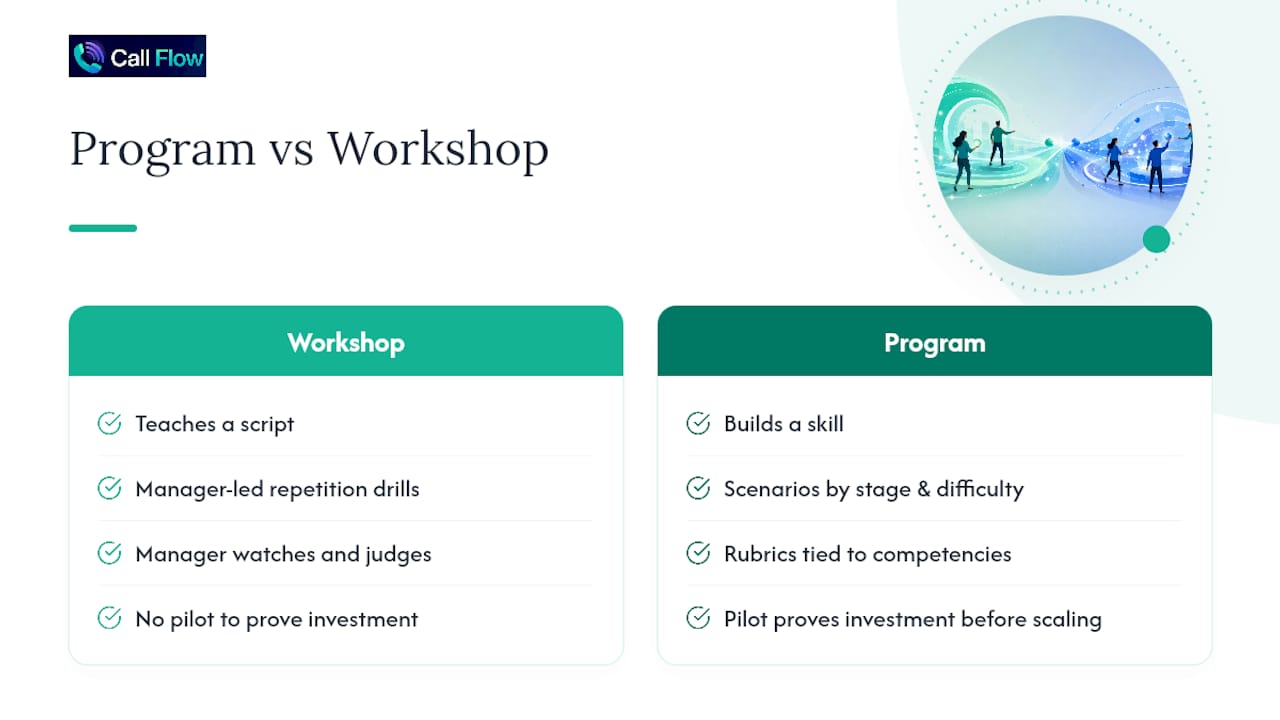
AI practice works because it removes the fear of judgment that keeps reps from repping the awkward calls, preferring a non-judgmental partner over a manager watching their every move. That frees managers to stop running repetition drills and start coaching the nuance: the read on a hesitant buyer, the moment to push back on procurement. AI multiplies coaching capacity. It doesn't replace the coach.
Callflow's scenario library and blog carry deeper breakdowns of the templates covered here if you want to build out a full program.
— Costa
Put This Scenario Kit Into Practice With Callflow
Callflow is built around the exact structure this article walks through: scenarios by stage and persona, instant scoring across five performance dimensions, and coaching feedback that reaches reps the moment a session ends, not three days later in a manager's calendar gap.
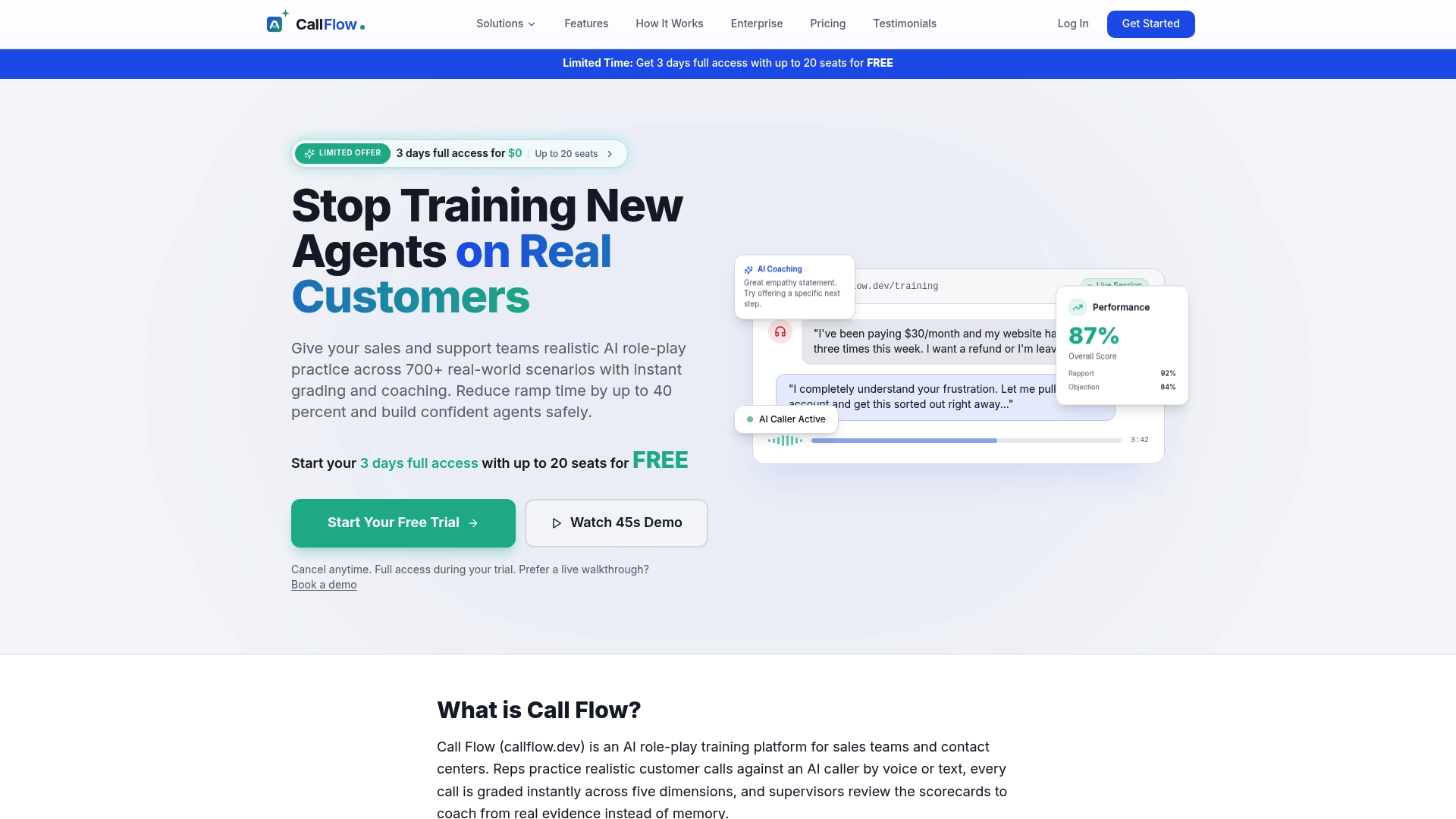
The templates above, cold open, discovery deep-dive, objection handling, negotiation, and escalation drills, map directly onto Callflow's configurable scenario builder, so a manager can turn a real call recording into a live simulation without writing a script from scratch. Teams using the platform report 147% faster ramp time and a 129% improvement in first-call resolution, the same outcomes the 30 to 45 day pilot plan above is designed to prove out. Contact centers running distributed teams can also see how system-simulation scenarios work on the contact-center AI page.
Start a risk-free trial, load your first cohort's scenarios this week, and measure your own ramp-time delta before the pilot window closes.