

Sales training gamification works when the game mechanics sit on top of real learning design, not instead of it. A 2025 field experiment with 147 sales reps found that a simple competitive quiz added to virtual training boosted recall by about 16% a week later, with the biggest gains among experienced reps. This guide covers the mechanics, the practical activities, how to measure them, and the mistakes that turn a promising pilot into a distraction.
TL;DR:
- Gamification improves short-term recall by around 16 percent when paired with deliberate learning mechanics like spaced repetition and immediate feedback.
- Leaderboards should focus on skill-specific metrics and be limited to two weeks to prevent disengagement among lower-ranked reps.
- Reinforcement tools like quizzes and role-plays work best when integrated into existing curricula, targeting weak knowledge areas through spaced, scaffolded practice.
- Larger performance gains require combining gamified reinforcement with proven coaching, feedback, and long-term content updates to maintain engagement.
- Tools with instant, multi-dimensional feedback and scenario customization are essential for scalable, effective gamified sales training pilots.
Table of Contents
- What Is Sales Training Gamification?
- What Gamified Sales Training Reliably Improves
- 7 Sales Training Games and Missions You Can Run This Quarter
- Designing Effective Gamified Training: Learning Science and Program Structure
- KPIs and a Simple Evaluation Plan for Gamified Programs
- Pitfalls That Sink Gamified Sales Training Programs
- Real-World Evidence: What the Research and Early Adopters Show
- Tools and Platforms for Gamified Sales Training
- A 30-Day Quick-Start Checklist for Your First Gamified Pilot
- Tailoring Gamification to Different Sales Roles and Experience Levels
- What Successful Gamified Sales Training Programs Have in Common
- Folding Gamification Into a Curriculum You Already Have
- Keeping a Gamified Program Fresh Over Time
- When Gamification Earns Its Place, and When It Doesn't
- How Callflow Brings Gamified Sales Training to Life
- Sources
What Is Sales Training Gamification?
Sales training gamification means applying game mechanics, points, badges, levels, missions, and leaderboards, to sales skill development so reps practice more often and retain more of what they learn. It is not the same as making training "fun." Fun without a learning objective is just entertainment, and entertainment fades the moment the novelty wears off.
The mechanics that make gamified sales training games work fall into two buckets:
- Game mechanics: points, badges, leaderboards, streaks, missions, and unlockable levels that drive short-term motivation.
- Learning mechanics: spaced repetition (practice spread across days, not crammed into one session), deliberate practice (repeated attempts with correction), and fast feedback loops that tell a rep exactly what to fix.
A leaderboard without deliberate practice behind it just rewards whoever already knew the material. Pair the leaderboard with a weekly role-play drill scored against a rubric, and the competition starts rewarding actual skill growth. That pairing, game mechanics wrapped around learning mechanics, is the difference between a gimmick and a program that shows up in your close rates six months later.
What Gamified Sales Training Reliably Improves
The best-documented benefit is short-term recall. In the field experiment on virtual sales training, reps who took a competitive post-training quiz retained roughly 16% more declarative knowledge one week out than reps who skipped it. That gain was larger for reps with more tenure, suggesting the quiz worked best as reinforcement for people who already had a mental model to sharpen, not as a substitute for foundational coaching.
By the Numbers: A gamified post-training quiz produced a 16% recall lift after one week, with training enjoyment and motivation scores both rising alongside it, according to the same study.
Enjoyment and motivation moved with the recall gains, which matters because virtual training tends to suffer from lower engagement and higher drop-out than in-person sessions. A well-placed quiz or mission can claw some of that back.
What gamification does not reliably prove, on its own, is a direct line to ramp time, call quality, or revenue. Those are outcomes worth tracking during a pilot, not guarantees to promise your VP of Sales before you have your own data.
7 Sales Training Games and Missions You Can Run This Quarter
Every idea below pairs a game mechanic with a specific learning objective. Skip that pairing and you just have a contest.
Core mechanics worth knowing before you build anything:
- Points and streaks reward consistent practice, not just one good day.
- Badges mark mastery of a specific skill (objection handling, discovery questions) rather than generic participation.
- Missions give reps a multi-step goal tied to a real deal stage.
- Leaderboards work best when scoped to a skill, not overall performance, so newer reps have a fair shot.
- The Recall Quiz. Run a five-minute competitive quiz right after any training session, mirroring the setup behind the 16% recall gain. Cadence: same day, then again seven days later. Reward: a small badge and bragging rights.
- Objection Sleuth. Reps analyze a recorded or simulated call, find the objection the seller missed, and pitch the better response. Works well as an interactive sales training format for weekly team meetings.
- Pitch-o-Rama. A timed, rapid-fire pitch challenge scored on clarity and structure. Great icebreaker before a bigger role-play block.
- Role-Play Champions. Structured, scored role-play scenarios run on a bracket format, with a coach or AI grader scoring each round on discovery, objection handling, and close.
- Discovery Bingo. Reps check off specific discovery questions they used on live calls, submitted for review. Builds habit without adding pressure.
- Mission: New Hire Ramp. A 30-day mission map for onboarding reps, unlocking new scenario tiers as they hit skill thresholds.
- Cross-Sell Challenge. A points-based cross-sell training mission tied to real product bundles, scored on accuracy rather than volume.
For hybrid or distributed teams, run the quiz and mission formats virtually and save the bracket-style role-play for in-person sessions or video call blocks; the scoring rubric should stay identical either way.
Pro Tip: Cap any leaderboard-based contest at two weeks. Longer than that, and the reps in last place tend to disengage rather than push harder.
Designing Effective Gamified Training: Learning Science and Program Structure
Spacing beats cramming. Field studies on sales training show that spaced practice produces better transfer quality and stronger sales competence than massed, single-session drilling. Practically, that means running your recall quiz or role-play mission across three or four short sessions over two weeks instead of one long workshop.
Deliberate practice needs a feedback loop, not just repetition. A rep who role-plays the same objection five times without correction just gets faster at making the same mistake. Pair every practice rep with scored feedback, whether from a coach or an AI grading system, so the next attempt actually improves. This mirrors the reinforcement logic behind operant conditioning: immediate feedback strengthens the behavior you want repeated.
Personalize the difficulty. Use a competency map to gate levels, novices start with scripted scenarios, veterans unlock improvisational or multi-objection rounds. This also avoids the trap of pitting a six-month rep against a five-year veteran on the same leaderboard.
To fight novelty fade, the biggest killer of long-running gamified programs:
- Rotate scenario content monthly, even if the scoring rubric stays fixed.
- Introduce new badges or mission types quarterly rather than letting the same three run forever.
- Ask reps directly what they find stale, and retire mechanics that stop generating engagement.
KPIs and a Simple Evaluation Plan for Gamified Programs
Track three layers of metrics, not just one.
- Engagement metrics: quiz completion rate, mission participation, leaderboard activity.
- Learning metrics: quiz score change over time, role-play rubric scores, recall at one week and one month.
- Performance metrics: ramp time to first sale, call quality scores, first-call resolution.
By the Numbers: The field experiment behind the 16% recall improvement also reported rising enjoyment scores, giving you a second, faster-to-collect signal before performance data catches up.
Run a simple A/B pilot: one team gets the gamified layer, a matched team runs standard training. Give it one to three months before drawing conclusions. Engagement metrics show up in week one; learning metrics need two to four weeks to stabilize; performance metrics usually take the full quarter.
A minimal dashboard for a pilot needs four numbers: completion rate, average quiz score trend, role-play rubric average, and ramp time comparison against the control group. If you already run a training metrics dashboard, add these as a new tab rather than building a separate system.
Pitfalls That Sink Gamified Sales Training Programs
Misaligned incentives are the most common failure. If the leaderboard rewards call volume, reps will make more calls and worse ones. Tie every reward to the behavior you actually want, discovery quality, objection handling, not to whatever is easiest to count.
Competition can also damage team morale if it is not managed carefully. Recognition-based rewards protect team dynamics better than cash prizes, which tend to push reps toward short-term point-chasing over genuine skill building.
A short mitigation list worth keeping on hand:
- Run team-based tracks alongside individual leaderboards so newer reps aren't just fodder for the top performer.
- Favor badges and recognition over cash prizes when team cohesion matters more than raw output.
- Pilot any new tool or mechanic with a small group first, checking the user experience and the data before rolling it out company-wide.
- Retire any mechanic that consistently produces gaming-the-system behavior, no matter how popular it is.
Real-World Evidence: What the Research and Early Adopters Show
The clearest evidence still comes from the 147-rep field experiment: a low-cost, Kahoot-style quiz after virtual training produced a measurable recall gain within a week, and the effect held up strongest among reps with more tenure. That is a useful ceiling to set expectations, this is a reinforcement tool for people who already have a foundation, not a replacement for onboarding.
Gamification's biggest wins show up in reps who can use competitive practice to sharpen tactics they've already learned. Novices generally need scaffolded coaching first, then gamified reinforcement layered on top.
A gamified sales training platform built around the research pattern uses realistic role-play scenarios scored instantly across multiple performance dimensions, letting reps get the fast feedback loop that the field experiment's quiz format only approximates.
Takeaways worth copying directly:
- Start with a low-cost quiz layered onto existing training before investing in a full platform.
- Reserve leaderboard-style competition for reps with some tenure; use scaffolded, coached role-play for new hires.
- Test instant feedback on a small team before scaling it org-wide.
Tools and Platforms for Gamified Sales Training
Three categories cover most needs. Quiz and trivia platforms handle the lightweight recall-boosting format behind the field experiment's results. Learning management systems with gamification modules add badges, streaks, and leaderboards on top of existing course content. Simulation and role-play platforms, Callflow among them, handle the harder problem: scored, realistic practice conversations with instant feedback.
Match the category to the use case. A quiz tool suits weekly reinforcement. An LMS gamification module suits tracking completion across a large, distributed team. A role-play simulator suits skill-building for objection handling, discovery, and closing, where scripted quizzes cannot capture nuance.
When evaluating any vendor, check for:
- Instant, multi-dimensional feedback, not just a pass/fail score.
- A scenario editor that lets you build custom situations relevant to your product and market.
- Reporting that rolls up to manager and executive dashboards, not just individual scores.
- Mobile access for reps who train between calls.
- Data security and compliance documentation appropriate for your industry.
During any trial, run the same scenario through the tool three times and check whether the feedback actually changes with rep performance, a tool that gives generic feedback regardless of input is not worth paying for. For a broader look at how SaaS buyers should structure this kind of evaluation, see this overview of SaaS use cases.
A 30-Day Quick-Start Checklist for Your First Gamified Pilot
- Week 1: Pick one skill (discovery, objection handling) and one team of 8 to 12 reps. Draft a one-page pilot scope and get manager sign-off.
- Week 2: Build the scoring rubric and the first quiz or role-play mission. Set your KPI sheet: completion rate, quiz score, rubric average, ramp comparison.
- Week 3: Launch. Run the first session, collect engagement numbers, and check in with reps on the experience.
- Week 4: Run the spaced follow-up session, compare week one and week four scores, and decide whether to expand the pilot.
Pro Tip: If engagement drops by week three, don't add more prizes. Cut the mechanic and simplify to a single quiz or mission before trying again.
Tailoring Gamification to Different Sales Roles and Experience Levels
New hires and tenured account executives need different game designs, and treating them the same is one of the fastest ways to kill engagement on both ends. A new hire needs scaffolded missions: short, scripted scenarios with generous feedback and low competitive stakes, since public leaderboards can discourage someone still learning the product.
Mid-tenure reps respond well to skill-specific badges and moderate competition, think objection-handling brackets or discovery-question streaks, because they already have a baseline to build on. This is where the field experiment's finding that experienced reps saw larger recall gains from competitive quizzes becomes actionable: give your veterans the sharper, faster-paced formats.
Top performers and team leads often need something different entirely: mentorship-based missions where they score or coach newer reps' role-plays. This keeps them engaged without making them compete in contests they will simply dominate by default.
Account managers and customer success roles benefit from scenario libraries built around retention and expansion conversations rather than net-new pitching, since the skill set and objections differ meaningfully from a hunter role.
A practical framework: map three tiers, ramp, core, and expert, to your competency model, then gate scenario difficulty and leaderboard visibility by tier. Reps only compete against others at their level unless they choose to challenge up. That single design choice prevents the most common complaint about gamified training: that it just becomes a showcase for whoever was already the best seller in the room.
What Successful Gamified Sales Training Programs Have in Common
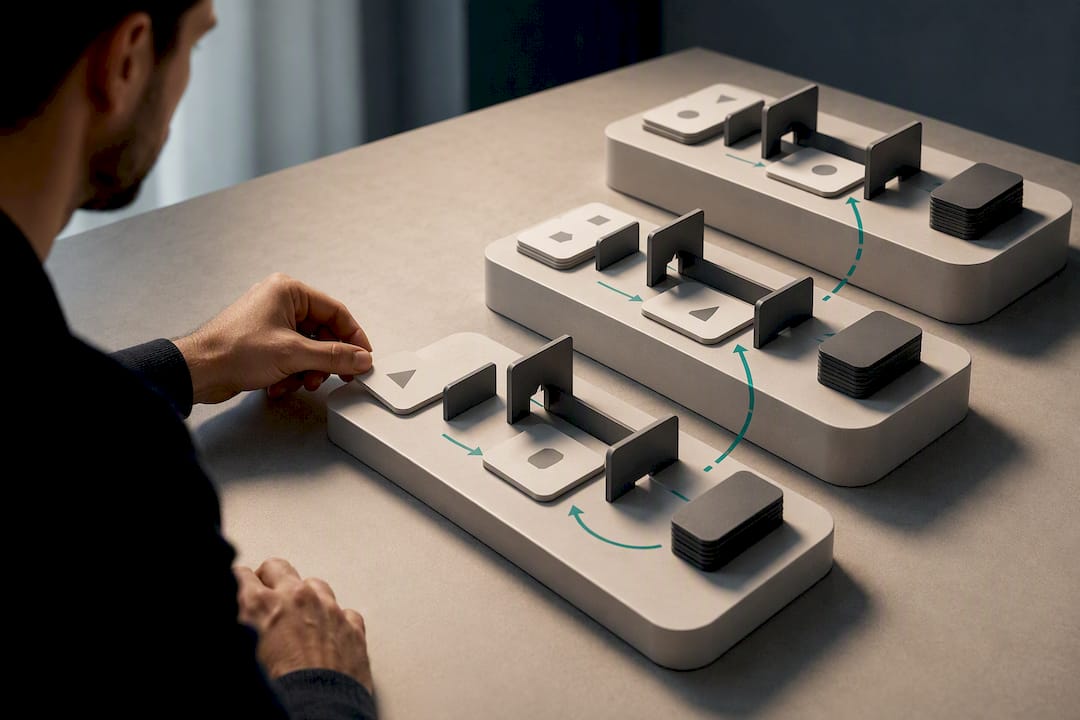
Programs that stick share a narrow set of traits, and none of them is "the flashiest leaderboard." The clearest pattern from the research is pairing a low-cost mechanic, a quiz, a mission, a scored role-play, with a genuine feedback loop and a spaced schedule rather than a one-time event.
The 147-rep field experiment is itself a case study in miniature: a five-minute competitive quiz, run once after training, produced a measurable recall lift a week later without requiring a major platform investment. That is the ceiling for what a minimal-effort program can achieve, useful context before promising your leadership team dramatic results from a single quiz rollout.
Programs that go further layer role-play missions on top of that quiz foundation, gating them by tenure and scoring them with instant, multi-dimensional feedback. Teams running instant-grading role-play simulations report ramp times cut dramatically and resolution rates climbing well above baseline, evidence that the combination of deliberate practice and fast feedback compounds over a full training cycle rather than producing a single short-term bump.
The common thread across every successful program: none of them treated gamification as the whole strategy. Each used it as reinforcement wrapped around a curriculum that already had clear learning objectives, competency benchmarks, and coaching support. The game mechanics amplified an existing structure. They did not replace one.
Folding Gamification Into a Curriculum You Already Have
Bolting a leaderboard onto an existing sales training curriculum without touching the curriculum itself rarely works. Start by mapping your current modules, product training, discovery skills, objection handling, closing, to the points where reps currently disengage or forget material. Those gaps are where a gamified layer earns its place.
A practical rollout sequence:
- Audit your existing curriculum for modules with weak knowledge retention (usually anything covered once and never revisited).
- Add a spaced quiz or mission to those specific modules first, rather than gamifying the entire curriculum at once.
- Layer role-play scoring onto any module that already includes practice calls, since that is the lowest-friction place to add instant feedback.
- Keep your existing assessment criteria intact; game mechanics should sit on top of your rubric, not replace it.
This staged approach also protects you from a common integration mistake: rebuilding your entire learning reinforcement strategy around gamification alone. Reinforcement techniques like microlearning and blended assignments still matter, and gamified elements work best as one layer within that broader system, not as a standalone curriculum.
For managers running blended synchronous and self-paced training, the integration point is usually the follow-up. A live session teaches the concept; a gamified quiz or mission the next day, and again a week later, does the reinforcing. That spacing pattern is what the spaced practice research consistently favors over cramming everything into one gamified event.
Keeping a Gamified Program Fresh Over Time
Every gamified program has a shelf life if the content never changes. The badges, missions, and leaderboard formats that felt fresh in month one start to feel like homework by month six unless someone is actively maintaining them.
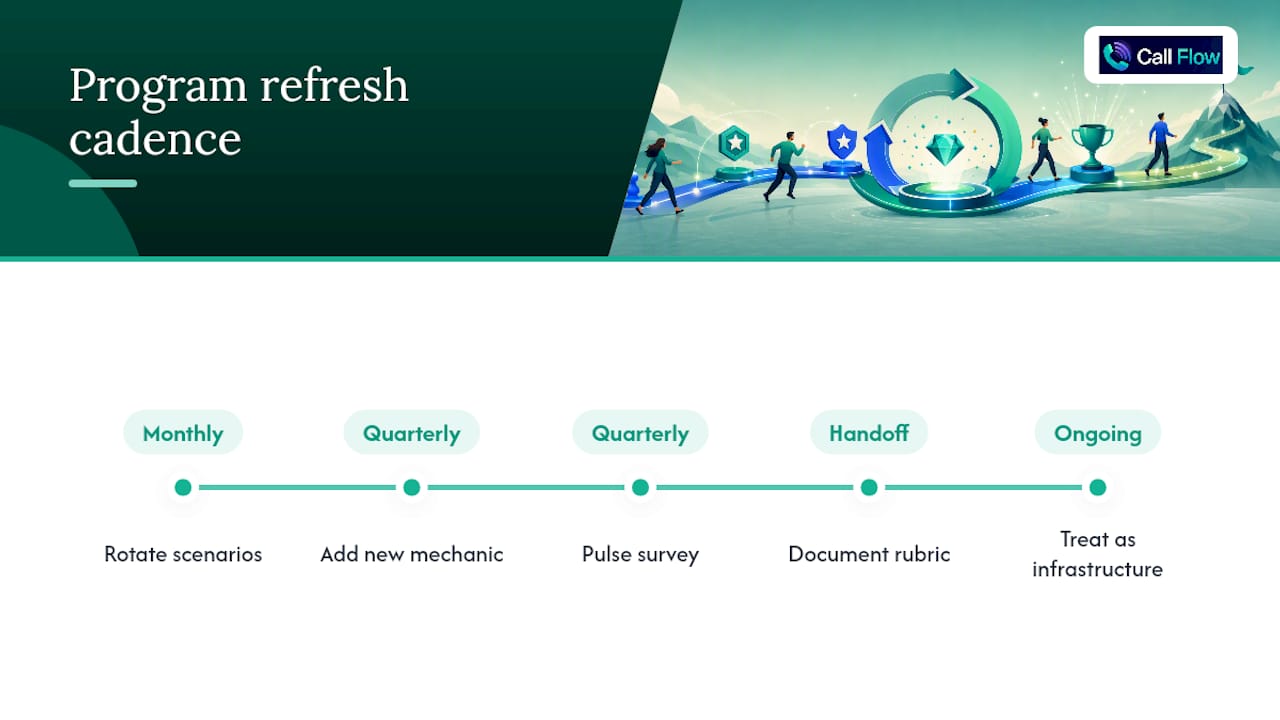
Build a content refresh cadence into the program from day one rather than treating it as an afterthought. Rotate scenario content monthly, keeping the underlying rubric and competency map stable so you are not rebuilding your measurement framework every time you add a new scenario. Introduce a new mechanic, a new mission type, a new badge tier, roughly once a quarter, timed to a natural business cycle like a new product launch or a seasonal push.
Ask reps what is stale before they stop participating rather than after. A quick pulse survey every quarter, three questions on which mechanics still feel motivating, catches novelty fade before it shows up as a drop in completion rates.
Plan for staffing changes too. A program built entirely around one enthusiastic manager's personal leaderboard tends to collapse when that manager moves on. Document the rubric, the scoring criteria, and the mission library somewhere durable, ideally inside whatever training data visualization or LMS system already holds your broader training records, so the next person running the program isn't rebuilding it from scratch.
Long-term sustainability ultimately depends on treating gamification as infrastructure, not a campaign. Campaigns end. Infrastructure gets maintained, updated, and handed off cleanly when the person running it changes.
When Gamification Earns Its Place, and When It Doesn't
Gamification is a high-leverage tactic when you already have a working curriculum and a specific retention problem, reps forgetting product details, discovery skills going stale, new hires losing momentum after week two. In those cases, a quiz or scored role-play mission is cheap to build and fast to show results.
It is the wrong first investment when your real problem is the curriculum itself, or when you are hiring reps who lack the foundational skills training was supposed to build. No leaderboard fixes a broken onboarding sequence or covers for a hiring process that keeps bringing in the wrong people. In those cases, spend the budget on curriculum redesign or better screening before touching game mechanics at all.
My recommendation stays consistent regardless of company size: pilot small, measure honestly against a control group, and only scale the mechanics that move your actual KPIs, not just your completion rates.
— Costa
How Callflow Brings Gamified Sales Training to Life
A certain platform offers a fast feedback loop that separates a real gamified program from a leaderboard bolted onto slides. Instead of guessing whether a rep's role-play performance actually improved, it provides instant grading across multiple performance dimensions the moment a scenario ends, the exact reinforcement loop the research behind spaced practice and deliberate feedback points to.
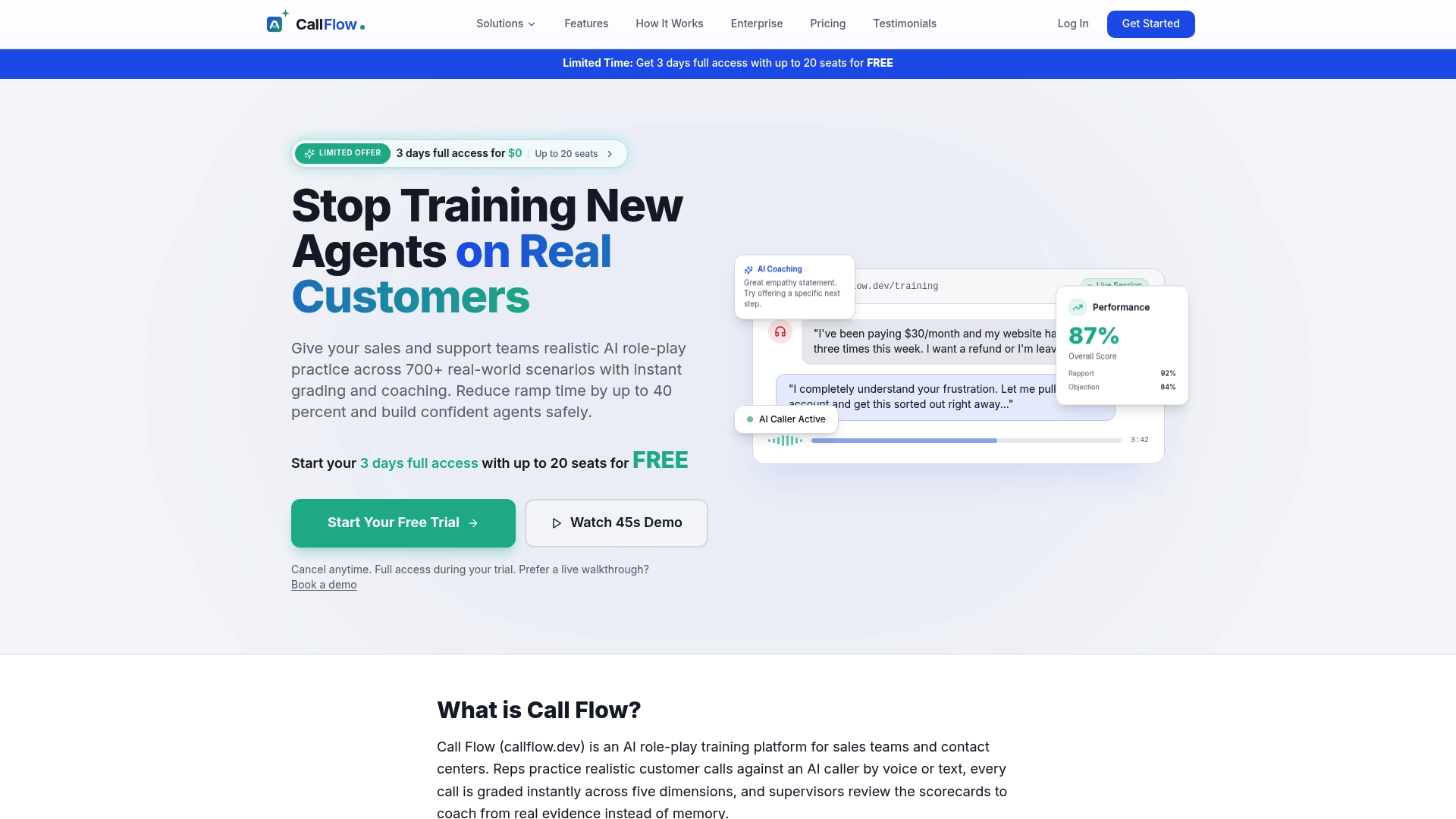
A practical pilot: pick one skill, objection handling or discovery, build a custom scenario with the platform, and run it as a scored mission across two weeks with spaced sessions rather than one big event. Track completion rate, rubric score trend, and ramp time against a control group, the same framework outlined earlier in this guide.
Start a risk-free trial and run your first scored role-play mission this week.
Sources
- Gamification in virtual sales training: evidence from a field experiment
- Sales training: effects of spaced practice on training transfer
- Does gamified training get results? | Harvard Business Review
- 5 Best Sales Training Games to Boost Results & Skills