

The right sales call framework structures the conversation so you qualify faster and advance more deals per call. Match the framework to deal complexity: use a light structure like BANT for quick qualification, MEDDIC or MEDDPICC for enterprise sales, then run a time-boxed 30-minute discovery arc and close every call with a calendar-confirmed next step. Gong's analysis of over 519,000 discovery calls found that top performers stick to 3 to 4 core problems and roughly 11 to 14 questions. Role-play simulations help reps drill that discipline before it costs them a live deal.
TL;DR:
- Matching the sales call framework to deal complexity improves efficiency, with BANT suited for quick, low-stakes qualification and MEDDIC or MEDDPICC for enterprise deals involving multiple stakeholders.
- Reps should ask 11 to 14 targeted questions focused on three to four core problems, listening more than speaking, to enhance discovery quality and deal progression.
- A structured 30-minute discovery call involves setting clear upfront contracts, probing for pain, and locking a follow-up date before ending the call, boosting deal advancement.
- Pre-call research, including understanding the buyer’s context and decision-making process, reduces wasted questions and sharpens the relevance of proof and next steps.
- Practicing frameworks via simulations and enforcing one structured approach at a time helps reps develop skills and maintain discipline during live calls, preventing common pitfalls like over-questioning or vague closing tactics.
Table of Contents
- What Sales Call Frameworks Actually Do
- Sales Call Frameworks Compared: SPIN, MEDDIC, BANT, and More
- A 30-Minute Discovery Call Blueprint You Can Run Tomorrow
- Pre-Call Research: What to Prepare Before You Dial
- Ending the Call: Mutual Action Plans and the P.L.A.N. Framework
- Objections, Talk-to-Listen Discipline, and Mistakes to Fix
- Turning Frameworks Into Skill: Why Practice Beats Reading
- What to Fix First When Frameworks Fail
- Make the Framework Stick With Practice, Not Just Training
- Sources
- FAQ
What Sales Call Frameworks Actually Do
A framework is not a script. It is a decision structure that tells a rep what to ask, in what order, and when to stop talking. Strip away the acronyms and every framework does the same three jobs: it organizes the conversation so nothing critical gets skipped, it forces qualification before commitment, and it creates a repeatable way to move a deal to the next stage instead of ending in a vague "let's circle back."
The mistake most teams make is picking one framework and forcing it onto every call regardless of deal size. That is backwards. The framework should match the complexity of the sale, not the other way around.
For quick-cycle, transactional deals, a lightweight structure works better:
- BANT or a simple 3-step model (open, qualify, close) keeps low-stakes calls moving without over-engineering a five-minute conversation.
- Speed matters more than depth when the deal size doesn't justify a 12-question discovery.
For complex, multi-stakeholder, long-cycle sales, you need more scaffolding:
- MEDDIC or MEDDPICC forces you to map the economic buyer, decision criteria, and paper process before you waste months chasing a deal that was never fundable.
- **HubSpot's breakdown of MEDDPICC recommends it specifically for long sales cycles where multiple stakeholders can quietly kill a deal you thought was moving.
Talk-to-listen ratio backs this up regardless of which framework you choose. Gong's research on millions of recorded calls shows top-performing reps ask a moderate number of questions and let the buyer do more of the talking, while lower performers ask more questions and still lose. Structure isn't about asking more. It's about asking the right ones and then listening.
Sales Call Frameworks Compared: SPIN, MEDDIC, BANT, and More
Every established framework solves a different part of the call. Some are built for discovery, some for qualification, and some for closing. Here's how the major ones actually work, and when each one earns a spot in your process.
SPIN Selling
SPIN breaks discovery into four question types: Situation, Problem, Implication, and Need-Payoff. You start by understanding the buyer's current setup, surface a problem, then walk them through the cost of leaving that problem unsolved before asking what solving it would be worth.
The power of SPIN is that the buyer articulates the value themselves instead of you pitching it at them, which ties closely to how you can create a unique selling proposition to boost growth. HubSpot's guide to SPIN selling points out that this self-articulated value tends to stick better than anything a rep could claim, because the buyer isn't defending against a sales pitch. They're describing their own situation.
Best for: consultative sales where the buyer doesn't yet see the full cost of their problem. On-call tip: never skip straight to Need-Payoff. If you ask "what would solving this be worth?" before you've walked through Implication, buyers give you a shallow, defensive answer.
MEDDIC and MEDDPICC
MEDDIC stands for Metrics, Economic buyer, Decision criteria, Decision process, Identify pain, Champion. MEDDPICC adds Paper process and Competition. Both are qualification frameworks, not conversation scripts. You use them to build a picture of whether a deal is real and winnable, usually across multiple calls rather than one.
The HubSpot breakdown of the MEDDPICC methodology notes that operationalizing it means embedding fields like economic buyer and paper process status directly into your CRM, and making those fields mandatory before a deal can move to late stage. That's the difference between a framework reps nod at in training and one that actually changes pipeline behavior.
Best for: enterprise or complex B2B deals with multiple stakeholders and a long approval chain. On-call tip: identify the economic buyer early.
BANT
Budget, Authority, Need, Timeline. BANT is the oldest qualification framework still in wide use, and it earns its place on shorter, simpler sales cycles where you need a fast yes/no on whether a lead is worth pursuing.
Best for: transactional or SMB deals where a long qualification process would waste more time than it saves. On-call tip: ask about timeline before budget. Buyers volunteer urgency more honestly than they volunteer numbers, and urgency tells you more about whether the deal is real.
Challenger
The Challenger approach flips the consultative model. Instead of asking questions until the buyer reveals their own insight, you lead with a new perspective on their business that they haven't considered, then use that tension to reframe the sale.
Best for: commoditized markets where buyers think they already understand their options and need to be taught something new before they'll engage. On-call tip: the "teach" only works if it's specific to their industry or role. A generic insight reads as a canned pitch and kills credibility fast.
P.L.A.N.
P.L.A.N. (Pivot, Logistics, Agenda, Next Steps) is a closing framework, not a discovery one. It governs the last few minutes of the call: pivoting from discovery into commitment, confirming logistics, setting the agenda for the next touchpoint, and locking concrete next steps before you hang up.
ZoomInfo's breakdown of the P.L.A.N. framework recommends sending the agreed agenda and mutual action plan within two hours of the call ending, while the conversation is still fresh for the buyer.
Best for: pairing with any discovery framework above. P.L.A.N. doesn't replace SPIN or MEDDIC. It's what you run after either one to make sure the call actually advances the deal. On-call tip: never end a call with "I'll send over some times." Confirm the next meeting on the calendar before you disconnect.
3/5/7-step models
Generic step models (open, qualify, present, handle objections, close, for example) exist mostly as training wheels for new reps who need a simple mental map before they're ready for something like MEDDPICC. They're not wrong, just thin. Use them for onboarding, then graduate reps to a framework that matches your actual deal complexity within their first few months.
Pairing advice: use a qualification framework (BANT, MEDDIC) to decide whether a deal deserves your time, then use a conversation framework (SPIN, Challenger) to run the actual discovery, then close every call with P.L.A.N. That's three frameworks working together, not one framework doing everything.
A 30-Minute Discovery Call Blueprint You Can Run Tomorrow
Most discovery calls fail not because the rep lacks a framework, but because they lose track of time. Ten minutes of small talk and a slow start to context-setting leaves five rushed minutes for the part that actually matters. A structured 30-minute discovery frame from Allston Labs fixes that by time-boxing every segment, and it correlates with meaningfully higher call advancement when reps stick to it.
Here's the structure, minute by minute:
- Opening (2 minutes). Confirm the agenda and set an upfront contract: "I'd like to spend the next 25 minutes understanding where things stand, then in the last few minutes we'll figure out if this makes sense to keep exploring. Sound fair?" This single line does more to control the call than anything that follows it.
- Context (5 minutes). Get oriented on their current setup before you start probing for pain. Ask what tools or process they use today and who else touches this problem.
- Discovery (15 minutes). This is where the real work happens. Ask 11 to 14 questions, focused on 3 to 4 core problems, matching the pattern Gong found across its dataset of recorded calls. Don't chase every tangent. Depth on fewer problems beats breadth across ten.
- Proof (5 minutes). Respond to the specific problems they just described with a relevant case or metric. Allston Labs calls this "earning the demo": you don't demo everything you have, you show the one thing that answers what they told you five minutes ago.
- Next steps (3 minutes). Lock a specific date and time for the follow-up, confirmed on the calendar before the call ends. Not "I'll send some times." An actual booked slot.
Talk-to-listen ratio should skew toward the buyer through the discovery block. If you're talking more than you're listening during minutes 7 through 22, you're pitching, not discovering.
Pro Tip: Time yourself on your next five discovery calls without telling the buyer. Most reps are shocked to find they spend 18 of the allotted 15 discovery minutes talking instead of asking.
Resist the urge to demo early, even when a buyer asks a product question mid-discovery. A quick "great question, let me hold that until proof so I can show you exactly how it applies to what you just told me" keeps the call on structure without dismissing them.

Pre-Call Research: What to Prepare Before You Dial
The 30-minute blueprint only works if you walk in with the right inputs. Reps who skip prep end up spending their 15 discovery minutes asking questions they could have answered themselves with two minutes of research, which burns the exact window you need for high-impact questions.
Build this into a five-minute pre-call routine:
- Buyer context: what does this company do, who are their customers, and where does your product likely fit into their existing stack?
- Decision-makers: who is likely the economic buyer, and who on this call is probably a champion versus an information-gatherer?
- Public urgency signals: recent funding, leadership changes, a new product launch, or a public complaint about the exact problem you solve.
- A tight agenda: three bullet points you can state in your opening line, not a rehearsed monologue.
- An upfront contract: a one-sentence version of what you'll cover and what happens at the end of the call, stated before you start context-setting.
- One proof artifact: a case study, ROI figure, or relevant metric ready to send the moment the call ends, along with a one-pager that reinforces what you covered.
None of this needs to take more than five to ten minutes per call. The payoff shows up immediately: fewer wasted discovery questions, sharper proof-section relevance, and a follow-up email you can send within minutes instead of scrambling to write one from memory an hour later.
Ending the Call: Mutual Action Plans and the P.L.A.N. Framework
The single biggest predictor of whether a deal stalls after a good call isn't the quality of the discovery. It's what happens in the last three minutes. Most reps end with something vague like "I'll follow up next week," and that's exactly the language that lets deals go quiet.
The P.L.A.N. framework structures this close into four deliberate moves:
- Pivot from discovery mode into commitment mode with a clear verbal signal: "Based on what you've shared, here's what I think makes sense as a next step."
- Logistics confirm who needs to be involved next and what format the next touchpoint takes.
- Agenda for that next meeting gets set on the spot, not left for a follow-up email to define.
- Next steps get locked into a mutual action plan with named owners and dates, agreed to before anyone hangs up.
A simple three-column MAP, built live on the call, keeps both sides accountable:
| Action | Owner | Deadline |
|---|---|---|
| Send pricing and case study | Rep | Within 2 hours |
| Review with finance team | Buyer | 3 business days |
| Confirm follow-up call | Both | Booked on calendar now |
Confirm the actual meeting time on the calendar before the call ends. ZoomInfo's research on the P.L.A.N. framework found that mutual action plans with named owners and deadlines meaningfully reduce deal stalls, and recommends sending the written recap within two hours while the conversation is still top of mind for the buyer.
Follow-up timing matters as much as the plan itself. Send the recap within two hours, a check-in if the buyer misses their MAP deadline by a day, and after three unanswered follow-ups, send a direct permission-to-close message: "I haven't heard back, so I'll assume this isn't a priority right now. Let me know if that's not the case and I'll keep the door open." It's blunt, but it usually gets a reply.
Objections, Talk-to-Listen Discipline, and Mistakes to Fix
Objections handled well start with silence, not a rebuttal. Gong's objection-handling research shows top reps pause for roughly two seconds after an objection before responding, instead of jumping straight into a defense. That pause does two things: it signals you actually heard the objection, and it gives you a beat to ask a clarifying question instead of guessing at what the buyer meant.
A simple paraphrase closes the loop: "So if I'm hearing you right, the concern isn't the price, it's whether this fits into your current rollout timeline. Is that accurate?" That single sentence usually surfaces the real objection hiding behind the stated one.
More questions is not the goal. HBR's research on consultative selling warns that poorly run discovery calls slide into interrogations, where the rep fires question after question without ever pausing to listen. The fix isn't fewer questions across the board. It's fewer, sharper questions: 11 to 14 focused on 3 to 4 real problems, the same pattern Gong found across its dataset of recorded discovery calls.
Common mistakes worth coaching out immediately:
- Rapid-fire questioning with no pause for the buyer to elaborate, which reads as an interrogation rather than a conversation.
- Pitching during discovery instead of waiting for the proof section to respond to a stated problem.
- Vague closes like "I'll follow up" instead of a calendar-confirmed next step.
- Skipping the upfront contract, which leaves the buyer unsure what the call is even for.
Pro Tip: Record and review one discovery call per rep per week specifically for talk-to-listen ratio. Reps almost always overestimate how much they let the buyer talk until they hear it back.
Turning Frameworks Into Skill: Why Practice Beats Reading
Knowing a framework and running it under pressure on a live call are different skills entirely. Reading about SPIN or MEDDIC doesn't build the muscle memory to pause after an objection or hold a discovery question until the buyer finishes their thought. Repetition does.
Callflow's role-play simulation gives reps a way to rehearse a specific framework, on a specific deal type, as many times as they need before it counts against a real pipeline number. The platform grades each simulated call across five performance dimensions instantly, so a rep gets feedback on question quality or talk-to-listen ratio in minutes instead of waiting for a manager to review a recording days later. Teams using this kind of structured practice have seen 147% faster ramp time and a 129% improvement in resolution rates.
Managers running a pilot should track a few specific behaviors during the trial: MAP completion rate on real calls, talk-to-listen ratio trending toward the buyer side, and how often reps advance a deal to a confirmed next step versus a vague follow-up. Those three numbers tell you faster than any anecdote whether a framework is actually sticking.
What to Fix First When Frameworks Fail
Most teams don't fail because they picked the wrong framework. They fail because they run three frameworks at once, half-trained, and never audit whether anyone is actually using any of them on real calls.
Fix that by enforcing one framework at a time for at least a full quarter. Pull call recordings weekly, not monthly, and score them against the framework's actual steps, not a gut feeling about "how the call went." Coach to the metrics that predict outcomes: MAP completion, question count against the 11 to 14 target, and talk-to-listen ratio, not just win rate, which lags too far behind the behavior that causes it.
The gap between a framework on a slide and a framework a rep actually runs under pressure is where most training budgets quietly disappear.
— Costa
Make the Framework Stick With Practice, Not Just Training
Reading about SPIN or MEDDIC won't help a rep hold their nerve through a real objection at minute 18 of a live call. Some platforms close that gap by allowing reps to rehearse any framework covered here inside realistic voice or text scenarios, get graded instantly across multiple performance dimensions, and fix specific gaps like talk-to-listen ratio or MAP completion before those mistakes cost a real deal.
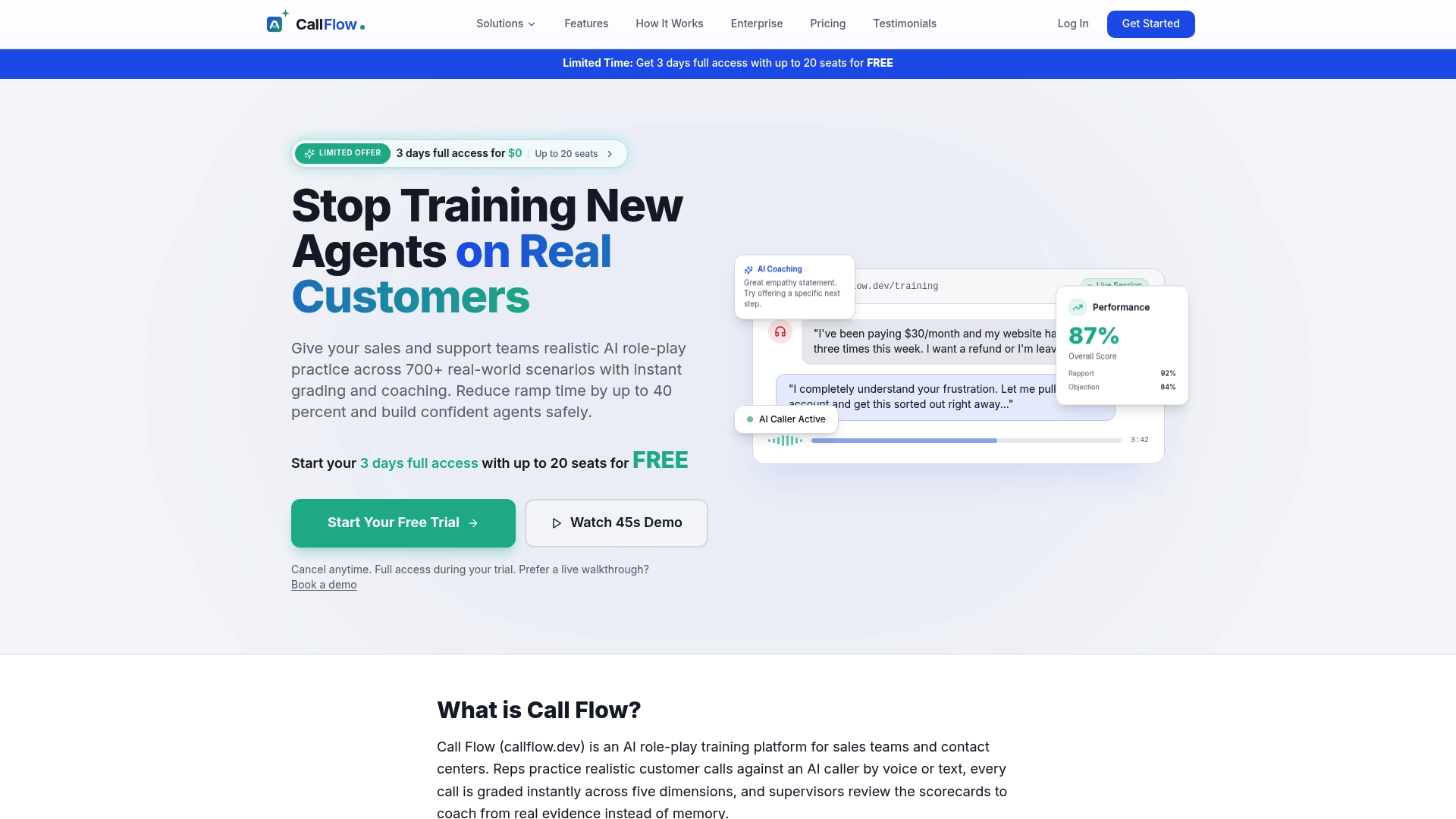
Managers get a supervisor dashboard showing exactly which reps are advancing calls and which are stuck pitching during discovery. Teams can start on the Starter plan at $7.42 a month, and larger sales organizations running multiple frameworks across teams can look at Enterprise options built for that scale. Every plan includes full access during a risk-free trial, so you can pilot a specific framework, like the 30-minute discovery blueprint, with your own team before committing to anything.
Sources
The claims and numbers in this guide draw on a handful of sources worth reading directly. Gong's analysis of over 519,000 discovery calls grounds the question-count and problem-focus guidance. Gong's separate talk-to-listen ratio research explains why asking more questions correlates with worse outcomes. Allston Labs's discovery call architecture is the source for the 30-minute time-boxed structure. ZoomInfo's P.L.A.N. framework covers how to close calls with a mutual action plan, and HubSpot's MEDDPICC breakdown explains enterprise qualification in more depth than this guide has room for.
- Essential discovery call techniques for effective deal closing | Gong
- How to run a sales discovery call — Allston Labs
- End sales calls with a plan framework | ZoomInfo
- Sales reps, stop asking leading questions | HBR
FAQ
What Are the Four Types of Sales Calls?
Sales calls generally fall into four categories: cold calls (first outreach to an unfamiliar prospect), discovery calls (qualifying and understanding needs), demo or proof calls (showing how your product solves a stated problem), and closing calls (finalizing terms and next steps). Most frameworks in this guide, like SPIN and MEDDIC, apply most directly to the discovery stage.
What Is the 2 2 2 Rule in Sales?
Definitions of the "2 2 2 rule" vary depending on the source, and it isn't a framework with consistent, widely agreed-upon steps the way SPIN or BANT are. If you've heard it applied to your specific process, it's worth clarifying with whoever taught it rather than assuming a universal standard.
What Are the 7 Steps of a Sales Call?
A common 7-step model runs: prospecting, preparation, opening/rapport, discovery, presentation or proof, objection handling, and close. It's a useful onboarding structure for new reps, but most experienced teams graduate to a more specific framework, like MEDDIC for complex deals, once they need deeper qualification than a generic step model provides.
What Is the 70/30 Rule in Sales?
The 70/30 rule refers to talk-to-listen ratio: the buyer should be talking roughly 70% of the time during discovery, with the rep talking closer to 30%. Gong's research on millions of recorded calls supports this direction, showing top performers let buyers talk more and ask fewer, sharper questions rather than dominating the conversation.
How Much Does Callflow Cost for a Sales Team?
Callflow's Starter plan is $7.42 per month or $89 per year, with Growth and Scale tiers available for larger teams needing more scenario volume. Business and Enterprise pricing is available on request through the enterprise page, and every tier includes a risk-free trial with full feature access.