

To reduce call avoidance, find out why agents duck calls, then fix that cause. Most of the time the cause is fear of hard calls, gaps in skill, or burnout. Discipline alone does not fix any of these. Practice on realistic calls, fair detection from your own data, and steady coaching do. Agents who have rehearsed the hard call take it. Agents who have not rehearsed it find a reason to skip it.
This guide is for sales managers, contact center leaders, training directors, HR professionals and team leaders. It covers what call avoidance is, how to spot it without micromanaging, how to find the cause, and how to build practice into the week so the behavior fades.
TL;DR
- Call avoidance means dodging a call when a call is the best way to help the customer. Common signs are idle "not ready" status, quick transfers and long after-call work.
- Check the pattern in data first. Then talk to the agent. The same behavior can mean burnout, fear, a skill gap or a legitimate choice.
- Agents avoid calls they feel unready for. Practice on realistic scenarios builds the confidence that removes the reason to avoid.
- Track transfer rate, after-call work, hold time, first-call resolution and customer satisfaction before and after you change anything.
- Set clear expectations and follow through for everyone. If one avoider faces no consequence, others copy.
Table of Contents
- What call avoidance is
- Why it matters
- Why agents avoid calls
- How to detect it fairly
- How to talk to the agent
- Fix the cause with practice
- Build coaching into the week
- Where Callflow fits
- Perspective: practice removes the reason to avoid
- How to track whether it worked
- A worked example
- Common mistakes
- FAQ
- Sources
What call avoidance is
Call avoidance is when an agent avoids taking calls even though a call is the best way to solve the customer's issue. One contact center guide lists the usual behaviors: taking the phone off the hook, transferring calls, taking excessive breaks, lingering in conference mode and stretching call length on purpose. Sending a customer to a self-service page that fully solves the problem is not avoidance.
Twilio's guide adds more tactics:
- Staying in "not ready" status.
- Claiming IT issues.
- Holding customers until they hang up.
- Ending calls before the greeting.
- Sending callers back to the queue.
- Lingering in post-call mode.
- Cycling disposition codes to drop to the back of the queue.
TechRepublic names others. These include idle small talk to stretch talk time, maxed-out after-call work, unusually long bio breaks and logging in and out to look unavailable.
The term has a second meaning. Some centers set out to reduce inbound volume by pushing callers to other channels. This article is about the first meaning: agent behavior.
Call avoidance versus call reluctance
Call avoidance happens in service queues. Call reluctance is the sales version: a rep puts off outbound calls with over-preparing, research and email. The roots are close. Both come from fear of a bad outcome. One academic guide for sales managers suggests a fixed morning start time for calls to curb over-preparing. It also suggests regular practice before peers and measuring success by appointments set, not by rejections. Reassure reps that people reject the offer, not the rep.
Why it matters
Every ducked call lands on someone else. TechRepublic notes that each avoided call lengthens queue waits, which wears down brand reputation and customer loyalty. It also warns that when a serial avoider faces no consequences, colleagues start avoiding calls too, and good reps burn out carrying the load.
That makes this a team problem as much as an individual one. Left alone, it spreads. It also raises transfers and repeat calls. McKinsey studied a large US energy producer whose call center took about 20% repeat calls. Working through four root causes (customer behavior, agent skills, resources and routing, process gaps) cut repeat calls by 25 to 50%, saving $5 to $10 million. It found that more supervisor time with an agent lowered that agent's repeat-call rate. Agents with less coaching access had higher repeat rates.

Why agents avoid calls
Ask "why" before you ask "who." Twilio lists the usual causes: anxiety or frustration over complaints, burnout from high volume, workplace conflict, personal distractions and job dissatisfaction. Another common cause is that agents lack the training or knowledge for certain issues. Performance metrics add pressure. Targets for handle time and first-call resolution can push agents toward easy calls.
That gives you four groups to sort what you see:
| Cause | What it looks like | Right response |
|---|---|---|
| Skill gap or low confidence | Quick transfers on one call type, ending calls early on complaints | Practice and coaching on that call type |
| Emotional strain | Breaks after hard calls, "not ready" after angry callers | De-escalation practice, recovery time, workload review |
| Burnout | Broad drop in activity, absences, lower QA scores | Workload, schedule and engagement conversation |
| Intentional avoidance | Clear pattern at peak times, system gaming, personal calls | Clear expectations, then documented follow-through |
The first two rows are the most common in teams that grow fast or hire in waves. New agents meet a call they have never handled, feel exposed and look for an exit. That is a training gap, not a character flaw.
How to detect it fairly
Detection should not turn into surveillance. TechRepublic advises spot-checking for anomalies: reps with more after-call-work sessions than teammates, overlapping breaks or gaps in availability. Do not track every rep minute by minute.
Step 1: Pick a few signals
Twilio recommends these measures:
- Average handle time
- Average hold time
- Call transfer rate
- Average queue wait time
- Average after-call work time
- Percentage of calls blocked
- Average speed of answer
For reference, Plivo's 2025 benchmark roundup puts the standard transfer rate at about 19%, with 15% or less counted as strong. It puts standard handle time at about 10 minutes. It also reports healthy occupancy at 75 to 85%, and warns that above 85% risks burnout. Your own team history is the better baseline. Benchmarks only tell you where to look.
Step 2: Look for a pattern, not an incident
Compare an agent's recent data with that agent's own past. One long break proves nothing. Three weeks of rising transfers on one call type says something. Pair the data with a small sample of recorded calls. Listen for what the agent does when the call gets hard.
Step 3: Rule out legitimate causes
Twilio warns that similar behavior can be good service. An agent may stay on a transferred line to make sure a hard issue is resolved. An agent may take a break for health reasons. It also says activity logs and KPIs may not show the whole story, so give the employee a chance to explain before you assume avoidance. The same behavior could be burnout or bad behavior, and those are two different problems to solve.
Step 4: Add a second view
TechRepublic suggests skip-level meetings, because reps are often more candid with senior leaders than with their direct supervisor. Short pulse surveys also help. Ask whether agents feel ready for the calls they get.
How to talk to the agent
Keep it short and factual.
- Show the data and the pattern. Do not guess at motive.
- Ask what makes certain calls hard.
- Agree on expectations in plain words: availability, transfer rules and when a hold is appropriate.
- Agree on support: practice, a call review or a schedule change.
- Set a date to review the numbers together.
TechRepublic says warnings or termination come only if violations continue after clear expectations were set. Document each step. Our guide on instant coaching feedback scripts gives 2 to 5 minute conversation formats you can use for these check-ins.
Fix the cause with practice
Most avoidance comes from calls agents have not rehearsed. Live customers are the worst place to learn a hard call. The agent has no safe way to fail, so the agent avoids the call.
Role play gives that safe place. The agent takes the angry caller, the refund demand or the cold prospect who says no, again and again, until the call feels familiar. Three things make it work:
- Realism. The scenario must sound like your real calls: your products, your policies, your common objections.
- Fast feedback. Feedback that comes right after the call changes the next attempt. Feedback a week later changes little.
- Repetition. Short sessions several times a week beat one long workshop.
Ask the team which call types they dread. Build scenarios for those first. For a sales team, that is usually the first cold call of the day and the price objection. For a service team, it is the escalation, the repeat caller and the abusive caller.
Our call center coaching plan template shows how to schedule this. For the emotional side, empathy training scored like live calls helps agents hold a hard conversation without shutting down.
Build coaching into the week
Practice only works when managers follow it. A simple weekly rhythm:
- Monday: review the team's signals. Pick two or three agents to check in with.
- Midweek: each agent completes short practice sessions on their weakest call type.
- Friday: review scores and one real call per agent. Praise the call they were afraid of and took.
Praise matters here. If the agent who takes the hard call gets nothing and the avoider gets nothing, the team learns the call does not matter. Say out loud who took the tough calls.
For new hires, build the hard calls into the first weeks, not the last. A 90 day manager plan ties early practice to retention, because agents who feel unready are the ones who leave.
Where Callflow fits

Callflow is an AI role-play training platform for sales teams and contact centers. Agents practice realistic customer scenarios in voice or text mode, and each practice call is graded instantly across five performance dimensions with coaching feedback. Supervisors see dashboards and skill analytics, can review and override scores, and can build custom scenarios from the call types your team avoids. The scoring is calibrated to match your existing QA standards. See how that connects to scorecards in our guide on contact center QA and AI role play.
Plans are billed monthly or yearly. Starter costs $7.42 per month or $89 per year. Growth costs $14.92 per month or $179 per year. Scale costs $33.25 per month or $399 per year. Business and Enterprise plans have no published price. Every team can try the full feature set free, with self-serve setup. See the Callflow plans, or the Business and Enterprise options for larger teams.
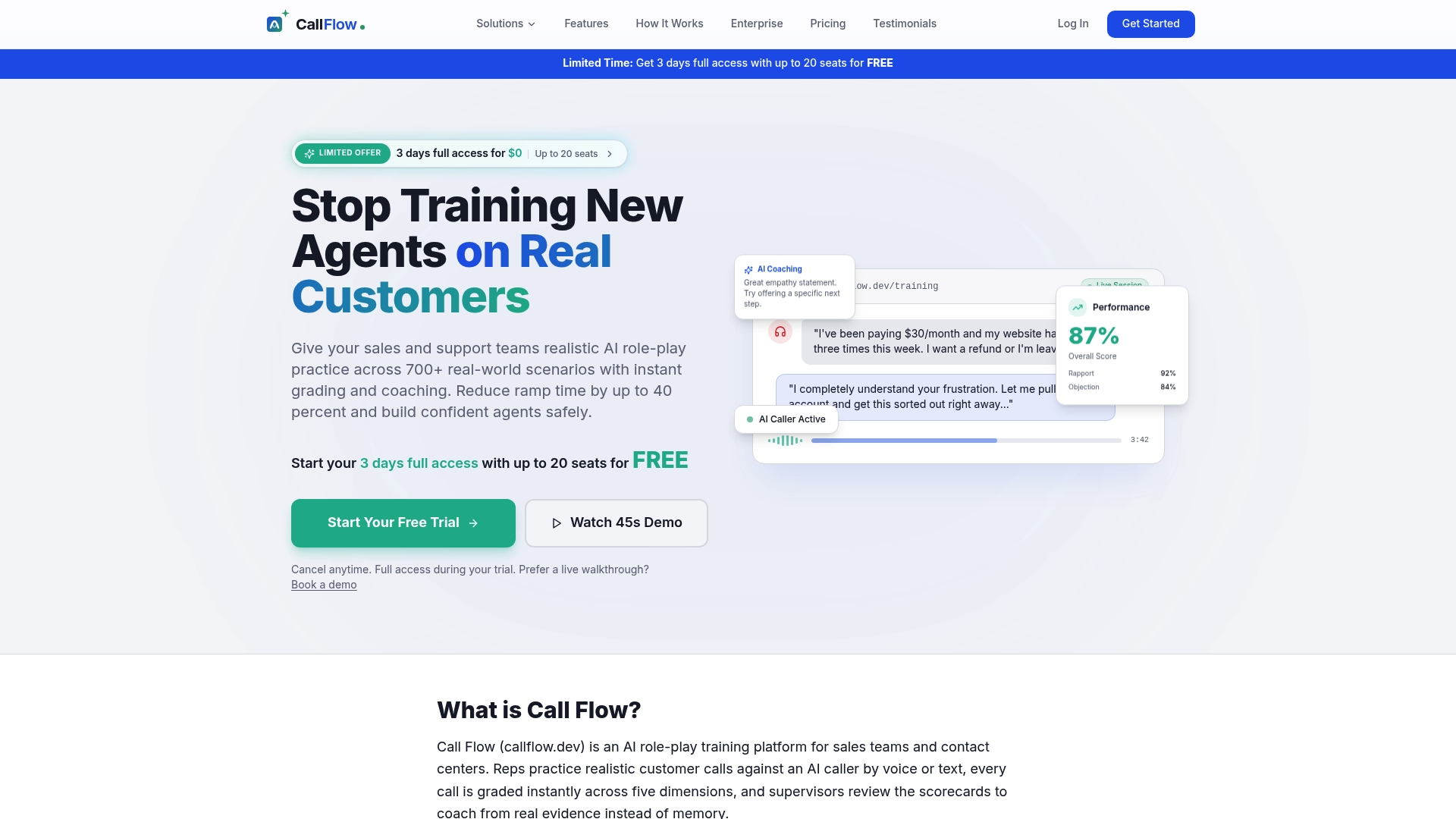
Our own figures for teams using the platform are 147% faster ramp time and a 129% improvement in resolution rates. Use the trial to test them on your own hardest call types.
Perspective: practice removes the reason to avoid
We build Callflow around one idea. An agent who dodges a call usually does not lack effort. The agent lacks a place to get it wrong first.
Managers often reach for rules: tighter status tracking, stricter transfer limits, warnings. Rules have a place, and clear expectations matter. But rules do not teach anyone how to calm an angry caller. They only raise the cost of avoiding.
So we focus on the rehearsal. Agents take the call they fear in a realistic scenario. They get graded right away on five dimensions. They see what to change and try again in minutes, with no customer on the line. The supervisor sees the same scores in a dashboard, so the coaching conversation starts from facts the agent has already seen.
We also think scoring should match how you already judge quality. That is why our scoring is calibrated to your QA standards, and why supervisors can review and override it. The agent should never hear one standard in practice and another in the review.
When the hard call stops feeling new, the urge to avoid it fades. That is the outcome we design for.
Costa
How to track whether it worked
Pick a baseline before you change anything. Record four weeks of data, then compare after four to eight weeks. Track these:
- Transfer rate and after-call work time by agent and call type. These are the first to move when avoidance drops.
- Queue wait and abandonment. Plivo's roundup puts standard abandonment at about 6%.
- First-call resolution and customer satisfaction. The same roundup describes good FCR as 70 to 79% and good CSAT as 75 to 84%.
- Practice completion and score trend for each agent, so you can tie progress to effort.
For retention, watch leading signals as well as resignations. The GTM Advisor Group says schedule adherence declines 30 to 60 days before resignation, and it recommends tracking QA score declines over two periods and unplanned absences. It also says new agents need 60 to 90 days to ramp, with lower FCR and higher handle time during that time. Plan your review windows around that period so you do not judge new hires too early.
A dashboard that shows these together saves hours of spreadsheet work. Our guide to training data visualization shows how to build one that drives coaching. If your focus is the first weeks on the job, the real-time coaching pilot lays out a 4 to 8 week test.
A worked example
Say a 40-agent support team sees transfers climb on billing disputes. The data shows five agents transfer those calls at twice the team rate. Two of them joined within the last 60 days.
You check ten recorded calls. In seven, the agent transfers within a minute of the customer raising the dispute. In your check-ins, three agents say they do not know what they are allowed to offer. One says the callers are rude.
The cause is a mix of knowledge and confidence. You build a billing-dispute scenario with the refund rules in it. Each of the five completes three short practice calls a week for a month. You review one real dispute call each Friday. After eight weeks, you compare their transfer rate on billing calls with the baseline and with the rest of the team.
No one was disciplined, and the queue improved. If the numbers had not moved for an agent who had practiced, you would move to the expectations conversation, with the history on paper.
Common mistakes
- Treating every flag as misconduct. Some of it is burnout or a skills gap, and each needs a different fix.
- Using one metric. Low handle time can mean fast service or rushed calls. Use several signals together.
- Punishing one agent and ignoring the rest. Consistent follow-through protects the culture. Inconsistent follow-through spreads the behavior.
- Training once. A single workshop fades. Short, frequent practice sticks.
- Skipping the workload check. If occupancy sits above 85%, avoidance may be the symptom of a staffing problem.
FAQ
Can you be fired for call avoidance?
In many workplaces, yes, if it breaks clear policy and continues after warnings. Set expectations in writing first, document the pattern with data, and talk to the agent before any formal step. Check your company policy and local employment rules, and involve HR before a termination decision.
How do you reduce call reluctance in sales reps?
Make outbound calls routine and make practice normal. A fixed daily call block stops over-preparing. Regular role play in front of peers builds nerve. Measure reps on appointments set, not on rejections, so one "no" does not feel like failure.
How do I tell avoidance from burnout?
Talk to the agent and look at the whole record. Burnout shows up broadly: lower QA scores, absences and falling adherence. Avoidance is usually targeted at certain calls or times. Ask open questions about workload and which calls feel hard, then act on what you learn.
How long until I see results?
Set a review point four to eight weeks after you start practice and coaching, and compare it with a baseline from before. New hires need longer, since ramp commonly takes 60 to 90 days. Track the same measures each time so the comparison is fair.
Sources
- The Definitive Guide to Call Avoidance
- How to Detect Call Avoidance Without Micromanaging, TechRepublic
- Call avoidance: What is it and how do you prevent it?
- Why are your customers calling you again? McKinsey
- Top contact center statistics and benchmarks (2025), Plivo
- Call Center Agent Retention, The GTM Advisor Group
- Call reluctance guide for sales managers