

The fastest way to reduce average handle time is to automate after-call work, surface knowledge in real time, and fix routing before an agent ever picks up the call. These three levers move the metric because they remove friction instead of pressuring agents to talk faster. Pilot ACW automation first, layer in knowledge base and real-time assist next, then tune routing and coaching. Watch first-call resolution and CSAT the entire time.
TL;DR:
- Automating after-call work and improving routing first reduce handle time by eliminating unnecessary transfers and time-consuming tasks before agents speak with customers.
- Segmenting AHT data by call type, complexity, and channel ensures targets are meaningful and prevents rewarding agents for avoiding difficult issues.
- Rewriting knowledge bases into decision trees and integrating search improves search speed and reduces hold time during interactions.
- Implementing AI-driven call summarization can cut post-call administrative work by up to 70%, especially in high-volume, simple call types.
- Measuring first-call resolution, repeat contact rates, and customer satisfaction alongside AHT prevents rushing calls that compromise quality or customer experience.
Table of Contents
- What Is Average Handle Time, and How Do You Calculate It?
- How Do You Baseline and Segment AHT Before You Act?
- Quick Checklist: Prioritized Strategies To Reduce AHT
- Self-Service and IVR: Stop Wasting Time Before an Agent Answers
- Routing, Transfers, and Escalation: Get the Right Agent First
- Knowledge Base and Real-Time Agent Assist: Cut Hold and Search Time
- Agent Training, Coaching, and Call Flow Design
- Reduce After-Call Work (ACW) With Automation and Templates
- Scripts and Call Flow: Structure Conversations for Speed and Clarity
- Measure Outcomes and Guardrails: What to Track Alongside AHT
- A Prioritized 30-60-90 Implementation Plan
- Evidence and Author Proof Points
- Cut Handle Time Without Cutting Corners
- Common Pitfalls in AHT Optimization
- Sources
What Is Average Handle Time, and How Do You Calculate It?
Average handle time is the average length of a customer interaction from the moment an agent engages to the moment the file closes, including everything that happens after the call ends. The formula is simple: AHT = (total talk time + total hold time + total after-call work time) ÷ total number of calls handled, a standard calculation used across the industry.
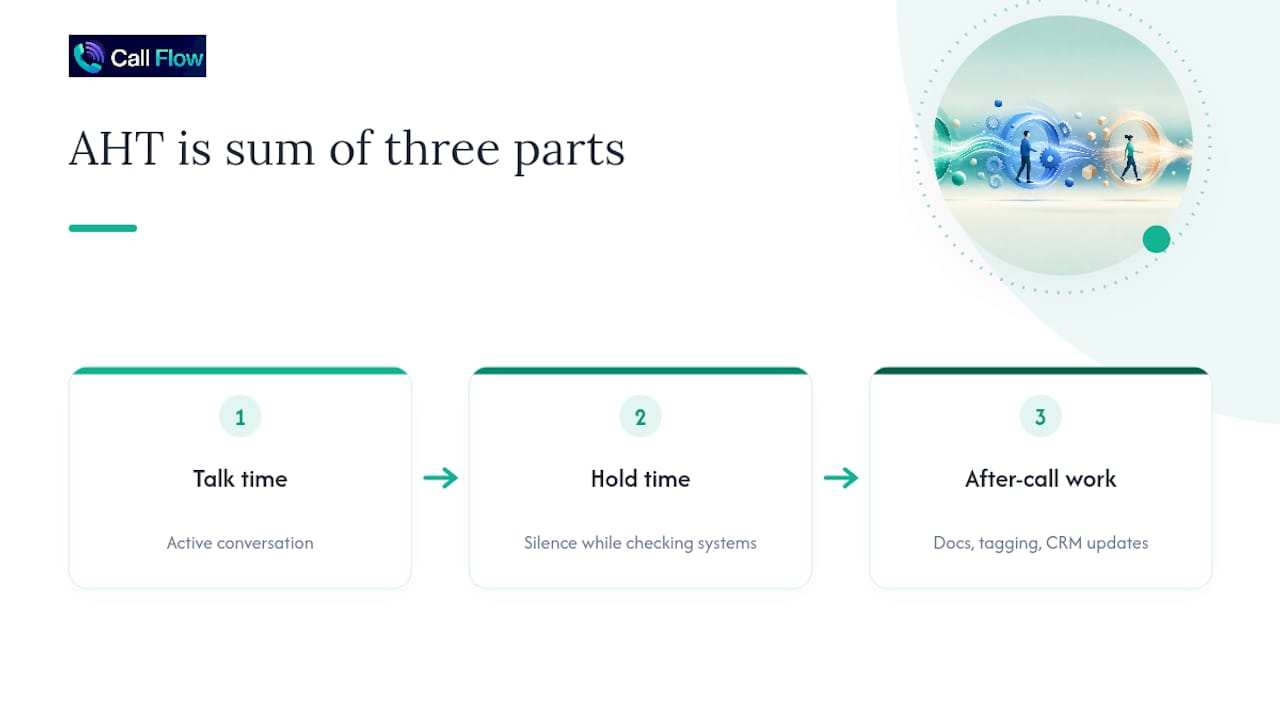
Talk time covers active conversation. Hold time includes silence while an agent checks a system or waits on a transfer. After-call work, or ACW, covers documentation, tagging, and CRM updates completed once the customer hangs up. Teams commonly undercount ACW because it happens off the clock in some dialer configurations, which quietly inflates reported AHT accuracy problems.
There's no universal "good" AHT. A telecom billing question and a healthcare eligibility check don't belong on the same scale, which is exactly why segmentation matters before you set a target.
How Do You Baseline and Segment AHT Before You Act?
You can't fix what you haven't measured at the right resolution. Pull 30 to 90 days of interaction data and break AHT down by call type, channel, and agent cohort before you touch a single process.
- Export raw handle time data across talk, hold, and ACW components separately, not just the blended total.
- Group calls by complexity tier (simple, moderate, complex) so a five-minute password reset doesn't get compared to a 20-minute billing dispute.
- Set segment-specific targets rather than one company-wide number. Top-performing centers use segmented AHT ranges tied to call complexity, channel, and tenure to keep agents from gaming a single metric, a practice Kayako documents across mature contact center operations.
- Flag your highest-volume, lowest-complexity segment. This becomes your first pilot, because wins there scale fastest and carry the least risk if something goes wrong.
Skip this step and you'll optimize the wrong thing. A center that averages AHT across tiers usually ends up rewarding agents who dodge complex calls and punishing the ones who actually solve them.
Quick Checklist: Prioritized Strategies To Reduce AHT
- ACW automation — quick win, 2 to 4 weeks, high impact. Watch for accuracy drift in AI summaries.
- Knowledge base rebuild + real-time assist — medium effort, 4 to 8 weeks. Watch FCR and search time.
- Routing and IVR fixes — medium effort, 3 to 6 weeks. Watch transfer rate.
- IVR pruning — quick win, 1 to 2 weeks. Watch abandonment rate.
- Training and coaching cohorts — ongoing, 60 to 90 days to show results. Watch repeat contacts and CSAT.
Self-Service and IVR: Stop Wasting Time Before an Agent Answers
A lot of AHT gets burned before an agent ever says hello. Every unnecessary IVR menu, every re-verification step, every "please listen carefully" script adds seconds that compound across thousands of calls a month.
Audit the full IVR tree and cut menus that don't route to a distinct resolution path. Most centers find at least one or two layers that exist out of habit rather than necessity. Capture intent early, ideally in the first prompt, so the system already knows why the customer called before an agent connects.
- Map every IVR branch and delete options with under 2% call volume.
- Build self-service flows that fully complete common transactions (balance checks, appointment changes, password resets) without ever routing to a human.
- When a handoff to an agent is unavoidable, pass along everything the caller already entered so nobody repeats themselves.
- Track abandonment points inside the IVR itself, not just abandonment before pickup.
Pro Tip: Run a "silent audit" where you call your own IVR ten times pretending to be five different customer types. If you get frustrated navigating it, your customers are too.
Routing, Transfers, and Escalation: Get the Right Agent First
Every transfer restarts the clock. The customer repeats their issue, the new agent re-reads notes or asks again, and hold time stacks on top of hold time. Skills-based routing, which matches call intent to agent expertise before the call connects, cuts this dramatically because the first agent is usually the right agent.
Intent and context-aware routing goes a step further by reading data the customer already provided (account type, recent purchases, IVR selections) and routing accordingly, not just by department. This is one of the biggest hidden AHT drivers because a single unnecessary transfer can add minutes, not seconds.
For escalations that are unavoidable, give frontline agents pre-approved decision authority for common exceptions (refunds under a set dollar amount, minor plan changes) so they don't need a supervisor sign-off on routine cases. A supervisor hotline for genuinely complex escalations beats a formal ticket queue every time speed matters.
- Track transfer rate as a primary tuning metric, not a footnote.
- Monitor time-to-resolution across the full customer journey, not just per-agent handle time.
- Review misroutes weekly during the first month of any routing change.
Knowledge Base and Real-Time Agent Assist: Cut Hold and Search Time
Agents don't need longer articles. They need faster answers, which means your knowledge base probably needs a structural rewrite before any AI layer gets bolted on top of it. Long-form KB articles written like manuals force agents to skim under pressure, which is where hold time quietly balloons.
Restructure content into short decision trees and direct if/then answers agents can scan in seconds. Real-time assist works far better when it's pulling from a KB reorganized this way instead of dense paragraphs.
- Rewrite top 20 KB articles as decision trees before deploying any AI assist tool.
- Integrate KB search directly into the agent desktop so nobody alt-tabs mid-call.
- Enable contextual surfacing that suggests answers based on live call transcription, not manual keyword search.
Real-time assist can lower AHT by double-digit percentages for targeted, high-volume call types, according to reporting on AI-driven contact center deployments. The gains concentrate in scenarios with a clear, repeatable diagnostic path, not open-ended complaint calls.
Agent Training, Coaching, and Call Flow Design
One-off onboarding doesn't stick. Skills decay, new products launch, and agents drift back into slow habits within a few months unless coaching stays continuous. The stronger model replaces annual refreshers with ongoing, insight-driven coaching pulled straight from real call data.
Teach diagnostic sequencing explicitly. Agents who ask the highest-value question first, instead of working through a mental checklist top to bottom, surface the resolution path minutes sooner. This is a trainable skill, not an innate one, and it's where role-play practice earns its keep before agents ever face a live customer.
- Replace static onboarding decks with simulation-based role-play that mirrors real call complexity.
- Run weekly micro-coaching sessions built around actual recorded calls, not generic scenarios.
- Standardize call flow with flexible scripting, guidance rather than a rigid script agents read verbatim.
Pro Tip: Give agents three ways to phrase the same diagnostic question. Rigid scripts sound robotic and force customers to correct misunderstandings, which adds time right back.
Reduce After-Call Work (ACW) With Automation and Templates
ACW is the single biggest hidden opportunity in most handle time budgets, and it's the one lever you can pull without changing anything about how an agent talks to a customer. Documentation, tagging, and CRM entry routinely eat two to four minutes per call, time that never shows up in a coaching conversation because nobody's watching it happen.
AI call summarization can generate case notes automatically from the transcript, auto-tag the call by category and outcome, and pre-fill CRM fields so agents review rather than retype, as explained in the guide to AI for business calls: boost efficiency and service. ACW automation commonly cuts post-call administrative time by 40 to 70 percent within the first month of deployment, based on analysis of AI-driven conversation analytics in contact center settings.
- Pilot on your highest-volume, lowest-complexity call type first to prove accuracy fast.
- Require a human accuracy audit on a sample of AI-generated summaries before full rollout.
- Standardize documentation templates so auto-fill has consistent fields to populate.
Don't scale before validating. A summarization tool that's 85% accurate on simple calls can still be dangerously off on complex, multi-issue cases, so set accuracy thresholds before you trust it broadly.
Scripts and Call Flow: Structure Conversations for Speed and Clarity
A lightweight five-step framework beats a rigid script almost every time: open, confirm, diagnose, resolve, recap. Open by acknowledging the reason for the call. Confirm the account and the specific issue in one breath instead of three separate questions. Diagnose using the highest-value question first, not a checklist read top to bottom.
- Open: greet and state the purpose in one sentence.
- Confirm: verify identity and issue together, not sequentially.
- Diagnose: lead with the question most likely to isolate the root cause.
- Resolve: state the fix and the timeline clearly.
- Recap: summarize the outcome in one sentence, which doubles as the ACW note.
Overscripting backfires. Word-for-word scripts make agents sound stiff and slow down natural diagnostic thinking. Coach the sequence and the intent, not the exact phrasing.
Measure Outcomes and Guardrails: What to Track Alongside AHT
AHT dropping without context can hide real damage. Track first-call resolution, repeat contact rate, and CSAT or NPS every single time you run an AHT initiative, because a faster call that doesn't solve the problem just relocates the time to a second contact.
- First-call resolution (FCR): if FCR drops as AHT drops, you're rushing calls, not fixing them.
- Repeat contact rate: rising repeats within 48 to 72 hours signal calls are ending before the issue is actually resolved.
- CSAT/NPS: a sustained dip here alongside a falling AHT is a rollback signal, not a coincidence.
- Set a rollback threshold before the pilot starts (for example, any FCR drop over 3 to 5 points triggers a pause), not after you're already worried.
Build a simple dashboard that shows AHT next to these guardrails on the same screen, not in separate reports reviewed weeks apart. Regressions caught in days are cheap to fix; regressions caught in a monthly review are already baked into customer sentiment.
A Prioritized 30-60-90 Implementation Plan
Sequencing matters as much as the tactics themselves. Start where the risk is lowest and the proof is fastest.
- Days 1 to 30: Baseline AHT by segment, launch the ACW automation pilot on your highest-volume simple call type, prune obvious IVR dead ends, and patch the worst KB gaps agents complain about most.
- Days 31 to 60: Roll out real-time agent assist tied to the rebuilt knowledge base, adjust routing rules based on transfer-rate data from month one, and start focused coaching cohorts around specific diagnostic behaviors.
- Days 61 to 90: Scale ACW automation to additional call types once accuracy audits clear, refine training based on coaching outcomes, and publish segmented AHT targets with a live guardrail dashboard for the whole team.
Each phase feeds the next. Skipping the baseline to jump straight to automation is the most common way pilots produce numbers nobody trusts.
Evidence and Author Proof Points
The case for this sequencing isn't a guess. It's built on documented patterns across contact center operations and Callflow's own work with sales and support teams working to shorten ramp time without sacrificing quality.
The most sustainable AHT gains come from removing system friction, slow interfaces, redundant verification steps, unnecessary transfers, rather than pressuring agents to simply talk faster.
That framing comes directly from analysis of when AHT reduction helps versus hurts CSAT, and it's the single most important idea in this entire playbook. Teams that treat AHT as a speed contest tend to see CSAT erode within a quarter. Teams that treat it as a friction problem tend to see both metrics improve together.
On the training side, simulation-first onboarding approaches have shown ramp times cut by roughly half compared to traditional shadowing-based programs, alongside measurable per-hire cost savings from simulation-first onboarding. Before trusting any vendor claim, including ours, validate it against your own pilot data. Run the accuracy audit, check FCR and CSAT during the trial window, and only scale what your own numbers confirm.
Cut Handle Time Without Cutting Corners
Ready to see how targeted coaching shortens calls without sacrificing resolution quality? Callflow's sales coaching tools give teams instant grading across five performance dimensions, so agents build the diagnostic instincts that shorten calls naturally instead of memorizing a script. For contact centers specifically evaluating AI-driven efficiency gains, the Callflow call center AI page walks through pilot options built around the exact 30-60-90 sequence outlined above. Teams that want to test the training approach before committing can start with free mock call practice, a risk-free way to see whether role-play-based coaching actually moves the needle for your agents before you roll it out company-wide.
Common Pitfalls in AHT Optimization
The biggest mistake I see teams make isn't choosing the wrong tactic. It's turning AHT into a personal scorecard. The moment agents believe a fast call protects their job and a thorough one puts it at risk, they'll find ways to hit the number that have nothing to do with actually helping customers, rushed diagnoses, premature call closures, quietly avoiding complex tickets. None of that shows up in the AHT report. It shows up three weeks later in your repeat contact rate.
Use AHT as a team-level operational signal, not an individual agent grade. Pair it with FCR and CSAT in every conversation, and coach the behavior (diagnostic sequencing, tool navigation) rather than the number itself.
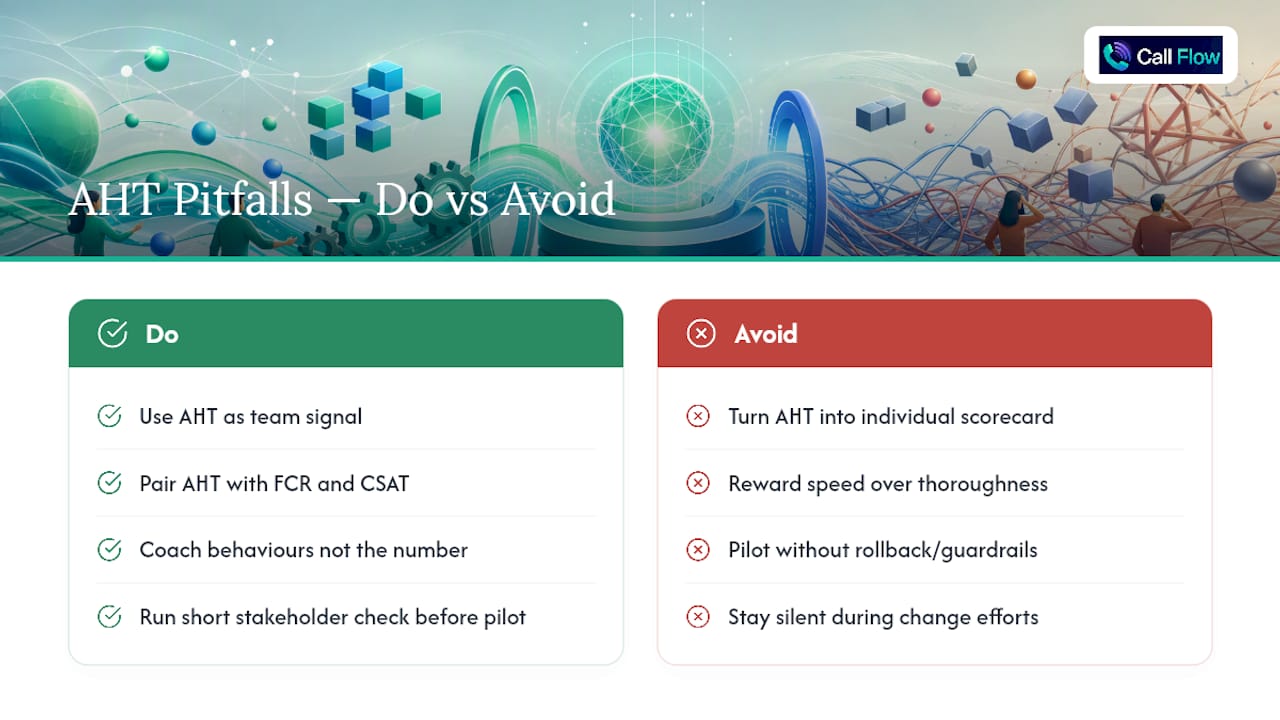
Before launching any pilot, run it past a short stakeholder check: Have agents been told why this is happening and what "success" looks like? Is there a clear rollback plan if guardrail metrics slip? Are the agents piloting new tools getting recognized, not just monitored, for adopting them?
Communicate weekly during a pilot, not just at kickoff and wrap-up. Silence during a change effort reads as surveillance to agents, even when your intentions are good. Recognize the early adopters publicly. The teams that get this right treat agents as partners in the redesign, not subjects of it, and that difference shows up in how fast the rest of the floor buys in.
— Costa