

The highest-impact focus for reducing call center turnover combines three things: faster, better onboarding, daily coaching, and analytics that flag at-risk agents before they quit. This approach lowers hiring costs and raises CSAT scores. Practical training tools, like AI role-play platforms, speed up this work. We built Call Flow around this exact problem.
TL;DR:
- A monthly turnover rate above 7–8% can signal a fixable issue; three rising months warrant more urgency than one poor month.
- Replacing one agent costs $10,000 to $20,000 in recruiting, training, and lost ramp productivity, before accounting for temporary declines in service quality.
- Set onboarding reviews at days 30, 60, and 90, moving from supervised calls to daily coaching before a formal final review.
- Track attendance, quality scores, customer satisfaction, and schedule adherence weekly; check in with flagged agents within 48 hours and review quality two weeks later.
Table of Contents
- What Call Center Turnover Is and How to Calculate It
- Top Causes of Agent Attrition
- Cost and Business Impact of High Turnover, Plus Benchmarks
- Hiring and Selection Practices That Reduce Future Attrition
- Onboarding, Nesting, and Training Tactics That Improve Retention
- Coaching, Engagement, and Daily Rituals That Retain Agents
- Scheduling, Pay, and Well-Being: Operational Fixes to Cut Churn
- Using Data and Early Warning Signs to Prevent Attrition
- Step-by-Step Retention Plan Managers Can Implement in 90 Days
- Evidence Spotlight: Training, Nesting, Huddles, and AI Role-Play as Retention Levers
- A Training Lead's View on Where to Start
- How Call Flow Supports Faster Ramp and Lower Turnover
- FAQ
- Sources
What Call Center Turnover Is and How to Calculate It
Turnover counts agents who leave in a given period. Attrition is a broader term. It sometimes includes internal moves, not just exits. Managers track turnover because it drives staffing costs, training spend, and customer experience scores.
The monthly formula is simple:
Monthly turnover rate = (Number of agents who left during the month / Average number of agents during the month) x 100.
Here is a worked example. Say a team has 50 agents at the start of the month and 46 at the end, with no new hires. Four agents left. Average headcount is 48. Divide 4 by 48. Multiply by 100.
Annual turnover rate = (Total number of agents who left during the year / Average number of agents during the year) x 100.
A few quick rules help managers read the number:
- A monthly rate above 7-8% often signals a specific, fixable problem such as a bad hiring cohort or a scheduling change.
- A steady climb over three consecutive months is more urgent than one bad month.
- Early departures (within the first 90 days) point to hiring or onboarding gaps, not pay.
- Departures after 12+ months often point to career stagnation or management quality.
Calculate both monthly and annual numbers. The monthly figure catches problems early. The annual figure tells leadership whether the fixes are working.
Top Causes of Agent Attrition
Most call center turnover traces back to a small set of root causes. Mapping the cause to an observable signal helps managers act before an agent resigns.
- Hiring-fit problems. Agents hired without a realistic job preview often discover the role does not match their expectations. Watch for early no-shows, late attendance, and resignations inside the first 30 days.
- Weak onboarding and nesting. Agents who ramp slowly feel behind their peers and lose confidence. Watch for low assessment scores during nesting and a spike in supervisor escalations during a new agent's first calls.
- Workload and burnout. Heavy call volume, high after-call work, and limited breaks wear agents down over weeks, not days. Watch for rising average handle time, more sick days, and declining quality assurance (QA) scores.
- Scheduling stress. Unpredictable shifts and last-minute changes make it hard for agents to manage personal obligations. Watch for swap requests, tardiness patterns, and no-shows clustered around certain shifts.
- Lack of career path. Agents who see no next step often disengage months before they resign. Watch for reduced participation in optional training and flat performance after a period of growth.
- Supervisory quality. Inconsistent coaching or poor feedback drives frustration faster than almost any other factor. Watch for a cluster of resignations tied to one team or shift, which usually points to a specific supervisor.
A Walden University dissertation on manager strategies found that managers who rely on structured feedback, development programs, and deliberate hiring practices report better retention outcomes than those who treat turnover as unavoidable. The same research catalogs coaching and feedback as the most commonly cited interventions, which lines up with what shows up operationally: teams with consistent one-on-one coaching see fewer surprise resignations.
Each cause above responds to a different fix. Hiring-fit problems need better screening, not better pay. Burnout needs schedule and workload changes, not more training. Matching the intervention to the cause avoids wasted effort on the wrong lever.
Cost and Business Impact of High Turnover, Plus Benchmarks
Each new contact-center hire can cost between $10,000 and $20,000 once recruiting, training, and lost productivity during ramp-up are counted. For a team losing 10 agents a year, that range translates to $100,000 to $200,000 in replacement cost alone, before counting the dip in service quality while new hires ramp up.
Turnover does not just cost money to replace staff. It drags down the metrics managers are judged on:
- Customer satisfaction scores drop when experienced agents are replaced by new hires still learning the systems.
- First call resolution (FCR) rates fall during ramp periods, pushing more repeat contacts into the queue.
- Supervisor time shifts from coaching to hiring and training, which slows improvement everywhere else.
- Remaining agents absorb extra volume, raising their own burnout risk and compounding the cycle.
SHRM's analysis of post-pandemic turnover pressure notes that organizations treating retention as a strategic talent management problem, not a hiring problem, are better able to weather post-pandemic turnover pressure. That framing matters for how budget gets allocated: retention spend competes with hiring spend, and this framing makes the case for shifting dollars toward keeping agents rather than replacing them.
Hiring and Selection Practices That Reduce Future Attrition
Retention starts before day one. Hiring decisions set the ceiling on how much onboarding and coaching can achieve later.
- Use a realistic job preview during interviews: show real call recordings or role-play a sample interaction so candidates know what the job actually involves.
- Screen for schedule fit explicitly. Ask about availability constraints before the offer stage, not after.
- Add a structured, scorecard-based interview so every candidate is judged against the same criteria, reducing inconsistent hiring decisions across interviewers.
- Include a short role-specific sampling task, such as a mock call or written response to a customer scenario.
- Prioritize soft-skill markers like patience under pressure and clear communication, especially for roles with high call volume or difficult customer segments.
- State the career path and performance expectations plainly during the hiring process, not after the first review cycle.
Pro Tip: Run a 15-minute mock call during the final interview round. It filters for fit faster than a reference check.
These changes cost little to implement and pay off in the first 90 days, which is where most avoidable attrition happens. A scorecard also protects against hiring inconsistency when multiple people interview for the same role, since gut-feel decisions tend to produce weaker long-term fits than structured criteria applied the same way every time.
Onboarding, Nesting, and Training Tactics That Improve Retention
Nesting, the period where new agents take live calls with close supervision, is where early attrition risk peaks. McKinsey's research on contact center talent found that nesting cohorts of at least six agents improve peer support and reduce early dissatisfaction, while very small cohorts correlate with higher dissatisfaction. A hybrid nesting approach, shorter floor time paired with targeted follow-up coaching, balances speed to productivity against the social support agents need in the first weeks.
A 30-60-90 structure gives both the agent and the manager clear checkpoints:
- Days 1-30: Core systems training, supervised calls, and a graded assessment at the end of week four to confirm readiness for independent work.
- Days 31-60: Independent calls with daily check-ins, shadowing from a peer mentor, and weekly practice calls scored against the same criteria used in live QA.
- Days 61-90: Full caseload with reduced check-in frequency, a formal 90-day review, and a conversation about next-level goals.
Deliberate practice, repeated, scored attempts at realistic scenarios, builds competence faster than lecture-style training alone. Role-play exercises let new agents make mistakes before those mistakes reach a live customer, which shortens the anxious period where confidence is lowest and resignation risk is highest. Faster ramp time matters here specifically because the agents most likely to quit in the first 90 days are the ones who feel behind.
Concrete manager actions that support this structure include graded knowledge checks at each checkpoint, structured shadowing pairs rather than ad hoc buddy systems, and scheduled practice calls with feedback tied to the same scorecard used in live monitoring. Our guide to AI role-play training and ready-to-adapt training manual template walk through how to build this structure without starting from a blank page.

Coaching, Engagement, and Daily Rituals That Retain Agents
Retention is built in small, repeated moments, not big annual initiatives. McKinsey's contact center engagement research found that agents satisfied with their jobs are four times more likely to stay at least a year and 16 times more likely to refer friends to open roles, and that frequent, well-structured huddles are one of the strongest levers available to managers, though they are often the first thing cut when call volume spikes.
A few daily and weekly rituals carry most of the weight:
- Run short huddles, 10 minutes or less, more than once a week, each ending with one specific action item agents can apply on their next call.
- Set a micro-coaching cadence: brief, frequent one-on-ones tied directly to recent QA scores rather than a single long monthly review.
- Use small, visible recognition, shout-outs, leaderboards, or point systems, to reinforce good performance in the moment it happens.
- Hold a short career conversation each quarter so agents know what promotion or lateral movement actually requires.
Pro Tip: Never cancel a huddle to handle call volume. Shorten it instead. Five minutes of structured huddle beats zero.
Gamification works best when it reinforces behaviors that matter for the customer, like resolution quality, rather than only speed. A leaderboard built around average handle time alone can push agents toward rushed calls, which shows up later as lower CSAT and more repeat contacts.
Scheduling, Pay, and Well-Being: Operational Fixes to Cut Churn
Scheduling problems drive a meaningful share of early resignations, and most of the fixes are operational rather than expensive.
- Offer flexible scheduling where volume allows, with clear, published rules for how shift swaps get approved.
- Enforce actual breaks. Skipped breaks compound fatigue over a full shift and show up later as declining QA scores.
- Limit repeated mandatory overtime to specific, announced periods rather than an ongoing expectation.
- Use targeted pay levers, such as retention bonuses at the 90-day and one-year marks or shift premiums for hard-to-staff hours, rather than broad raises that do not target the actual pain point.
- Provide access to wellness support, since burnout recovery resources reduce the kind of chronic fatigue that drives resignations months before they happen.
Short-term operational fixes, better swap rules, enforced breaks, capped overtime, can be live within a pay period. Structural pay changes take longer and usually require a budget cycle, so managers should run the operational fixes first while building the case for pay adjustments. For teams building out formal scheduling policy, Desert Roots Wellness's corporate burnout prevention training and Ayyes's guide to employee scheduling best practices offer practical starting frameworks for both the well-being and scheduling sides of this work.
Using Data and Early Warning Signs to Prevent Attrition
A minimal predictive attrition model can be built from 6-10 routinely collected signals, including attendance, shrinkage, QA trends, training completion, CSAT trend, and schedule adherence. These signals, tracked together, let managers flag agents at risk weeks before a resignation letter arrives.
Watch for these combined patterns rather than any single data point in isolation:
- Rising missed shifts or late arrivals over a two-to-four week window.
- A downward QA trend across three or more consecutive scored calls.
- A dip in personal CSAT scores that does not match team-wide trends.
- Increased after-call work time, which often signals an agent struggling to keep pace.
A minimal KPI dashboard reviewed weekly, covering attendance, QA trend, CSAT, and schedule adherence, catches most at-risk patterns without requiring a data science team. McKinsey's service operations guidance notes that analytics-driven early warning lets managers target retention resources efficiently: a small, well-timed intervention for one at-risk agent costs far less than a full replacement hire.
A targeted playbook for flagged agents might include a one-on-one check-in within 48 hours, a short-term schedule adjustment if fatigue is the likely driver, and a follow-up QA review two weeks later to confirm the intervention worked. Pair the dashboard with periodic stay interviews, structured conversations asking engaged agents what keeps them, not just exit interviews asking departing agents why they left. Both data sources matter, and relying on exit interviews alone means managers only learn what went wrong after it is too late to fix it.
Step-by-Step Retention Plan Managers Can Implement in 90 Days
A phased plan keeps retention work from becoming an abstract goal with no owner or deadline.
- Days 1-30: Fix immediate scheduling pain points, launch mandatory weekly huddles, and revise the hiring screen to include a realistic job preview and scorecard.
- Days 31-60: Redesign onboarding around the 30-60-90 structure, start a micro-coaching cadence for all supervisors, and introduce a targeted retention bonus for the 90-day mark.
- Days 61-90: Run the minimal KPI dashboard for four consecutive weeks, measure the monthly turnover rate against the prior quarter, and scale whichever tactics show the clearest improvement.
| Phase | Key actions | Owner | Success metric |
|---|---|---|---|
| Days 1-30 | Schedule fixes, weekly huddles, revised hiring screen | Team leads, HR | Fewer early no-shows, stable attendance |
| Days 31-60 | Onboarding redesign, coaching cadence, retention bonus | Training lead, managers | Faster ramp, improved QA scores |
| Days 61-90 | KPI dashboard review, pilot measurement, scale-up | Operations manager | Lower monthly turnover rate vs. prior quarter |
Each phase builds on the last. Schedule and hiring fixes reduce the number of agents entering the funnel with a high risk of early exit. Onboarding and coaching improve the experience of agents already in that funnel. The data review in the final phase confirms which specific tactic drove the improvement, so budget for the next quarter goes toward what actually worked. Our 30-60-90 training plan guide for managers lays out this same structure with adaptable checklists.
Evidence Spotlight: Training, Nesting, Huddles, and AI Role-Play as Retention Levers
Contact center employees who are satisfied with their job are four times more likely to stay for at least a year and 16 times more likely to refer friends.
McKinsey, Customer care: The future talent factory
The research consensus across McKinsey's contact center studies points to a consistent pattern:
- Frequent, structured huddles correlate with higher satisfaction and performance, yet they are often the first ritual cut when volume spikes, which undercuts exactly the lever that works.
- Nesting cohorts of six or more agents build peer support that smaller cohorts cannot replicate, reducing early dissatisfaction during the hardest weeks on the job.
- Analytics built from routine performance and attendance signals let managers flag at-risk agents early enough to intervene before a resignation decision is final.
Practical training tools can accelerate the same outcomes these studies point to. Faster, more confident ramp reduces the early-attrition window, and built-in grading gives supervisors the structured feedback that research ties to retention. Our own platform's instant AI grading across performance dimensions exists to make that coaching cadence possible without adding supervisor hours, since consistent feedback is the resource most teams run short of first.
A Training Lead's View on Where to Start
If you can fund only one retention initiative this year, fund scalable onboarding paired with daily coaching. Everything else, pay, scheduling, recognition, works better once agents already feel competent and supported in their first 90 days.
Leadership commitment matters more than any single tactic. A coaching cadence that a regional director enforces survives a busy quarter. One that depends on a single enthusiastic supervisor does not.
Start with our real-time call coaching pilot guide if you want a four-to-eight week test before committing to a full program redesign.
— Costa
How Call Flow Supports Faster Ramp and Lower Turnover
We built our platform around the exact gap research points to: agents need repeated, realistic practice and fast feedback, not just a manual and a shadowing shift. Our AI role-play scenarios let agents rehearse real customer situations as often as needed, and instant grading across five performance dimensions gives supervisors the structured feedback that drives the coaching cadence this guide recommends.
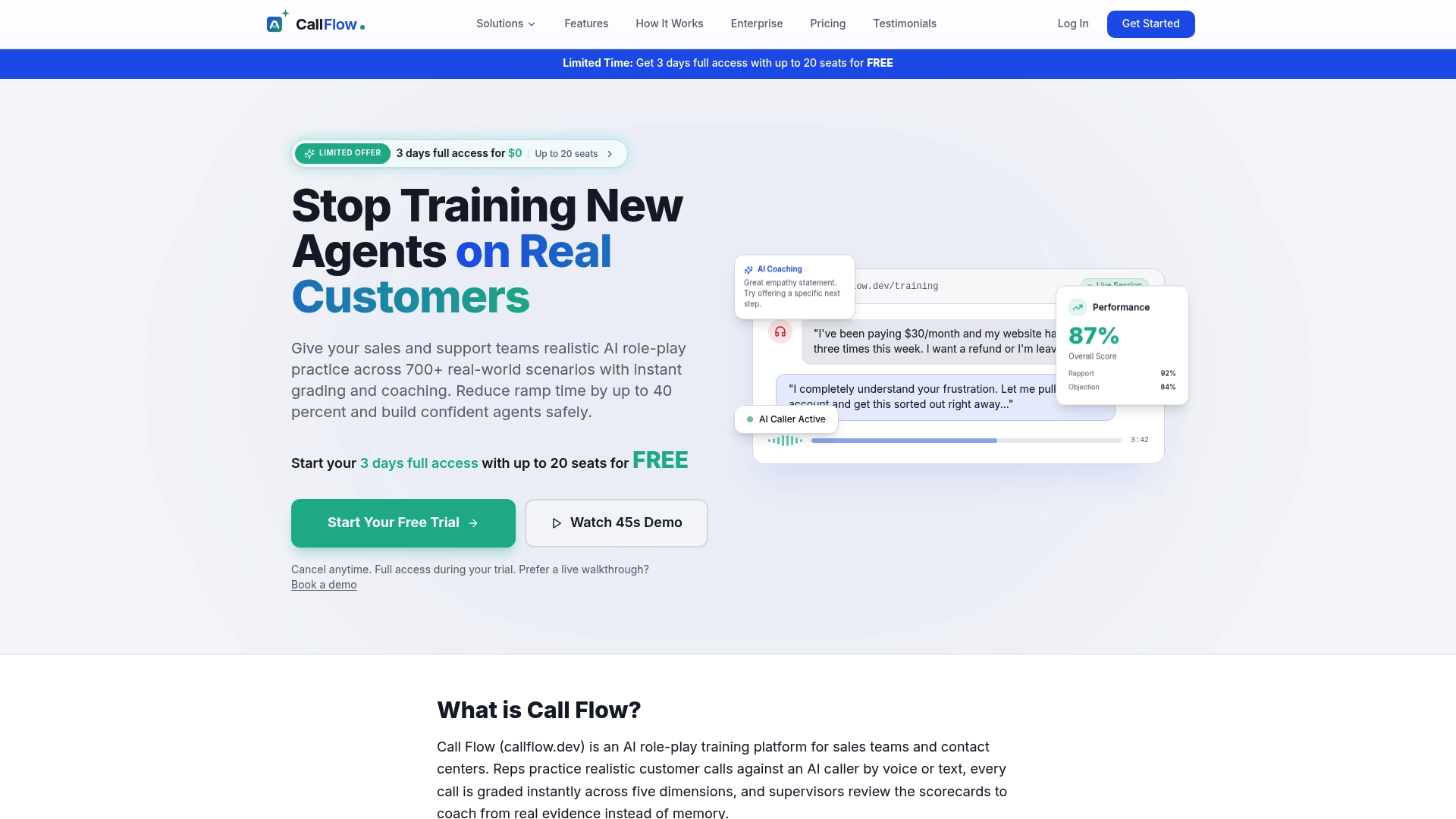
- Supervisor dashboards surface skill gaps early, supporting the same analytics-driven monitoring described above.
- Configurable scenarios match your actual call types, so practice time translates directly to live-call confidence.
- Gamification and skill analytics support the recognition and engagement rituals covered earlier in this guide.
Our Starter plan starts at $7.42 per month, with Growth and Scale tiers available for larger teams, and a risk-free trial so you can test the fit before committing. Larger contact centers can review Business and Enterprise options for a pilot built around your team's size.
FAQ
What is the 80/20 rule in call centers?
The 80/20 rule in call centers most commonly refers to a service-level target: answering 80% of calls within 20 seconds. It is a staffing and scheduling benchmark, not a turnover metric, though understaffing against this target often drives the workload stress that contributes to attrition.
Why is call center turnover so high?
Turnover tends to run high because of a combination of hiring mismatches, weak onboarding, heavy workload, and inconsistent supervisory coaching. Each Walden University's research on manager strategies and McKinsey's engagement studies point to structured feedback and engagement rituals as the clearest counterweights.
What can managers do to reduce turnover?
The most effective combination is a structured hiring screen, a 30-60-90 onboarding plan, frequent short huddles, and a lightweight analytics dashboard to flag at-risk agents early. Nesting cohorts of six or more agents and consistent micro-coaching, as described by McKinsey's contact center research, add measurable improvement on top of these basics.
What is an acceptable turnover rate for a call center?
A monthly turnover rate under 5% is generally considered healthy, while rates climbing past 7-8% for several consecutive months usually signal a specific, fixable problem. Use the monthly formula consistently so you can compare trend lines, not just a single month's snapshot.
How much does replacing a call center agent cost?
Replacing a single contact-center agent can cost $10,000 to $20,000 once recruiting, training, and lost productivity during ramp-up are counted. That range makes retention investment easy to justify against the alternative cost of constant rehiring.
Sources
- Boosting contact-center performance through employee engagement (McKinsey PDF)
- Strategies call center managers use to reduce employee turnover (Walden University dissertation)
- Turnover tsunami expected once pandemic ends (SHRM)