

Customer empathy training teaches agents two linked skills: diagnostic listening and enactment. Start with a short role-play pilot scored on the same rubric you use for live calls. Research on empathy training shows medium gains, and an AI role-play platform like ours lets you repeat that practice at scale without pulling supervisors off the floor.
TL;DR:
- A review of randomized trials found empathy training effects measured 0.52 immediately after training, peaked at 0.69 by 12 weeks, then fell to 0.34.
- Score empathy within technical QA checks, including whether agents acknowledge the customer’s specific emotion before offering a solution, rather than as a separate soft skill.
- Measure outcomes immediately, again at 4 to 12 weeks, and at 3 to 6 months, tracking QA scores, customer satisfaction, first call resolution, and escalations.
- Use workshops or cohorts for onboarding, online lessons with practice for refreshers, and simulation for ongoing coaching; manually compare AI scores with supervisors’ judgments.
Table of Contents
- Why does empathy matter for contact centers?
- Which core empathy skills should you train?
- Which empathy exercises can trainers run this week?
- Which training format fits your team?
- How do you measure whether empathy training works?
- How do you build a repeatable empathy program?
- What makes role-play and simulation realistic?
- A quick checklist for busy leaders
- How can an AI role-play platform speed up empathy training?
- FAQ
- Sources
Why does empathy matter for contact centers?
Empathy is a de-escalation tool. Research on call center interactions finds that attentive and cognitive empathy, meaning listening for the customer's need and then saying what you will do about it, keeps calls moving and supports first-call resolution and satisfaction better than a generic apology.
The training evidence is solid. A meta-analysis of randomized controlled trials found empathy training works overall, with a medium effect (g = 0.63) that dropped to 0.51 after correcting for publication bias.
A 2023 systematic review of 44 studies found 68.2% reported significant gains in empathy-based service skills. Empathy training can help, though results vary. The question is whether the gains last.
Durability needs reinforcement. A systematic review of randomized trials reported a moderate effect right after training (SMD 0.52), a stronger one up to 12 weeks (0.69), and a smaller but still significant one beyond 12 weeks (0.34). Plan booster practice from day one.

Which core empathy skills should you train?
Service research points to four trainable competencies. A mixed-methods review of 44 studies names them, and a PLOS One version of that review confirms them as core skills for service work:
- Communication: the agent paraphrases the problem in plain words and confirms they heard it right.
- Relationship building: the agent uses the customer's name, keeps a steady tone, and stays on their side of the problem.
- Emotional resilience: the agent stays calm when a customer is angry and does not take it personally.
- Counseling skills: the agent asks open questions that surface the real need behind the complaint.
Together these make up empathy work: diagnostic listening to read the customer's emotion and need, then enactment through attentive language and concrete action. Cognitive empathy that explains the next step tends to outperform a sympathetic phrase with no follow-through.
Do not score empathy as a separate soft-skills line. Build it into the technical checks, for example: "Did the agent acknowledge the specific emotion before offering a solution?" Our guide to communication skills for agents maps these competencies to call behaviors.
Which empathy exercises can trainers run this week?
Keep each exercise short and tied to one behavior. Here are twelve, each with a clear objective:
- Active listening pairs (10 minutes): One agent describes a problem, the other paraphrases it. Objective: accurate restating before advising. See our active listening guide.
- Defending an unreasonable request: Agents argue for a customer's odd demand. Objective: understand the logic behind it.
- Escalation role-play: Run an angry-caller scenario. Our angry customer scenarios fit this slot.
- Empathy map: Agents chart what a customer thinks, feels, and does during a case.
- Empathy bingo (10 minutes): A card of empathic phrases; agents mark them off during practice calls.
- Polite eavesdropping: Agents review a recorded call and note emotional cues.
- Guided reflection (10 minutes): Each agent names one moment they could have acknowledged feeling sooner.
- Scripting empathetic language: Rewrite flat lines into specific acknowledgments.
- Committed close (10 minutes): Practice ending with a named next step and a time frame.
- Emotion labeling: Facilitator reads a customer line; agents name the emotion.
- Silence practice (5 minutes): Agents hold a pause after a complaint before replying.
- Peer scoring: Agents score each other with the live QA rubric.
Facilitators should prompt with "What did you hear under the words?" and expect agents to leave with one rewritten phrase. Mix micro-practice with a longer session each month. Our copy-ready role-play scenarios save prep time.
Which training format fits your team?
Match the format to the goal and the headcount:
- In-person workshop: Deep and social, with room for debrief. A university two-day empathy workshop pairs role-play with reflection and train-the-trainer follow-ups. It is costly to schedule for large floors.
- Cohort-based facilitated practice: Small groups meet weekly with a coach. Good for new hires, but it depends on facilitator time.
- Asynchronous e-learning: Cheap to scale and easy to certify. Collections such as edX's workplace learning catalog and its empathy and emotional intelligence course are quick starts. They build knowledge, not call behavior, so pair them with practice.
- Simulation and AI role-play: Repeatable on demand with instant scoring. It suits ongoing coaching and busy shifts, though it still needs a human review for tough cases.
Use workshops or cohorts for new-hire onboarding, e-learning for a mass refresher, and simulation for ongoing coaching. Whatever you pick, avoid the one-time event: training fails when it is a single session.
How do you measure whether empathy training works?
Use the Kirkpatrick model, one level at a time:
- Level 1, reaction: a short post-session survey on usefulness.
- Level 2, learning: a scored role-play or knowledge check.
- Level 3, behavior: QA rubric scores on live calls, especially the empathy-in-workflow items.
- Level 4, results: CSAT, first-call resolution, and escalation rate.
Check at three points: right after training, at 4 to 12 weeks, and in a business review at 3 to 6 months for Level 4. Follow-up matters because the effect of empathy interventions can persist beyond 12 weeks, though it may be smaller.
Listening training reduced agent anxiety and raised perspective-taking, with effects that persisted in experimental studies. Track agent confidence next to customer metrics. A related quasi-experimental study supports the same conclusion.
Calibration is the practical lever. Score role-plays with the exact rubric used on live calls, so agents see practice scores carry over. Our post on aligning QA to scorecards shows how. For dashboards, this guide to business intelligence for customer service covers KPI reporting.
How do you build a repeatable empathy program?
Start small, then scale on evidence:
- Pick a pilot cohort: one team, enough agents to see a pattern.
- Run weekly sessions: a 15-minute micro-practice plus one longer role-play every month.
- Set success criteria before you start: a lift in the empathy items on your QA rubric and a stable or falling escalation rate.
- Add manager checkpoints: supervisors coach one empathy behavior per agent from QA data.
- Schedule boosters: repeat core scenarios at the 12-week mark.
- Scale when the pilot clears its criteria: extend to the next teams with the same rubric.
Budget for interpersonal skills as a standing line, not a launch cost. Research on service design recommends making empathy part of the system, using empathy maps and process maps aligned to the customer journey, so it is not left to individuals. Give soft skills a steady share of training time alongside product knowledge rather than a one-off day.
What makes role-play and simulation realistic?
Build each scenario in three phases: opening, escalation, and resolution. Branch the story on explicit action flags: empathy, apology, proposal, assertiveness, and distancing. If the agent skips an empathic statement, the virtual customer pushes back.
Score scenarios with the live-call QA rubric. When practice grading matches the metrics agents are held to, transfer to real calls improves.
Set realistic expectations for AI role-play. A recent workplace deployment of LLM role-play training used adaptive virtual customers and a virtual coach. It showed strong immediate motivation and mixed 4-week outcomes. So treat AI practice as a motivator and a repetition engine, and evaluate it against your own KPIs.
Pro Tip: Review a sample of AI-scored role-plays by hand each week until the scores match your supervisors' judgment.
A quick checklist for busy leaders
My view: leaders overspend on content and underspend on repetition. Six moves matter most:
- Pilot a role-play: evidence shows gains, and a pilot proves them locally.
- Align the QA rubric: practice only transfers when the scoring matches.
- Schedule recurring micro-practice: effects may become smaller over time, though they can persist beyond 12 weeks.
- Track three KPIs: CSAT, first-call resolution, escalations.
- Coach managers on diagnostic listening: they reinforce it daily.
- Offer booster sessions: they protect the gains.
— Costa
How can an AI role-play platform speed up empathy training?
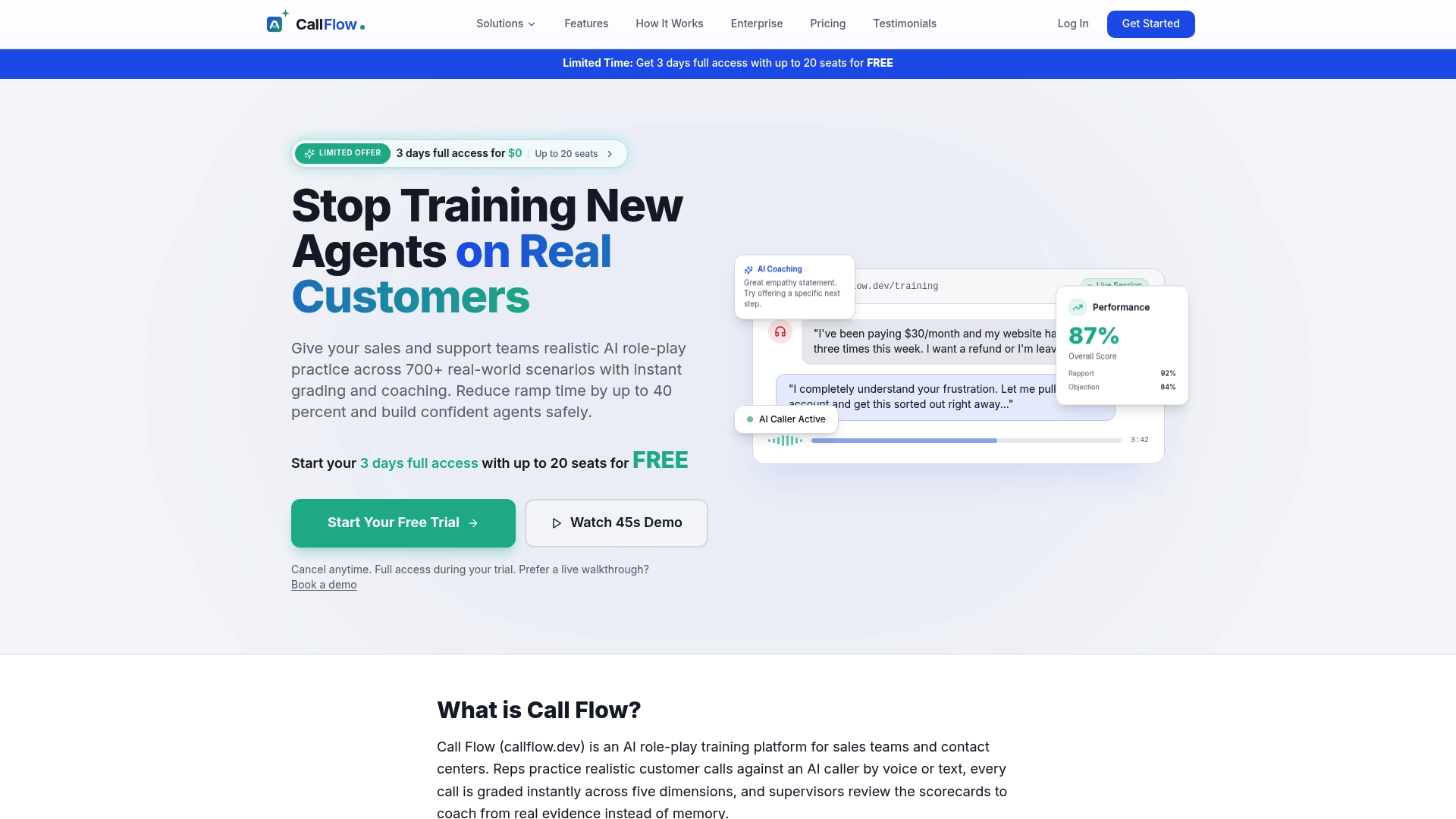
Practice is the bottleneck: supervisors cannot role-play with every agent every week. Call Flow helps teams practice without relying on supervisors to role-play with every agent. Teams can practice through realistic calls without waiting for a coach. Here is what we provide:
- AI role-play for sales and support calls, by voice or text
- Instant grading and coaching across five performance dimensions
- A scenario library plus custom scenario creation
- Supervisor review and override so scores match your QA standards
Agents can repeat the same scenario for consistent practice, and you ramp new hires faster. Review plans on our pricing page, or see our enterprise page for larger teams. Start with the risk-free trial and run your first empathy pilot this month.
FAQ
What are the 4 A's of customer empathy?
There is no single standard list, and versions differ by trainer. A common one is acknowledge, attend, apologize, and act. Whatever your version, check that it maps to diagnostic listening and a concrete next step.
How do you teach empathy in customer service?
Teach it as a behavior, not a personality trait. Combine listening drills, short role-plays, and QA feedback on the same rubric used for live calls. Reinforce it every few weeks, since gains decline after about 12 weeks without it.
What is the 5 step method for empathy?
Definitions vary, but a workable version is: listen fully, name the emotion, show you understand the cause, state what you will do, and confirm the customer is satisfied. Each step can be scored as a QA behavior.
How long does empathy training take to show results?
Immediate gains are common, and effects were strongest up to 12 weeks in one review. Plan a later review for business results like CSAT and escalation rate.
Sources
- Pubmed
- The efficacy of empathy training: A meta-analysis of randomized controlled trials
- Assessing the effect of empathy-enhancing interventions in health education and training: a systematic review of randomised controlled trials
- Frontiers | Preventing escalation in customer service: immediate motivation and 4-week outcomes in a workplace deployment of LLM role-play training