

Discovery call training teaches reps to run the first real sales conversation: find the buyer's problem, test the fit, and agree on a next step. It works best in three parts. Give reps a simple framework. Let them practice it out loud. Coach each call against clear criteria. This guide covers all three.
TL;DR
- A discovery call is an early call used to learn the prospect's pains, goals, decision process and resources, and to decide if there is a fit.
- Teach one repeatable structure: agenda, open questions, pain and consequence, stakeholders, qualification, committed next step.
- Reps improve by speaking, not by reading scripts. Use role-play with scored feedback.
- Coach with a short rubric. Score the same dimensions on every call so progress is visible.
- AI role-play lets every rep practice daily without tying up a manager.
Table of Contents
- What a discovery call is for
- A six-stage discovery call framework
- How to prepare for the call
- Practice: where discovery skill is built
- Coaching discovery calls
- A four-week plan for a new discovery program
- Perspective: what we see in discovery training
- Try discovery practice with your team
- FAQ
- Sources
What a discovery call is for
A discovery call is an early conversation with a prospect. Salesforce describes it as a call to determine fit and uncover motivations, pains, goals, decision-makers, the buying process and available resources. Mailchimp's definition is similar: an exploratory talk to identify pain points and see if the person needs what you sell.
The goal is not to pitch. The goal is to learn enough to do two things:
- Decide whether this opportunity is a fit. Aviso frames the objective as qualifying or disqualifying the buyer.
- Agree on a useful next action.
This changes what you train. A rep who talks for 25 minutes about features has run a demo, not a discovery call. A rep who asks ten questions in a row has run an interrogation. Good discovery sounds like a conversation where the prospect does most of the talking and the rep steers.
What reps get wrong
The same errors show up on most teams:
- They pitch before they understand the problem.
- They ask closed questions that produce one-word answers.
- They stop at the first pain and never ask what it costs.
- They talk to one contact and never learn who else decides.
- They end with "I'll send some info" instead of a dated next step.
Each of these is a skill. Each can be practiced. That is the case for training rather than just giving reps a question list.
A six-stage discovery call framework
Reps need a structure they can hold in their head. ZoomInfo's guide lays out six stages: agenda, open-ended investigation, pain and consequence, stakeholders and buying committee, qualification dimensions such as BANT or MEDDIC, and a specific committed next step. It keeps discovery structured without turning it into a rigid checklist.

Here is how to teach each stage.
1. Open with an agenda
State why you are on the call, how long it will take, and what you want to cover. Ask if the prospect wants to add anything. This takes 30 seconds and sets you up as the person leading.
Train this line until it sounds natural. Reps who skip it drift.
2. Investigate with open questions
Ask about the prospect's role, recurring challenges, current solution, goals and priorities. Outreach's list of discovery questions covers these areas, plus the decision process, who approves, who sets the budget and when a solution should be in place.
Teach reps to follow the answer, not the list. The best next question comes from what the prospect just said.
3. Dig into pain and consequence
A stated problem is not yet a reason to buy. Reps need to ask what the problem costs and what happens if nothing changes. Aviso recommends exploring the business impact of ongoing projects and the repercussions of missing goals.
Sample prompts to drill:
- "What does that cost you each month?"
- "What happens if this is still the same in six months?"
- "Who else feels this?"
4. Map stakeholders and the buying process
Ask who else is involved, how decisions get made, and what a typical approval looks like. Reps often avoid this because it feels pushy. Teach them to ask it as help: "So I can send the right information to the right people, who else should see this?"
5. Qualify
Use whatever method your team already runs, such as BANT or MEDDIC. The point is the same: budget context, authority, need, timing. If the answers say no fit, a good rep says so politely and moves on. That saves everyone time.
6. Close with a committed next step
End with a specific action, a date and attendees. Salesforce suggests saving the last five minutes of the call for a clear action item. A next step like "Thursday at 2 p.m., with your finance lead, to review a pilot scope" beats "let's reconnect soon."
How to prepare for the call
Training should include prep, because weak prep shows up in the first minute. ZoomInfo's guide suggests checking CRM history, LinkedIn activity, recent company news, funding and leadership changes, technology stack, fiscal-year timing and stakeholder roles. It also suggests drafting an agenda and considering sending questions ahead.
Salesforce recommends researching the prospect and industry, setting an agenda, and keeping calls under 60 minutes, or 30 minutes when possible.
A small academic study points to what experienced reps actually use. A University of Arkansas study of 10 experienced technology sales professionals at a midsized U.S. software company found that prior customer experience, organizational and strategy cues, customer behavior cues and conversation value shaped first-call decisions. Product training was not a critical element. The sample is small, so treat it as a signal, not a rule. Still, it fits what most managers see: reading the situation matters more than reciting product facts.
A ten-minute prep routine
Give every rep the same routine:
- Read the CRM notes and any past emails.
- Scan the contact's role and the company's recent news.
- Write one hypothesis about the likely problem.
- Write three open questions that test it.
- Write the agenda in one sentence.
- Decide what next step you want to ask for.
Reps who do this walk in with a plan and still stay flexible.
Practice: where discovery skill is built
Reading a framework does not change how a rep sounds on a live call. Speaking does. Discovery needs real-time listening and quick follow-up questions, and only practice builds that.
Manager-led mock calls
HubSpot describes a mock call as a low-stakes dry run in which a manager or interviewer plays the prospect, so the rep's strengths and gaps can be observed directly. This works. It also has limits:
- It takes manager time. One 20-minute mock plus feedback per rep per week is a lot on a team of ten.
- Managers play the prospect differently each time, so reps get uneven practice.
- Reps can feel watched, so they play it safe.
Peer role-play fixes some of the time cost but adds new problems. Peers know each other's habits, go easy, and rarely give structured feedback.
AI role-play
AI simulation removes the scheduling problem. A rep can run a discovery call at 7 a.m. or between meetings, get a different buyer each time, and see a score right away.
There is early evidence at scale. The Sales Management Association reported on a University of Houston program where the Sales Excellence Institute replaced more than 325 hours of live role-play logistics with over 21,000 self-directed AI simulations for 1,350 students. The institute reported gains in skill development, consistency and efficiency.
For more on how this works for teams, see our guide to AI role play training for sales and contact centers and our look at simulation-based learning.
Discovery drills that work
Short, focused reps beat long ones. Try these:
- The silent buyer. The simulated prospect gives short answers. The rep must use open questions to draw them out.
- The vague pain. The prospect says "things are slow." The rep must find the specific problem and its cost.
- The hidden decider. The contact is not the buyer. The rep must learn who is without losing the contact.
- The early pitch trap. The prospect asks about price in minute two. The rep must redirect without dodging.
- The weak close. Run the last five minutes only. Practice asking for a dated next step.
Our post on sales role play games has more formats. Drills for pushback live in objection handling practice.
Sales teams that sell through consultative conversations at the counter, such as retail finance offers, face the same need. This guide on training sales staff to offer financing shows how a structured first conversation applies in that setting. Teams in real estate can also build client-facing skills with a client and presentation skills course.
Coaching discovery calls
Practice without feedback repeats mistakes. Feedback without a rubric turns into opinion. Use a short rubric and score every call the same way.
A simple discovery rubric
| Dimension | What good looks like |
|---|---|
| Opening | States purpose, time and agenda; invites changes |
| Questions | Mostly open; follows the prospect's answers |
| Pain and impact | Finds the problem and what it costs |
| Stakeholders | Learns who decides and how |
| Next step | Asks for a specific action, date and attendees |
Score each from 1 to 5 and add one sentence of evidence. Limit feedback to the one or two lowest scores. A rep can fix two things at a time, not eight.
Measure coaching itself
Managers need to track their coaching, not only rep results. The Sales Management Association's Dun & Bradstreet case study describes measuring both the quantity and the quality of manager coaching, and reviewing that data next to sales results. The idea carries over to a small team: log how many coaching sessions each rep gets and how good they are, then compare against win rates and stage conversion.
If you want a full manager routine, read our coaching framework for sales managers. For distributed teams, use the remote sales coaching checklist.
Review real calls too
AI practice builds habits. Real calls show whether the habits transfer. Pick one recorded call per rep each week. Score it with the same rubric. Compare the real score to the practice score. A gap means the practice scenarios are too easy or too far from your market.
A four-week plan for a new discovery program
Keep the first month simple.
Week 1: baseline. Have each rep run the same simulated discovery call. Record scores on the five rubric dimensions. This is your starting point. Our guide to a one-week call simulation pilot shows how to set this up.
Week 2: teach the framework. Run a 45-minute session on the six stages. Use two real calls, one good and one weak, as examples. Reps then practice stages 1 and 6 only, since opening and closing are easiest to fix.
Week 3: drill the middle. Focus on pain, consequence and stakeholders. Assign three short simulations per rep. Review the lowest scores in a team huddle.
Week 4: transfer. Reps use the framework on live calls. Managers score one real call each. Re-run the baseline simulation and compare.
Then keep it going. Skills fade without repetition, so schedule two or three short practice calls a week for every rep, new hires and veterans alike.

Perspective: what we see in discovery training
Most discovery training fails for one reason. It teaches reps what to ask but never lets them say it out loud under pressure.
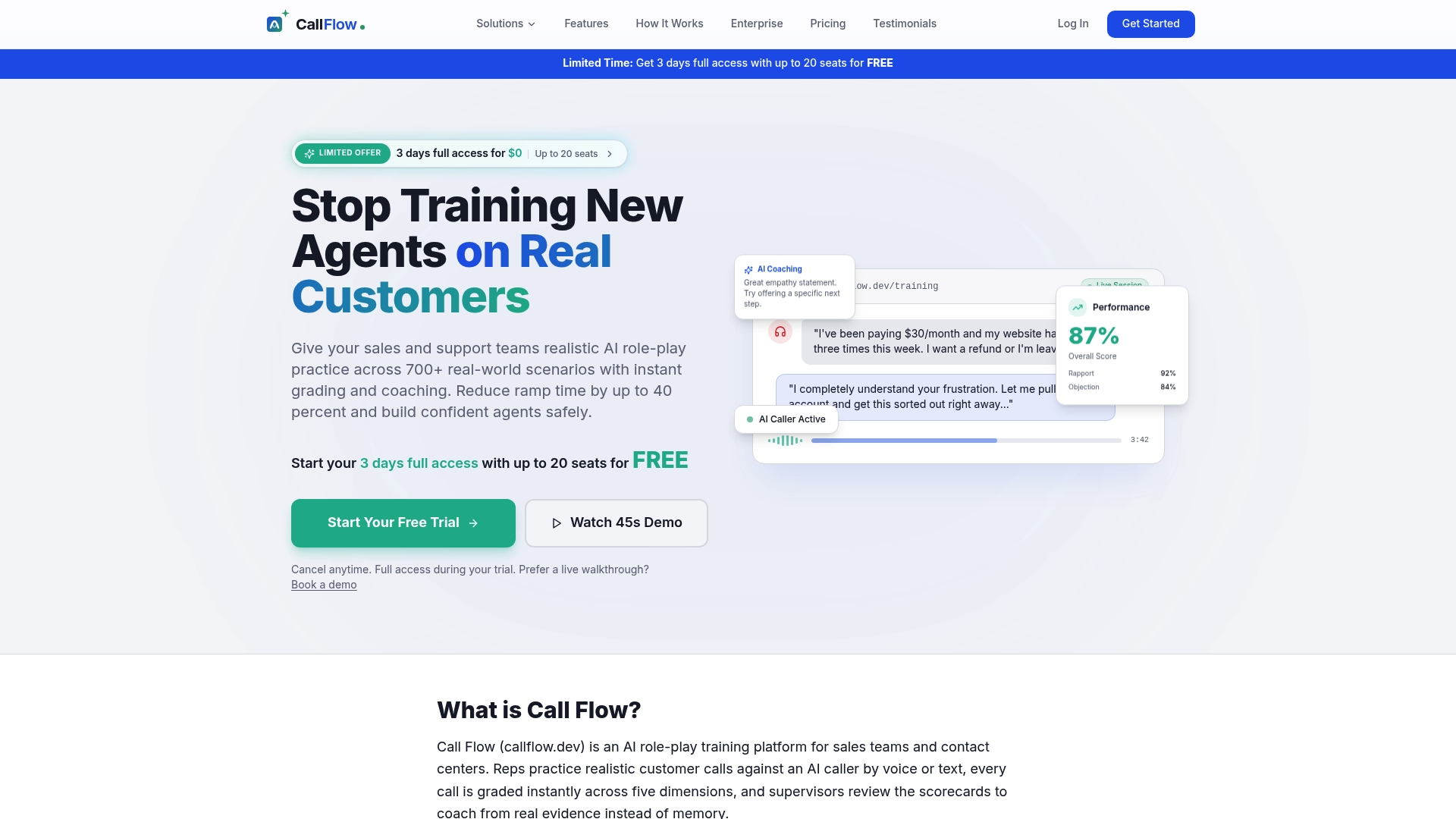
We built Callflow around that gap. Reps practice with a simulated buyer by voice or text. They get a score across five performance dimensions as soon as the call ends, plus coaching notes on what to change. Managers see the scores in a dashboard and can review and override them. Scoring can be aligned to the QA standards a team already uses, so practice results match how managers judge real calls.
Our published figures are a 147% faster ramp time and a 129% improvement in resolution rates. Results depend on how often a team practices and how well it follows through on coaching. The tool does not replace the manager. It gives the manager more good practice reps to coach from.
Our advice: pick one framework, one rubric and one practice habit. Do not add more until those stick.
— Costa
Try discovery practice with your team
Callflow gives your team realistic discovery scenarios, instant scoring and coaching feedback. You can run custom scenarios built from your own buyers and track skill growth on a supervisor dashboard. Start with the free full-feature trial and run a baseline before you buy.
Plans are published at Callflow pricing:
| Plan | Monthly | Annual |
|---|---|---|
| Starter | $7.42 per month | $89 per year |
| Growth | $14.92 per month | $179 per year |
| Scale | $33.25 per month | $399 per year |
Business and Enterprise plans have no published price. See the enterprise page for details.
For a wider view of the approach, see AI sales training for managers and the evidence on simulation benefits.
FAQ
How long should a discovery call be?
Salesforce advises keeping calls under 60 minutes, and 30 minutes when possible. Hold the last five minutes for the next step. Train reps to pace the call so pain and stakeholders get covered before time runs out.
How many questions should a rep ask?
There is no right number. Reps should ask enough open questions to cover the prospect's challenges, goals, impact, stakeholders and timing. Teach them to follow answers instead of working down a list.
How often should reps practice discovery calls?
Short and frequent beats long and rare. Two or three practice calls a week, each under 15 minutes, is a workable target for most teams. Add a weekly review of one real call to check that practice carries over.
Do experienced reps need discovery call training?
Yes, but a different kind. Veterans often have habits such as pitching early or skipping stakeholder questions. Baseline scoring shows which habits to fix, so coaching targets the gap instead of repeating basics.
Sources
- Salesforce: What is a Discovery Call?
- Mailchimp: Discovery Calls
- Aviso: Discovery Call definition, steps and questions
- ZoomInfo: Discovery Calls, A Complete Guide
- University of Arkansas: Naturalistic Decision Making in First Sales Calls
- Outreach: Essential discovery call questions
- HubSpot: The Mock Call
- Sales Management Association: How AI is Revolutionizing Sales Training
- Sales Management Association: Raising Front-Line Managers' Sales Coaching Proficiency at Dun & Bradstreet
- Training Sales Staff to Offer Financing
- Real Estate Client & Presentation Skills Package