
The most effective remote sales coaching combines structured, predictable 1:1s with async call reviews, AI-augmented role-play practice, and a small set of behavior metrics rather than outcome-only tracking. Call Flow's role-play data shows teams using AI-driven practice loops ramp new reps significantly faster and see call resolution improve markedly when practice pairs with regular manager coaching.
TL;DR:
- Tracking behavior metrics such as talk-to-listen ratio, discovery question quality, and multi-threading provides early signals of coaching effectiveness well before outcomes improve.
- Building a remote coaching system in stages, starting with call recording and baseline behavior measurement, prevents burnout and ensures sustainable scaling.
- Short, focused drills and async call reviews with instant AI feedback are more effective than general role-plays for developing specific sales skills.
- Limiting triggers to high-impact behaviors like long monologues or few open-ended questions reduces alert fatigue and increases coaching precision.
- Using a simple, integrated tech stack with call recording, practice platforms, async feedback, and CRM data maximizes coaching impact and compliance.
Table of Contents
- What Makes Remote Sales Coaching Different (and Why It Matters)
- A Step-by-Step Remote Coaching Process That Scales
- Virtual Training Activities That Actually Build Skill
- The Remote Coaching Tech Stack (and Where AI Actually Helps)
- Metrics and Dashboards That Actually Prove Coaching Works
- A Sample Weekly Rhythm for a Remote Sales Manager
- How AI Role-Play Platforms Fit Into Manager-Led Coaching
- Legal and Privacy Considerations in Remote Sales Coaching
- Author Perspective: 30/60/90 Priorities That Actually Matter
- Try Call Flow as Your Practice and Feedback Layer
- Sources
- FAQ
What Makes Remote Sales Coaching Different (and Why It Matters)
Office-based coaching runs on ambient information. A manager overhears a rough call, catches body language after a rejection, and jumps in before a bad habit calcifies. None of that exists on a distributed team. You get outcome data (deals closed, calls logged) but almost nothing on how a rep actually behaved on the call that produced that outcome.
That gap has real cost. Coaching built on lagging indicators like closed revenue is too slow to catch the behavior that caused the miss. By the time a manager notices a rep's numbers slipping, the underlying habit (talking too much, skipping discovery, failing to multi-thread into a second stakeholder) has already repeated across dozens of calls. Remote teams also carry higher ramp risk: new reps have fewer chances to shadow a peer, ask a quick question, or absorb tone from osmosis, so ramp time stretches and early-tenure turnover climbs.
The fix is shifting from reactive spot-checks to proactive, behavior-based coaching systems built on leading indicators, not just the deals that close. That means watching:
- Talk-to-listen ratio on discovery and demo calls, not just win rate.
- Discovery question quality (open versus closed, follow-up depth).
- Objection handling patterns across a rep's last ten calls, not one flagged call.
- Multi-threading behavior, meaning whether a rep is reaching more than one stakeholder per account.
None of these show up in a CRM pipeline report. All of them predict the outcome report you'll see three weeks later.
A Step-by-Step Remote Coaching Process That Scales
Most remote coaching programs fail for a boring reason: managers try to run the whole system at once, burn out in six weeks, and quietly drop back to spot-checking whoever complains loudest. Building it in stages fixes that.
1. Build the foundation first
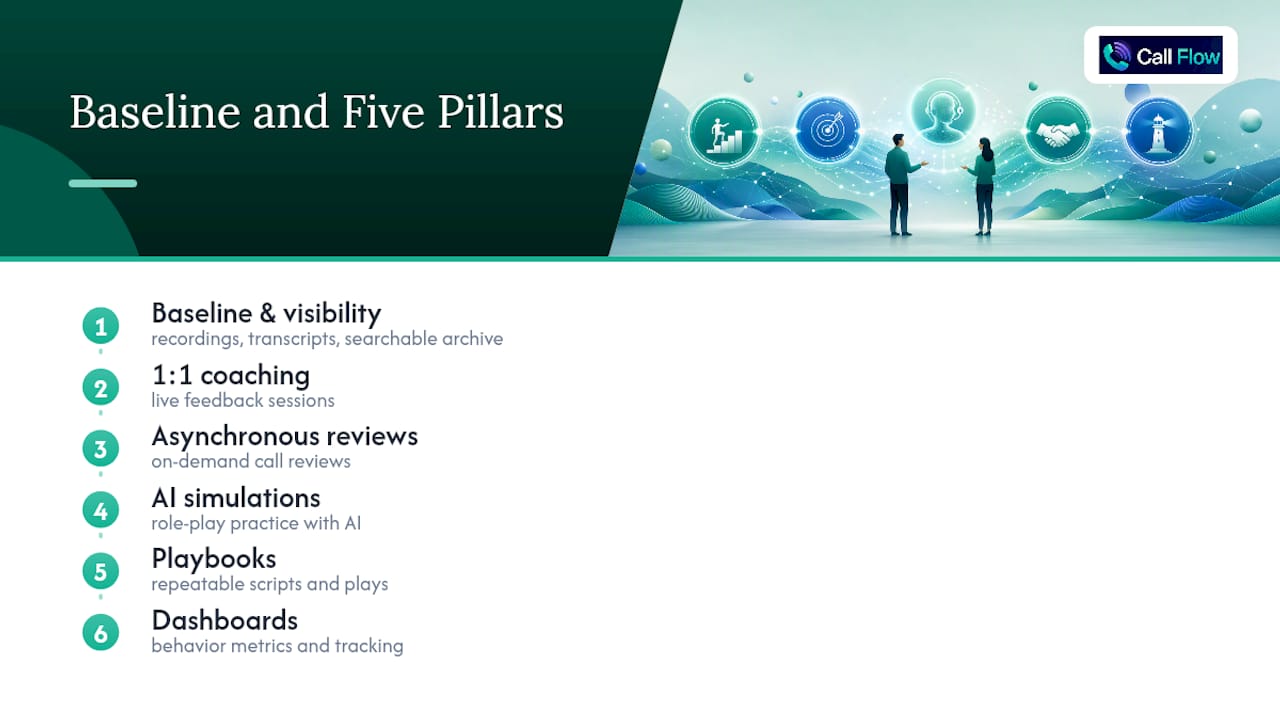
Before you coach anything, you need to see it. That means recorded calls, transcripts, and a searchable archive, not just a CRM note that says "good call." Once visibility exists, baseline your team's current behavior metrics for two to three weeks with zero intervention. A structured five-pillar approach, pairing 1:1s, async reviews, AI simulations, playbooks, and dashboards, gives remote teams a foundation that in some cases outperforms in-person coaching once it's running.
2. Set up triggers, but start narrow
Once you have data, it's tempting to flag everything. Don't. Alert fatigue kills adoption faster than bad data does. Pick two or three high-impact triggers, such as a monologue that runs past 90 seconds uninterrupted, or a discovery call with fewer than three open-ended questions, and prove those catch real problems before adding more. Conversation intelligence tools let you surface these moments in near real time, which shortens the gap between a bad habit forming and a manager catching it.
3. Build the weekly operating rhythm
This is where the program becomes routine instead of a project. Structured 1:1s happen on a fixed cadence (weekly, same day, same length). Async call reviews happen between 1:1s so the meeting itself is discussion, not discovery. Group practice sessions target one skill at a time. Peer pods let reps review each other's calls using the same rubric a manager would use.
4. Scale with calibration, not more manager hours
A manager can realistically run quality coaching for 8 to 12 reps within roughly 6 to 8 hours a week of dashboard review, async feedback, 1:1s, and group practice. Past that headcount, the math stops working. The answer isn't hiring more managers immediately, it's shifting some review load to calibrated peer pods and standardized playbooks so quality doesn't depend entirely on one person's attention span.
Pro Tip: Run your first trigger-based alert on a single team of three to five reps for two weeks before rolling it out wider. You'll catch the false positives while the blast radius is small.
Virtual Training Activities That Actually Build Skill
Generic "role-play practice" sessions fail because they try to fix everything at once. Tight, single-skill drills work better than sprawling mock calls.
- 10 to 20 minute skill drills. Pick one behavior (opening a cold call, handling a pricing objection, asking a second discovery question after the first answer) and drill it in isolation. Shorter sessions with a single focus beat hour-long "full call" role-plays almost every time.
- Async call review workflow. Have reps submit one call a week with a self-identified win, one challenge, and a timestamped note on the moment they want feedback on. The manager responds with 2 to 3 minutes of recorded audio feedback rather than a wall of text. Async audio feedback tends to land as more personal and more actionable than written comments, largely because tone carries information text can't.
- Monthly skill themes. Instead of coaching ten skills badly, pick one per month (multi-threading in March, discovery depth in April) and run group role-plays around it every week.
- Peer coaching pods. Group four to six reps, give them the same scoring rubric a manager uses, and let them review each other's calls. Calibrate scores monthly by having the manager review a sample from each pod and compare.
Closing calls are a natural theme month, and proven closing techniques give pods a concrete script to practice against rather than an abstract skill.
The Remote Coaching Tech Stack (and Where AI Actually Helps)
You don't need a dozen tools. You need four categories covered well.
- Conversation intelligence / call recording. This is your visibility layer, transcripts, searchability, and the raw material for coaching.
- Practice and simulation platform. This is where reps rehearse scenarios between live calls, ideally with instant scoring so they know immediately what to fix.
- Async feedback tool. A short recorded video or audio note (Loom is the common choice) beats a paragraph of written notes almost every time.
- CRM integration. Without this, you can't connect a behavior change to a revenue outcome, which means you can't prove coaching worked.
A minimal, well-integrated stack covering these four categories outperforms a sprawling toolkit nobody fully uses. On triggers specifically, start with the two or three behaviors that predict the most churn or the most lost deals, and resist the urge to flag every minor deviation. That's also where AI tools can quietly help, automating the routine follow-up nudges so managers spend their attention on actual coaching instead of chasing submission reminders.
AI adds the most value in three specific spots: scalable role-play (a rep can practice at 9 p.m. without a manager present), instant multi-dimensional scoring (feedback in seconds instead of days), and surfacing which specific call moments deserve a manager's attention instead of forcing a manager to scrub every recording manually.
Metrics and Dashboards That Actually Prove Coaching Works
Track three layers, not one. Activity metrics (calls made, meetings booked) tell you volume. Skill and behavior metrics (talk-to-listen ratio, discovery question quality, multi-threading, follow-through on committed changes) tell you whether coaching is landing. Outcome metrics (win rate, deal size, cycle length) tell you whether it eventually pays off.
The mistake most dashboards make is skipping straight to outcomes and ignoring the middle layer, which is exactly where coaching impact shows up first. Behavior shifts consistently show up before revenue does, which gives managers an early read on whether a coaching push is working weeks before the pipeline reports would tell them anything.
- Talk-to-listen ratio, tracked per rep, per week.
- Discovery question count and quality (open vs. closed).
- Multi-threading rate, meaning contacts reached per active account.
- Follow-through rate: did the specific change committed to in the last 1:1 show up in the next call?
That last one is the single most useful leading indicator available. Tracking whether a committed change appears in the next recorded call as a simple yes or no gives you a fast, binary signal that coaching is actually changing behavior, well before it shows up in a quarterly number.
For basic ROI math: take the ramp-time difference between reps who get structured coaching and those who don't, multiply by average quota attainment per week of ramp saved, and you have a defensible number to bring to leadership without needing a data science team.
A Sample Weekly Rhythm for a Remote Sales Manager
A workable week for a manager coaching 8 to 12 reps looks like this:
- Monday morning: 30 minutes reviewing last week's dashboard (talk ratios, discovery scores, follow-through rate).
- Tuesday through Thursday: Async call reviews, 15 to 20 minutes per rep, submitted with a timestamped note and returned as 2 to 3 minutes of recorded feedback.
- Wednesday: One 30-minute group practice session on the month's skill theme.
- Thursday or Friday: Individual 1:1s, 30 minutes each, following a fixed template: 5-minute personal check-in, 10-minute review of one submitted call, 10-minute skill drill tied to that call, 5-minute action plan with one specific commitment.
- Friday afternoon: Quick check of peer pod calibration scores and flag any drift before it becomes a pattern.
If the manager is talking most of the meeting, it's a lecture, not coaching.
How AI Role-Play Platforms Fit Into Manager-Led Coaching
AI role-play tools don't replace the manager, they multiply the practice reps get between coaching sessions. A rep can run a difficult pricing objection scenario at 9 p.m. the night before a big call, get scored across multiple performance dimensions instantly, and walk into the real conversation having already rehearsed the exact moment that used to trip them up.
Some AI role-play platforms are built specifically around that gap. They give reps configurable practice scenarios and grade performance across multiple dimensions instantly, then provide managers with dashboards showing where each rep is strong or stuck.
- Practice happens on the rep's schedule, not the manager's calendar.
- Instant grading means feedback arrives in seconds, not after a day-old call review backlog.
- Supervisor dashboards surface which skills need group attention versus 1:1 attention.
Pro Tip: Run a two-week pilot with a single team before rolling AI practice out company-wide. Measure ramp time and call-quality scores before and after, so you have your own number instead of borrowing someone else's.
If you want a deeper walkthrough of how AI-assisted practice pairs with manager coaching, AI sales training for managers covers the mechanics in more detail, and a 30-day skill gap analysis is a solid way to define your baseline before you start.
Legal and Privacy Considerations in Remote Sales Coaching
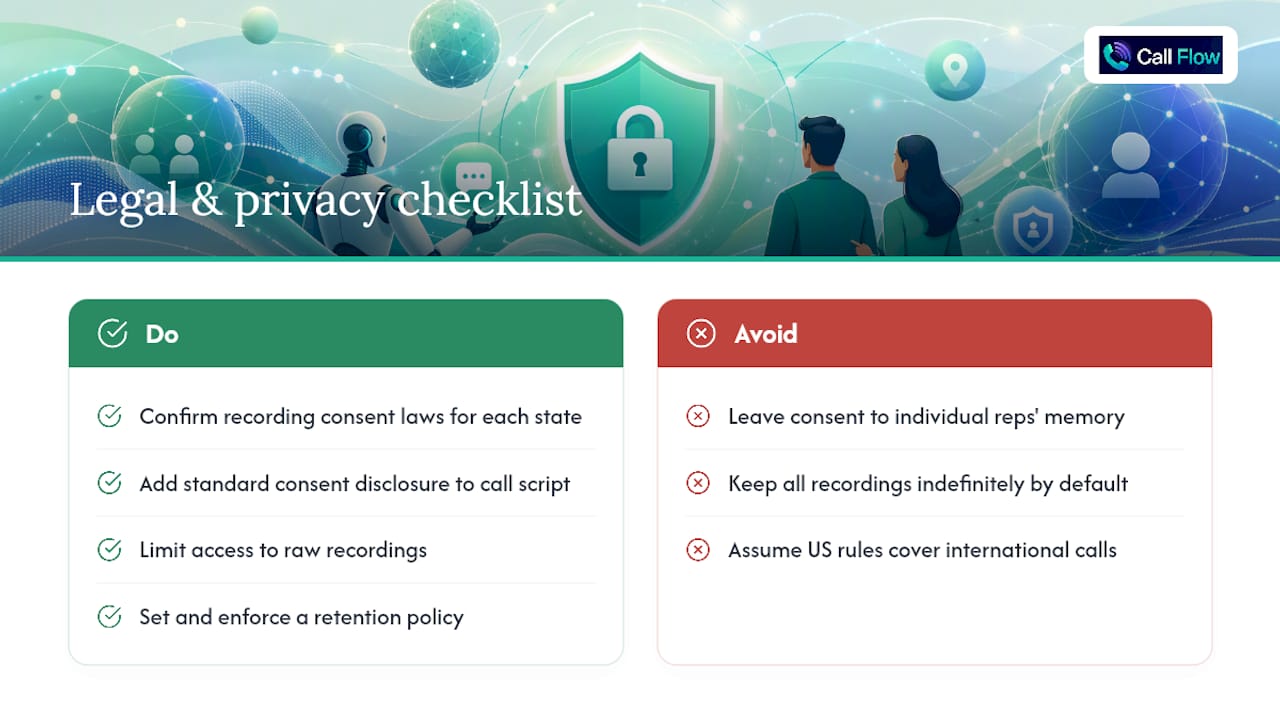
Call recording and AI-based scoring both touch consent and data privacy rules that vary by state and, for international teams, by country. In the United States, several states require two-party consent to record a call, meaning both sides need to know it's happening, not just the rep. Before you turn on any recording or conversation intelligence tool, confirm what your state (and any state your reps or customers sit in) actually requires, and build a standard consent disclosure into your call opening script rather than leaving it up to individual reps to remember.
Storage and access matter too. Recorded calls, transcripts, and AI-generated scorecards often contain customer names, account details, and sometimes payment or account information depending on your industry. Limit who can access raw recordings versus summarized coaching scores, and set a retention policy instead of keeping everything indefinitely by default.
If you operate internationally, be aware that data protection frameworks like GDPR in the European Union impose stricter consent and data-handling requirements than most US state laws. A rep coaching a prospect in another country may trigger rules your standard US disclosure doesn't cover.
None of this should scare you off recording calls, it's the foundation of the entire coaching system described above. It just means the rollout should include a short legal review of your consent language and storage practices before the first call gets recorded, not after.
Author Perspective: 30/60/90 Priorities That Actually Matter
If you take one thing from this guide, make it this: visibility comes before coaching, and coaching comes before scale. Trying to run structured 1:1s before you can actually see rep behavior is coaching blind. Trying to scale peer pods before your own coaching rhythm is consistent just spreads inconsistency across more people.
In the first 30 days, focus entirely on visibility and baselines: get calls recorded, pick your two or three triggers, and resist the urge to coach anything yet. Days 30 to 60 are for building the actual rhythm, structured 1:1s, async reviews, and your first group practice sessions. Days 60 to 90 are for scaling that rhythm through peer pods and calibration, not for adding more metrics.
The real signal of progress isn't a better win rate in month one, that's too slow to show up. It's whether the specific change a rep committed to in last week's 1:1 shows up in this week's call. Track that one number obsessively, and everything else follows.
— Costa
Try Call Flow as Your Practice and Feedback Layer
Some platforms give reps unlimited AI-driven practice between coaching sessions, which can supplement manager-led coaching schedules. Instead of waiting for a scheduled role-play with a manager, a rep can rehearse a tough renewal conversation the same night it comes up, get scored across multiple performance dimensions instantly, and show up to the real call already sharper.
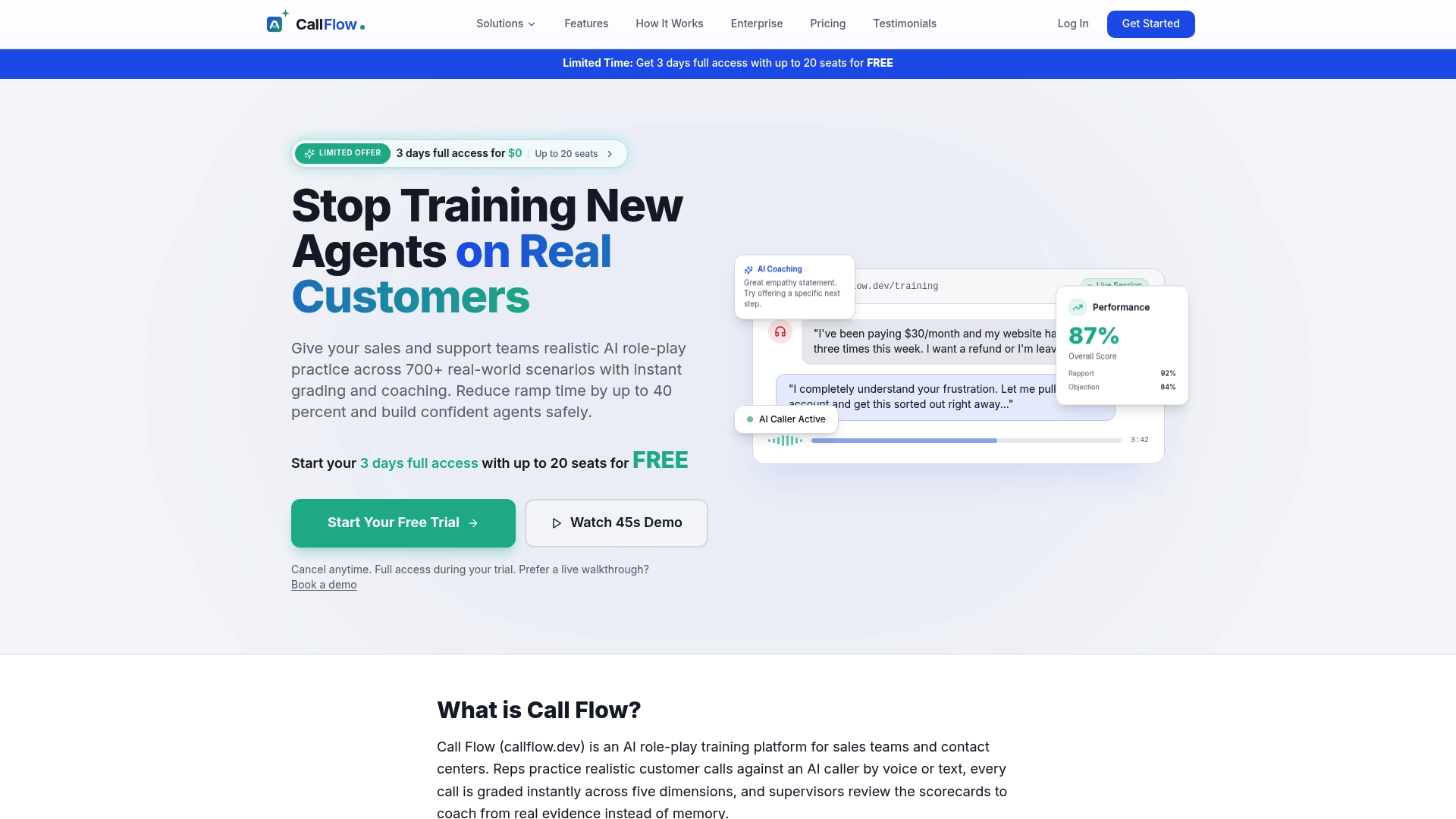
Such platforms often map directly onto coaching processes with configurable scenarios for monthly skill themes, instant grading to reduce review backlog, and supervisor dashboards highlighting areas needing attention. Running a low-risk pilot can be a straightforward way to measure impact by comparing ramp time and call-quality scores between teams using the tool and those not using it. For a closer look at how configurable scenarios work in practice, AI role-play training breaks down the setup. Start a risk-free trial and run your own two-week pilot before deciding whether to roll it out to the full team.
Sources
- Enabling remote sales teams: How training and coaching can help — Training Industry
- Remote SDR coaching — HubSpot Blog
- How do you coach reps you never see in person? — Pulse RevOps
FAQ
How Often Should Remote Sales Coaching Sessions Happen?
Weekly 1:1s paired with two to three async call reviews between sessions works for most teams of 8 to 12 reps, keeping coaching frequent without overloading manager bandwidth.
What Metrics Matter Most for Remote Sales Coaching?
Follow-through rate (whether a committed change shows up in the next call) is the single fastest leading indicator, followed by talk-to-listen ratio and discovery question quality.
Can AI Really Replace In-Person Coaching for Remote Sales Teams?
No. AI role-play platforms like Call Flow add practice volume and instant scoring between sessions, but structured manager 1:1s and call reviews still drive the actual coaching.
How Do I Start Remote Sales Coaching Without Overwhelming My Team?
Start with visibility (recorded calls) and two or three high-impact triggers for 30 days before adding structured 1:1s, then layer in group practice and peer pods once the rhythm holds.
Is Call Recording for Sales Coaching Legal?
It depends on your state, several US states require two-party consent, so confirm your state's rules and build a standard disclosure into your call opening before recording.