

AI role play training is the fastest scalable way to turn product knowledge into repeatable conversation skills for sales and contact-center teams. Run a focused pilot now. Select a cohort of 10–30 agents, pick one high-impact scenario (a discovery call or a de-escalation), and request a Callflow trial this week. Callflow's internal pilot data shows onboarding time dropping from 24 days to 9 days for BPO agents, and a peer-reviewed ERIC study of virtual role-play simulations across 33,703 participants found statistically significant gains in preparedness, self-efficacy, and helping behaviors at both post-training and three-month follow-up.
147% faster ramp time and a 129% improvement in resolution rates — those are Callflow's reported pilot outcomes for sales and contact-center teams.
Start there. The rest of this guide explains how to evaluate platforms, design a pilot, and measure results.
Table of Contents
- What is AI role play training and how does it work?
- Why AI role play training works: the evidence
- How to run a pilot: timeline, cohort, and cost drivers
- How to measure ROI and the KPIs that matter
- Callflow pilot results: what the data shows
- Key Takeaways
- What most training managers get wrong about AI role play
- Callflow gives you a faster path from pilot to results
- Useful sources for your pilot and vendor evaluation
What is AI role play training and how does it work?
AI role play training is an interactive simulation where a learner converses with an AI character that behaves like a real customer, prospect, or colleague. The AI responds dynamically to what the learner says, and a scoring engine grades the exchange against a defined rubric. The learner gets feedback immediately, then repeats the scenario until they hit the target score.
Common formats you will encounter:
- Text chat simulations: — Typed exchanges. Lower technical overhead, easier to deploy across devices, and useful for email or chat-support training.
At a high level, the workflow is: a scenario designer builds the persona and objectives, sets the rubric, and publishes the simulation. Learners practice on demand. The platform logs every attempt, scores each dimension, and surfaces results in a supervisor dashboard. Generative AI now speeds up scenario authoring significantly, letting training teams iterate content and difficulty without rebuilding from scratch. LinkedIn Learning's adoption of AI-powered role-play coaching for enterprise learners confirms this format has moved from experimental to mainstream.
For corporate use cases, the most common scenario types are: a sales discovery call (agent uncovers needs before pitching), a support de-escalation (agent calms an angry customer and resolves the issue), and a manager feedback rehearsal (a leader practices delivering a performance review).
Why AI role play training works: the evidence
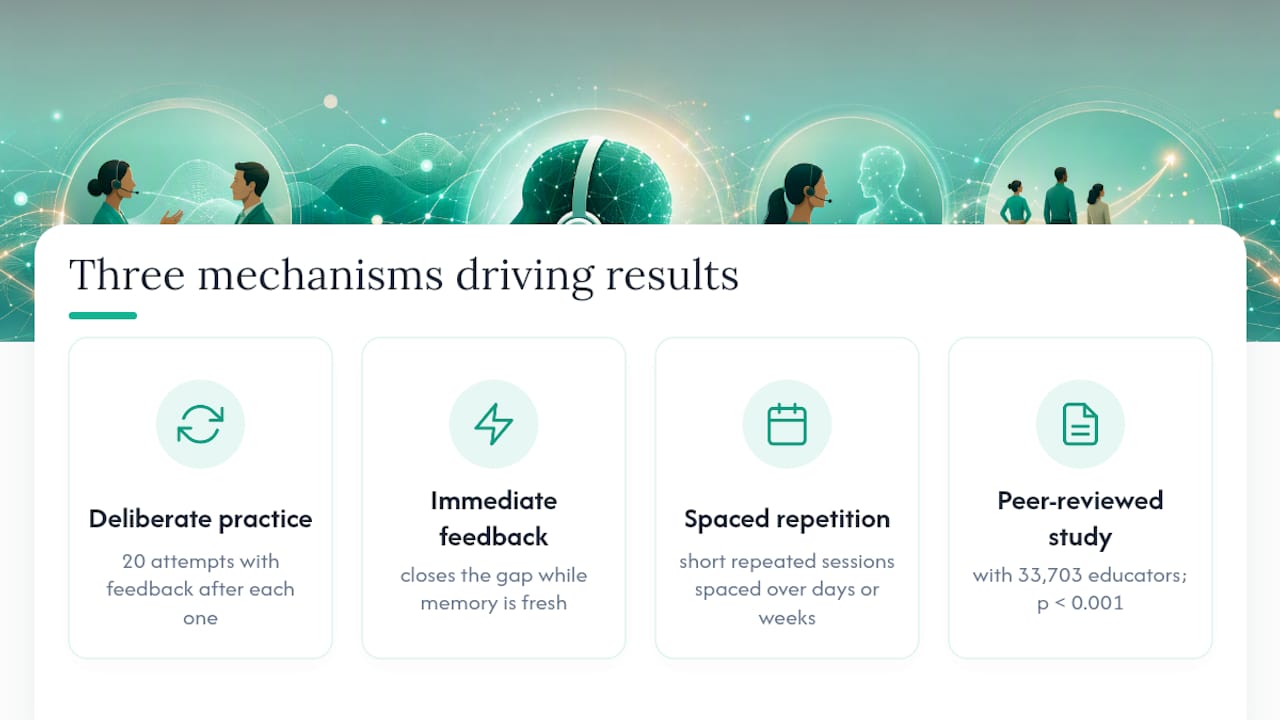
The learning science behind repeatable AI practice is well established. Three mechanisms drive the results.
Deliberate practice requires focused repetition with corrective feedback on specific behaviors. A single training session does not build a skill; 20 attempts with feedback after each one does. AI simulations make that volume of practice possible without consuming manager time.
Immediate corrective feedback closes the gap between what the learner did and what they should have done while the memory is fresh. Passive e-learning delivers information; it cannot tell an agent that they interrupted the customer three times in a two-minute call.
Spaced repetition fights the forgetting curve. Skills decay fast after a single exposure. Short, repeated practice sessions spaced over days or weeks produce far better long-term retention than a one-day training event.
The empirical record supports these mechanisms. A peer-reviewed study indexed on ERIC evaluated the Kognito At-Risk virtual role-play simulation across 33,703 middle school educators. It found statistically significant improvements (Hotelling's T², p < 0.001) in gatekeeper preparedness, likelihood to act, and self-efficacy at both post-training and a three-month follow-up. That sustained effect at follow-up is the key point: the behavior change held. Simulation-based training literature on PMC/NCBI provides additional evaluation frameworks supporting rigorous pilot design.
The critical nuance: fidelity matters. Scenarios with realistic personas and well-calibrated rubrics produce behavior change. Generic, low-fidelity prompts produce completion metrics, not skill gains.
For corporate KPIs, these mechanisms translate directly. Faster deliberate practice shortens ramp time. Immediate feedback on call structure raises first-call resolution. Spaced repetition sustains CSAT improvements past the first month of deployment.
How to run a pilot: timeline, cohort, and cost drivers
A well-designed pilot answers one question: does this platform improve a specific skill for a specific team in a defined time window? Keep it narrow.
Pilot design checklist:
- Objective: one measurable skill (e.g., objection handling pass rate above 80%)
- Cohort: 10–30 learners, split into a practice group and a control group if possible
- Scenarios: 1–3 high-impact conversation types
- Rubric: locked before the pilot starts, not adjusted mid-run
- Manager alignment: supervisors review dashboards weekly and debrief learners
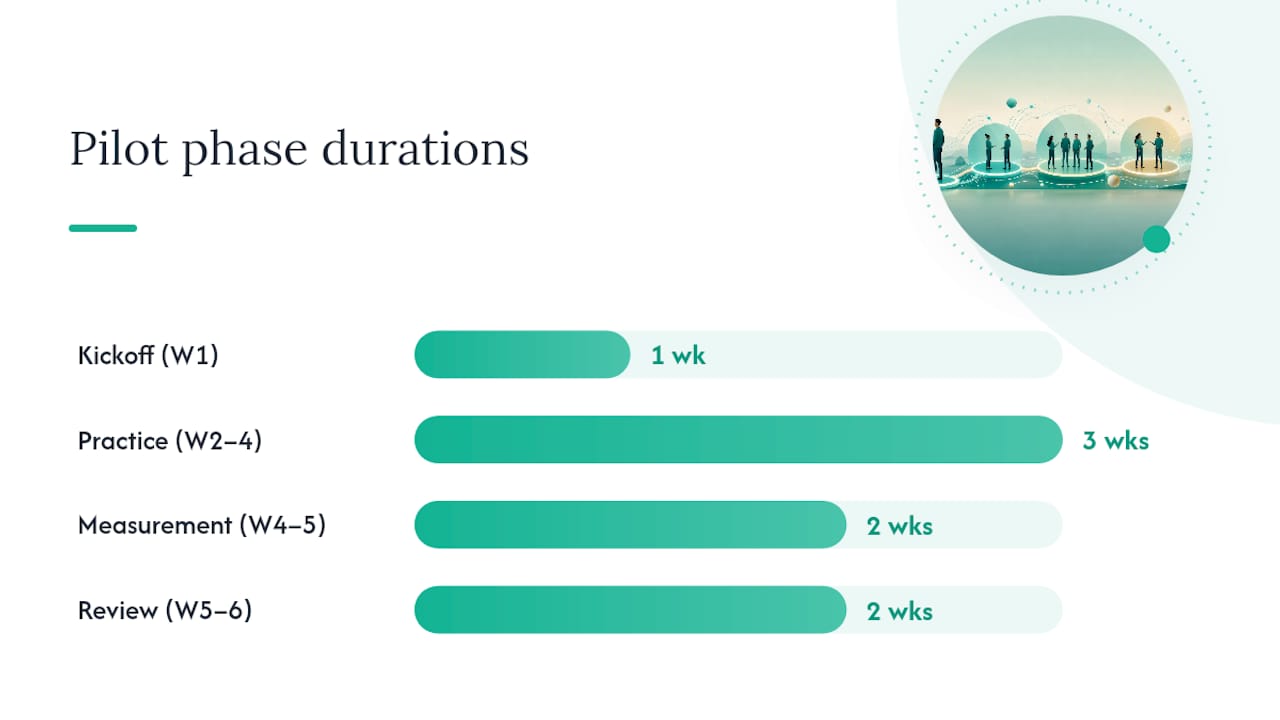
| Phase | Duration | Key Activities |
|---|---|---|
| Kickoff and config | Week 1 | Scenario selection, rubric definition, LMS setup, manager briefing |
| Practice period | Weeks 2–4 | Learners complete assigned scenarios; managers review dashboards |
| Measurement window | Week 4–5 | Collect rubric scores, operational KPIs, and learner feedback |
| Review and decision | Week 5–6 | Compare pilot group vs. control; present findings to stakeholders |
Cost drivers to budget for:
- Seat licensing: most platforms charge per active user per month. Get a pilot rate in writing.
- Custom content build: off-the-shelf scenario templates are faster and cheaper. Custom scenarios built from your call recordings add fidelity but add time and cost.
- Integration effort: SCORM export to an existing LMS is usually low effort. API-level CRM integration requires engineering time.
- Professional services: rubric design support from the vendor saves time in the first pilot. Ask whether it is included or billed separately.
Sample success criteria: 20% reduction in ramp time vs. the control group, 80% of learners reaching the rubric pass threshold by week four, and a measurable improvement in first-call resolution in the 30 days after training.
How to measure ROI and the KPIs that matter
Training managers often collect the wrong metrics. Completion rates and satisfaction scores tell you the training ran. They do not tell you it worked.
Primary KPIs to track:
- CSAT and NPS: — customer satisfaction scores from post-call surveys. Lagging indicator, but meaningful at 60–90 days post-training.
Measurement plan:
Collect baseline data before the pilot starts. Use the control group to isolate the training effect from other variables (new scripts, product changes, seasonal call volume). Pull data from three sources: the platform's analytics export, your CRM or call-center reporting tool, and QA transcripts. Report at 30 days and 90 days.
Callflow's published pilot data links training efficiency directly to business outcomes: 14.2% conversion gains attributed to training improvements in a BPO context. Use figures like that as a benchmark when building your ROI narrative for procurement.
Callflow pilot results: what the data shows
Callflow ran a pilot with a BPO contact-center team focused on onboarding new agents. The configuration used voice simulations covering two scenario types: initial customer onboarding calls and objection-handling exchanges. The rubric scored agents across five dimensions, including call structure, empathy signaling, issue confirmation, resolution accuracy, and close technique.
The quantitative result: agent onboarding time dropped from 24 days to 9 days. That is a 147% acceleration in ramp time. Resolution rates improved 129% over the same period.
"Agents who completed the Callflow simulation sequence hit performance benchmarks in 9 days. The previous standard was 24 days of supervised floor time." — Callflow internal pilot report
Qualitative outcomes from the pilot included faster manager adoption of the dashboard (supervisors checked scores daily within the first week) and higher learner confidence scores on post-training surveys. The main tuning required: the customer persona's objection intensity was initially too low, which meant agents were not practicing against realistic resistance. Adjusting the persona's pushback level in week two produced sharper rubric differentiation between strong and weak performers.
Adapting this pilot to your context:
- Enterprise sales teams: replace the onboarding scenario with a discovery call and add a multi-stakeholder objection scenario. Extend the practice period to six weeks.
- BPO contact centers: use the onboarding + de-escalation scenario pair. Prioritize FCR and AHT as operational KPIs.
- Customer success teams: focus on renewal conversation scenarios. Track NPS and churn rate at 90 days.
Key Takeaways
AI role play training works when it is built on realistic scenarios, rubric-graded feedback, and a measurement plan tied to operational KPIs like ramp time and first-call resolution.
| Point | Details |
|---|---|
| Start with one scenario | Pick one high-impact conversation type and lock the rubric before the pilot begins. |
| Cohort size and timeline | Run 10–30 learners over 4–6 weeks; collect baseline data before day one. |
| Measure what moves business | Track ramp time and FCR alongside rubric scores; completion rates alone prove nothing. |
| Watch for common pitfalls | Misaligned rubrics and missing LMS integration are the two most common reasons pilots stall. |
| Callflow as your starting point | Callflow's pilot data shows agent onboarding time dropping from 24 days to 9 days, a 147% acceleration in ramp time; request a risk-free trial to test it with your team. |
What most training managers get wrong about AI role play
The conventional wisdom says: pick a platform, load your content, and measure completion. That approach produces completion data and little else.
The gap is almost always the rubric. Training managers spend weeks selecting a vendor and hours configuring scenarios, then define the rubric in 20 minutes at the end of setup. A rubric that does not reflect the actual behaviors your best agents use is measuring the wrong thing. Agents optimize for the rubric. If the rubric is wrong, they practice the wrong behaviors at scale.
The second overlooked factor is manager involvement. AI simulations handle the practice volume, but managers still need to review scores, run brief debriefs, and calibrate what "good" looks like on the rubric. Platforms with supervisor dashboards make this fast. Managers who never open the dashboard undermine adoption within two weeks.
On the change management side: run a live demo for your ops lead before the pilot starts. Show them the dashboard, not the learner interface. Ops leaders adopt tools they can see producing results in their own reporting language. A manager who watches a rubric score improve in real time is a stronger internal advocate than any vendor case study.
Off-the-shelf scenario templates get you into practice fast. Custom scenarios built from your actual call recordings produce higher fidelity and better rubric alignment, but they add two to four weeks to setup. For a first pilot, start with templates. Reserve custom builds for the full rollout.
Callflow gives you a faster path from pilot to results
Most teams spend more time evaluating platforms than running their first pilot. Callflow is built to close that gap. The platform provides realistic voice and text simulations configured for sales and contact-center conversations, rubric grading across five performance dimensions, instant coaching feedback, supervisor dashboards, and analytics exports that map directly to the KPIs covered in this guide.
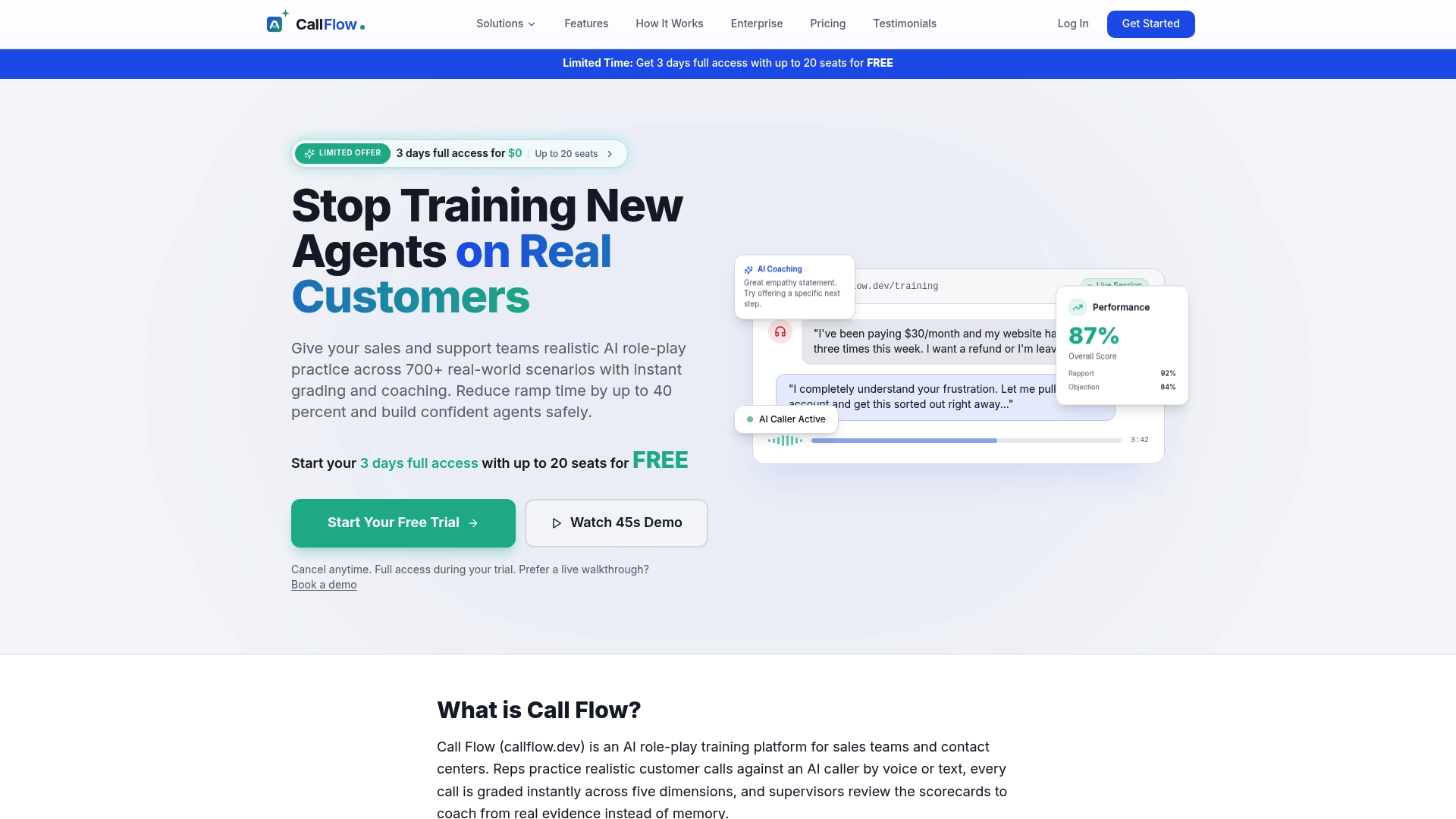
The risk-free trial includes sample scenarios, full analytics access, and pilot support so you can run a real cohort, not just a demo. For contact-center teams specifically, the trial is scoped to your scenario types and team size. Start with the onboarding or objection-handling scenario, run it with 10–15 agents for four weeks, and measure ramp time against your current baseline. Request your free trial at Callflow and have your first pilot cohort in practice within the week.
Useful sources for your pilot and vendor evaluation
Use these resources to build your pilot proposal and support vendor evaluation.
- ERIC — Virtual Role-Play: Middle School Educators Addressing Student Mental Health
- PMC article on simulation-based training (placeholder listing)
- How to Use AI to Create Role-Play Scenarios for Your ..
- AI-Powered Role Play for Learners
- callflow.dev blog — Onboarding BPO agents in 9 days instead of 24