

This page gives you ten ready-to-run sales role play games, the exact steps to run a session, and a scoring rubric your team can use today. Role play builds retention that lectures cannot match, and platforms now let you score practice instantly across multiple skills. Pick one or two scenarios below, block 30 minutes with your team, and run your first session before Friday.
TL;DR:
- Tailoring scenarios to pipeline stages and individual rep competencies accelerates skill transfer and prevents script memorization.
- Using structured scoring rubrics across skills like discovery and objection handling ensures consistent, actionable feedback to improve performance.
- AI role play enables unlimited, flexible practice aligned with real deals, significantly shortening ramp times and boosting first-call resolution.
- Remote practice requires cameras on, session recordings, and rotation across time zones to mimic live sales conditions effectively.
- Regular scenario variation, focusing on personas, industries, and seniority levels, develops reps' adaptability and prevents training fatigue.
Table of Contents
- 1. Sales Role Play Games and Scenarios You Can Use Today
- 2. How to Run a Role-Play Session That Actually Sticks
- 3. Matching Scenarios to Role and Tenure
- 4. Measuring Whether Role Play Is Actually Working
- 5. Scaling Practice With AI Role Play
- 6. Running Each Scenario: Facilitator Instructions
- 7. Scripts and Dialogue Examples for Common Situations
- 8. Building Diverse Personas Across Industries
- 9. Adapting Role Play for Remote and Hybrid Teams
- Costa's Take: What Actually Makes Role Play Work
- Try Call Flow for AI-Scaled Role Play
- Sources
1. Sales Role Play Games and Scenarios You Can Use Today
Ten scenarios cover the deal stages where reps actually lose ground. Each one lists the objective, the roles you need, a timebox, a starter prompt, and what to score. These map to the categories Highspot identifies as the core skill areas reps need, and each is built around a real pipeline stage the way Zoomforth recommends structuring practice.
-
Discovery call. Objective: uncover pain, budget, and timeline without pitching. Roles: rep and a buyer persona with a vague, half-formed problem. Timebox: 8 minutes. Starter prompt: "Tell me what's not working with your current process." Score: does the rep ask open questions before proposing anything, and do they confirm the pain in the buyer's own words before moving on?
- Variation: give the buyer a hidden budget constraint the rep must uncover through questioning alone.
-
Elevator pitch. Objective: deliver a 30-second value statement that earns a second meeting. Roles: rep and a skeptical prospect met at an event. Timebox: 3 minutes plus 2 minutes feedback. Starter prompt: "So what do you actually do?" Score: clarity, relevance to the buyer's likely role, and whether the pitch ends with a specific next step.
- Variation: run it three times back to back with three different buyer titles to test adaptability.
-
Objection island. Objective: handle a rapid sequence of five objections without losing composure. Roles: rep faces an observer who reads objection cards one after another. Timebox: 6 minutes. Starter prompt: "Your price is 20 percent higher than the vendor we're using now." Score: does the rep acknowledge before responding, and do they avoid over-explaining any single objection?
- Variation: mix in one objection that is actually a buying signal disguised as a complaint.
-
Demo under pressure. Objective: run a product walkthrough while a distracted buyer interrupts and checks their phone. Roles: rep and a buyer who asks off-topic questions mid-demo. Timebox: 10 minutes. Starter prompt: "Can you skip ahead to the part about integrations?" Score: does the rep redirect gracefully and tie every feature back to a pain named earlier?
- Variation: add a second silent buyer in the room who says nothing until the final two minutes.
-
Virtual and remote selling. Objective: run a full call over video where the buyer has their camera off. Roles: rep and a buyer who responds only in short typed chat messages. Timebox: 8 minutes. Starter prompt: "I'm on mute, just talk and I'll type if I have questions." Score: energy and pacing without visual feedback, and whether the rep checks for engagement out loud.
- Variation: simulate a dropped connection midway and score how the rep recovers the thread.
-
Negotiation. Objective: hold margin while still closing. Roles: rep and a procurement lead demanding a discount plus extended payment terms. Timebox: 10 minutes. Starter prompt: "We need 15 percent off and net 90 terms or we walk." Score: does the rep trade concessions instead of giving them away, and do they protect at least one term?
- Variation: add a hard deadline the buyer invents to pressure a fast yes.
-
Customer success renewal. Objective: secure a renewal from an account showing low product usage. Roles: rep or CSM and a buyer quietly considering a competitor. Timebox: 8 minutes. Starter prompt: "Honestly, we haven't used this much this quarter." Score: does the rep surface the real risk before defending the product, and do they propose a concrete usage plan?
- Variation: reveal midway that the buyer's champion has left the company.
-
Competitor conversation. Objective: address a direct comparison without trashing the competitor. Roles: rep and a buyer already in late-stage talks with an alternative. Timebox: 7 minutes. Starter prompt: "We're also looking at [competitor]. Why should we pick you?" Score: does the rep stay factual, and do they ask what matters most to the buyer before contrasting?
- Variation: give the buyer a specific, correct fact about the competitor to test how the rep handles accuracy.
-
Letting go or graceful exit. Objective: disqualify a bad-fit lead without burning the relationship. Roles: rep and a prospect who is a poor fit on budget or use case. Timebox: 5-minute. Starter prompt: "We really want to move forward, but our budget is a tenth of your pricing." Score: does the rep exit cleanly, offer a referral or resource, and avoid wasting the next 20 minutes chasing a dead deal?
- Variation: make the prospect emotionally persistent to test how firmly the rep holds the line.
-
Rapid cold pitch. Objective: open a cold call and earn 60 more seconds of attention. Roles: rep and a busy buyer who answers distracted. Timebox: 4 minutes. Starter prompt: "I'm in the middle of something, what's this about?" Score: does the rep get to relevance in the first two sentences, and do they ask permission to continue?
- Variation: have the buyer hang up at random intervals to force the rep to front load the value.
2. How to Run a Role-Play Session That Actually Sticks
A role-play session lives or dies by setup, not talent. Give each participant a written persona brief before the session starts, not a verbal summary on the spot. The brief should name the buyer's title, their stated pain, one hidden objection, and what a "win" looks like for the rep. Skipping this step is the single most common reason sessions feel fake and reps disengage.
Choose your format based on group size and time available.
- Hot seat: one rep plays every scenario in front of the group while others observe and score. Best for smaller teams building confidence fast.
- Round robin: pairs rotate through scenarios simultaneously, then swap roles. Best for larger teams where everyone needs live reps.
- Observer-driven: a third person scores silently and only speaks during debrief. Useful when you want unbiased scoring separate from the acting.
- Timed rounds: strict clocks force decisiveness and mimic the pressure of a real call. Works well for objection handling and negotiation scenarios.
For remote teams, run video calls with cameras on and record the session (with consent) so the rep can watch their own delivery afterward. A shared scoring sheet in real time keeps observers focused instead of drifting.
Score each round on a 1 to 5 scale across four behaviors:
| Skill | 1 (weak) | 3 (adequate) | 5 (strong) |
|---|---|---|---|
| Discovery | Pitches before asking questions | Asks some open questions | Uncovers pain in the buyer's own words |
| Value framing | Lists features | Connects one feature to pain | Ties every point back to a named business outcome |
| Objection handling | Argues or over-explains | Answers directly | Acknowledges, then reframes toward value |
| Closing / next step | No clear ask | Vague next step | Specific, time-bound commitment |
Debrief in four moves, in this order: what you observed (factual, no judgment), one specific thing to commend, one specific thing to improve, and one action item the rep commits to before the next session. This order matters. Leading with criticism shuts down the conversation before the rep hears anything useful.
Pro Tip: Never let the debrief run longer than the role play itself. If feedback takes 15 minutes for a 5-minute scenario, you're lecturing, not coaching.
3. Matching Scenarios to Role and Tenure
A brand-new BDR and a five-year account executive need different practice, even on the same scenario. Running everyone through identical drills wastes senior reps' time and overwhelms new hires with situations they aren't ready for yet.
Map focus areas by role first:
- BDRs need heavy reps on the rapid cold pitch and elevator pitch scenarios, since qualifying and booking meetings is their entire job.
- Account executives need discovery, demo under pressure, negotiation, and competitor conversation, since they own the full cycle to close.
- Customer success managers need the renewal and letting-go scenarios most, plus objection island for pricing pushback during expansion conversations.
- Sales managers benefit from running the observer role themselves regularly, since scoring reps sharpens their own coaching eye faster than any workshop.
Then layer in tenure:
| Tenure stage | Focus | Suggested scenarios |
|---|---|---|
| Weeks 1 to 4 | Foundational scripts and confidence | Elevator pitch, rapid cold pitch, basic discovery |
| Months 2 to 3 | Applied skill under mild pressure | Objection island, demo under pressure, competitor conversation |
| Quarter 2 and beyond | Performance under real stakes | Negotiation, customer success renewal, letting go |
Before assigning scenarios, run a short competency check. A five-minute assessment covering the four scoring skills above tells you exactly where a rep is weak, so you're not guessing which drill to assign. A sales skills assessment built for this purpose beats gut instinct every time.
Build a "starter set" for each role: three scenarios a new hire runs in their first two weeks, scored the same way every time, so you get a clean baseline before performance pressure enters the picture.
4. Measuring Whether Role Play Is Actually Working
Track five things and you'll know if practice is moving the pipeline, not just filling calendar time.
- Participation rate: percentage of reps completing scheduled sessions, tracked weekly.
- Competency scores: average rubric scores per skill, tracked over time to spot which behavior is lagging across the team.
- Scenario completion: how many of the ten scenarios each rep has run at least twice.
- Time-to-ramp: days from hire to first closed deal or quota-qualifying activity, compared before and after adding structured role play.
- Conversion rate changes: stage-to-stage conversion on live deals, tracked for reps who practice regularly versus those who don't.
Run this as a phased rollout rather than a company-wide mandate. Pick one team or one cohort of new hires, run structured role play for six weeks, and compare their ramp time and conversion against a similar group that didn't get the structured practice. That comparison is your evidence when you ask for budget or buy-in later.
Report monthly with four fields on a simple dashboard: sessions completed, average rubric score by skill, ramp time trend, and stage conversion trend. Keep it to one page. Nobody reads a ten-tab spreadsheet.
The underlying case for all of this isn't guesswork. Classroom research summarized by ATD shows role play produces far higher retention than lecture-based training, and the original case for role play as a training method goes back to Harvard Business Review's early work on active rehearsal, which found that forcing reps to perform and reflect builds skill that passive training doesn't.
5. Scaling Practice With AI Role Play
Live sessions cap out fast. A manager running 20 reps through hot-seat rounds twice a week gets maybe 40 practice reps a week, total, across the whole team. That's not enough repetition to build muscle memory on objection handling or negotiation, and it eats hours of manager time that could go toward live coaching on real deals.
AI role play removes the ceiling. Reps practice asynchronously, on their own schedule, against configurable scenarios tied to their actual pipeline, and every session gets scored the same way every time. Standardized scoring matters more than it sounds. When five different managers grade discovery calls, you get five different bars. An AI rubric applies one bar to everyone.
An AI role-play training platform grades practice sessions instantly across multiple performance dimensions, gives supervisors a dashboard to track scores and completion across the whole team, and lets trainers build custom scenarios instead of relying only on generic scripts. Gamification elements keep newer reps engaged through repetition that would otherwise feel like homework.
Teams using structured AI role play report significantly faster ramp times and improved first-call resolution compared to teams relying on live-only practice sessions.
A reasonable first 30 days looks like this:
- Week 1: build or import three to five scenarios tied to your team's actual deal stages.
- Week 2: assign every new hire a starter set and require two completed sessions.
- Week 3: pull the first rubric scores and identify the one skill dragging the team average down.
- Week 4: compare ramp progress against your last cohort's baseline before AI practice.
Platforms structured this way let managers keep live coaching focused on real deals while AI role play training handles volume and repetition in the background.
6. Running Each Scenario: Facilitator Instructions
Before any scenario starts, hand the persona brief to the buyer role in writing, not verbally, so details stay consistent across multiple reps running the same drill. Set the timer visibly so everyone, including the rep, knows how much runway they have. Silence is fine. Don't jump in to rescue a rep who's stuck. That instinct feels helpful but it robs them of the exact struggle the drill is designed to surface.
Assign an observer for every round, even in pairs, using a printed or shared rubric so scoring happens in real time rather than from memory afterward. When the clock runs out, stop the scenario immediately, even mid-sentence. A hard stop trains reps to work within real call constraints instead of assuming they'll always get extra time.
Run the same scenario twice in a row with a different buyer persona before moving to the next one on your list. One rep, one scenario type, two different buyers. This shows whether a rep's skill transfers or whether they memorized a script for one specific situation. For group settings, rotate the observer role every round so everyone practices scoring, not just performing. That builds a shared sense of what "good" looks like across the team faster than any written rubric alone.
7. Scripts and Dialogue Examples for Common Situations
A cold pitch opener that works: "Hi, this is [name] from [company]. I know I'm catching you cold. Do you have 30 seconds for me to explain why I called, and if it's not relevant, just say so?" That last clause matters. Giving the buyer permission to say no lowers their guard and usually earns more time, not less.
A discovery probe that surfaces real pain: "Walk me through what happens today when [specific process] breaks down. Who gets pulled in, and how long does it usually take to fix?" This forces a story instead of a yes-or-no answer.
An objection reframe for price pushback: "That's fair, and I want to make sure the investment matches the impact. Can you tell me what solving [specific problem] is worth to your team over the next year?" This shifts the frame from cost to value without dismissing the concern.
A renewal risk probe for customer success: "I noticed usage dropped this quarter. Before we talk renewal, help me understand what changed on your end." Naming the data point directly, instead of dancing around it, signals the rep is paying attention and builds trust faster than a generic check-in call. Practical scripts like these work best when reps rehearse the delivery, not just read them silently, which is the entire point of running them as role play rather than handing out a script sheet.
8. Building Diverse Personas Across Industries
Reps who only ever practice against one buyer type get blind sided the moment a real prospect doesn't fit that mold. Build a rotating bench of at least six personas that vary by industry, seniority, and communication style, not just by objection type.
Vary the industry context specifically. A healthcare buyer worries about compliance and patient impact. A manufacturing buyer worries about downtime and supply chain risk. A software buyer worries about integration and switching cost. Write one sentence of industry-specific context into every persona brief so reps learn to adjust vocabulary and priorities on the fly instead of running the same pitch regardless of who's on the call.
Vary seniority too. A frontline manager wants tactical detail. A VP wants business outcomes and wants the call to move fast. Give reps practice with both in the same week so they learn to read the room before they've even asked their first question.
Vary personality on purpose: the rushed executive who wants bullet points, the skeptical technical buyer who wants proof, the friendly but noncommittal buyer who never actually says no. Rotating through these styles across a month of practice builds the flexibility that a single repeated script never will, and it keeps sessions from feeling like the same drill wearing a different name.
9. Adapting Role Play for Remote and Hybrid Teams
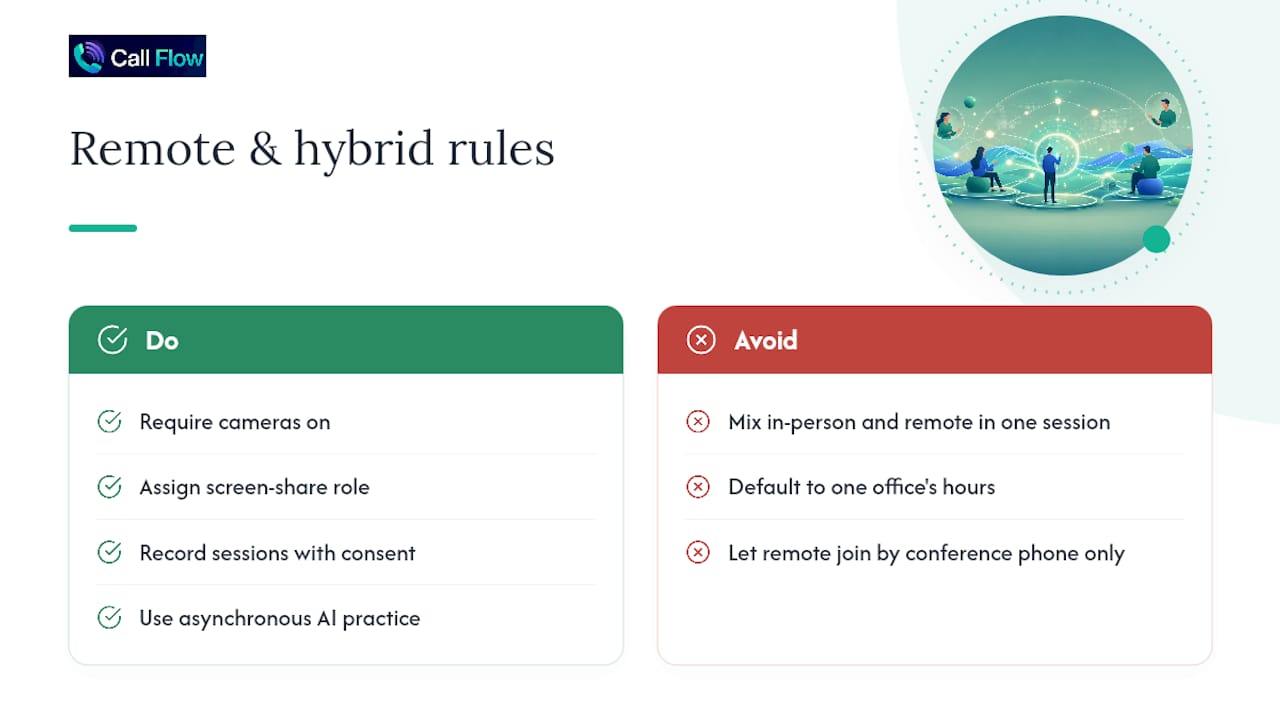
Remote practice needs different rules than a conference room, not just a video link bolted onto the same format. Cameras on is a hard requirement, not a suggestion, since reps need to practice reading and projecting body language over video the same way they'll need to on a real remote sales call.
Assign a dedicated screen-share role for demo scenarios so the rep practices talking while navigating software at the same time, which is genuinely harder than doing either alone. Record every session, with consent, since remote teams lose the casual hallway feedback that in-person teams get for free. A recorded library also lets a rep compare their own delivery over time.
Stagger scheduling across time zones by rotating which region hosts live sessions each week, rather than always defaulting to one office's working hours. For hybrid teams split between office and remote reps, avoid mixing formats in the same session. A hybrid group where half the room is on camera and half is speaking into a conference phone produces uneven audio and worse practice for everyone. Run either fully in-person or fully remote for a given session, and rotate which one happens each week.
Asynchronous AI practice solves the scheduling friction entirely for teams spread across time zones, since reps can run scenarios whenever their day allows without waiting for a group slot to open up.
Costa's Take: What Actually Makes Role Play Work
Three things separate role play that changes behavior from role play that just fills a training calendar. First, tie every scenario to a rep's real pipeline, not a generic script. Second, protect psychological safety. Reps who fear looking foolish in front of peers will coast through a scenario instead of genuinely struggling with it, and struggle is where the learning happens. Third, measure competency progress on a rubric, not just attendance.
The most common mistake I see is managers running the same three scenarios on repeat for months. Reps memorize the script, not the skill. Rotate personas and pipeline stages constantly, and check the objection handling practice drills and role play scenario templates for fresh material when your list starts feeling stale.
— Costa
Try Call Flow for AI-Scaled Role Play
Live sessions alone cap how much repetition your team gets, and manager time is the scarcest resource in any sales org. This platform gives reps unlimited practice against configurable scenarios, with instant grading across multiple performance dimensions so every rep gets the same standard of feedback, every time.
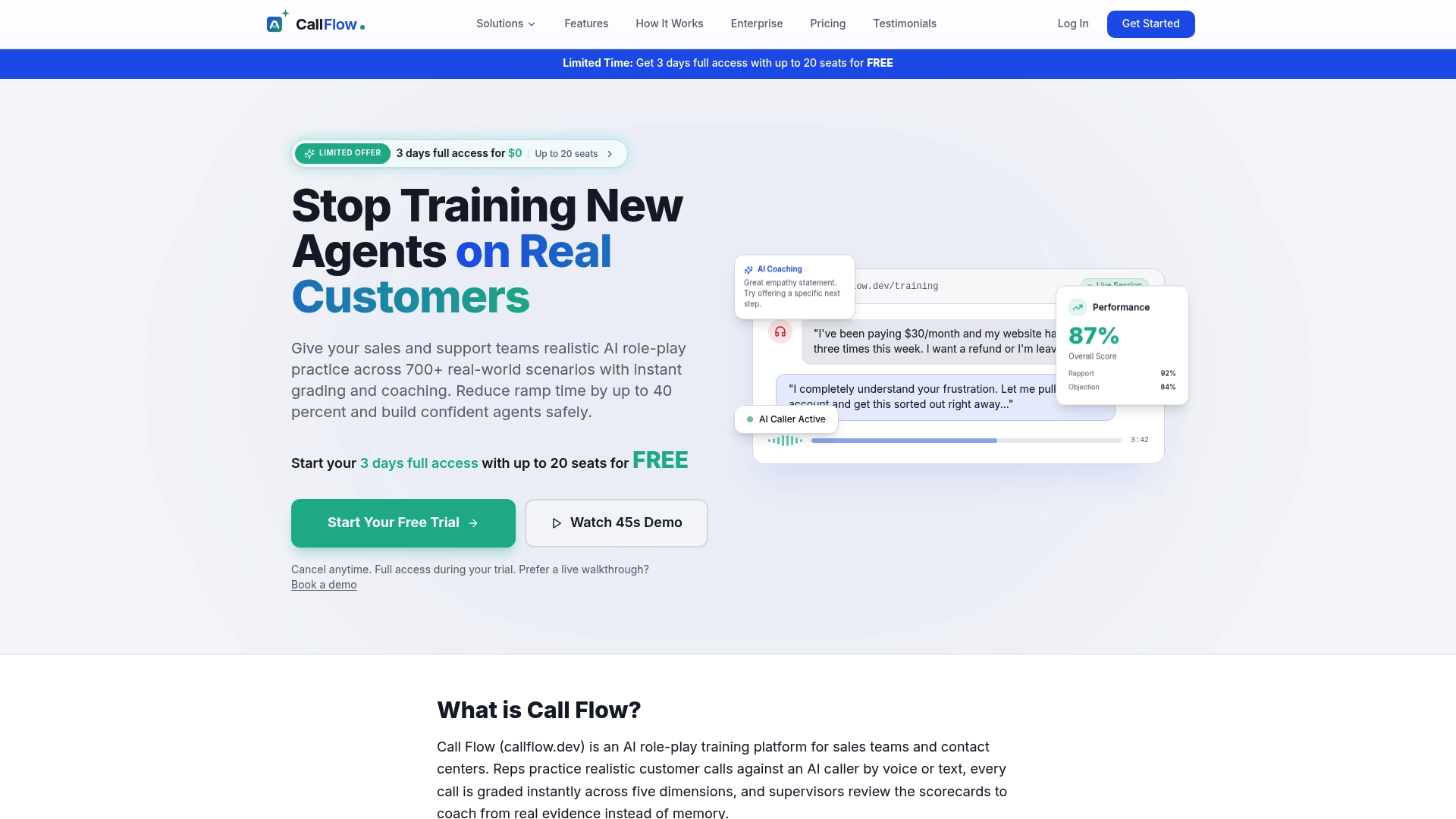
The platform includes supervisor dashboards for tracking scores and completion, gamification to keep practice engaging, and custom scenario tools so you can build drills around your own pipeline instead of relying only on generic scripts. Start a risk-free trial and load your first scenario at Callflow today.
Sources
For deeper scenario libraries, check role play scenarios that cut ramp time and objection handling drills. For broader enablement context, see this sales enablement framework and this guide to difficult client conversations. For the research behind why practice beats lectures, read Highspot's scenario guide and ATD's retention research.
- 9 sales role plays and exercises that boost skills — Highspot
- Role-playing as a sales training tool — Harvard Business Review
- Sales role play scripts — Zoomforth