

Use AI role-play and coaching platforms if you want the fastest measurable lift in sales skill. This is the direct verdict for 2026: pair realistic AI-driven practice with instant, structured feedback, and skills close faster than they do in traditional workshops or shadowing. Call Flow is built specifically for this job, and it belongs on your shortlist.
Here's what changes when you deploy this approach:
- Reps rehearse discovery calls, objection handling, and demos as many times as they need, with no scheduling friction.
- Every session gets scored against a rubric, not a manager's gut feeling.
- Managers get analytics on who is coaching-ready versus who still needs reps.
Gartner's analysis of sales coaching technology documents this shift directly: AI-enabled coaching now ties learning to measurable behavior change, not just completion rates.
Pro Tip: Pick your first pilot use case based on volume, not difficulty. A high-frequency scenario like cold-call openers gives you enough reps in two weeks to see a real trend line.
Key Takeaways
AI role-play combined with instant, structured coaching feedback shortens sales ramp time more reliably than shadowing or generic e-learning content.
| Point | Details |
|---|---|
| Start with one use case | Pick a high-frequency scenario like discovery calls or cold-call openers for your first pilot. |
| Measure five KPIs | Track ramp time, win rate, conversion rate, average deal size, and coaching coverage. |
| Demand realism and integration | Choose platforms with adaptive persona resistance and CRM or LMS connections, not scripted bots. |
| Prove value in 30 days | Run a small cohort through five scenarios against a control group before scaling. |
| Call Flow fits the model | Offers voice and text role-play, five-dimension instant grading, and a risk-free trial for pilots. |
Table of Contents
- What Is AI Sales Training?
- What Core Features Should an AI Sales Coaching Platform Have?
- Which Sales Scenarios Get the Best Results From AI Role-Play?
- What KPIs Should You Track for AI Sales Training?
- How Do You Choose the Right AI Sales Training Solution?
- How Do You Run a 30-Day AI Sales Training Pilot?
- Why Call Flow Is Built for This Approach
- Frequently Asked Questions
- Sources
What Is AI Sales Training?
AI sales training uses software, usually voice or text based, to simulate customer conversations and grade a rep's performance instantly. Instead of role-playing with a manager who has ten other things to do, a rep practices against an AI persona that responds, pushes back, and evaluates the interaction the moment it ends.
Four modalities make up most of the category:
- Role-play simulations, where reps talk or type through a scripted-but-adaptive scenario against an AI buyer.
- Conversation intelligence, which analyzes recorded live calls for talk ratio, objection handling, and language patterns.
- Live coaching assistants that whisper prompts or cues during real customer conversations.
- Personalized learning paths that sequence practice based on a rep's weakest skill area.
Teams typically use role-play before high-stakes calls, conversation intelligence for post-call debriefs, and personalized paths during onboarding ramp. The underlying technology in nearly all of these is natural language processing, which lets the system understand what a rep says and generate a realistic, in-character response instead of a scripted branch.
What Core Features Should an AI Sales Coaching Platform Have?
Not every AI role-play tool is built the same way, and the gap between a scripted chatbot and a genuine sales training tool shows up fast once your team starts using it daily.
Look for these capabilities before you commit budget:
- High-fidelity role-play with voice and text modes, persona memory across a conversation, and adaptive resistance that escalates based on what the rep actually says.
- Objective, multi-dimensional scoring tied to your own sales methodology, not a generic one-size rubric.
- Real-time coaching prompts during practice plus a structured debrief after each session.
- Integration with CRM, LMS, and call recording systems so scenarios reflect real pipeline data instead of generic scripts.
- Admin controls and reporting that scale from a five-person pilot to a two-hundred-person floor.
The realism piece deserves attention. Platforms built on agentic AI architectures maintain state and persona-specific memory, so a simulated buyer's objections build on what the rep already said rather than resetting each turn, a distinction one practitioner analysis of agentic sales role-play calls "dynamic resistance." A scripted bot repeats the same objection regardless of how well the rep handled it. An agentic one escalates or backs off based on the rep's actual answer, much closer to how a real prospect behaves.
Pro Tip: Ask any vendor to show you the scoring rubric before you sign anything. If they can't explain what the AI is actually measuring, you can't defend the results to your VP later.
Which Sales Scenarios Get the Best Results From AI Role-Play?
Some training scenarios return value in days. Others take months to show anything. Start with the ones that compound fastest.
- Pre-call practice for named, high-value deals. Have a rep run the actual discovery call against an AI persona built to mirror that specific buyer before the real meeting.
- Objection handling and price defense drills. Repetition here builds muscle memory that live coaching alone rarely delivers at scale.
- Cold outreach and qualification simulations, ideal for reps still building comfort with rejection.
- Demo rehearsals and closing conversations, where tone and pacing matter as much as content.
- Sequenced onboarding scenarios for new hires, moving from easy to hard as skill builds.
New hire ramp is where this pays off fastest, since it replaces weeks of shadowing with structured, repeatable reps a manager doesn't have to personally run.
What KPIs Should You Track for AI Sales Training?
Track five numbers: ramp time, win rate, conversion rate, average deal size, and coaching coverage, which is the percentage of reps getting regular structured feedback versus the percentage getting none. Time-to-proficiency, how long until a new rep hits quota-ready performance, ties all of these together and is usually the metric leadership cares about most.
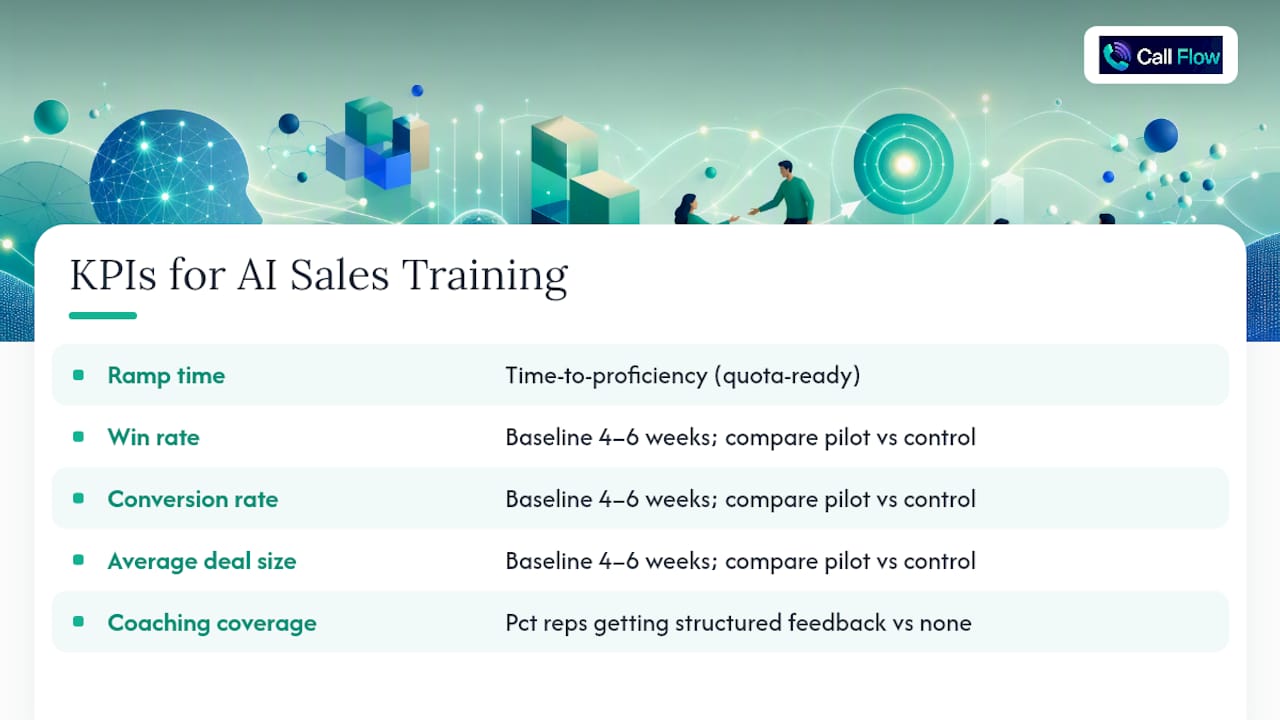
Measure with a simple before-and-after design. Set a baseline over four to six weeks before rollout, then compare a pilot cohort against a control group running your existing training process. Rolling cohorts work better than a single before/after snapshot because seasonality and deal mix can distort a short window.
Gartner's research on sales coaching technology notes that organizations shifting to AI-enabled coaching increasingly link practice behavior directly to revenue outcomes, rather than treating training completion as the end goal.
How Do You Choose the Right AI Sales Training Solution?
Vendor demos all look impressive. The differences show up in daily use, three weeks into a pilot, when the novelty wears off.
Evaluate on these criteria:
- Role-play realism: does the AI persona adapt, or does it loop the same three responses regardless of what the rep says?
- Scoring depth: can you customize the rubric to your methodology, or is it a black box?
- Integration footprint: does it connect to your CRM and LMS, or does it live in isolation?
- Admin controls: can a manager build a custom scenario in an afternoon, or does it require a vendor ticket?
- Data privacy: where is call and conversation data stored, and who can access it?
In demos, ask directly: how long until the first rep sees value? What does CRM integration actually require from our team? Does your methodology support translate into the scoring model, or is it generic?
Red flags worth walking away from: opaque scoring with no explanation, no integration options beyond manual upload, no free trial or pilot period, and reporting that only a super-admin can access.
Pro Tip: Prove value in 30 days by running one cohort through five scenarios and comparing their live call scores against a control group. You don't need a full rollout to get a defensible result.
How Do You Run a 30-Day AI Sales Training Pilot?
Keep the scope tight. A pilot that tries to fix everything at once fails for the same reason a New Year's resolution does: too many variables, no clear signal.
- Pick one use case. Discovery calls for your top ten open deals is a strong starting point.
- Set baseline KPIs before day one: current win rate, average call score, ramp time for your last three hires.
- Map required integrations: CRM for deal context, call recording for real transcripts, single sign-on for easy rep access.
- Roll out in sequence: admin setup, build two or three scenarios, enroll the pilot group, run manager calibration sessions so scoring stays consistent.
- Collect feedback weekly and adjust scenario difficulty before you scale beyond the pilot group.
API-based integrations that pull real CRM and pipeline data into training scenarios are what separate a generic simulation from one that actually reflects your deals, and Silk Data's guide to connecting AI tools via API walks through what that setup typically involves on the technical side.
Why Call Flow Is Built for This Approach
Call Flow runs realistic, multimodal role-play (voice and text) with instant AI grading across five performance dimensions, so reps get a structured debrief the second a practice call ends, not a week later in a coaching one-on-one.
What managers get on top of the role-play itself:
- Supervisor dashboards showing skill gaps across the whole team, not just individual scores.
- Custom scenario creation, so practice reflects your actual deals and objections.
- Full access during a risk-free trial period, with no need to commit before seeing results.
Call Flow's own reporting points to 147% faster ramp time and a 129% improvement in resolution rates among teams using scenario-based practice with instant feedback. Starting a pilot takes an afternoon: set up an account, build two or three scenarios around your highest-priority use case, and enroll a small cohort to run through them that same week.
What Managers Get Wrong About Rolling This Out
The biggest mistake I see is treating AI role-play as a replacement for manager coaching instead of a multiplier for it. The tool handles repetition. The manager still owns judgment calls on deal strategy and career development. Skip that distinction and adoption stalls within a month, because reps sense when a tool is decoration rather than a genuine part of how the team operates. Run a two-week pilot on one scenario before you roll out anything wider. You'll know almost immediately whether it earns a permanent spot in your process.

Start a Risk-Free Pilot With Call Flow
There are other ways to modernize sales training, from conversation intelligence tools to generic e-learning platforms, but most of them stop at analysis or content delivery. They tell you what went wrong on a call. They don't give reps a place to fix it before the next one.
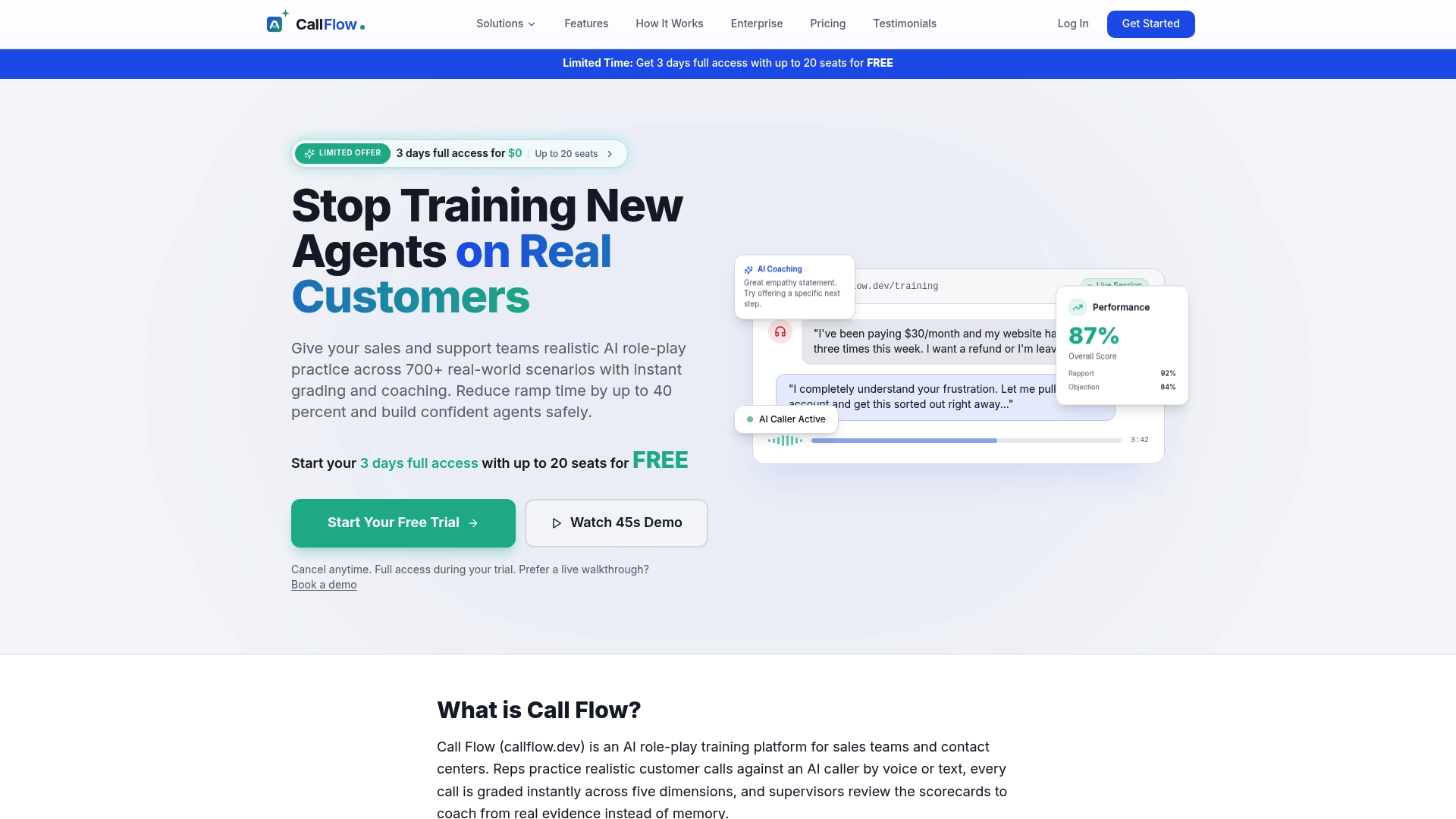
Call Flow gives your team unlimited realistic practice, voice or text, with instant grading across five performance dimensions and a supervisor dashboard that shows exactly who needs more reps and on what. The full platform is available during a risk-free trial period, so you can run the pilot described above without committing budget first. Start with free mock call practice on your highest-priority scenario this week, and you'll have a scored cohort and a real before-and-after comparison before your next team meeting.
Frequently Asked Questions
What is AI sales training? It's the use of AI software, typically voice or text based, to simulate sales conversations and instantly grade a rep's performance so managers can coach at scale.
How is AI sales coaching different from traditional coaching? Traditional coaching depends on a manager's available time and memory of a call. AI sales coaching scores every session against a consistent rubric and delivers feedback the moment practice ends.
What results should I expect from an AI role-play pilot? Expect measurable movement in ramp time and call scores within two to four weeks if you run a tight pilot with a clear baseline and control group.
Does AI sales training replace manager coaching? No. It handles repetition and objective scoring so managers can spend their limited time on strategy, deal reviews, and career coaching instead of scheduling role-play sessions.
How long does it take to see value from Call Flow? Most teams see scored practice data and a usable trend line within the first two weeks of a pilot, since sessions can run daily without scheduling a manager.