

AI-driven sales call simulation lets reps practice realistic buyer conversations safely and get scored feedback in minutes, not weeks. Sales development reps, account executives, and contact center agents use it to face objections, gatekeepers, and demo pushback before a real prospect hears their voice. Sales managers use it to see exactly where a rep's skill gaps sit. The rest of this guide covers the features that matter, how to run sessions, what to measure, and where teams stumble.
TL;DR:
- Sales call simulation systems must accurately replicate realistic buyer personas and objection patterns to be effective training tools.
- Running structured, scenario-based micro-drills regularly, focused on actual pipeline stages, accelerates skill mastery and improves ramp time.
- Tracking KPIs like ramp time, conversion rate, and competency scores over a full ramp cycle provides reliable evidence of training impact.
- Avoiding common mistakes such as gaming scores, misaligned rubrics, and outdated scenarios ensures simulation data remains valid and actionable.
- Combining AI-driven feedback with targeted human coaching maximizes improvement in essential call skills, especially discovery, objection handling, and closing.
Table of Contents
- What Should a Sales Call Simulation Platform Actually Do?
- How to Run Sales Training Simulation Sessions That Stick
- What KPIs Actually Prove Sales Training Simulation Works?
- What Proof Backs Up These Sales Call Simulation Claims?
- Common Mistakes Teams Make With Sales Call Simulations
- Building Custom Scenarios From Your Own Playbook
- Sales Call Simulation in Practice Across Industries
- Keeping Reps Engaged During Practice Sessions
- What Actually Moves the Needle in Coaching
- Try Callflow's Sales Call Simulation Risk Free
- Sources
- FAQ
What Should a Sales Call Simulation Platform Actually Do?
A sales call simulation is only as useful as the buyer it puts in front of a rep. Scenario fidelity matters more than any other spec sheet item: does the AI persona push back like a real skeptical CFO, stall like a distracted gatekeeper, or go quiet like a champion who's lost internal support. Platforms built for domain-specific training configure role, industry context, and call type so the objections a rep hears in practice match what shows up on the live sales floor.
Beyond the persona, a handful of capabilities separate a serious training tool from a novelty app:
- Multiple practice modes. Voice sessions for phone and video call prep, text sessions for chat and email objection drills, and "pressure modes" that compress response time to simulate a hostile prospect.
- Guided versus blind practice. Hint-assisted runs for new hires, no-hint blind assessments for reps proving readiness.
- Automated scoring across competencies. Rubrics that grade discovery questions, objection handling, tone, and closing technique separately, not one blended score.
- Manager dashboards and CRM or LMS connectors. So practice data lands next to the rep's actual pipeline and training record instead of sitting in a separate silo.
- Data handling and access controls. Enterprise buyers should ask how call transcripts and scores are stored and who inside the organization can see them.
Skip any of these and you're left with a chatbot, not a training system.
How to Run Sales Training Simulation Sessions That Stick
Buying the tool is the easy part. Building a cadence reps actually follow is where most rollouts either take off or quietly die. Here's a sequence that works across team sizes:
- Turn real playbooks into scenario prompts. Pull actual call recordings and objection patterns from your CRM and convert them into rubrics and buyer personas. Generic scenarios teach generic skills; scenarios built from your own lost deals teach the exact objections your team keeps losing to.
- Set a cadence, not a one-off event. Daily five-minute micro-drills for muscle memory, weekly coached reviews where a manager watches the recording, and a monthly blind assessment that functions like a checkpoint.
- Balance hints with blind runs. Guided practice with hints accelerates early learning; toggling off hints for periodic blind assessments is what produces an objective readiness signal a manager can actually trust.
- Close the loop with targeted drills. A low score on discovery questions should trigger a specific follow-up drill on discovery, not a repeat of the same generic scenario. Coaching that ignores the score defeats the point of scoring at all.
Pro Tip: Assign one scenario per week tied to your team's actual pipeline stage bottleneck. If deals are stalling at the demo, drill demos, not cold opens.
Scaling this across a bigger team comes down to admin templates that let managers clone scenarios fast, dashboards that flag who hasn't practiced in a week, and small gamified streaks that keep reps opening the app without a manager nudge. None of it needs to be complicated. It just needs to run every week without someone manually chasing it.
What KPIs Actually Prove Sales Training Simulation Works?
Ramp time is the number every sales manager cares about first, and it's the easiest to track because you already have hire dates and quota-attainment dates in your CRM. Beyond that, watch:
- Conversion or win rate lift for reps who complete regular simulation sessions versus those who don't
- Competency score trends over time, broken out by category (discovery, objections, closing)
- Demo-to-close ratio, which tends to move faster than raw win rate
- Objection-handling success rate on specific objection types your team logs most often
A simple way to validate whether the training is actually driving these numbers, rather than coincidence, is a small cohort test: split a new-hire class into a pilot group that trains on simulations and a control group that trains the old way, run it for a full ramp cycle, and compare time-to-quota and early win rate. You don't need a huge sample. Even 10 to 15 reps per group over one ramp cycle gives a manager a real signal.
Call Flow reports customers seeing significant improvement in ramp time and resolution rates when simulation training replaces or supplements traditional shadowing. Treat any improvement under a full ramp cycle as noise. A meaningful signal shows up as a sustained shift across at least one full cohort, not a good week. Dashboards that surface competency trend lines by rep, rather than just an aggregate team average, are what let a manager catch a struggling hire in week two instead of week eight.
What Proof Backs Up These Sales Call Simulation Claims?
The gap between a demo that looks impressive and a program that actually moves ramp time is where most training tools fall apart. Instant grading across multiple performance dimensions, rather than one blended pass or fail score, is what makes the difference measurable in the first place. When a rep's discovery score lags while their closing score is strong, a manager can assign the right drill instead of guessing.
Some reported numbers illustrate what this looks like in practice:
- Faster ramp time reported among teams that adopted structured simulation practice as part of onboarding
- Improvement in resolution rates tracked through scoring across the training period
- Scoring built across multiple performance dimensions, allowing managers to see different areas of a rep's performance, rather than a single vague grade
These are publisher-reported figures tied to teams using the platform, not third-party audited benchmarks, so treat them as a strong directional signal worth testing against your own cohort rather than a guaranteed outcome for every team.
Common Mistakes Teams Make With Sales Call Simulations
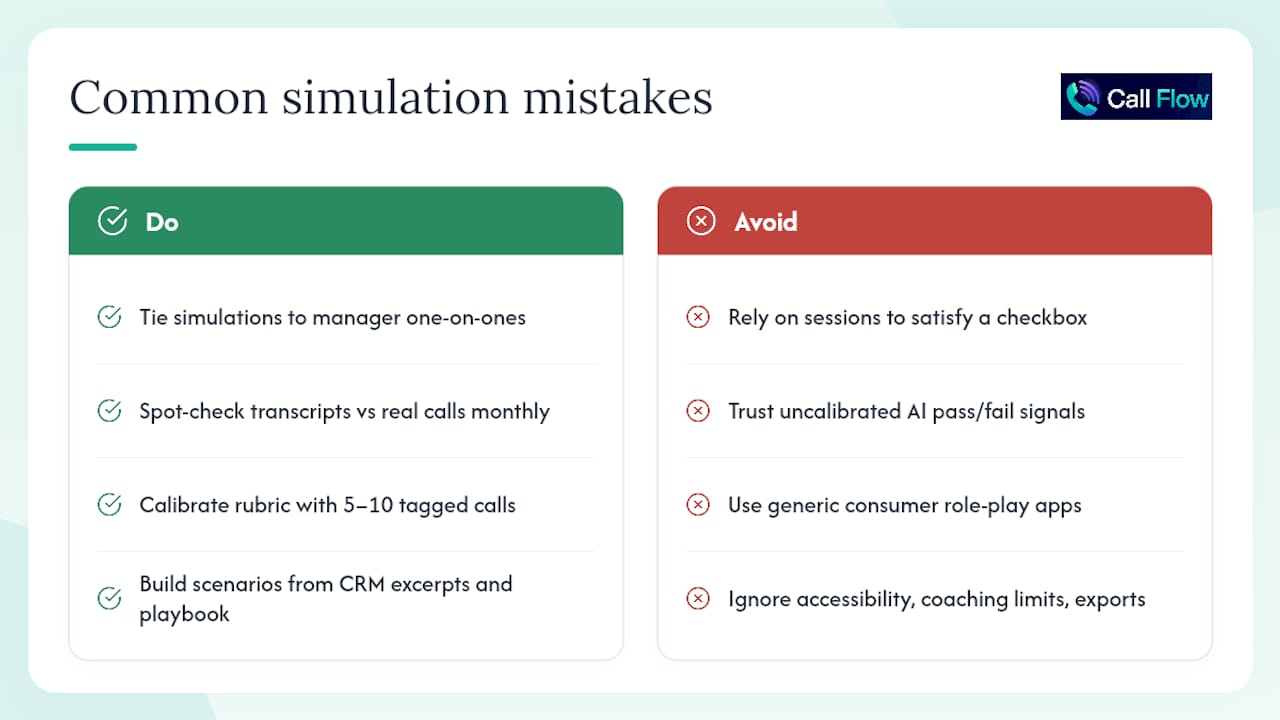
The most common failure mode is what training teams call the checkbox trap: reps complete a required number of sessions to satisfy a compliance metric, then coast. Scores go up because reps learn to game the rubric, not because their actual calls improve. The fix is accountability structure, not more sessions. Tie simulation completion and scores to manager one-on-ones, and spot check a rep's simulation transcript against a real call recording every month.
A second trap is scoring calibration drift. If the AI's rubric doesn't match what your best human coaches actually reward on a real call, reps optimize for the wrong behavior. Before trusting automated pass or fail signals, calibrate the rubric against a small set of tagged real calls, five to ten per use case, so the AI's judgment lines up with what an experienced coach would score.
Scenario fidelity is the third recurring issue, and it's exactly where lightweight tools tend to fall short. App Store reviews for consumer-grade role-play apps repeatedly flag the AI cutting off the rep mid-sentence or failing to follow natural conversation turns, both of which break immersion fast. Build scenarios from real CRM call excerpts and your actual playbook language, not generic templates.
Pro Tip: Run a 10-call spot audit each quarter comparing simulation scores to live call scores for the same reps. If the two diverge, your rubric needs recalibration before you trust it further.
Other pitfalls worth watching: accessibility for reps who prefer text over voice, whether managers have enough coaching bandwidth to act on the feedback the platform generates, and long-term vendor lock-in if scenario libraries and scoring history can't be exported later.
Building Custom Scenarios From Your Own Playbook
Off-the-shelf scenario libraries get a new hire started, but the fastest ramp improvements come from scenarios built around your specific product, market, and the objections your reps actually hear. The process starts with your call recordings. Pull five to ten calls per common objection type, whether that's price pushback, a competitor comparison, or a stalled champion, and turn the language prospects actually use into scripted AI persona responses.
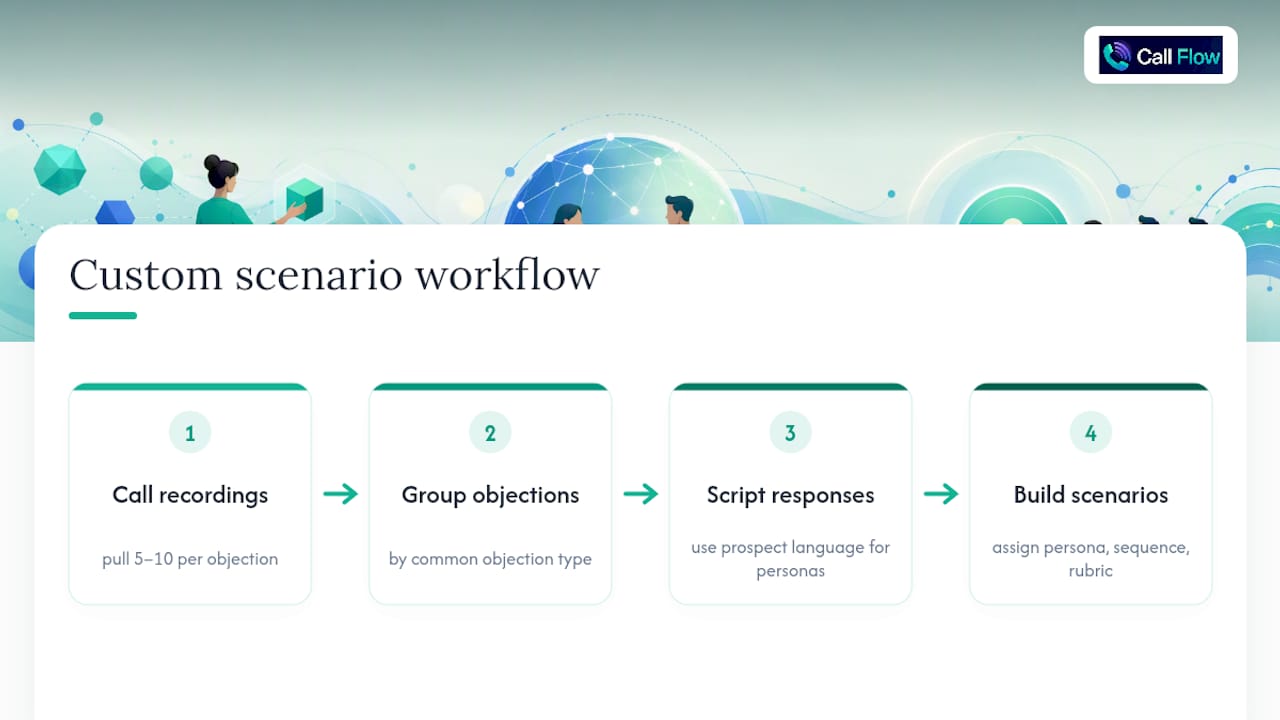
Custom scenario builders let managers assign a persona role (skeptical buyer, distracted gatekeeper, technical evaluator), set the objection sequence, and attach a scoring rubric tied to your own sales methodology rather than a generic framework. That last part matters more than it sounds. A rubric built around MEDDIC scores differently than one built around a straightforward discovery to demo to close flow, and reps need to be scored against the process they're actually trained to run.
Version control matters here too. As your product or pricing changes, scenarios built six months ago start teaching reps to handle objections that no longer apply. Treat scenario libraries the way you'd treat sales collateral: something a manager reviews and updates on a quarterly cycle, not something built once and left alone. Teams that skip this step end up with reps who score well on outdated scenarios and freeze on new ones.
Sales Call Simulation in Practice Across Industries
Contact centers running high call volume have leaned hardest into simulation because the ROI math is simple: shave even a few weeks off ramp time across a class of 30 new hires and the payback shows up fast in reduced overtime and fewer escalations. New agents drill resolution scenarios, refund requests, and de-escalation before ever taking a live call, with supervisor dashboards flagging who needs another pass.
Enterprise software sales teams use simulation differently, focused less on volume and more on discovery depth. AEs selling complex, multi-stakeholder deals drill scenarios built around specific buyer personas, a skeptical technical evaluator, a champion who's lost budget authority, because those conversations only happen a handful of times a quarter in real pipeline. Practicing them in a simulation means the first real conversation with that persona isn't the rep's first attempt.
Field sales and life sciences organizations use configurable scenario context tied to specialty and call type, letting a rep practice a conversation specific to a particular product line or region before stepping into a territory where the stakes are higher. Insurance and financial services teams, working under compliance-heavy scripts, use simulation to drill the exact required disclosures alongside the persuasive parts of the call, since getting either wrong creates real risk.
Across all of these, the common thread isn't the industry. It's that simulation works best when the scenarios map to conversations reps will actually have within weeks, not abstract skill categories.
Keeping Reps Engaged During Practice Sessions
The biggest engagement killer in any training program is repetition without variation, and simulation training is no exception. Reps disengage fast when every session feels like the same scenario with a different name attached. Rotating persona difficulty, mixing an easy warm-up call with a genuinely hard blind assessment, keeps sessions from feeling like a formality to click through.
Gamification helps more than most managers expect. Streaks for consecutive days practiced, leaderboards ranked by competency score rather than raw call count, and small recognition for a rep who improves the most in a category all give reps a reason to open the platform without being told to. Scaled programs combine this kind of automated practice with reinforcement micro-learning so a five-minute drill compounds into an actual habit rather than a one-time event.
Timing matters as much as format. A ten-minute drill squeezed in before a rep's first live call of the day builds a different kind of engagement than a mandatory hour-long session bolted onto Friday afternoon. Shorter, more frequent sessions tend to hold attention better than long ones, and tying a specific drill to a specific upcoming call, "you have a demo with a technical evaluator this afternoon, here's a five-minute warm-up", makes the practice feel relevant instead of abstract.
Manager visibility closes the loop. Reps engage more when they know a coach will actually look at the score, not just when the platform tracks it silently in the background.
What Actually Moves the Needle in Coaching
Most teams treat simulation and live coaching as separate tracks. The ones getting real ramp gains treat AI scores as the diagnostic and human coaching as the treatment: a manager still watches the recording, but knows exactly which competency to address before pressing play. One SDR cohort improved cold open scores fastest not through more practice volume, but through drills narrowed to the single competency their AI score flagged as weakest.
— Costa
Try Callflow's Sales Call Simulation Risk Free
This platform offers a path to readiness with scenario libraries, instant grading across multiple competencies, and manager dashboards that show where each rep stands. They aim to reduce voice latency and conversation-turning issues common in lightweight tools.
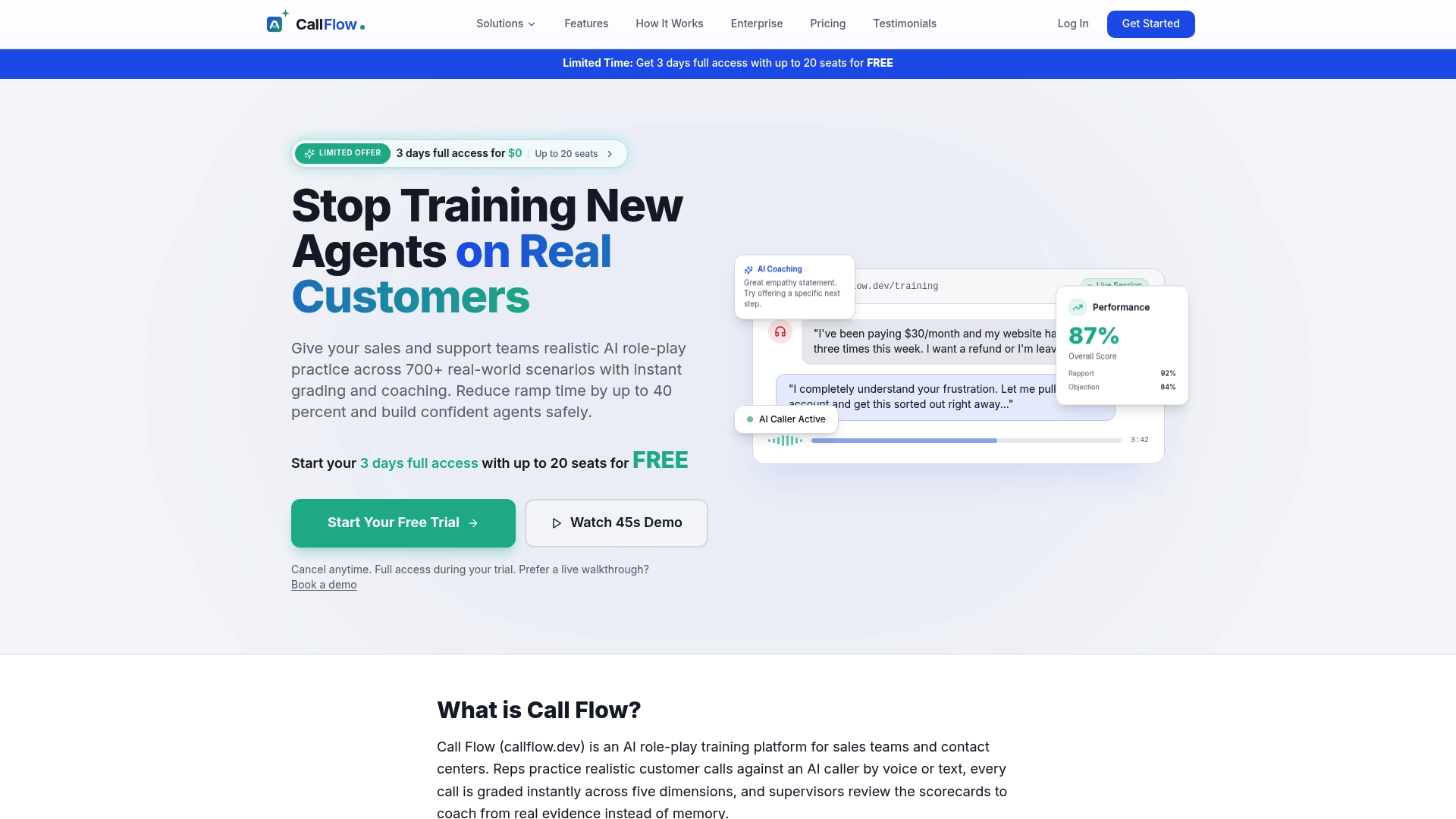
In week one of a typical trial, teams import a handful of real call transcripts, build two or three custom scenarios around their toughest objections, and run an initial cohort of reps through blind assessments to establish a baseline score. By the end of that week, managers usually have their first real competency breakdown, discovery, objections, tone, structure, and closing, scored separately instead of guessed at. From there, scaling to daily micro-drills and weekly coached reviews is a matter of turning on the cadence rather than building new infrastructure.
If your team is still relying on shadowing and gut-feel readiness calls, a trial run through Callflow's platform is the fastest way to see what a structured, measured alternative actually looks like.
FAQ
What Are the 7 Steps of a Sales Call?
Most frameworks cover the same core sequence: opening, needs discovery, presentation or demo, handling objections, trial close, closing, and follow-up. Sales call simulation lets reps drill each step separately instead of only practicing the whole call end to end.
Is B2B Cold Calling Illegal?
Cold calling businesses is legal in the United States, though outbound calls to consumer phone numbers can fall under Telephone Consumer Protection Act rules depending on how the number was obtained and whether it's on a do-not-call list. B2B calling to a business line generally carries fewer restrictions, but reps should still confirm their organization's compliance policy before dialing.
How Can I Practice Sales Calls Without a Real Prospect on the Line?
AI-driven sales call simulation is the most direct way, since it lets a rep run through realistic buyer objections and get scored feedback without risking an actual deal. Lightweight options like a free AI cold call bot or a browser-based role-play extension work for casual practice, though enterprise platforms like Callflow add manager dashboards and calibrated scoring most teams need for real readiness tracking.
What Are the Four Types of Sales Calls?
The four common types are cold calls, discovery calls, demo or presentation calls, and closing calls, each requiring a different skill set and objection pattern. Effective sales call simulation programs build separate scenarios for each type rather than treating all calls as one generic skill.
How Long Does It Take to See Results From Sales Training Simulation?
Meaningful change typically shows up across a full ramp cycle rather than a single week of practice, since a few sessions aren't enough to separate real skill gain from a lucky call. Running a simple pilot versus control cohort over one ramp cycle gives a manager the clearest signal on whether the training is actually driving faster time to quota.