

Run short, high-frequency role plays that force diagnosis before response, and score them against a rubric instead of a gut feeling. That single change, practiced in 15 to 20 minute blocks two or three times a week, does more for close rates than any script rewrite. HubSpot's research on sellers who successfully defend against objections shows close rates as high as 64% when the response is built on real diagnosis rather than a memorized rebuttal.
Start this week with three moves:
- Drill: Back-to-back rapid-fire objection exchanges, 10 objections in 10 minutes, no visual cues.
- Who: Pair reps with a peer or manager acting as a skeptical buyer.
- Target: 15 reps per rep by the end of week one, logged with a simple win/loss/isolating-question tag.
Pro Tip: Ban the phrase "I understand" from every drill for one week. It's filler that buys time without moving the conversation forward, and cutting it forces reps to actually acknowledge the concern.
Key Takeaways
Structured, high-frequency practice built on frameworks like LAER and SPIN, scored against a consistent rubric, improves objection resolution faster than script memorization or occasional workshops.
| Point | Details |
|---|---|
| Practice frequency beats polish | Short, frequent role-plays build the diagnostic reflex that a single long session cannot. |
| Use frameworks, not scripts | LAER, SPIN, and MEDDIC adapt to buyer variation; verbatim scripts break when phrasing shifts. |
| Score five observable behaviors | Listening, isolating questions, value reframing, tone, and confirm-and-advance make coaching specific. |
| Mix drill formats weekly | Rapid-fire, back-to-back, hot-seat, fishbowl, and recorded playback each build a different skill. |
| Scale repetitions with AI role-play | Callflow lets reps run graded scenarios independently, reporting 147% faster ramp time and 129% better resolution rates. |
Table of Contents
- What Is Objection Handling Practice, and Why Does It Beat Script Memorization?
- Which Frameworks Should You Practice First?
- What Are the Most Common Sales Objections, and How Do You Respond?
- What Drills and Role-Play Formats Build Real Skill?
- How Do You Build a Training Program That Shows Measurable Progress?
- What Breaks Role-Play Practice, and How Do You Fix It?
- What Does the Research Say About Practice-Driven Objection Training?
- How Should Objection Practice Differ Across Industries and Roles?
- How Do You Use Real-Time Feedback Tools During Practice?
- Why Does Empathy Training Belong in Objection Handling Practice?
- What Most Training Programs Get Wrong About Objection Handling
- How Call Flow Turns These Drills Into a Repeatable System
- Frequently Asked Questions
- Sources
What Is Objection Handling Practice, and Why Does It Beat Script Memorization?
Objection handling practice is repeated, structured rehearsal of how to diagnose and respond to buyer pushback, run under conditions close enough to a real call that the skill actually transfers. That's different from reading a script out loud until it sounds natural. A script gives a rep one path through a conversation; practice gives them the judgment to handle the fifteen paths a real buyer might take.
The frameworks worth building practice around include LAER (Listen, Acknowledge, Explore, Respond), the diagnostic questioning from SPIN Selling, and the learning-science principle of spaced repetition, which spreads short practice sessions over time instead of cramming them into one workshop.
Focused, framework driven practice outperforms ad-hoc rebuttal drilling for a few concrete reasons:
- Reps ramp faster because they're learning a repeatable process, not memorizing dozens of one-off answers.
- Objection-to-resolution rates climb because reps learn to isolate the real concern instead of guessing.
- Forecasts get cleaner because objections get logged and categorized instead of dismissed as "just noise."
- Confidence improves measurably, since reps who've handled a concern in practice don't freeze when they hear it live.
Sandler's research on sales training makes the case directly:
Frameworks provide logical rails that adapt to variation in a buyer's language, tone, and emotional state. Rigid scripts break the moment a buyer phrases a concern differently than the script anticipated.
That's the core argument for practice over scripts: buyers don't read from the same page reps do, so reps need reps that build adaptability, not recall.
Which Frameworks Should You Practice First?
Trainers don't need ten frameworks. They need two or three that reps can apply without thinking, plus a checkpoint for when to abandon the framework and negotiate instead. Here's the compact set worth drilling.
LAER is the default flow for almost any objection. Listen without interrupting, acknowledge the concern in the buyer's own words, explore with a diagnostic question, then respond with a scoped answer. This maps closely to the 5-stage objection flow that field playbooks recommend: listen, isolate, clarify, respond, confirm. The extra step, isolating, matters because it stops reps from answering a symptom instead of the real concern.
SPIN Selling contributes the diagnostic engine underneath LAER's "Explore" step. Situation and Problem questions surface what's actually going on; Implication and Need-payoff questions get the buyer to state the cost of inaction themselves, which does more persuasive work than any rep-delivered pitch. SPIN's question categories are worth drilling as a standalone exercise: give reps an objection and 60 seconds to write one Implication question before they're allowed to respond.
MEDDIC isn't an objection-response framework so much as a triage lens for enterprise deals. When an objection surfaces late in a complex sale, run it through MEDDIC's categories, metrics, economic buyer, decision criteria, decision process, identified pain, and champion, before coaching a response. An objection about "budget" from a procurement contact means something different than the same objection from the economic buyer, and MEDDIC forces reps to ask which one they're actually talking to.
Switch out of a framework and into a value trade or scoped concession when the objection is really a negotiation, not a misunderstanding. If a buyer has already agreed on fit and value and is now asking for a lower price or extra terms, more diagnostic questions will frustrate them. That's the signal to move to a structured trade: something for something, not a discount for nothing.
Two practice prompts and sample phrases per framework:
- LAER prompt: "Your price is too high" — practice the Acknowledge line before the Explore question. Sample: "That's fair. Compared to what?"
- SPIN prompt: Give reps a vague objection ("we're not ready") and require one Implication question before any response. Sample: "What happens to the project timeline if this waits another quarter?"
Pro Tip: Time-box the diagnostic phase. Give reps 20 seconds to ask an isolating question before they're allowed to respond. Reps who skip diagnosis under pressure are the ones who freeze on real calls.
What Are the Most Common Sales Objections, and How Do You Respond?
Objections cluster into a handful of categories, and treating them as data rather than drama is what separates a coachable team from one that relitigates the same excuse every quarter. Build your scenario bank around these five buckets.
Price and budget. Probe with: "Compared to what?" and "What did you allocate for solving this problem?" The isolating question is "If price weren't a factor, is this the direction you'd go?" A LAER-based response: "That's a fair concern. A lot of teams compare us to the cost of doing nothing, which usually runs higher over a year. Can we look at that math together?"
Timing and priority. Probe with: "What's competing for attention right now?" and "What changes in three months that doesn't change today?" Isolate with: "Is this a timing issue, or is there something about the solution itself giving you pause?" That question alone surfaces roughly half of "not now" objections as disguised fit or trust concerns.
Authority and multi-stakeholder deals. Probe with: "Who else needs to weigh in?" and "What would they want to know that I haven't covered?" The isolating move here is asking the buyer to walk through their internal approval process out loud, since reps often discover a blocker nobody mentioned.
Product fit. Probe with: "What would need to be true for this to be a clear yes?" and "What's the gap you're seeing?" A scoped response names the gap honestly rather than arguing it doesn't exist.
Brush-offs and stalls. "Send me some information" and "let me think about it" are rarely real objections. Isolate with: "Happy to. What specifically would you want that information to answer?" If the buyer can't name a specific question, it's a stall, not a concern, and the coaching cue is to ask for the real objection directly rather than complying with the brush-off.
The difference between a true objection and a brush-off is specificity. A real concern has a shape you can probe. A stall dissolves the moment you ask what, exactly, needs more thought.
Log every objection type during practice sessions the same way you'd log it on a real call. That habit is what makes the next training cycle sharper than the last one.
What Drills and Role-Play Formats Build Real Skill?
Realism is the variable that determines whether a drill transfers to a live call. A rep who's only practiced against a friendly, cooperative "buyer" hasn't built the skill of staying composed against a hostile one. Run a mix of formats across a training cycle rather than defaulting to the same exercise every week.

Rapid-fire objections. Objective: build reflexive recognition of objection categories. Setup: one rep, one coach firing ten different objections back to back with no time to think between them. Timing: 10 minutes. Learning outcome: reps stop pausing awkwardly when they hear a familiar objection, because they've heard it fifteen times already.
Back-to-back phone simulation. Objective: strip away visual cues so reps rely on tone and word choice alone, the way an actual phone or video call does. Setup: two reps sit back-to-back, one plays the buyer with a written persona card, the other handles the call cold. Thiagi Group's role-play design recommends exactly this positioning, plus a third participant as judge, because removing eye contact and body language forces reps to rely on the verbal skill that actually matters on a real call. Timing: 8 to 10 minutes per exchange, then rotate roles.
Hot-seat. Objective: build composure under group observation. Setup: one rep fields objections in front of the full team while a coach calls out increasingly difficult scenarios. Timing: 5 minutes per rep. This format is uncomfortable by design, since composure under scrutiny is exactly what a high-stakes call demands.
Fishbowl. Objective: teach pattern recognition by observation. Setup: two reps role-play in the center while the rest of the group watches and takes notes on a shared rubric, then debriefs as a group. Timing: 15 minutes total. Fishbowl drills work well early in a training cycle, before reps are ready to perform themselves.
Recorded playback. Objective: build self-awareness. Setup: record a role-play or a real call, then have the rep review it against the rubric before the coach adds feedback. Timing: 10 minutes recording, 10 minutes review. This is the format most teams skip and the one that produces the sharpest improvement, because reps hear their own filler words and rushed responses in a way live feedback rarely captures.
AI role-play. Objective: scale repetitions safely without burning manager time on every rep. Setup: a rep runs a configured scenario against an AI persona that grades the exchange automatically. Timing: 15 to 20 minutes, self-paced. This format solves the volume problem that live drills can't: a manager can watch three hot-seat rounds in an hour, but a rep can run twelve AI role-plays in the same window.
| Drill | Duration | Ideal group size | Measurable outcome |
|---|---|---|---|
| Rapid-fire objections | 10 min | Pairs | Reduced hesitation time per response |
| Back-to-back phone simulation | 8–10 min per round | Groups of 3 | Improved isolating-question rate |
| Hot-seat | 5 min per rep | Full team | Composure under observation |
| Fishbowl | 15 min | Groups of 4–6 | Pattern recognition, rubric familiarity |
| Recorded playback | 20 min total | Individual | Self-identified filler and rushed responses |
| AI role-play | 15–20 min | Individual, self-paced | Repetition volume, consistent scoring |
Score every drill against the same rubric so results are comparable across formats and weeks:
- Listening — did the rep let the buyer finish before responding?
- Isolating question — did the rep confirm this is the real objection before answering it?
- Value reframing — did the response connect back to the buyer's stated priority rather than a generic feature list?
- Tone and composure — did the rep stay measured rather than defensive?
- Confirm-and-advance — did the rep close the exchange with a next step instead of trailing off?
Score each behavior on a 1 to 4 scale (1 = absent, 4 = consistently strong) and average across the five for a session score. A rep scoring below 2.5 on isolating questions needs a targeted drill, not a general "keep practicing" note.
Pro Tip: Give feedback on one behavior at a time. A rep who hears five corrections at once retains none of them. Pick the single behavior most holding them back, coach that, and let the rest wait for next session.
How Do You Build a Training Program That Shows Measurable Progress?
A one-off workshop teaches nothing that survives past Friday. Spaced repetition research backs this up directly: distributing practice over time produces far better retention than concentrating it into one long session, which is exactly why a six to eight week program beats a single training day.
A workable timeline looks like this:
- Week 1: Baseline. Run every rep through a mixed-scenario role-play with no coaching beforehand. Score it against the five-behavior rubric to establish a starting point.
- Weeks 2 to 3: Framework drilling. Focus practice on one framework (LAER) and one objection category at a time. Run rapid-fire and back-to-back drills three times a week.
- Weeks 4 to 5: Mixed practice. Introduce hot-seat and fishbowl formats mixing objection categories, forcing reps to recognize the type before applying the framework.
- Week 6: Reassessment. Run the same mixed-scenario role-play from week one and compare rubric scores directly.
- Weeks 7 to 8: Targeted remediation. Coach the specific behaviors that lagged in reassessment, using recorded playback for self-review.
Track a short set of KPIs across the cycle rather than a long dashboard nobody checks:
| KPI | What it measures | How to collect it |
|---|---|---|
| Objection-to-resolution rate | Share of raised objections that end in a confirmed next step | CRM tagging or call review |
| Time-to-first-advance | How long a rep takes to move past an objection to a next step | Call timestamps or role-play timing |
| Confirm-and-advance rate | Share of exchanges ending with a clear next step, not a trail-off | Rubric scoring |
| Rep confidence survey | Self-reported confidence handling top five objections | Short survey pre/post cycle |
Reassess every two weeks at minimum. Reps who improve on the rubric but haven't moved on live-call KPIs likely need more back-to-back and recorded drills, since the gap usually points to composure under real pressure rather than knowledge of the framework itself.
What Breaks Role-Play Practice, and How Do You Fix It?
Most failed practice sessions fail for the same handful of reasons, and they're fixable in the room without redesigning the whole program.
Don't let the "buyer" go easy. A coach who plays a cooperative buyer teaches reps nothing about handling real resistance. Assign a persona card with a specific personality (skeptical, rushed, indecisive) and hold the coach to it.
Don't skip the debrief. A drill without feedback is just performance, not practice. Even a 60-second debrief locks in the learning that would otherwise evaporate by the next meeting.
Don't pile on five corrections at once. Harvard Business Review's research on feedback makes the case that effective feedback is specific, observable, and forward-looking rather than a list of everything that went wrong. One behavior per debrief, phrased as an instruction: "Ask one isolating question before responding" beats "you need to listen better."
Don't run practice in front of the whole team every time. Hot-seat builds composure, but reps also need private reps where the stakes are lower and the goal is pure repetition.
- Preserve psychological safety by naming the drill's purpose before starting: "This is about repetitions, not judgment."
- Rotate who plays the buyer so no single rep becomes the default skeptic.
- End every session on a rep's strongest moment, not their worst, so practice doesn't become something reps dread.
Pro Tip: If a rep goes quiet mid-drill, pause and ask "What are you thinking right now?" instead of jumping in with the answer. The hesitation itself is the coaching moment.
What Does the Research Say About Practice-Driven Objection Training?
The case for structured, repeated practice isn't just intuition. A handful of research findings, taken together, explain why framework-driven drilling outperforms script memorization and one-off training days.
HubSpot's data on close rates, as high as 64% for reps who successfully handle objections, shows the ceiling on what good objection handling is worth. That figure only holds when the handling is genuine diagnosis and response, not a defensive rebuttal.
Buyer behavior has shifted too. The 2025 G2 Buyer Behavior Report documents buyers expecting consultative, responsive sellers rather than pitch-first reps, which raises the value of practice that builds real listening skill over practice that builds delivery polish.
Buyers increasingly expect sellers to be consultative and responsive to their specific situation, not to recite a value proposition regardless of context.
Harvard Business Review's research on customer indecision adds a different angle: many stalled deals aren't objections at all, they're unresolved indecision that structured questioning and process clarity can resolve. That's the argument for building confirm-and-advance into every drill rather than treating a successful response as the finish line.
Call Flow's own case data adds a concrete implementation example: teams using simulated, scenario-driven practice reported meaningfully faster ramp times and improved resolution metrics after shifting from manual, ad-hoc coaching to structured AI role-play.
A caution worth stating plainly: vendor case metrics and single-report statistics describe what happened for a specific team under specific conditions. Treat them as directional evidence that structured, high-frequency practice works, not as a guaranteed outcome for every sales floor.
How Should Objection Practice Differ Across Industries and Roles?
A SaaS AE and a B2B field rep selling capital equipment face structurally different objections, so the scenario bank should look different for each. SaaS deals tend to surface pricing-tier confusion and integration concerns; drill those with SPIN's Implication questions aimed at the cost of switching systems mid-year. Field sales in manufacturing or industrial equipment more often hits authority objections, since the person in the room rarely signs the purchase order alone, so weight practice toward the MEDDIC triage note and multi-stakeholder probing.
Contact center and support-to-sales roles need a different tempo entirely. Calls are shorter, buyers are often already frustrated, and the objection frequently masks a service complaint rather than a genuine sales concern. Practice for that role should emphasize the Acknowledge step in LAER more heavily, since skipping straight to a diagnostic question on an already-irritated caller reads as dismissive.
Enterprise account executives working long-cycle deals need scenarios that stretch across multiple sessions, an objection raised in a discovery call, revisited in a proposal review, and resurfacing at contract negotiation. Build a scenario bank that tracks the same fictional deal across weeks rather than treating each drill as a standalone exchange.
Customize the persona cards, not just the objection list. A rep selling to a school district hears budget objections shaped by fiscal-year procurement cycles; a rep selling to a startup hears budget objections shaped by runway anxiety. Same category, different diagnostic questions.
How Do You Use Real-Time Feedback Tools During Practice?
Live coaching during a role-play works, but it interrupts the rep's flow and can make the exercise feel more like an exam than practice. A better split: let the rep run the full exchange uninterrupted, then use a scoring tool immediately afterward while the exchange is still fresh.
AI grading tools that score a role-play across multiple performance dimensions, listening, question quality, tone, closing, solve a scaling problem live coaches can't. A manager watching one hot-seat round at a time simply can't observe every rep every week; automated scoring makes it possible to give every rep a consistent rubric-based readout after every session, not just the ones a manager happened to watch.
Real-time transcription during recorded drills also changes what a debrief can catch. A coach reviewing a transcript can flag the exact sentence where a rep skipped the isolating question, rather than relying on memory of how the exchange felt. Pair that with the recorded-playback drill described earlier, and the rep sees their own transcript highlighted against the rubric before the coach adds anything.
The practical rule: use live human coaching for the formats that need judgment calls, hot-seat, fishbowl debriefs, and reserve automated scoring for the high-volume reps, rapid-fire and AI role-play, where consistency matters more than nuance.
Why Does Empathy Training Belong in Objection Handling Practice?
Objection handling that skips empathy produces reps who win the argument and lose the deal. The Acknowledge step in LAER exists specifically to prevent this, but acknowledging a concern convincingly is a skill that needs its own practice reps, not an assumption that reps will do it naturally under pressure.

Run a dedicated drill where the only scored behavior is the acknowledgment line, no diagnostic question, no response, just the sentence a rep uses to show they heard the concern. Reps tend to default to "I understand" or "that makes sense," phrases so generic they can sound dismissive. Coach toward acknowledgment that names the specific concern back: "It sounds like the timeline is the real blocker here, not the price," proves the rep was listening in a way generic phrases never do.
Emotional intelligence also shows up in how a rep reads escalation. A buyer whose objection is delivered with rising frustration needs a slower pace and a genuine pause before the next question; a buyer stating a calm, matter-of-fact objection can handle a quicker diagnostic follow-up. Build persona cards for practice sessions that specify emotional tone, not just the objection content, so reps practice reading the room, not just the words.
What Most Training Programs Get Wrong About Objection Handling
Most sales training treats objection handling as a knowledge problem: give reps the right answers, and the objections stop being scary. That's backwards. The reps who struggle most in live calls usually know the "right" answer already. What they lack is the reflex to diagnose before responding, and that reflex only comes from repetition under mildly uncomfortable conditions.
The conventional advice to "role-play more" also undersells how much format matters. A friendly, cooperative practice partner builds false confidence. Realistic drills, back-to-back phone simulation, persona cards with actual emotional texture, rubric scoring instead of a thumbs-up, are what separate practice that transfers from practice that just feels productive.
If there's one place to start, it's frequency over polish. A rep who runs ten rough role-plays a week will outpace a rep who runs one polished one, because the reflex being built is speed of diagnosis under mild pressure, not delivery of a perfect line. Tools that let reps rack up repetitions without waiting on a manager's calendar, Call Flow's AI role-play among them, solve the volume constraint that has quietly limited most training programs for years. The framework matters less than the rep count behind it.
How Call Flow Turns These Drills Into a Repeatable System
Every drill in this guide works better with a partner who never gets tired, never runs out of patience, and grades the same way every time. Call Flow is an AI role-play platform built for exactly that: configurable scenarios that mirror the objection categories covered here, instant grading across five performance dimensions, and supervisor dashboards that turn individual rubric scores into a team-wide view of where coaching time should go.
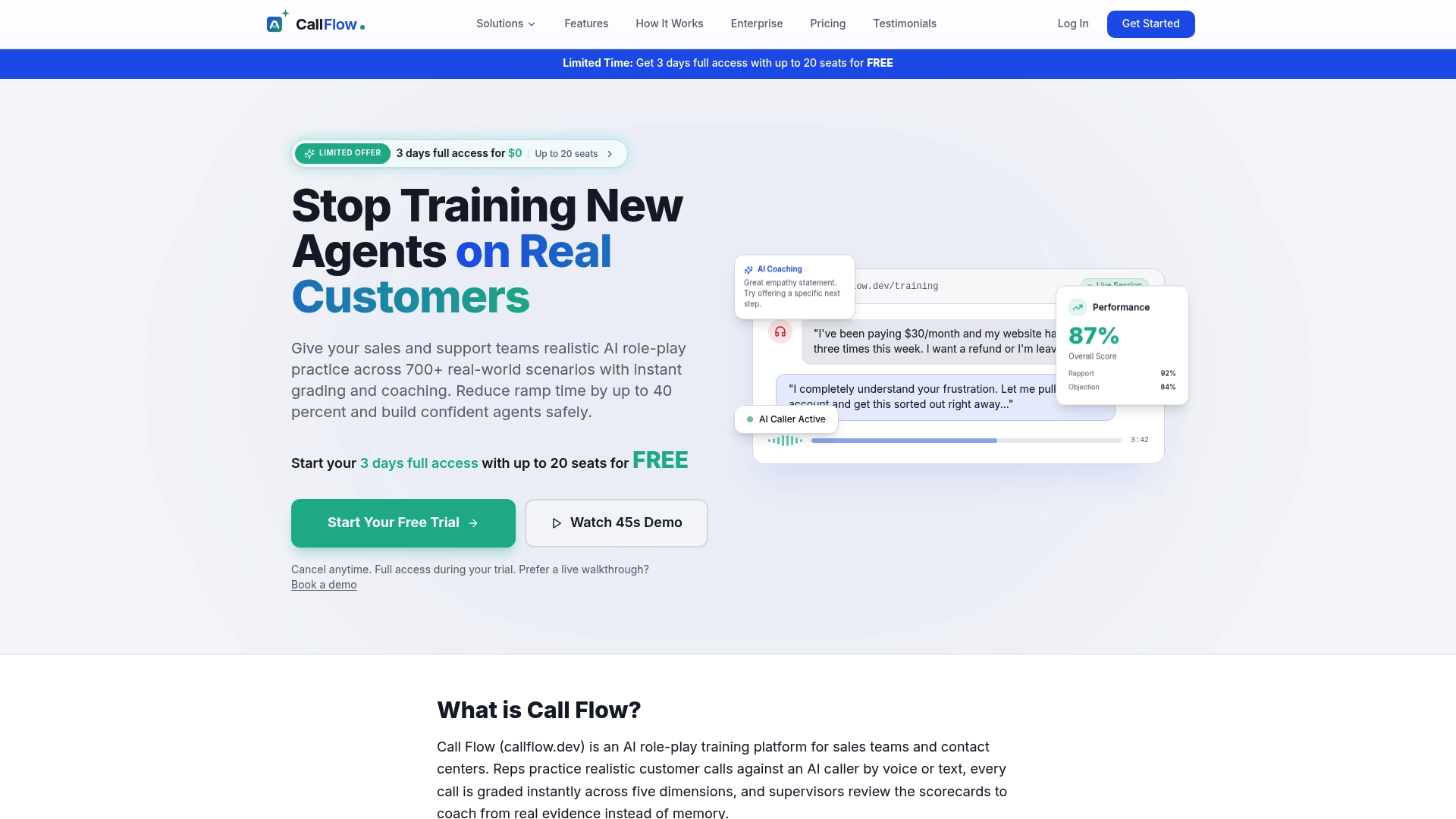
Teams using scenario-driven AI practice have reported 147% faster ramp time and 129% improvement in resolution rates, the kind of gain that comes from reps running dozens of repetitions a week instead of waiting for a manager's calendar to open up. Build the back-to-back and rapid-fire drills from this guide directly into Call Flow's AI mock-call practice tool, and every rep gets a scored transcript within minutes of finishing.
If you're running a training cycle for a full team, the sales coaching tools dashboard shows rubric trends across every rep, so you can spot who needs isolating-question drills before the gap shows up on a live call. Try a session for free at Callflow and run your first scored role-play today.
Frequently Asked Questions
What are the five steps of objection handling? Listen, acknowledge, explore, respond, and confirm. This LAER-based flow keeps reps from jumping to a response before they understand what the buyer actually means, and it ends with a confirmed next step rather than letting the conversation trail off.
What is the golden rule of handling objections? Diagnose before you respond. An answer to the wrong concern, however well delivered, doesn't move the deal forward. Ask an isolating question first: "Is that the main thing holding you back, or is there something else?"
What are the top objections sales reps hear most often? Price, timing, authority (needing another stakeholder's approval), product fit, and brush-offs like "send me some info." Cataloging these as data rather than one-off frustrations makes coaching and forecasting more accurate.
How often should a sales team practice objection handling? Two to three short sessions a week beats one long monthly workshop. Spaced, distributed practice produces stronger retention than cramming, which is why a six to eight week program with regular reassessment outperforms a single training day.
Can AI role-play replace live coaching for objection handling? It replaces the repetition bottleneck, not the judgment calls. Use AI role-play for volume, rapid-fire and solo practice reps, and reserve live coaching for nuanced formats like hot-seat and fishbowl debriefs where a human eye catches things a rubric might miss.