

Simulation-based training reliably speeds skill mastery, reduces risk, and produces measurable performance gains across healthcare, education, business, and safety work. A 2020 meta-analysis of 145 studies found a large effect on skill acquisition, the Society for Simulation in Healthcare links it to better patient outcomes, and platforms like Callflow now extend the same mechanics to sales and contact center teams.
TL;DR:
- Effective programs vary scenarios to practice judgment, include structured debriefs, and start small with one team and one clear metric before scaling up.
- Lower-cost options like tabletop exercises and telesimulation can deliver comparable results to high-fidelity setups, especially in resource-constrained environments.
- Key success factors are deliberate practice with variability, immediate feedback, and system testing during real workspace simulations.
- Early pilot testing with one scenario and team, along with facilitator training, helps ensure measurable improvement before full program investment.
Table of Contents
- What Counts as Simulation-Based Training
- The Research Case for Simulation Training Benefits
- Simulation Benefits Across Medical, Education, Business, and Safety Fields
- Why Simulation Improves Learning: The Mechanisms Behind the Numbers
- Building a Simulation Program That Actually Delivers Results
- Measuring Simulation ROI: Metrics That Prove the Investment Worked
- What Simulation Training Can't Fix, and How to Plan Around It
- How Callflow Applies Simulation Benefits to Sales and Contact Center Teams
- What Leaders Should Actually Do First
- Try Callflow's AI Role-Play Training
- Sources
What Counts as Simulation-Based Training
Simulation-based training puts learners inside a realistic scenario and lets them act, rather than telling them what to do. That's the line that separates it from a lecture or a slide deck: a lecture transfers information, a simulation forces a decision, and the decision generates feedback the learner can act on immediately. E-learning modules test recall. Simulation tests performance under conditions that resemble the real task, including time pressure, incomplete information, and consequences.
The field uses several modalities, and picking the wrong one for your goal is the most common design mistake:
- In situ simulation happens in the actual work environment (the real operating room, the actual call floor), which surfaces workflow problems a lab setting never would.
- Center-based simulation happens in a dedicated lab with controlled variables and repeatable setups, ideal for standardized skill checks.
- Computer-based and modeling simulations run scenarios digitally, useful for engineering, logistics, and financial forecasting where physical props aren't the point.
- Tabletop exercises walk a team through a scenario verbally or on paper, common in emergency management and incident command training.
- VR and AR simulations immerse the learner visually and physically, adding realism for spatial or high-stakes tasks.
- Standardized patients and manikins give clinical learners a human or human-like body to practice on without risk to a real patient.
- Telesimulation delivers the scenario remotely, which the Society for Simulation in Healthcare notes can match in-person outcomes while cutting travel and scheduling friction.
- Role-play, including AI-driven voice and text scenarios, lets learners rehearse conversations with realistic pushback before facing a live customer or patient.
Fidelity, meaning how closely a simulation mimics reality, matters less than most programs assume. A high-fidelity manikin or a sprawling VR rig isn't automatically superior to a low-cost role-play exercise if the learning objective is a conversation skill rather than a psychomotor one. The right question isn't "how realistic can we make this," it's "what specific behavior are we trying to change, and what's the cheapest simulation that forces that behavior?"
The Research Case for Simulation Training Benefits
The strongest data point in this field comes from a 2020 meta-analysis covering 145 empirical studies of simulation-based learning in higher education. In practical terms, that's a big enough effect that most learners trained with simulation outperform the majority of those trained through conventional instruction alone. Meta-analyses this size are rare in education research, and an effect this large clears the bar most researchers use to call a finding "important" rather than merely "detectable."
Simulation training benefits, by the numbers: A large-scale meta-analysis found simulation-based learning produces a g = 0.85 effect on skill acquisition. In situ clinical simulation has been linked to a 0.66 odds ratio for mortality risk in pooled analyses. Industry data shows 73% of simulation-led design teams report faster time to market.
Clinical evidence backs the same conclusion from a different angle. Guideline-level evidence compiled by the Society for Simulation in Healthcare associates in situ simulation with reduced mortality risk (odds ratio of 0.66 in pooled analyses) and improved care-delivery metrics. That's not a training statistic, it's a patient-outcomes statistic, which is a much harder bar to clear. The same body of evidence finds that simulation improves nontechnical skills, things like communication, situational awareness, and team coordination, which don't show up on a written exam but show up constantly in actual clinical error.
A systematic review documents a concrete example worth sitting with: a quality-improvement intervention using simulation raised nurses' adherence to medication administration best practices from 51% to 84%. That's not a lab result. That's a workflow that changed because staff rehearsed it enough times that the correct sequence became automatic rather than effortful.
The business case runs parallel to the clinical case. Reporting from Digital Engineering 24/7, synthesizing McKinsey and vendor data, shows engineering and product teams that adopt simulation-led design report:
- 73% experience faster time to market
- many teams report reduced product costs
- many teams see improved product performance
- many teams report reduced engineering costs
- many teams move toward zero-prototyping workflows
That data set matters because it comes from a completely different domain than healthcare, yet lands on the same underlying mechanism: rehearsing decisions in a simulated environment before committing resources in the real one cuts waste and catches problems earlier. The importance of simulation, across every field studied here, traces back to that single structural advantage.
Simulation Benefits Across Medical, Education, Business, and Safety Fields
The advantages of simulation look different depending on what you're training for, but the underlying payoff, catching mistakes before they cost something real, holds everywhere.
Medical and clinical training
Clinical simulation's biggest win is what it prevents, not what it teaches. Nontechnical skills, closed-loop communication, situational awareness, escalation timing, are hard to teach through lecture and nearly impossible to assess without watching someone perform under pressure. Simulation makes that observation possible without risking a patient.
In situ simulation, run in the actual unit rather than a simulation center, adds a second benefit clinical educators prize: it exposes latent safety threats. A drug cart stocked wrong, a call button that's hard to reach, a handoff protocol that breaks down under real time pressure. None of that shows up in a lab. It only shows up when you run the drill in the actual space with the actual equipment.
Higher education and skills training
In classroom and lab settings, simulation's advantage is transfer, meaning the skill learned in the simulation actually shows up later in a different, real context. That's the entire point of training, and it's the thing lectures are worst at producing. The 2020 meta-analysis found the effect held across a wide range of disciplines, not just clinical fields, which suggests the mechanism isn't specific to medicine.
One nuance educators frequently miss: scaffolding needs differ by learner level. Novices need explicit prompts and structure during the simulation itself to avoid cognitive overload, since a beginner trying to process a realistic scenario for the first time can hit a wall fast. More advanced learners get more value from what happens after the simulation ends: structured reflection and debriefing, where they connect what happened to broader principles.
Business and engineering
Faster time to market, cited by 73% of teams in the Digital Engineering 24/7 coverage, is the headline benefit, but the deeper story is about who gets access to simulation tools. The real constraint isn't whether simulation works, it's whether frontline engineers can run a simulation themselves or have to wait on a specialist analyst every time they want to test an idea. Teams that push simulation tools down to the people making day-to-day design decisions see the cost and performance gains show up faster, because the feedback loop shrinks from weeks to hours.
Pro Tip: If your simulation tool requires a specialist to operate, you've built a bottleneck, not a training program. The fastest ROI comes from putting simulation directly in the hands of the people making the decision.
Public safety and emergency preparedness
Rare, high-consequence events, active shooter response, mass-casualty triage, multi-agency disaster coordination, can't be rehearsed on the actual event. Simulation is the only practical substitute. Tabletop exercises let command staff walk through a scenario's decision points without deploying a single resource, making them cheap and repeatable. Full-scale exercises add the physical and logistical complexity that tabletops can't replicate, revealing communication breakdowns between agencies that look fine on paper but fail under real coordination demands. Coverage from The PSC Group on public safety training notes that this kind of rehearsal builds the communication muscle memory that written protocols alone never test.
Why Simulation Improves Learning: The Mechanisms Behind the Numbers
None of the benefits above happen by accident. Simulation works because it reproduces three conditions that decades of learning-science research keep identifying as the drivers of real skill gain.
Deliberate practice with variability. Repeating the same scenario the same way builds familiarity, not skill. Effective simulation programs vary the scenario, changing the patient's history, the customer's objection, the failure mode, so the learner practices judgment rather than memorizing a script. That variability is what forces transfer to new situations later.
Feedback and debriefing. This is arguably the single highest-leverage piece of the whole model. The Society for Simulation in Healthcare identifies debriefing, especially video-assisted and structured reflection, as a primary driver of learning gains, often outperforming unstructured feedback by a wide margin. A simulation without a debrief is just a performance. The debrief is where the performance turns into learning.
System-level rehearsal. Simulation doesn't just build individual skill, it stress-tests the system around that individual. Running a scenario in the real workspace, with the real equipment and the real team, tends to surface latent process failures that no manual ever catches: the NTSA's modeling and simulation primer calls these "unknown unknowns," the bottlenecks and gaps that only appear once you actually run the process end to end.
A few moderators determine how much of this benefit a given learner actually captures:
- Prior knowledge shapes how much cognitive load a learner can absorb during the scenario itself.
- Cognitive load that's too high shuts learning down; novices need scaffolding to prevent that.
- Facilitator skill determines debrief quality, and a weak debrief can waste an otherwise well-designed scenario.
Building a Simulation Program That Actually Delivers Results
Programs that produce the effect sizes described above share a common design sequence. Skip a step and the effect shrinks, sometimes to nothing.
- Define the objective before choosing the modality. Decide exactly what behavior you're trying to change. A communication skill needs a different simulation than a psychomotor skill.
- Choose the lowest-fidelity option that still forces the target behavior. A cheap role-play scenario that requires the right decision beats an expensive VR rig that doesn't.
- Craft scenarios with built-in variability. Write three or four versions of each scenario so learners can't pattern-match their way through.
- Prepare participants beforehand. Explain the rules of the simulation and set expectations so anxiety about the format doesn't crowd out the learning itself.
- Train facilitators specifically on debriefing. This is a distinct skill from subject-matter expertise, and it's the step most programs underinvest in.
- Debrief every single time, without exception. A simulation without a structured debrief loses most of its learning value.
Scaling doesn't have to mean bigger budgets. In situ simulation using existing equipment costs far less than a dedicated center. Telesimulation, per Society for Simulation in Healthcare guideline evidence, produces comparable outcomes to in-person delivery while removing travel and scheduling barriers. Low-fidelity kits and paper-based tabletop exercises remain legitimate options for teams testing whether a full program is worth building. For teams managing distributed staff, a hybrid approach to team training often gets more real practice hours logged than trying to gather everyone in one room.
Pro Tip: Run a pilot with one scenario and one team before building a full curriculum. If the pilot doesn't move a measurable metric within four to six weeks, the scenario design needs revision, not more budget.
Quality assurance matters as much as design. Periodically audit debrief sessions the same way you'd audit any other part of a training program, because facilitator drift is real, and a facilitator who skips the reflective questions after a few months of routine erases most of the benefit.
Measuring Simulation ROI: Metrics That Prove the Investment Worked
Simulation programs die in budget meetings when leaders can't point to a number. The good news: the numbers this field produces are genuinely strong, if you track the right ones.
Start with metrics that map to the actual objective rather than generic training satisfaction scores:
- Time-to-competency: how many sessions or days until a learner reaches the target performance level.
- Error rate: pre- and post-training error frequency on the specific task the simulation targeted.
- Retention: whether the skill holds up weeks or months later, not just immediately after training.
- Throughput: how many learners a program can move through per cohort without sacrificing quality.
- Customer-facing metrics: for contact centers and sales teams, first-call resolution and customer satisfaction scores tied to trained behaviors.
The business case, in one line: Industry data synthesized by Digital Engineering 24/7 shows 73% of simulation-led design teams report faster time to market and 72% report reduced product costs, numbers that translate directly into a budget conversation finance leaders understand.
The measurement design matters as much as the metric. A simple before-and-after comparison on the same learners is the minimum bar. Matched-control designs, comparing a trained group against a similar untrained group, produce more credible evidence but require more planning upfront. Continuous monitoring, tracking a KPI over months rather than a single snapshot, catches whether gains hold or decay, which single-point measurements miss entirely.
When you present this to executives or budget owners, frame it the way the Digital Engineering 24/7 coverage recommends: tell a measurable business story. "Time-to-competency dropped from six weeks to four" lands with a finance committee. "Learners felt more confident" does not.
What Simulation Training Can't Fix, and How to Plan Around It
Simulation's evidence base is strong, but it's not without real gaps, and pretending otherwise sets programs up for disappointment.
The research itself has limits. The 145 studies behind the 2020 meta-analysis vary widely in how they measure "skill acquisition," which means the pooled effect size, while large, blends together some genuinely different outcome types. Treat g = 0.85 as a strong signal of direction and magnitude, not a precise prediction for your specific program.
Operational constraints hit harder than methodological ones in practice:
- Cost and access inequity: high-fidelity centers and manikins remain out of reach for smaller organizations, which is exactly why low-cost alternatives like tabletop exercises and telesimulation matter.
- Poor facilitation actively harms outcomes: a badly run debrief, or no debrief at all, can leave learners with reinforced bad habits rather than corrected ones.
- The fidelity myth: assuming more realistic equals more effective leads programs to overspend on immersion while underinvesting in scenario design and debrief quality, which is where the actual learning happens.
- Measurement inconsistency: programs that skip a clear before/after metric can't tell leadership whether the investment worked, regardless of how good the training felt.
The mitigation for nearly all of this is the same: start small, measure honestly, and invest in facilitator training before you invest in equipment. A phased rollout, one team, one scenario, one clear metric, catches design flaws before they get expensive.
How Callflow Applies Simulation Benefits to Sales and Contact Center Teams
The learning mechanisms behind clinical and engineering simulation, deliberate practice, scenario variability, structured feedback, apply just as directly to a sales call or a customer service interaction. Callflow builds an AI role-play platform around exactly that mapping. Agents practice configurable scenarios that mimic real customer interactions, get instantly graded across five performance dimensions, and receive coaching feedback fast enough to correct a habit before it calcifies, rather than in a review meeting three weeks later.
That instant-grading loop matters because debriefing speed is part of what makes simulation effective in the first place. A delayed debrief loses most of its punch; an instant one keeps the mistake and the correction close enough together that the learner actually connects them.
Callflow reports vendor-observed outcomes of notably faster ramp time and significant improvement in resolution rates among teams using the platform. Treat those as vendor-provided performance figures rather than independent research findings, useful directional evidence of what an AI role-play approach can produce, not a guaranteed result for every team.
For a leader considering a pilot, a simple checklist keeps the rollout honest:
- Set one measurable objective, such as reducing average ramp time for new hires by a specific number of days.
- Build two or three scenario variants covering the most common and most difficult customer interactions your team faces.
- Decide your success threshold before you start, not after you see the results.
- Run the pilot with one team for four to six weeks, tracking ramp time and resolution rate against your baseline.
- Review the coaching feedback data, not just the outcome metrics, to see which specific behaviors moved.
Pro Tip: Pick your hardest, most common customer objection for the pilot scenario. If agents improve on the toughest conversation, easier ones take care of themselves.
Teams building out their scenario library can pull structure from existing role-play scenarios designed to cut ramp time rather than starting from a blank page, and pairing simulation with gamified training elements tends to keep engagement high across longer pilot windows.
What Leaders Should Actually Do First
Most simulation write-ups end with a long list of best practices. I'll narrow it to three, because trying to do everything at once is how most programs stall before they produce a single measurable result.
Pilot and measure before you build anything permanent. Pick one team, one scenario, one metric, and run it for six weeks. Train your facilitators on debriefing before you spend another dollar on equipment or software, since a weak debrief erodes even a well-designed scenario. Choose your success metric before you start, not after you see how the pilot went, because retrofitting a metric to match a good-looking result is how programs fool themselves.
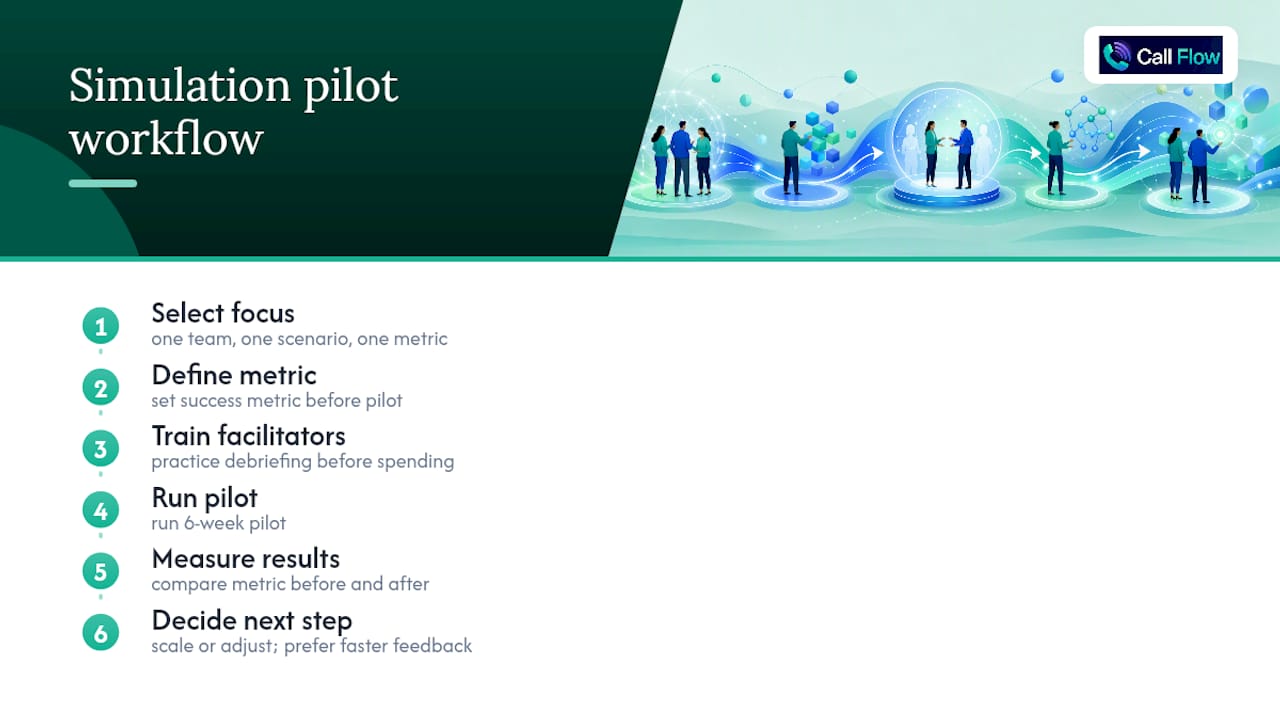
The two trade-offs worth accepting upfront: fidelity costs money you often don't need to spend, and speed of feedback usually matters more than realism of environment. If you have to choose between a more immersive simulation and a faster debrief loop, choose the faster loop.
Start smaller than feels comfortable. A four-week pilot with one clear number attached will tell you more than a year of planning a perfect program.
— Costa
Try Callflow's AI Role-Play Training
Callflow gives sales and contact center teams a way to run real practice repetitions without burning live customer calls to do it. Agents work through configurable scenarios that mirror actual customer conversations, and instead of waiting for a supervisor to review a recording days later, they get instant AI grading across five performance dimensions plus coaching feedback they can apply on the very next call.
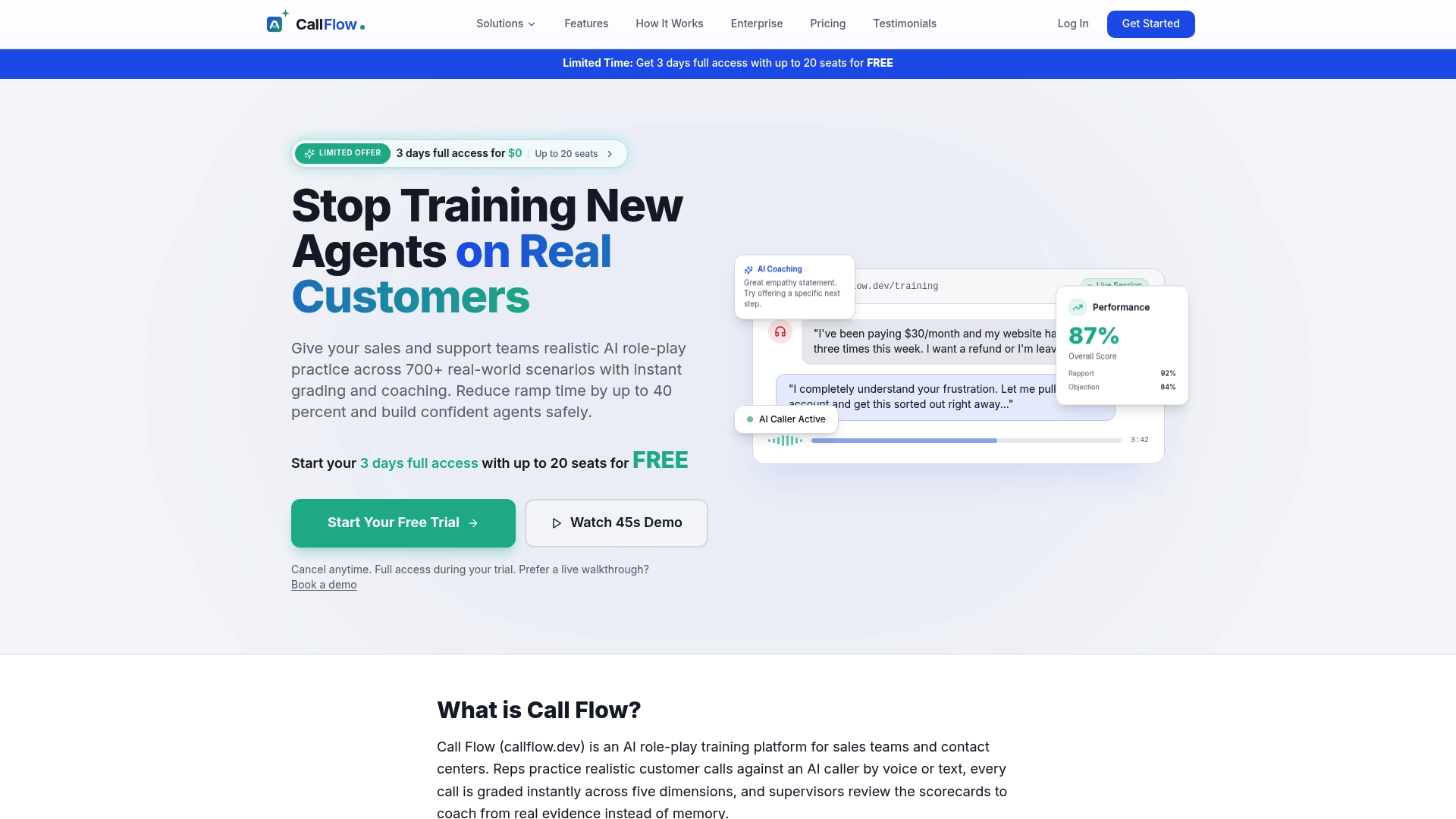
That instant feedback loop is the same mechanism driving the effect sizes described earlier in this piece, tight, repeated cycles of practice and correction, applied specifically to sales and service conversations instead of clinical or engineering tasks. Teams get access to voice and text simulation modes, supervisor dashboards for tracking team-wide skill trends, and custom scenario creation for the specific objections and workflows your business actually faces. If you're evaluating whether AI role-play belongs in your training stack, start a risk-free trial with Callflow and run your own pilot against a real ramp-time or resolution-rate baseline.
Sources
- Simulation-Based Learning in Higher Education: A Meta-Analysis (2020)
- The Business Case for Simulation-Led Design - Digital Engineering 24/7
- Society for Simulation in Healthcare — guideline evidence (summary)
- The benefits of simulation-based training (systematic review / primer) - 2024