

A coaching cadence is a fixed schedule of coaching touchpoints between a manager and each agent. Most teams do well with three layers: a short daily huddle, a weekly one-on-one with one skill in focus, and a monthly review of progress. Pick the rhythm, protect the time, and coach one skill at a time.
This guide shows you how to set that rhythm, what to put in each session, which mistakes break it and how to tell if it works.
TL;DR
- A cadence is a repeating schedule, not a one-off talk. Skills grow through repetition.
- Start simple: daily huddle, weekly one-on-one, monthly review.
- Coach one skill per session. Use a real call or a practice call as the evidence.
- Practice between sessions, so the next coaching talk starts from new work.
- Track a few metrics before and after, and compare coached agents with a baseline.
Table of Contents
- What a coaching cadence is
- Why a steady rhythm matters
- The three layers of a cadence
- A weekly cadence for a contact center
- How to design the cadence around your people
- What happens in a coaching session
- Evidence for the session: calls and practice
- Remote and distributed teams
- Common mistakes that break a cadence
- Measure whether the cadence works
- Our perspective
- Run the practice part of your cadence with Callflow
- A 30-day plan to launch your cadence
- FAQ
- Sources
What a coaching cadence is
A coaching cadence answers three questions. Who coaches whom? How often? What happens in each session?
Without answers, coaching happens when something goes wrong. A manager reacts to a bad call, a missed target or an angry customer. Then the pressure fades and coaching stops until the next problem.
A cadence removes that cycle. Coaching goes on the calendar like any other recurring meeting. Agents know when it is coming. Managers know what to bring.
For sales teams, the cadence covers calls, demos and follow-up. For contact centers, it covers service calls, chats and quality scores. The structure is the same.
Why a steady rhythm matters
Skills are built by repetition. Feedback given once and then left alone fades. A rep who hears advice in one monthly meeting has few chances to try it before the next one.
Short, frequent coaching gives the agent more tries. Each try gets a quick response. The change shows up in calls sooner.
Time is the other reason. Training Industry cites CSO Insights data showing that slightly less than 20 percent of a sales leader's time goes to coaching. The same article notes that many managers meet reps only once a month, which pushes coaching toward after-the-fact review. A fixed cadence is the simplest way to change that.
Evidence from call centers points the same way. A study by Ozgul and colleagues, published by CEPR in June 2025, found that AI-enhanced coaching raised worker productivity by 10 percent. Handle time fell by 60 seconds across five teams of call center agents. The study ran from February 1 to October 31, 2023. It shows that regular, specific coaching can move a measurable number.
The three layers of a cadence

Most working cadences stack three layers. Each layer has one job.
Daily: the huddle
Keep it to 5 to 10 minutes. Cover one target for the day, one tip from a recent call and one question from the floor. Do not turn it into a status meeting.
The daily huddle is not individual coaching. It keeps the focus skill in front of the whole team.
Weekly: the one-on-one
This is the core of the cadence. Hold it every week with every agent, for 20 to 30 minutes. The agent's direct supervisor or team lead should run it. That person usually has the best rapport, and a talk with a more senior leader can feel like an evaluation.
Cover one skill, one piece of evidence and one commitment. We cover the structure below.
Monthly: the review
Once a month, take 45 to 60 minutes per agent. Look at trends, not single calls. Compare scores with last month. Check whether the focus skill moved. Pick the next focus. Talk about goals and career path.
A weekly cadence for a contact center
The O'Reilly book Next Level Sales Coaching by Steve Johnson and Matthew Hawk includes a contact center cadence built on one week. It has a weekly goal-setting meeting, daily huddles, a weekly sales meeting and performance feedback twice a week. It is a good template if your team is large and your calls are short.
Here is a version you can adapt. The times are our suggestions, not a standard.
| Day | Touchpoint | Length | Purpose |
|---|---|---|---|
| Monday | Goal-setting and focus skill | 15 min | Set the week's one skill and target |
| Daily | Huddle | 5 to 10 min | Reinforce the skill with the team |
| Tuesday | Coaching one-on-one | 25 min | Review evidence, agree one change |
| Wednesday | Practice block | 15 to 20 min | Agent rehearses the change |
| Thursday | Team meeting | 30 min | Share wins, update scripts, answer questions |
| Friday | Quick feedback check | 10 min | Confirm the change showed up in live calls |
For sales teams, swap the Friday check for a pipeline-free call review. Keep pipeline talk out of coaching sessions. Deal strategy is a different meeting with a different goal.
How to design the cadence around your people
Do not give every agent the same schedule. Match it to role, experience and need.
New hires. Coach more often. Short daily check-ins in the first weeks catch bad habits early. Pair them with daily practice. A new agent needs reps more than reviews.
Mid-tenure agents. Keep the weekly one-on-one. This group often gains the most from steady coaching. They have the basics, and one focused skill can lift results.
Top performers. Coach them on stretch skills and let them coach others. Do not over-schedule them, but do not skip them either.
Agents who struggle. Do not pile on sessions. Narrow the focus instead. One skill, more practice, faster feedback.
Also think about span of control. If a manager cannot find the hours, the cadence will fail no matter how well it is designed. Count the hours first. A manager with twelve direct reports and 30 minutes each per week needs six hours for one-on-ones alone. Adjust team size, split duties with team leads or shorten sessions before you promise a rhythm you cannot keep.
What happens in a coaching session
A tight session beats a long one. Here is a 25 to 30 minute format.
- Connect (3 to 5 minutes). Ask how the week is going. Ask about the last commitment.
- Review the evidence (8 to 10 minutes). Play one call moment or one practice attempt. Let the agent speak first. Ask what they heard.
- Name one gap (3 minutes). Pick the single biggest gap. Say it in plain words.
- Practice it (8 to 10 minutes). Role-play the moment again. Try it two or three times.
- Commit (2 minutes). Write down one action for the week. Both of you keep a copy.
Two rules keep this working.
One skill only. A call may show four problems. Pick one. An agent working on one thing gets better at it. An agent working on five often gets better at none.
Start with what worked. Training Industry reports on an experiment in which veteran managers were asked to comment on a mix of good and bad points. 82 percent of their comments were negative. The article says that mindset demoralizes a sales force. Name one thing the agent did well before you name the gap.
For ready-to-use wording, see our scripts for instant coaching feedback. For the overall method, see our four-step coaching framework for sales managers.
Evidence for the session: calls and practice
Coaching needs something to point at. Without an artifact, a session turns into opinion.
Two sources work well.
Real calls. Pull two or three recorded calls per agent. Score them against a rubric. Look for the pattern, not the single slip. Our guide to skill gap analysis from CRM calls shows one way to do this over 30 days.
Practice calls. Real calls are slow to collect and hard to repeat. Practice calls give you a controlled test. An agent can run the same objection five times in one afternoon. That is where AI role-play helps. Read how to pilot a sales call simulation in one week and get baseline scores.

Practice between sessions is what makes the cadence work. The coaching talk sets the target. The practice block builds the habit. Our piece on deliberate practice for sales managers explains how to start with a one-week pilot.
Remote and distributed teams
A cadence matters even more when the team is not in one room. You cannot overhear calls. You cannot catch a quick word at a desk.
Keep the same three layers. Use video for one-on-ones. Share call clips before the meeting so the session starts with the evidence, not a search for it. Hold practice blocks at set times so agents do not skip them.
We lay out a 30, 60 and 90 day plan in our remote sales coaching checklist. For live support during calls, see our four to eight week real-time call coaching pilot.
Common mistakes that break a cadence
- Coaching everything at once. The agent leaves with a list and changes nothing. Fix: one skill per session.
- The manager talks too much. If you hold the floor most of the time, the agent is listening, not learning. Fix: ask, then wait. Aim for the agent to speak most of the time.
- No artifact. Advice with no call or practice attempt behind it is easy to ignore. Fix: always bring evidence.
- No commitment. A session that ends without an action is a chat. Fix: write one action and check it next time.
- Pipeline review dressed as coaching. Deals and skills are different topics. Fix: separate the meetings.
- Skipping sessions when busy. One cancelled week becomes a cancelled month. Fix: shorten the session, do not drop it.
- Coaching only the weakest. The middle of the team often has the most room to grow. Fix: put every agent on the calendar.
Measure whether the cadence works
Decide before you start what you will track. Pick a small set. Five to seven metrics is plenty.
Split them into two groups.
Leading indicators show behavior change: rubric scores on practice calls, scores on live calls, completion of weekly practice, share of commitments met.
Lagging indicators show results: quota attainment, win rate, first-call resolution, customer satisfaction, handle time and turnover.
Leading numbers move first. If they do not move after several weeks, change the coaching. If they move and lagging numbers do not, give it more time or check that you are coaching the skill that drives the result.
To make the comparison fair, record a baseline before the cadence starts. Then re-score at fixed points, such as week six and week twelve. If you can, keep a group of agents on the old schedule for comparison. Our readers often ask how to measure skill growth over time without drowning in numbers. The answer is the same: a few metrics, the same method each time.
For dashboards, see our guides to a training metrics dashboard and training data visualization for contact centers.
Our perspective
Most teams do not lack coaching ideas. They lack a rhythm they can keep.
We build Callflow around that point. Managers are busy. A cadence only works if each part is small enough to survive a bad week. Practice should not need a manager in the room. Feedback should not wait for the next meeting.
That is why we focus on instant AI grading across five performance dimensions. An agent runs a scenario, gets a score and coaching notes right away, and runs it again. The manager then walks into the weekly one-on-one with real evidence and a clear gap to work on.
Our scoring is built to align with the QA standards a team already uses. Supervisors can review and override grades. So the cadence stays under the manager's control, and the platform handles the repetition.
Our advice is simple. Set the weekly slot. Pick one skill. Let agents practice between sessions. Use the data in the monthly review.
Costa
Run the practice part of your cadence with Callflow
The weekly practice block is the part most teams skip, because it takes setup. Callflow gives you realistic sales and customer service scenarios in voice or text, instant grading and coaching feedback, supervisor dashboards and skill analytics. You can also build custom scenarios for your own objections and products.
Plans are billed per team. Starter is $7.42 per month or $89 per year. Growth is $14.92 per month or $179 per year. Scale is $33.25 per month or $399 per year. Business and Enterprise plans have no published price. See Callflow pricing or the Business and Enterprise options. A free full-feature trial lets you try the weekly practice block with your own team.
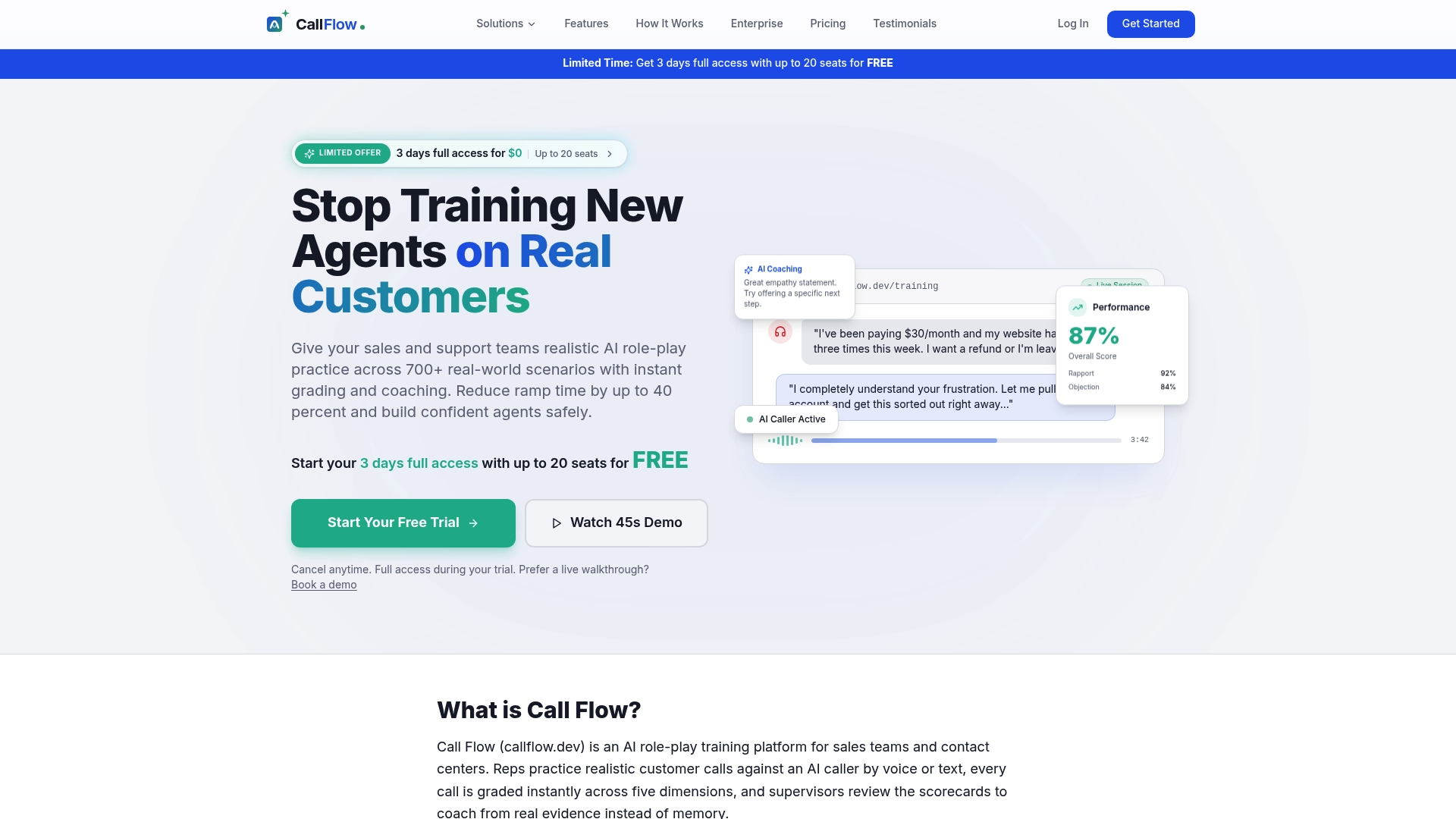
To see the platform first, visit callflow.dev.
A 30-day plan to launch your cadence
Week 1: Baseline. Pull two or three calls per agent, or run one practice scenario each. Score them with one rubric. Find the biggest gap per agent.
Week 2: Start the rhythm. Put the daily huddle, weekly one-on-one and practice block on calendars. Run the first sessions using the five-step format.
Week 3: Hold the line. Keep every slot. Check that each session ended with a written commitment. Trim any session that runs over.
Week 4: First review. Compare scores with the baseline. Ask agents what helps and what wastes time. Pick the next focus skill for each person.
Then repeat. Re-score on a fixed schedule, and adjust the cadence by role and need as you learn.
FAQ
How often should managers coach agents?
Weekly one-on-ones are a practical default, with a short daily huddle and a monthly review on top. New hires may need more frequent check-ins. Choose a rhythm you can keep every week, because consistency matters more than length.
How long should a coaching session last?
Twenty-five to thirty minutes is enough for most one-on-ones. That is time for a quick check-in, one piece of evidence, one practice round and one commitment. Longer sessions tend to drift into several topics.
Who should run the coaching session?
The agent's direct supervisor or team lead is usually the best choice. That person knows the agent's work and has the strongest rapport. A meeting with a more senior leader can feel like an evaluation and make open discussion harder.
What is the difference between a coaching cadence and a training program?
Training teaches new material in a block. A coaching cadence is the ongoing rhythm that helps agents apply it on real calls. Teams usually need both. Training sets the standard, and the cadence builds the habit.
Sources
- 5 Common Sales Coaching Errors and How to Avoid Them, Training Industry
- Artificial Intelligence in Coaching: Improving Productivity, CEPR
- Appendix: Sales Coaching Cadences, Next Level Sales Coaching, O'Reilly