

A sales skill gap analysis has to produce two things: a prioritized, impact-weighted list of coachable gaps, and a one-page coaching plan per rep. Start this week by pulling CRM stage conversions for the last quarter and scoring eight recent calls per rep, or a three-call quick pass if time is tight. The five steps that follow (define, assess, identify, prioritize, plan) turn that raw evidence into something a manager can act on Monday morning.
TL;DR:
- Prioritize coaching efforts on skill gaps with the highest revenue impact, focusing on behaviors like discovery, qualification, and pipeline hygiene based on role-specific weightings.
- Gather evidence primarily from call recordings and CRM data, involving managers and peers to ensure scoring calibration and reliable assessment.
- Limit coaching to one or two critical gaps at a time, re-measuring progress monthly on leading indicators before expanding to additional areas.
- Use structured, scenario-specific role-play practice with instant feedback tools to accelerate behavior change and improve skill mastery.
- Focus on observable, measurable action plans and reinforce improvements with frequent coaching to ensure sustainable behavioral shifts.
Table of Contents
- What Is a Sales Skill Gap Analysis, Step by Step?
- What Sales Skills Should You Actually Test?
- How Do You Gather Reliable Evidence on Sales Skills?
- How Do You Prioritize Which Gaps to Fix First?
- How Do You Turn a Gap Into a Coaching Plan?
- How Soon Should You See Improvement?
- Why Do Most Skill Gap Analyses Fail?
- Does Role-Play Practice Actually Close These Gaps Faster?
- An Editorial Take on Chasing Every Gap at Once
- An Alternative Way to Scale the Coaching Plans
- Sources
What Is a Sales Skill Gap Analysis, Step by Step?
A skill gap analysis is a comparison between the sales behaviors your team needs and the behaviors they actually show on calls, in CRM data, and in role plays. The output is a ranked list of gaps weighted by revenue impact, not a generic training wishlist. Structured diagnostics consistently outperform ad hoc coaching because they force you to define the target behavior before you judge anyone against it.
Here is the five-step sequence, in order:
- Define. Write down what excellent looks like for each role (SDR, AE, CS) in observable terms. Not "good discovery," but "asks three open questions before pitching, confirms budget authority by end of call."
- Assess. Pull evidence: recorded calls, CRM stage data, role-play scores, manager ratings. Involve the rep's direct manager and, where possible, a second reviewer to reduce bias.
- Identify. Score each rep against the defined behaviors and flag where scores fall below target. This is where you separate a skill gap from a pipeline or lead-quality problem.
- Prioritize. Weight each gap by potential revenue impact and how many reps share it. A gap that affects six of eight AEs outranks one affecting a single rep.
- Plan. Build a one-page coaching plan per rep, tied to a specific re-measure date.
For a credible first pass, involve the sales manager, one peer reviewer, and RevOps if you have call recording or CRM reporting access. The minimal evidence bar is eight recorded calls per rep, or three if you need a faster read. In week one, aim to finish the define and assess steps for one team. By day 30, you should have prioritized gaps and coaching plans in motion for every rep on that team.
What Sales Skills Should You Actually Test?
Most gap analyses fail because managers test what's easy to observe (talk time, activity volume) instead of what actually predicts revenue. Six competency zones cover the behaviors that move deals, and each one maps to a specific place deals tend to die.
- Discovery. Asks layered open questions, uncovers budget and timeline, confirms decision process before proposing anything.
- Objection handling. Separates a real objection from a stall, responds without getting defensive, and reframes rather than repeating the pitch louder.
- Qualification. Applies a consistent framework (BANT, MEDDIC, or a house version) instead of qualifying on gut feel.
- Closing and next steps. Locks a specific next meeting with a named attendee and date, not "I'll follow up."
- Product and value framing. Ties features to the buyer's stated problem instead of reciting a feature list.
- Pipeline hygiene. Updates CRM stages accurately and logs next steps same day, which is a leading indicator managers routinely ignore.
A stalled pipeline at the proposal stage usually traces back to weak qualification earlier in the call, not a closing problem. For SDRs, weight discovery and qualification heavier; for AEs, weight closing and objection handling; for CS teams doing expansion, weight value framing and pipeline hygiene the most.
How Do You Gather Reliable Evidence on Sales Skills?
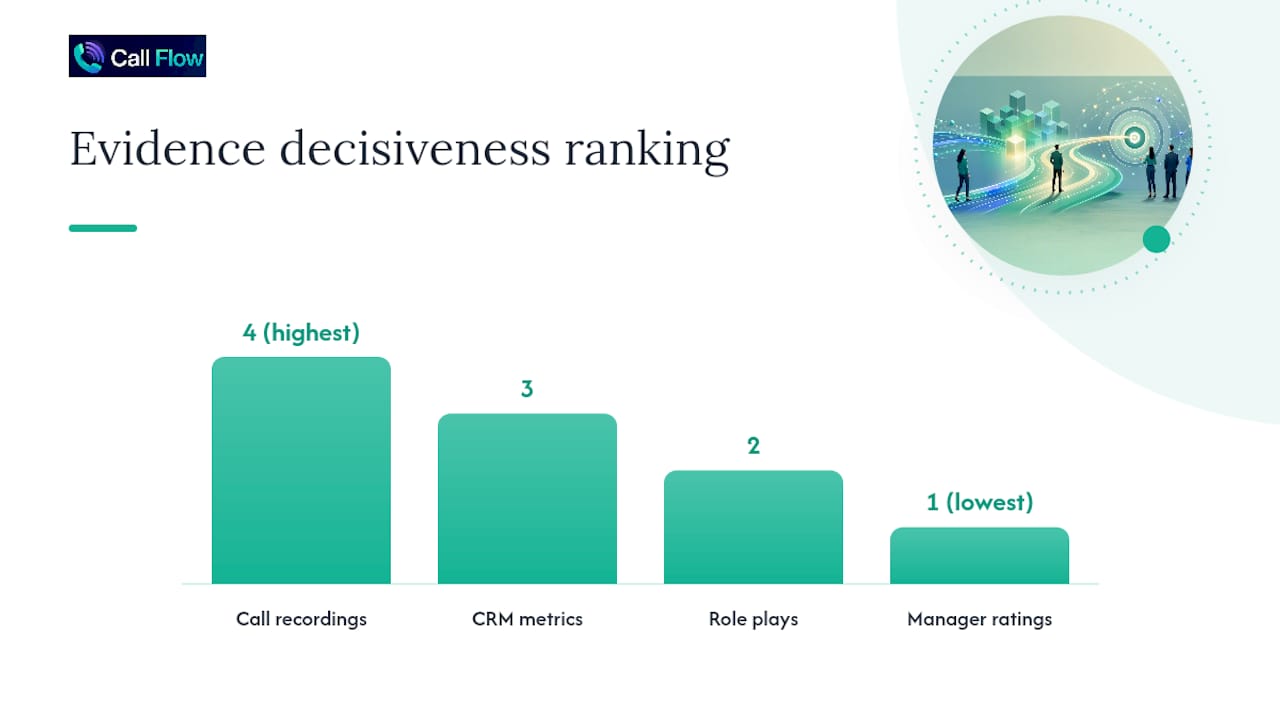
Evidence quality determines whether your analysis holds up when a rep pushes back on a low score. Four evidence types carry different weight, and knowing which one is decisive for which question matters more than collecting more data.
Call recordings are decisive for discovery, objection handling, and framing because you're watching the actual behavior, not a description of it. Role plays are useful for measuring how a rep handles a scenario they haven't faced yet, which tells you about adaptability rather than habit. CRM metrics (stage conversion, next-step logging, cycle time) are decisive for pipeline hygiene and qualification discipline. Manager ratings are the least reliable on their own; self-reported confidence is consistently the weakest input and needs triangulation against calls or CRM data before you act on it.
Sample eight to ten calls per rep for a full assessment, or run a three-call quick pass when you need a faster read. Before scoring anyone, calibrate: have two managers independently score the same three calls and compare notes until their scores land within one point of each other on a 1 to 5 scale.
| Score | Behavioral anchor |
|---|---|
| 1 | Skill absent; rep does not attempt the behavior |
| 2 | Attempts the behavior inconsistently, often incorrectly |
| 3 | Executes the behavior but misses nuance or timing |
| 4 | Executes consistently with good judgment |
| 5 | Executes and coaches others; a model for the behavior |
Gap size is simply target level minus current level. A rep scoring 2 against a target of 4 has a gap of 2, which is your raw input for prioritization.
Pro Tip: Score the calibration calls before you score anyone's real calls. Skipping calibration is the single fastest way to end up with a rubric that means something different in every manager's hands.

How Do You Prioritize Which Gaps to Fix First?
Not every gap deserves a coaching plan this quarter. The formula that keeps teams from spreading effort too thin is priority score equals impact weight multiplied by gap size, where impact weight reflects how directly that skill affects revenue and how many reps share the deficiency.
- Assign impact weights on a simple 1 to 3 scale: 3 for skills tied directly to close rate or deal size, 2 for skills tied to pipeline velocity, 1 for skills that mostly affect efficiency.
- Multiply impact weight by the average gap size across the team to get a priority score, then rank gaps highest to lowest.
- Train the skill when the gap is behavioral and repeatable across the team; consider hiring or restructuring the role when the gap reflects a mismatch between the person and the job, not a fixable behavior.
- Redesign the process itself when the "gap" is actually a broken handoff or missing enablement asset, not a rep failing to execute.
- Flag single points of failure: if only one AE can run a technical demo, that's a business risk independent of skill scores, and it needs a backup trained regardless of where it ranks.
This ranking approach mirrors how structured skills gap templates convert raw scores into a ranked action list rather than a flat list of everyone's weaknesses.
How Do You Turn a Gap Into a Coaching Plan?
A gap on a spreadsheet doesn't change behavior. A one-page plan, handed to the rep and reviewed on a fixed schedule, does. Keep every plan to these fields so nothing gets lost in a longer document nobody reopens:
- Skill being targeted, named specifically (not "communication," but "confirming next steps by name and date").
- Evidence that triggered the plan (call date, CRM metric, role-play score).
- Current level and target level on your 1 to 5 scale.
- Action: the specific practice format, whether that's a scripted scenario drill, a five-minute micro-practice before calls, or paired shadowing with a stronger rep.
- Owner and deadline for the first practice session.
- Re-measure date, set 30 days out.
Success criteria should be observable, not aspirational: "confirms budget authority on 4 of 5 next calls" beats "improve discovery." Weekly coaching check-ins of 15 to 20 minutes work better than monthly hour-long reviews because the feedback loop stays tight to the behavior. Converting evidence into a documented, one-page coaching plan per rep is what separates an analysis that changes behavior from one that just generates a report.
Pro Tip: Have the rep fill in the "action" field themselves after you show them the evidence. A plan they helped write gets followed more often than one-handed down.

How Soon Should You See Improvement?
Leading indicators move before revenue does, and that gap in timing trips up a lot of managers who quit a coaching push too early. Watch stage conversion rate, the quality of logged next steps, and demo-to-proposal conversion. Revenue and close rate lag behind these by a full sales cycle, sometimes two.
- Re-measure leading indicators at 30 days. If discovery scores are up but conversion hasn't moved, give it another cycle before you judge the coaching a failure.
- Run a full re-score at 60 days, using the same rubric and roughly the same call sample size as the original assessment.
- Where possible, run a pilot group against a control group of similar reps who aren't getting the focused coaching, so you can attribute movement to the training rather than seasonal pipeline swings.
A minimal, evidence-based re-check at these intervals gives you a defensible answer to "is this working" instead of a gut feeling. One reliable practitioner rule holds up across teams: coach to one or two constraints at a time and confirm movement on leading indicators before rolling the plan out to the rest of the team.
Why Do Most Skill Gap Analyses Fail?
The most common failure mode isn't bad data. It's skipping the step that would have told you the data was bad in the first place.
- Self-ratings inflate scores because reps rate their own confidence, not their observed behavior; always triangulate against call recordings or CRM data before trusting a self-assessment.
- Managers jump to blaming the rep before ruling out process causes: check lead quality, territory assignment, and product gaps before assuming a low close rate means a skill deficit.
- Inconsistent rubrics across managers make scores incomparable; run the calibration exercise described earlier before any team-wide rollout.
- Vague action items ("be more consultative") produce vague results; every plan needs an observable success criterion tied to a specific call behavior.
- Treating the analysis as a one-time event instead of a recurring cadence lets the same gaps resurface a quarter later.
A gap analysis that skips process troubleshooting tends to produce coaching plans aimed at the wrong constraint, which wastes a manager's limited coaching hours on a symptom instead of the cause.
Does Role-Play Practice Actually Close These Gaps Faster?
Once you've identified a gap, the coaching format matters as much as the diagnosis. Reps who practice a specific scenario repeatedly, with feedback right after each attempt, tend to close the gap faster than reps who get a single coaching conversation and no follow-up rep. Structured practice with fast feedback loops beats occasional, unstructured coaching sessions for the same reason spaced repetition beats cramming.
The behaviors that separate a 3 from a 5 on a discovery rubric aren't complicated. They're just inconsistent under pressure. Repeated, scored practice is what makes them automatic instead of aspirational.
Add role-play to a one-page coaching plan by naming the exact scenario (a specific objection type, a specific buyer persona) rather than a generic "practice discovery" instruction. AI role-play tools that grade instantly against a defined rubric, like Callflow, let a rep run that same scenario multiple times in a day and see where the score moved, without waiting for a manager's calendar to open up. Teams using structured, instantly-graded practice report ramp times cut by roughly half and resolution-quality improvements of similar magnitude, which lines up with the core logic of this whole framework: score the behavior, coach the specific gap, remeasure fast.
An Editorial Take on Chasing Every Gap at Once
Most managers build a skill gap analysis and then try to fix everything the spreadsheet flags. That's the mistake. Pick one or two constraints, coach hard against those, and re-measure in 30 days before you touch anything else on the list. A plan with six priorities is a plan nobody follows.
Manager buy-in and clean data matter more than the rubric's elegance. If two managers can't agree on what a 3 looks like, fix that before you roll anything out further. Run the quick three-call scan this week on one rep. You'll learn more from that than from another quarter of guessing.
— Costa
An Alternative Way to Scale the Coaching Plans
Building one-page coaching plans by hand works for a team of six. It gets brutal at twenty reps, especially when every plan needs fresh call evidence and a re-measure date tracked on a spreadsheet. Callflow was built for that scaling problem: it runs the scenario practice your coaching plans already call for (objection handling, discovery, closing) and grades every attempt instantly across the same performance dimensions your rubric already tracks.
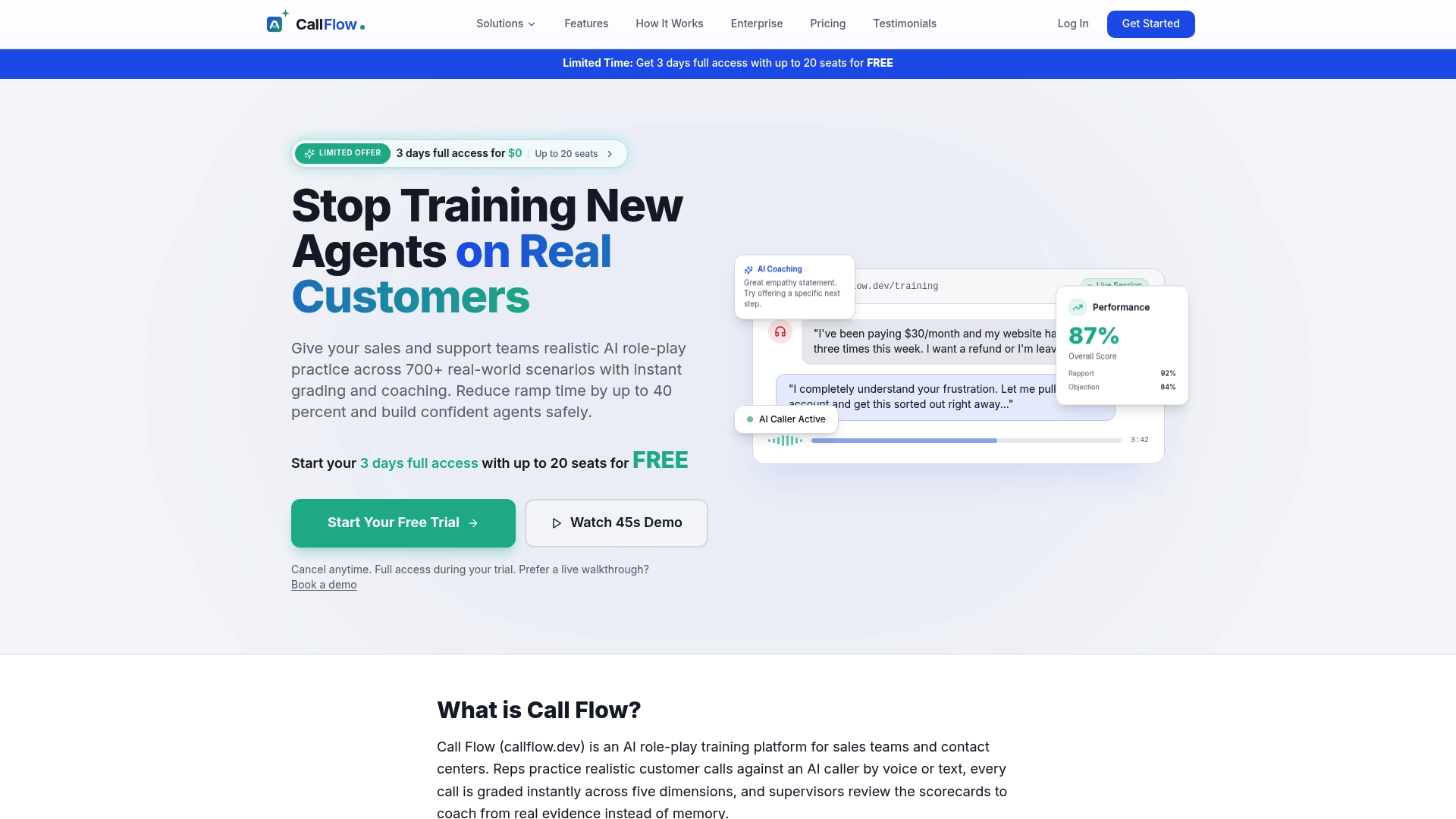
Instead of waiting for a manager to review a call recording, a rep runs the scenario tied to their specific gap and gets scored feedback in the moment, then runs it again. Supervisor dashboards roll individual scores up into the same kind of gap analytics this article walks through, so the priority list stays current instead of going stale between quarterly reviews. Teams using this approach have reported significantly faster ramp times and improved resolution rates, reflecting meaningful gains in coaching efficiency.
If your current bottleneck is coaching capacity rather than diagnosis, start a risk-free trial of Callflow's sales coaching tools and load one rep's priority gap in as a scenario this week. See what the score looks like on attempt one versus attempt five before you decide whether it fits your team.
Sources
- Skills Gap Analysis Template: Step-by-Step with Scoring
- Skills Gap Analysis Template Free Download
- Sales skills gap analysis and competencies
- ScienceDirect: organizational skills/diagnostics literature