

This library gives you copy-and-paste coaching feedback examples across three categories: positive reinforcement, constructive redirection, and coaching questions that shift ownership back to the employee. Each set draws on the SBI model, STOP/START/CONTINUE, and CORE frameworks, plus short situational scripts. Adapt the wording to your own voice and follow every line with a real question, not a lecture.
TL;DR:
- Most managers need to deliver structured, observable feedback tailored to the employee’s role and experience to drive real improvement.
- Front-loading specific behaviors and impacts in face-to-face or remote feedback ensures clarity and reduces defensiveness.
- Regular, well-practiced coaching conversations with clear next steps and follow-up significantly boost team engagement and performance metrics.
- Using targeted models like SBI, STOP/START/CONTINUE, or CORE helps create effective, context-specific coaching interactions.
- Practicing feedback delivery through role-play and AI-powered simulations shortens the learning curve and increases long-term coaching effectiveness.
Table of Contents
- Coaching Feedback Examples for Every Situation
- Best Practices and Pitfalls to Avoid
- Scripts and Templates You Can Use Word for Word
- Which Feedback Model to Use and When
- Running a Five-Minute Coaching Conversation
- Adapting Feedback Across In-Person, Email, and Video Channels
- Tailoring Feedback by Role and Seniority
- Coaching Feedback for Remote and Distributed Teams
- What Actually Changes Feedback From Noise to Growth
- Practice Delivering Feedback Before It Counts
- Sources
- FAQ
Coaching Feedback Examples for Every Situation
Good feedback examples work because they name a specific behavior and its effect, not a vague trait. Below are four categories you can pull from depending on the moment.
Positive feedback examples:
- "When you walked the client through pricing step by step on that call, they stopped pushing back. That clarity closed the deal."
- "You caught the scheduling conflict before it reached the customer. That kind of attention saves us rework."
- "Your update in stand-up today gave the team exactly what they needed to plan the sprint. Keep that level of detail."
- "You stayed calm when that caller escalated. Your tone brought the temperature down in under a minute."
- "The way you documented that handoff meant the next shift didn't have to ask a single follow-up question."
- "You asked the customer a clarifying question before quoting a solution. That's exactly the discovery habit we want."
- "Your numbers were accurate and submitted early three weeks running. That consistency makes my job easier."
- "You gave a teammate credit for the idea in the meeting instead of taking it yourself. That builds trust fast."
Constructive feedback examples (built on situation, behavior, impact):
- "In yesterday's demo, you spent twelve minutes on features before asking what the client actually needed. That order lost their attention early."
- "During the call at 2 p.m., you interrupted the customer twice while they were describing the issue. That made them repeat themselves and raised their frustration."
- "On the report due Friday, three of the five totals didn't match the source sheet. That forced finance to redo the reconciliation."
- "In the team meeting, you spoke for most of the update and Priya didn't get a chance to share her numbers. That left a gap in what leadership saw."
- "You closed that ticket without confirming the customer's issue was resolved. They reopened it two hours later."
- "Your email to the client on Tuesday used technical terms they hadn't seen before. They asked us to explain it twice."
- "You missed the 9 a.m. huddle twice this week without a heads-up. That left the team short on context for the morning calls."
- "The proposal skipped the budget breakdown the client asked for last time. That's the second round of edits we'll need."
Coaching-question examples turn a correction into a conversation:
- "What do you think happened right before the customer got frustrated?"
- "If you replayed that call, what's the one thing you'd change?"
- "What information would have helped you make that call differently?"
- "What's getting in the way of hitting that deadline consistently?"
- "How did you decide to handle the objection that way?"
- "What would 'ready to submit' look like for this report?"
- "What support do you need from me to close that gap?"
- "What did you notice about how the client reacted when you paused there?"
Situational mini-scripts you can adapt on the spot: for a missed deadline, try, "I noticed the deck wasn't ready for the 10 a.m. review. Walk me through what happened, and let's figure out what needs to change for next time." For a strong client call, try, "That was a clean save on the pricing objection. What made you decide to lead with the discount instead of the feature list?" For a collaboration issue, try, "In the planning meeting, the room went to you first and stayed there. What's one way we split airtime more evenly next time?"
Best Practices and Pitfalls to Avoid
Effective coaching feedback follows a short set of rules that separate managers whose teams improve from managers whose teams tune them out.
- Ask permission first. A quick "Do you have two minutes for some feedback on that call?" sets a contract and lowers defensiveness before you say a word.
- Stick to observable behavior, not motive. "You cut the customer off twice" is verifiable; "you don't care about the customer" is a guess, and guesses trigger arguments.
- Skip the feedback sandwich. Wrapping criticism between two compliments confuses the message, and research on the technique finds it changes how feedback feels without improving what people actually do. Give praise and developmental notes as separate, clearly labeled moments.
- Prioritize skill over frequency. Coaching more often only helps when the coaching itself is sharp. One academic study on managerial coaching found that high-frequency coaching from managers with weak coaching skill actually hurt performance and blurred role clarity. Fewer, better conversations beat constant, sloppy ones.
- Close the loop. Write down the one action you agreed on and check back at a set time. Feedback that evaporates after the conversation rarely changes behavior.
That fifth point matters more than most managers assume. Gallup's research on employee feedback found employees who strongly agree they get meaningful feedback are substantially more likely to be engaged at work, and follow-through is what makes feedback feel meaningful rather than performative.
Pro Tip: Keep a running note per team member with the date, the behavior you flagged, and the agreed next step. Three months later, that log tells you whether coaching is actually working or just happening.
Scripts and Templates You Can Use Word for Word
You don't need to write feedback from scratch every time. These templates cover the moments that come up most.
Micro-feedback lines (use immediately after a call or meeting):
- "Quick note: when you [specific behavior], the result was [impact]. Keep that up."
- "One thing to adjust: in that call, [specific behavior] led to [impact]. Try [alternative] next time."
- "Fast flag: [behavior] happened again today. What's making that hard to catch before it ships?"
SBI one-on-one script, fillable in under a minute:
"Do you have a few minutes to talk through the [call/meeting/report] from [day]? In the [situation], I noticed [specific behavior]. The impact was [effect on customer/team/numbers]. I wanted to check in. What's your take on how that went? Based on what you're saying, what's one thing you'd try differently next time? Let's check back in on [date] to see how it's landing."
STOP/START/CONTINUE template, filled with a real example:
- Stop: Interrupting customers before they finish describing the issue.
- Start: Repeating the customer's problem back before proposing a solution.
- Continue: Following up with a summary email after every escalated call.
Coach-led script for a fuller conversation:
"Before I share what I noticed, is now a good time? [Pause for permission.] In the client call this morning, I saw you skip the discovery questions and jump straight to pricing. What was going through your mind at that point? What would change if you had an extra thirty seconds before quoting a number? Let's agree on one thing to try on your next call, and I'll check in with you Thursday."
Which Feedback Model to Use and When
Four frameworks cover almost every coaching situation a manager runs into, and each one solves a slightly different problem.
- SBI (Situation, Behavior, Impact) names the moment, the specific action, and the effect it had. Example: "In the demo (situation), you skipped the pricing slide (behavior), so the client left without next steps (impact)." Use it for one-off, behavior-specific corrections, as Careerminds explains in its breakdown of the model.
- STOP/START/CONTINUE sorts feedback into three quick buckets, ideal for brief post-event check-ins when you need speed over depth, according to university coaching guides.
- CORE (Context, Observation, Result, Explore) builds in a step for dialogue after the observation, which Vachon Coaching's framework overview positions as better suited to development-focused conversations than quick corrections.
- CDA (Contract, Data, Action) front-loads permission, then presents specific data, then moves straight to an agreed action. It works well for recurring performance conversations where trust is already established.
Use SBI for isolated incidents, STOP/START/CONTINUE for fast check-ins, and CORE or CDA when you're building a longer coaching relationship.
Running a Five-Minute Coaching Conversation
A coaching conversation doesn't need thirty minutes on the calendar. It needs structure.
- Contract (15 to 30 seconds). Ask permission and state your intent: "Got a minute? I want to talk through the call from earlier."
- Observation (30 to 60 seconds). State the specific situation and behavior using SBI, no interpretation attached.
- Reflection (one to three minutes). Ask one or two open questions, like "What was your read on how that landed?" and let them answer fully before you respond.
- Next steps. Co-create one measurable action together rather than assigning it, and set a specific follow-up date.
- Documentation. Log the date, behavior, and agreed action, then set a calendar reminder to check in.
Pro Tip: If you only have ninety seconds, do steps one, two, and four. Skip reflection only when the moment truly can't wait, and revisit it properly later. Managers who invest in this kind of structured coaching see it show up in the numbers: Gallup's manager development research found manager-focused training lifted manager performance metrics by about 20 to 28 percent and team engagement by up to 18 percent within 9 to 18 months according to Gallup research.
Adapting Feedback Across In-Person, Email, and Video Channels

The words change less than the delivery does. In person, you have tone and body language to soften a hard message, so you can be direct: "Can we grab five minutes? Something from the call I want to flag." Over email, strip out anything that could read as sarcastic or clipped, and lead with the specific behavior before the impact: "Following up on today's client call, I noticed we skipped the discovery questions before quoting price. Let's talk through an alternative approach when you have a minute." Email works best for documentation after a verbal conversation, not as the first delivery of a hard message.
In a video meeting, keep your camera on and pause visibly before delivering the feedback, since silence reads differently over a screen than in a hallway. A line like "I want to pause here for a second before we move on, because I noticed something in that last call" signals a shift in tone that's easy to miss on a flat video feed. Chat messages during a live call work only for quick, low-stakes notes ("nice save on that objection") and never for anything that needs context or follow-up. Reserve chat feedback for reinforcement, not correction. Whatever the channel, ask permission before you deliver anything corrective. A written message that skips that step can land harder than intended, since the reader supplies their own tone.
Tailoring Feedback by Role and Seniority
An entry-level rep six weeks into the job needs more scaffolding than a five-year veteran. For a new hire, pair the SBI observation with an explicit teaching moment: "In that call, you didn't ask about budget before presenting the package. Here's why that question usually comes first, and here's a line you can try next time." New employees benefit from feedback that explains the reasoning behind the standard, not just the gap from it.
For a tenured performer, skip the explanation and go straight to the question: "You didn't ask about budget on that call. What happened there?" Assume they know the standard and use the conversation to surface what got in the way. Treating an experienced rep like a trainee reads as condescending and wastes the moment.
For managers coaching other managers, the frame shifts from behavior correction to leadership modeling: "In the team meeting, you answered every question yourself instead of asking your reps to weigh in. What message do you think that sent about who owns the decisions?" The impact statement points at team dynamics rather than a single task outcome. Across every level, the STOP/START/CONTINUE model scales cleanly: a new hire might get five items across the three buckets while a senior manager gets one sharp item per bucket, tied to strategic behaviors rather than task mechanics.
Coaching Feedback for Remote and Distributed Teams
Distance strips out the informal signals that make in-person feedback feel low-stakes, so remote coaching needs a more deliberate structure. Without a hallway conversation to fall back on, schedule a short, named call instead of dropping feedback into a chat thread: "Can we jump on a quick call about this morning's client email? Fifteen minutes." That framing avoids the anxiety a vague "we need to talk" message creates when someone can't read your face.
Written feedback for remote teams should front-load the specific behavior before any interpretation, since remote employees often reread messages several times looking for tone cues that aren't there: "In the proposal you sent Tuesday, the budget section didn't match the numbers from our call. Let's sync so I understand what happened." Recording short video clips of calls (with consent) and referencing exact timestamps also removes ambiguity that plagues text-only remote feedback: "At the 4-minute mark, when the client asked about the contract length, that's the moment to slow down."
Distributed teams also need more explicit closing of the loop, because there's no desk to walk by later to check progress. State the follow-up date and channel out loud: "Let's check in on this in Thursday's one-on-one." Managers running fully remote sales or support teams often lean on structured practice sessions to rehearse these conversations before they happen live, which is where a manager checklist for remote sales coaching can help build the habit.

What Actually Changes Feedback From Noise to Growth
Most coaching feedback advice treats the words as the hard part. They're not. The hard part is adapting a template to the person in front of you, and that's where most managers quietly fail. A line that lands as direct and respectful with one employee reads as harsh with another, depending on their history, their culture, and how safe they feel raising a disagreement with you. Psychological safety isn't a soft add-on to feedback delivery; it determines whether your carefully worded SBI script gets heard or gets defended against.
The bigger miss is treating feedback delivery as a talent instead of a skill. Managers rehearse sales pitches and client presentations for hours but walk into a corrective conversation cold, on the fly, hoping the right words show up. They don't reliably show up. Structured practice, including role-play with real-time correction, closes that gap faster than reading another list of example phrases ever will.
— Costa
Practice Delivering Feedback Before It Counts
Reading example lines only gets a manager so far. The gap between knowing what to say and saying it smoothly under pressure closes through repetition, and Callflow gives you a place to rehearse coaching conversations, objection handling, and client calls with an AI partner that grades the interaction across five performance dimensions the moment it ends.
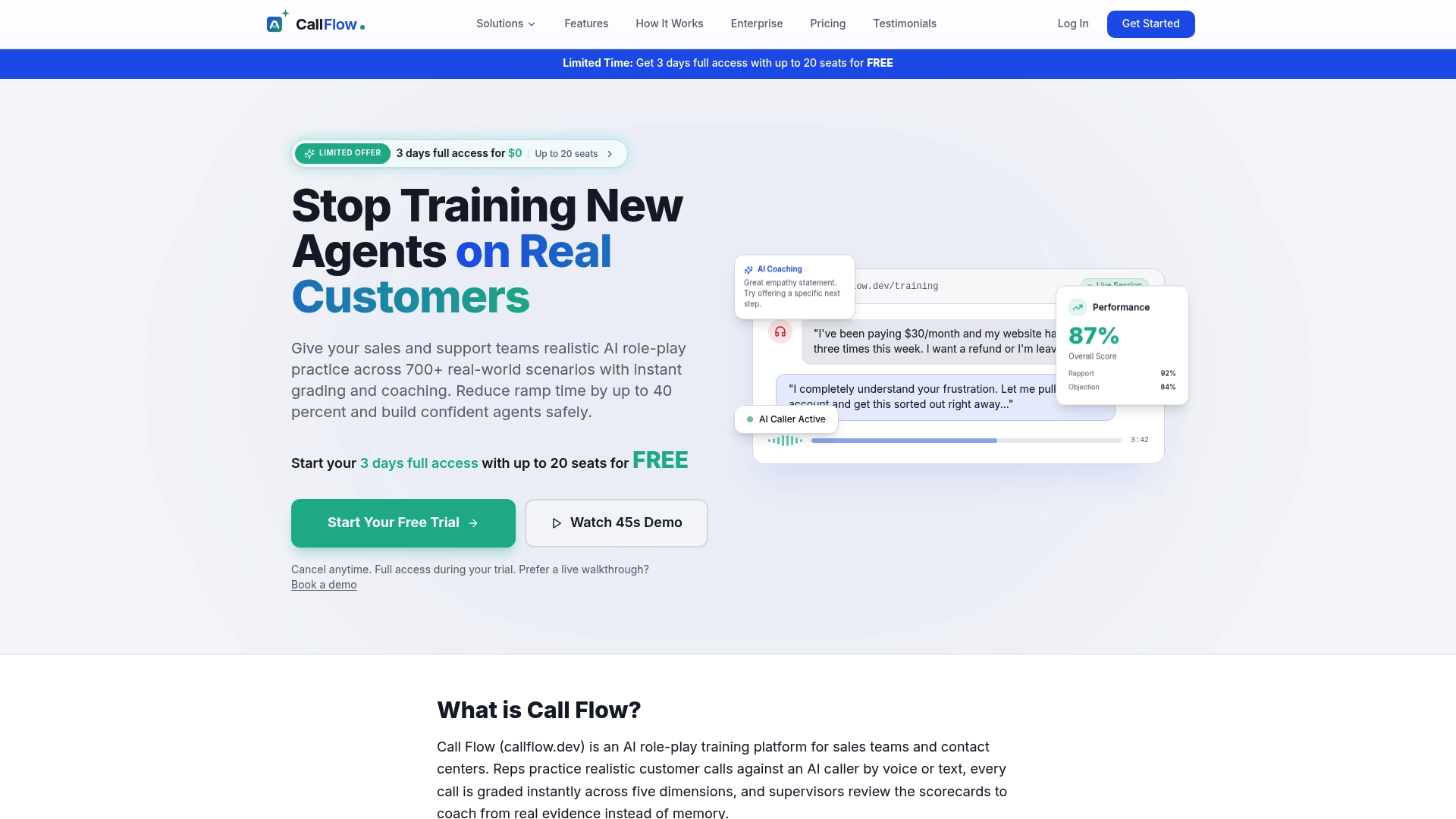
Instead of waiting for a live call to test a new script, you or your team can run it through a configurable scenario, get instant coaching feedback on tone, pacing, and structure, and adjust before the next real conversation. Supervisor dashboards let you track which reps are improving and where a manager's coaching time is best spent, which matters more once you've seen how much manager skill drives team outcomes. Teams that want a faster ramp can see the approach in action through the AI sales training resource for managers. Plans start at $7.42 per month for the Starter tier, and larger teams can review Business and Enterprise options for organization-wide rollouts. Every plan includes a risk-free trial, so you can test the scripts in this article inside a real scenario before committing.
Sources
- Gallup — Manager development research
- Center for Creative Leadership / CCL — closing the gap between intent vs. impact (SBI context)
- Careerminds — SBI model explanation
- MIT HR — Ongoing coaching and feedback
FAQ
How Do You Give Good Coaching Feedback?
Ask permission before you start, then describe the specific situation and behavior you observed, followed by its impact. Close by asking an open question, like "What's your take on that?" so the employee helps shape the next step instead of just receiving instructions.
What Are Some Examples of Good Feedback?
Good feedback names a specific moment and its effect rather than a general trait: "When you repeated the customer's issue back before offering a fix, they calmed down immediately." It works because it's specific enough to repeat on the next call.
What Are Examples of Positive Feedback?
Strong positive feedback ties praise to a concrete action: "You caught the billing error before it reached the client. That saved us a difficult follow-up call." Naming the behavior, not just the outcome, helps the employee know exactly what to keep doing.
What Is an Example of Positive Feedback for Training?
During a training or practice session, effective feedback might sound like: "In that role-play, you asked three discovery questions before pitching. That sequencing is exactly what we want to see on live calls." Some platforms generate this kind of specific, behavior-level feedback automatically after each practice scenario, which can speed up how fast new hires internalize the pattern.
Should Managers Avoid the Feedback Sandwich?
Yes. Research on the feedback sandwich technique finds it changes how feedback feels without improving actual performance. Give praise and developmental feedback as separate, clearly labeled conversations instead of blending them.