

The most effective approach to learning reinforcement for sales teams and contact centers is short, spaced micro-sessions tied to live deals and calls, coached with fast feedback through AI role-play and manager-led practice. Ebbinghaus forgetting-curve research shows learners forget roughly half of new material within an hour and large shares within days without reinforcement. A spaced-practice field study confirmed that distributed practice produces greater transfer quality and higher self-reported sales competence than massed training. Callflow is the platform built to run this at scale.
Key Takeaways
Effective learning reinforcement requires short, spaced practice sessions tied to live work, immediate feedback, and consistent manager coaching to move ramp time, proficiency, and FCR.
| Point | Details |
|---|---|
| Spaced practice beats massed training | Distributed micro-sessions produce greater transfer quality than single long events. |
| Fewer than half of companies reinforce | Organizations that formally follow up training see approximately 20% more sellers meet quota. |
| Keep sessions to 15–20 minutes | Short sessions sustain engagement and completion; one skill per session is the target. |
| Measure ramp time, proficiency, and FCR | Set a baseline before day one and compare at week 4 and week 8 of your pilot. |
| Callflow scales AI role-play reinforcement | Instant grading across five dimensions and supervisor analytics support faster ramp time. |
Table of Contents
- What is learning reinforcement and why does it matter for your team?
- Core elements every effective reinforcement program must include
- A practical 30/60/90-day reinforcement blueprint
- What to measure and how to prove reinforcement is working
- Technology and integration checklist for a reinforcement platform
- How to run a low-risk pilot and scale your reinforcement program
- Common pitfalls when implementing reinforcement and how to fix them
- Research and evidence that back the recommended approach
- What a training leader would actually do first
- Callflow puts this blueprint into practice
- Sources
What is learning reinforcement and why does it matter for your team?
Instructional learning reinforcement means strengthening skills after initial training through repeated practice, targeted feedback, and real-work application. This article uses that definition throughout. It is not reinforcement learning, the machine-learning subfield.
The business case is direct. Training Industry cites the Ebbinghaus forgetting curve and recommends structured, manager-led reinforcement to prevent rapid loss of learning. Without it, agents revert to old habits within weeks. Ramp time extends. First-call resolution (FCR) stays flat. Proficiency scores stall.
Rain Sales Training, citing Aberdeen research, finds that less than half of companies formally follow up initial training with reinforcement, yet organizations that do see approximately 20% more sellers meet quota. That gap is the ROI opportunity.
- Agents forget large shares of training content within days without reinforcement
- Reversion to old habits increases average handle time and lowers FCR
- Ramp time, proficiency scores, quota attainment, and FCR are the primary KPIs to track
Core elements every effective reinforcement program must include
A reinforcement program is only as strong as its structure. These are the components that actually move the needle:
- Microlearning sessions. Keep each session to 15–30 minutes. Short, focused practice beats long review blocks every time.
- Spaced practice cadence. Schedule repeated exposures over days and weeks, not a single follow-up event. Spaced practice produces greater transfer quality than massed practice in real sales settings.
- Live-opportunity tie-ins. Connect practice to active deals and real calls. Deal reviews, call coaching, and pipeline inspection convert training into measurable execution.
- Structured coaching. Managers need a repeatable framework, not improvised feedback. Prescriptive toolkits, role-plays, and reference libraries make coaching consistent.
- Immediate feedback. Agents need to know what they did right and what to fix before the next call. Delayed feedback loses its effect.
- Performance analytics. Track skill adoption, practice frequency, and coaching cadence alongside business KPIs.
Pro Tip: Give managers a pre-built 15-minute coaching card for each skill being reinforced. One card per skill, one conversation per week. Low prep, high consistency.
A practical 30/60/90-day reinforcement blueprint
This plan scales from a small pilot to a full team rollout. Adjust session owners and frequency to match your team size.
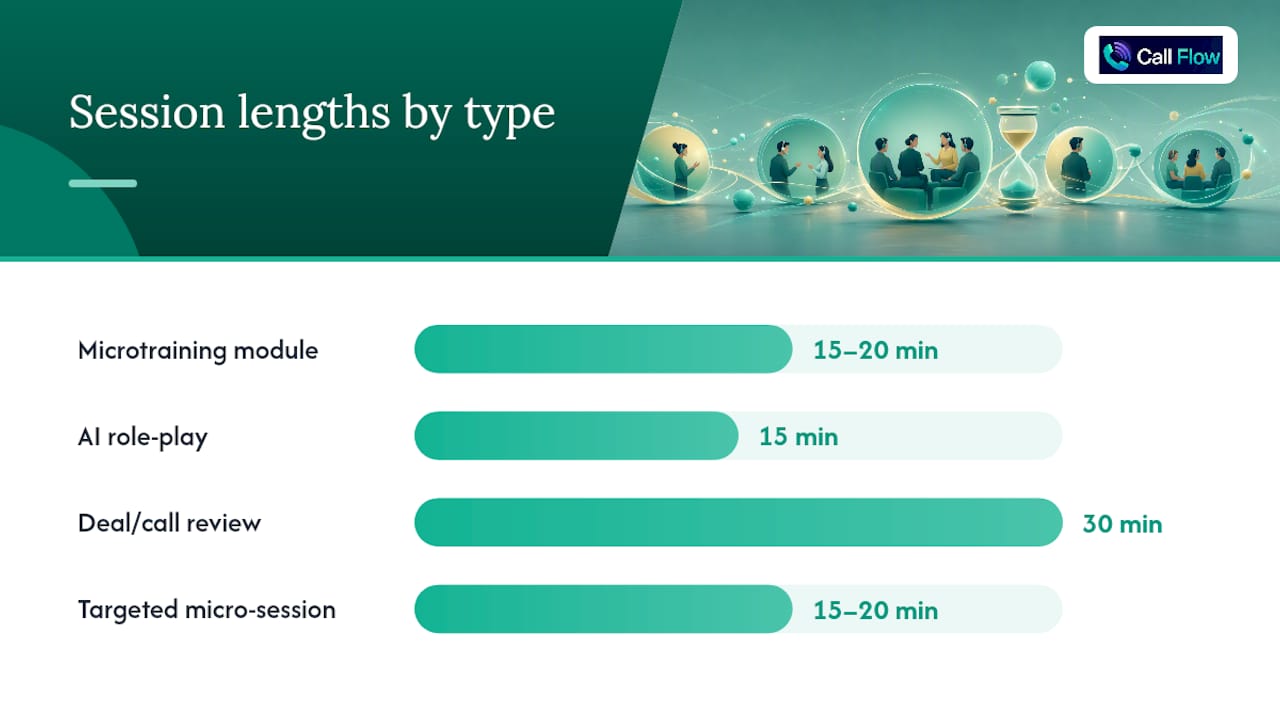
| Phase | Focus | Session type | Length | Frequency | Owner |
|---|---|---|---|---|---|
| Days 1–30 | Baseline + skill selection | Microtraining module | 15–20 min | multiple times per week | Enablement |
| Days 1–30 | Practice fundamentals | AI role-play + feedback | 15 min | a couple of times per week | Agent |
| Days 31 to 60 | Apply to live work | Deal/call review | 30 minutes | 1x/week | Manager |
| Days 31 to 60 | Reinforce gaps | Targeted micro-session | 15–20 min | a couple of times per week | Enablement |
| Days 61 to 90 | Scale and measure | Full cadence | Mixed | Per cadence | All |
Sample session templates:
- 15-minute microtraining. One skill, one scenario, one key takeaway. Agent reads or watches, then answers two application questions.
- 15-minute AI role-play. Agent runs a simulated call or sales conversation. Platform grades performance and delivers instant feedback across five dimensions.
- a manager-led deal review lasting under an hour. Manager picks two active deals, walks through the agent's approach, and ties feedback to the skill being reinforced that week.
Microtraining modules of 15–20 minutes tied to live opportunities keep sessions relevant and increase the chance skills transfer to actual calls.
What to measure and how to prove reinforcement is working
Measurement connects reinforcement to business outcomes. Without it, you cannot justify the program or improve it.
Primary KPIs:
- Ramp time (days to full productivity)
- Proficiency scores from practice sessions
- Quota attainment and stage-to-stage conversion
- Average deal size and sales cycle length
- First-call resolution rate for contact center teams
Behavioral metrics:
- Coaching cadence (sessions completed per manager per week)
- Practice frequency and participation rate
- Skill-adoption checks in CRM notes or call recordings
Organizations that formally reinforce training see approximately 20% more sellers meet quota compared to those that do not. Set that as your baseline expectation for a well-run pilot.
Run pre/post comparisons at 30 and 60 days. Where possible, use a control cohort that receives standard training without the reinforcement cadence. The difference in ramp time and FCR between the two groups is your clearest proof point.
Technology and integration checklist for a reinforcement platform
When evaluating a platform, check for these features and integrations before committing.
Feature checklist:
- AI role-play with voice and text simulation modes
- Instant grading and coaching feedback across multiple performance dimensions
- Configurable and custom scenario creation
- Supervisor dashboards and skill analytics
- Gamification to sustain engagement
- Personalization by skill gap, not one-size-fits-all content
- Content library with pre-built reinforcement modules
Integration requirements:
| Category | What to confirm |
|---|---|
| CRM | Deal context feeds into scenario selection |
| LMS/SCORM | Completion data syncs to your existing system |
| QA systems | Call scores align with practice scores |
| Calendar/meeting tools | Sessions schedulable without manual admin |
| SSO | Single sign-on for frictionless agent access |
| Data export | Raw analytics available for your BI tools |
AI role-play provides scalable, realistic practice with immediate feedback and supports consistent practice at scale without pulling trainers off the floor. That is the core operational argument for adding it to your stack.
Brooks Group recommends structured cadences, purposeful coaching, microlearning, and AI/analytics for personalized reinforcement and scaling adoption across teams.
How to run a low-risk pilot and scale your reinforcement program
A focused pilot limits risk and builds the evidence you need to get budget for a full rollout.
- Define scope. Pick one team of 8–15 agents. Choose 2–3 skills to reinforce, not the entire training curriculum.
- Baseline metrics. Record current ramp time, proficiency scores, FCR, and quota attainment before the pilot starts.
- Set a control cohort. If possible, identify a comparable group that will not receive the reinforcement cadence during the pilot window.
- Schedule the cadence. Block micro-sessions and AI role-play on agents' calendars for the full 4–8 week window. Treat them as non-optional.
- Enable managers. Give each manager a coaching card per skill and a 30-minute orientation on how to run the weekly deal review.
- Measure at week 4 and week 8. Compare primary KPIs against baseline and control cohort.
- Decide on scale-up. Use these thresholds: ramp time down, proficiency scores up, FCR improved, manager sessions completed at 80%+ of target.
Stakeholder responsibilities:
- Enablement owner: content, cadence design, platform admin
- Frontline managers: weekly coaching sessions, deal reviews
- QA team: align call scoring with reinforcement skills
- IT: SSO, CRM integration, data export
- Executive sponsor: remove blockers, communicate priority
Common pitfalls when implementing reinforcement and how to fix them
Most reinforcement programs fail for predictable reasons. Here are the most common ones and a direct fix for each.
- Sessions too long. Agents disengage after 30 minutes. Cut every session to 15–20 minutes. One skill per session.
- Low manager involvement. Managers skip coaching because it feels like extra work. Give them a pre-built card. Make it a 15-minute calendar block, not an open-ended conversation.
- No tie to live work. Practice that does not connect to active deals feels abstract. Anchor every role-play scenario to a deal or call type the agent is working right now.
- Poor measurement. Without pre/post data, you cannot prove impact. Set your baseline before day one.
- Role-play unavailable at scale. Human role-play requires a trainer or peer. AI role-play removes that bottleneck entirely.
- One-size-fits-all content. Agents at different skill levels need different scenarios. Use skill analytics to route agents to the right content.
One operational fix that reclaims adoption quickly: shorten the first session of a new reinforcement cycle to 10 minutes. Completion rates jump. Once agents build the habit, you can extend to 20 minutes in week two.
Research and evidence that back the recommended approach
The recommendations in this article rest on a consistent body of evidence.
- Spaced practice produced greater transfer quality and higher self-reported sales competence than massed practice in a quasi-experimental study with bank employees (n=64).
- Training Industry cites the Ebbinghaus forgetting curve and recommends structured reinforcement to prevent rapid loss of learning after training events.
- Rain Sales Training reports that fewer than half of companies formally follow up training, yet those that do see materially better quota outcomes.
- Sales Growth's operational framework identifies deal reviews, call coaching, and microtraining as the highest-leverage reinforcement tactics.
- Brooks Group recommends cadence, purposeful coaching, microlearning, and AI/analytics to personalize and scale reinforcement.
- VereQuest outlines the business case for AI role-play: scalable, standardized practice with immediate feedback and measurable ROI on practice time.
For a lightweight pilot methodology: set a baseline, run a 4–8 week window, use a control cohort where possible, and measure pre/post on ramp time, proficiency, and FCR. You do not need complex statistics. A clear directional shift in two or three KPIs is sufficient to justify a full rollout. Expect to see early signals at week 4 and meaningful data at week 8.
What a training leader would actually do first
If you are running a contact center or a sales team and you want one concrete change to make next week, mandate a 20-minute weekly micro role-play tied to the deals or call types agents are actively working. Not a training event. A recurring calendar block. Agents practice one skill. They get feedback before the next live call.
The immediate result: agents stop practicing on customers. Managers get a visible signal of who is ready and who needs more work. The program becomes self-sustaining because it connects directly to outcomes the team already cares about.
Pro Tip: Send managers a single coaching question each Monday tied to that week's reinforcement skill. One question. Fifteen minutes. It keeps coaching consistent without adding prep time.
Callflow puts this blueprint into practice
Agents who reach 92% proficiency before their first live dial do not get there through one-time training. They get there through repeated, graded practice with immediate feedback. That is what Callflow delivers.
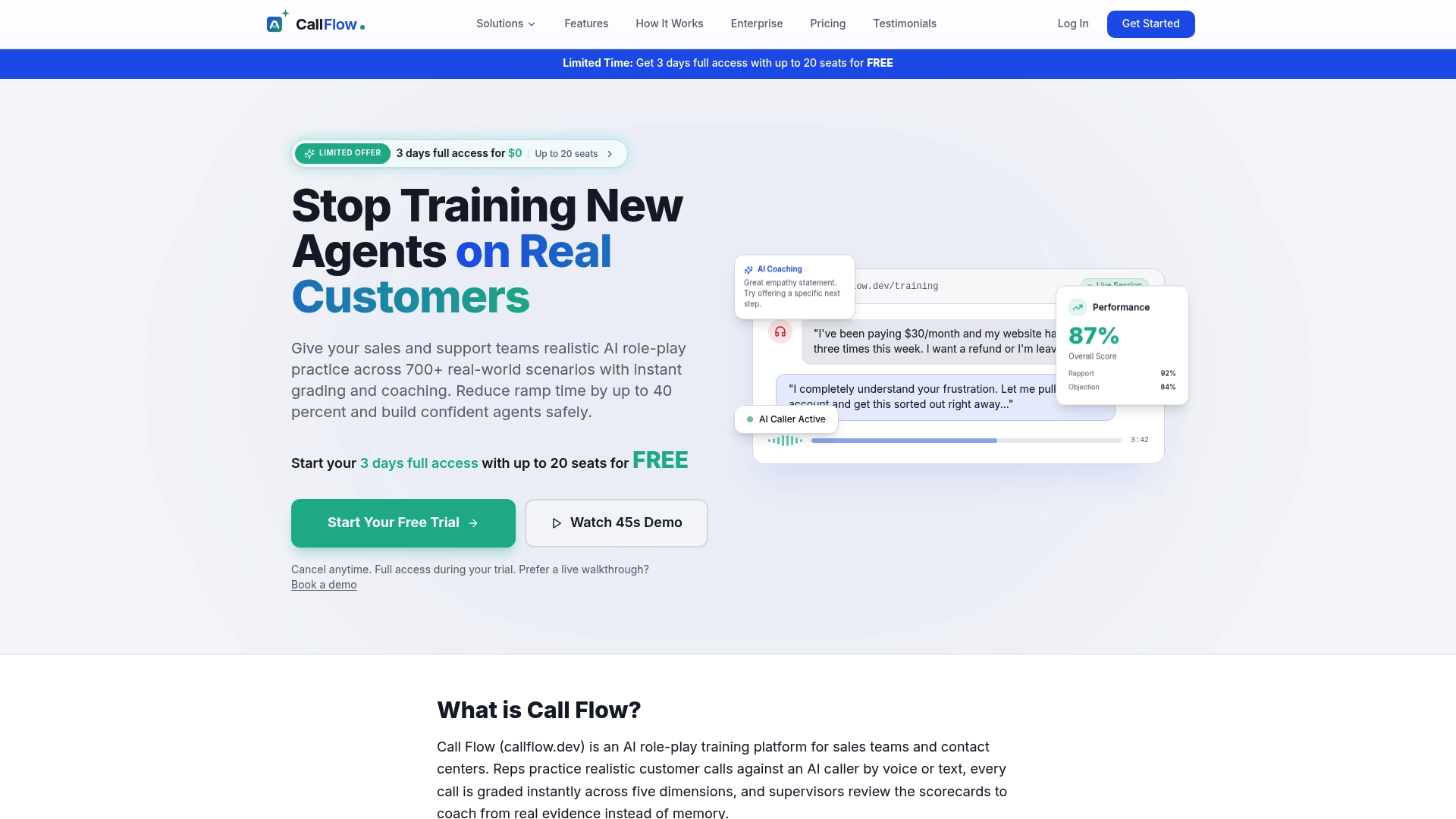
Callflow is an AI mock-call practice platform built for sales teams and contact centers. It runs configurable role-play scenarios in voice and text, grades performance across five dimensions instantly, and gives agents coaching feedback before they ever touch a live call. Supervisors get dashboards and skill analytics to track who is ready and where gaps remain. Client data show substantially faster ramp time and improved resolution rates. You can start a free trial and run your first reinforcement session today.