

Training gamification reliably improves engagement and measurable skill practice when it's aligned to learning objectives and instructional design. Three use cases where it consistently delivers results:
- Deliberate practice for sales skills. Reps repeat objection handling, discovery questions, or closing sequences until they hit a mastery threshold, with points and levels marking progress.
- New process and CRM adoption. Quests and streaks guide employees through required workflows, turning rote steps into a structured progression.
- Micro-skill refreshers for compliance and product knowledge. Short challenge sequences with badges and instant feedback keep retention high without pulling people off the floor for hours.
For teams ready to pilot, the implementation checklist and measurement framework are in the sections below.
Key Takeaways
Gamification works when mechanics are aligned to a specific, measurable behavior and supported by active manager participation — without both, you get activity, not skill development.
| Point | Details |
|---|---|
| Alignment is the critical variable | Map every mechanic to one target behavior before choosing a platform or tool. |
| Manager participation drives sustainment | Programs with active leader involvement show materially higher adoption, per HBS research. |
| Pilot before scaling | Run a 4–8 week A/B pilot with a control group; pull field metrics at day 90 for business impact. |
| AI role-play scores quality, not just completion | Instant, dimension-level feedback closes the gap that points-and-badges systems leave open. |
| Callflow as a starting point | Callflow's AI role-play platform combines instant grading, gamified progression, and supervisor dashboards for sales teams and contact centers. |
Table of Contents
- What is training gamification, and what does it leave out?
- Why does gamification improve training outcomes?
- What are the core design principles for gamified training?
- When does gamification help, and when does it backfire?
- How do you implement gamified training step by step?
- What gamification techniques actually work in practice?
- How do you measure impact and ROI?
- What pitfalls and ethical issues should you watch for?
- How does AI role-play amplify gamified training?
- What should training teams do first?
- Callflow gives your team a ready-made gamification and role-play engine
- Sources
What is training gamification, and what does it leave out?
Gamification applies game-design elements — points, badges, levels, leaderboards, quests, and feedback loops — to non-game learning contexts. The goal is not entertainment. It's to increase the frequency of a target behavior, accelerate skill acquisition, or sustain engagement across a training program that would otherwise lose momentum after week one.
Gamification is not the same as a serious game or a simulation. A serious game is a fully designed game with its own narrative, rules, and win conditions built from scratch for a learning purpose. A simulation or virtual lab replicates a real environment (a call floor, a surgical suite, a factory line) with high fidelity. Gamification, by contrast, layers mechanics onto an existing learning experience — a course, a coaching session, a practice drill — without replacing the underlying instructional design.
The distinction matters for budget and scope. A leaderboard on a sales quiz is gamification. A branching scenario where a rep navigates a full customer call with scored decision nodes is closer to a simulation. Both have a place; they are not interchangeable.
Pro Tip: Before choosing a mechanic, write down the behavior you want to increase. If you can't state it as "I want learners to do X more often," the mechanic has no target and will produce activity, not learning.
Why does gamification improve training outcomes?
The mechanisms are behavioral and cognitive, not cosmetic. Gamification taps several well-documented psychological drivers:
- Immediate feedback closes the gap between action and consequence, which accelerates skill calibration.
- Goal commitment gives learners a concrete target to pursue, which increases persistence.
- Autonomy — letting learners choose challenge level or sequence — raises intrinsic motivation.
- Mastery progression (levels, unlocks) signals competence growth, which sustains effort over time.
- Social recognition through visible progress or peer comparison activates status-based motivation.
A 2025 Springer meta-analysis found that gamification is most effective when integrated with core instructional design principles, and that perceived enjoyment and goal commitment are the primary mediators of outcomes. Mechanics alone don't move the needle; the learning design underneath them does.
A mixed-methods study published in ScienceDirect with 110 participants across several European countries found that gamification techniques including points, badges, and leaderboards enhanced knowledge retention and job performance when social interaction and meaningful mechanics were present. The social layer was not optional — programs without it showed weaker effects.
Stat to know: Harvard Business Review reports that gamified training incorporating progression, instant feedback, and challenge sequencing can significantly improve employee performance — but only when the program is designed properly. Design quality is the variable that separates results from wasted effort.
Plecto's analysis of gamification psychology points to operant conditioning and social recognition as the two fastest-acting levers for short-term engagement, which is why sales teams see early wins with activity-based mechanics before deeper skill gains appear.
What are the core design principles for gamified training?
Four pillars separate programs that produce measurable outcomes from those that produce a brief novelty spike and then flatline.
Design alignment
Every mechanic must map to a specific learning objective. If the objective is "handle price objections confidently," the scoring system should reward quality responses, not just the number of attempts. Implement Consulting Group recommends aligning mechanics to specific behavior-change goals before any platform decision is made. Volume-based mechanics work for activity targets; quality-weighted scoring works for complex skills.
Meaningful feedback
Feedback must be specific, timely, and tied to the behavior being practiced. A badge that says "Great job!" teaches nothing. A score that breaks down tone, accuracy, and pacing — delivered within seconds of a practice attempt — gives the learner something to act on. The Springer meta-analysis identifies goal commitment as a key mediator, and commitment requires feedback that shows learners where they stand relative to a clear standard.
Progressive challenge
Difficulty should increase as competence grows. A learner who masters basic objection handling needs harder scenarios, not more repetitions of the same one. Flat challenge curves produce boredom; steep ones produce dropout. The design target is a narrow band where the task is hard enough to require effort but achievable enough to sustain confidence.
Social mechanics
Leaderboards, team challenges, and peer recognition are not decoration. The ScienceDirect study found that social interaction was a necessary condition for strong outcomes. The mechanic type matters, though. Incenteev's framework distinguishes individual mechanics (personal progress bars), collective mechanics (team goals), and relational mechanics (peer recognition). Dispersed teams often respond better to collective and relational mechanics than to head-to-head leaderboards.
Pro Tip: Run this alignment check before adding any mechanic: (1) What behavior does this mechanic reinforce? (2) Does the scoring reward the right behavior or a proxy for it? (3) Could a learner game this mechanic without actually improving? (4) Does the feedback this mechanic provides tell the learner what to do differently?
When does gamification help, and when does it backfire?
Good-fit situations
Gamification tends to work when the target behavior is repeatable, measurable, and benefits from frequent practice. Strong fits include:
- Skill practice with a clear right/wrong signal (sales calls, compliance scripts, product knowledge quizzes)
- Behavior adoption for new tools or processes where you need people to complete specific steps repeatedly
- Dispersed or remote teams where social mechanics substitute for in-person coaching energy
- High-volume roles (contact centers, inside sales) where activity metrics are already tracked
Poor-fit situations
Some learning contexts resist gamification. Avoid it when:
- The decision being trained involves complex ethical judgment with no clear correct answer
- The training is a one-time informational module with no repeated behavior to reinforce
- The audience is highly autonomous and experienced, and scoring may feel patronizing
- The organization lacks the manager bandwidth to animate the program (more on this in the pitfalls section)
Decision checklist before you pilot
Use these questions to decide whether gamification fits your next training initiative:
- Is the target behavior measurable and observable?
- Can feedback be delivered quickly enough to close the learning loop?
- Will learners encounter this behavior repeatedly, not just once?
- Is there a manager or facilitator who will actively participate in the program?
- Does the audience have roughly comparable starting skill levels, or will a leaderboard demoralize beginners?
If you answer yes to at least four of five, gamification is a reasonable fit. Start with the mechanic that most directly rewards the target behavior: activity-based points for volume goals, quality-weighted scoring for skill goals, team challenges for adoption goals.
How do you implement gamified training step by step?
Phase 1: Design (weeks 1–3)
- Define the target behavior. Write one sentence: "We want [role] to [do X] [Y times per week] with [quality standard Z]."
- Select mechanics. Match mechanics to the behavior type (volume vs. quality vs. adoption).
- Build scoring rubrics. Define what a 1, 3, and 5 score looks like for each dimension.
- Assign owners. L&D designs the rubric; the training manager owns manager animation; IT owns LMS/SSO integration.
Phase 2: Pilot (weeks 4–7)
- Select a cohort. Aim for 20–40 participants split into a gamified group and a control group doing the same training without game mechanics.
- Set a duration. Four weeks is the minimum to see engagement signals; eight weeks gives early skill data.
- Define success criteria upfront. Example: gamified group completes 20% more practice sessions and scores 10% higher on the post-assessment than the control group.
- Integrate with your LMS or LXP. Confirm SSO works, data feeds are live, and reporting endpoints are configured before launch day.
Phase 3: Iterate (weeks 8–10)
- Review engagement data at day 4. If fewer than 60% of the gamified group have logged in, the onboarding is broken — fix it before week two.
- Adjust challenge difficulty. If average scores are above 90%, the scenarios are too easy. If below 50%, they're too hard.
- Collect qualitative feedback. A five-question survey at week four surfaces friction points that metrics miss.
Phase 4: Scale
- Present pilot results to stakeholders using the metrics from the measurement section below.
- Roll out to the full team only after the pilot shows a statistically meaningful signal on at least one field-performance metric.
- Rotate goals and mechanics every 60–90 days to prevent habituation.
Integration checklist: Confirm LMS/LXP data sync, SSO authentication, CRM data feeds for field-performance metrics, role-based dashboards for supervisors, and WCAG 2.1 AA compliance for accessibility before any launch.
What gamification techniques actually work in practice?
Mechanics menu
- Points. Best for: tracking activity volume (calls made, modules completed). Simple to implement; loses meaning if not tied to a visible goal.
- Badges. Best for: marking milestone achievements (first 10 calls, product certification). Work well as social signals when shared in a team feed.
- Levels. Best for: showing mastery progression across a skill domain. Give learners a sense of trajectory, not just a snapshot score.
- Leaderboards. Best for: competitive cultures with comparable skill levels. Dangerous in mixed-skill groups — see pitfalls section.
- Quests. Best for: guiding adoption of multi-step processes (onboarding a new CRM, completing a certification path). Sequence required behaviors into a narrative arc.
- Streaks. Best for: building daily habits (one practice call per day). Effective for the first 30 days; rotate the goal after that.
- Branching scenarios. Best for: complex skill practice (objection handling, difficult conversations). Each decision node scores a different competency dimension.
- Reward stores. Best for: sustaining long-term engagement. Points convert to tangible or social rewards; requires ongoing curation.
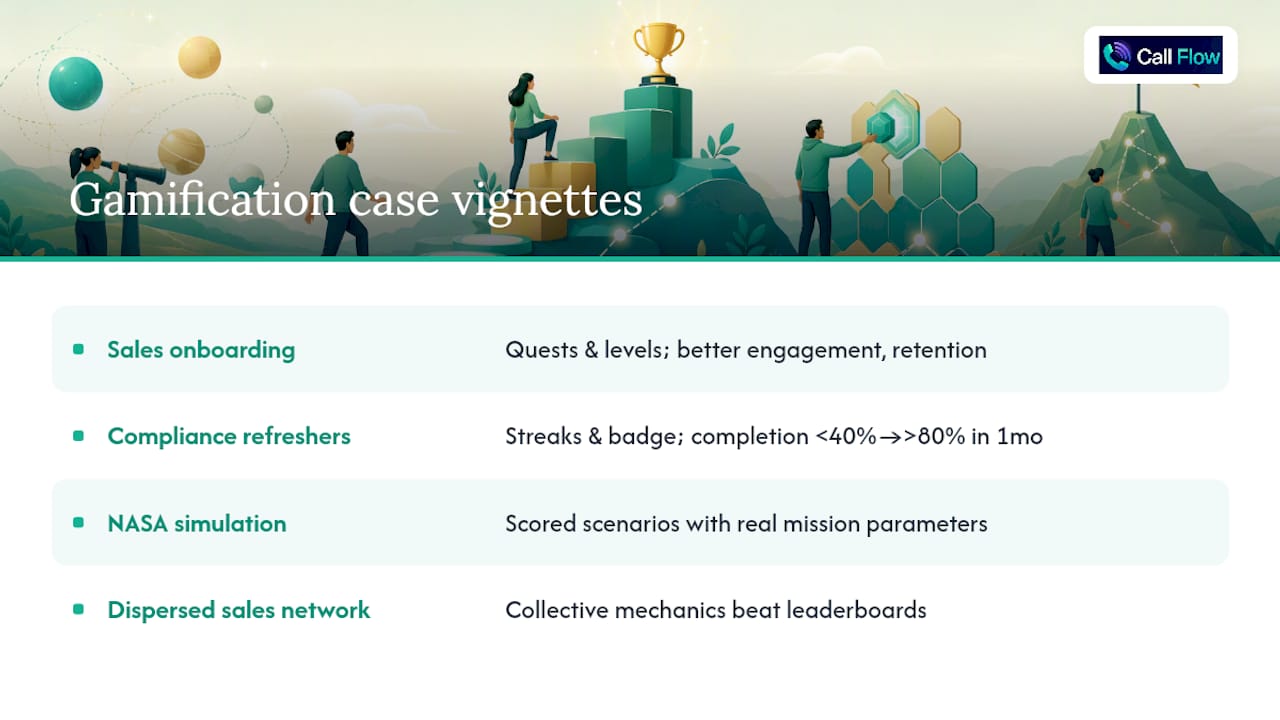
Short case vignettes
Sales onboarding with quests and levels. A mid-size SaaS company restructured its onboarding into a quest sequence: new reps earned levels by completing call simulations, product quizzes, and CRM tasks in order. Vendor-reported outcomes from Centrical show improved engagement and higher retention after similar gamified sales training implementations, though specific figures vary by deployment.
Compliance refreshers with streaks and badges. A contact center added a daily two-minute compliance quiz with a streak counter and a badge for 20 consecutive days. Completion rates rose from under 40% to above 80% within the first month, according to practitioner accounts of similar programs.
NASA's asteroid-sampling simulation demonstrates what happens when gamification scales into full scenario design: players navigate a virtual asteroid-sampling mission with real mission parameters, showing how institutional programs use scored scenarios for both practice and engagement at scale.
Dispersed sales network with collective mechanics. Incenteev's case data shows that tailored collective and relational mechanics — team challenges, peer recognition — improve adoption across dispersed sales networks more reliably than individual leaderboards alone.
Pro Tip: Mixing three or more mechanics at launch creates cognitive overhead. Start with one primary mechanic that directly rewards the target behavior. Add a second mechanic only after week two, once learners understand the scoring system. Stacking points, public ranks, and badges simultaneously without coaching support produces activity theater, not skill development.
How do you measure impact and ROI?
Sample metrics
| Metric | Purpose | Collection method |
|---|---|---|
| Login rate (days 1–4) | Adoption signal | LMS access logs |
| Practice session frequency | Engagement depth | Platform activity data |
| Average scenario score | Learning outcome | Platform scoring rubric |
| Score improvement (week 1 vs. week 4) | Skill growth | Pre/post comparison in platform |
| Post-assessment pass rate | Knowledge retention | LMS assessment module |
| Field metric (calls per day, conversion rate) | Business impact | CRM or call-center reporting |
| Manager participation rate | Program health | Platform login data by role |
A/B pilot outline
Split your pilot cohort into two groups of equal size (minimum 10 per arm, ideally 20+). The control group completes the same training content without game mechanics. The gamified group gets the full mechanic stack. Track both groups on the same metrics for four to eight weeks.
For a statistical signal, you need a meaningful difference on at least one primary metric — not just a trend. If your cohort is small (under 20 per arm), focus on directional signals and qualitative data rather than claiming statistical significance.
Timeline expectations
- Day 4: Check login rate. Below 60% means onboarding friction. Fix it now.
- Day 30: Review practice frequency and scenario scores. Skill gains at this stage are early indicators, not proof.
- Day 90: Pull field metrics from the CRM. This is where business impact becomes visible. If field metrics haven't moved by day 90, the mechanics are not connected to the right behaviors — revisit the alignment check.
When results lag, the most common causes are weak manager participation, mechanics that reward proxies instead of target behaviors, and challenge curves that are too flat.
What pitfalls and ethical issues should you watch for?
Common failure modes
- Shallow mechanics. Points awarded for logging in, not for practicing. Learners optimize for the points, not the skill.
- Gaming the system. Learners find the fastest path to a high score that doesn't require actual learning. Implement Consulting Group flags this as a direct consequence of misaligned mechanics.
- Leaderboard discouragement. Public rankings demoralize low performers, who disengage rather than practice. In mixed-skill groups, use relative progress (improvement from baseline) instead of absolute rank.
- Over-reliance on extrinsic rewards. When the reward disappears, so does the behavior. Design for intrinsic motivation (mastery, autonomy) as the primary driver; use extrinsic rewards to spark early engagement, not to sustain it.
- Manager disengagement. Research published in an HBS working paper shows that programs with active manager participation show materially higher adoption and sustainment. When managers ignore the platform, teams follow.
Mitigation checklist
- Calibrate scoring rubrics so the highest scores require genuine skill, not just speed.
- Use relative scoring (improvement from personal baseline) for leaderboards in mixed-skill groups.
- Brief managers weekly with a one-page dashboard; make their participation visible to the team.
- Rotate goals and mechanics every 60–90 days to prevent habituation.
- Audit the scoring logic monthly for the first quarter to catch gaming patterns early.
Legal and accessibility considerations
In the US, if gamification scores feed into performance reviews or compensation decisions, disclose that use to employees in writing before the program launches. Apply data minimization: collect only the behavioral data the program needs, and store it according to your organization's data retention policy. All gamified interfaces must meet WCAG 2.1 AA standards — this covers color contrast for badges, keyboard navigation for scenario tools, and screen-reader compatibility for leaderboards.
How does AI role-play amplify gamified training?
AI-driven role-play maps directly onto gamified learning mechanics. The loop works like this: a learner enters a scenario, completes a simulated call or conversation, receives immediate AI-scored feedback across multiple dimensions (tone, accuracy, pacing, objection handling, closing), and earns a score that feeds into the gamification layer. That score updates their level, contributes to a streak, or moves them up a leaderboard. The coaching feedback tells them exactly what to improve before the next attempt.
This closes a gap that traditional gamification leaves open: most point-and-badge systems score completion, not quality. AI role-play scores the actual behavior you want to change.
Key implementation notes for trainers:
- Scenario configuration. Build scenarios that mirror real calls your team handles — specific objections, specific product lines, specific customer personas. Generic scenarios produce generic scores.
- Scoring rubrics. Define the five dimensions you want the AI to evaluate before you configure the platform. Rubrics built after launch are almost always too broad.
- Supervisor dashboards. Give managers a real-time view of team scores by dimension, not just aggregate pass rates. Dimension-level data tells a manager which skill to coach this week.
- Folding role-play data into gamification scoring. Use role-play scores as the quality-weighted input to your gamification layer. Activity points reward volume; role-play scores reward skill. Both feed the same progression system.
Callflow's vendor-reported data shows a 147% faster ramp time and a 129% improvement in resolution rates for teams using AI role-play with instant grading — these are vendor-reported figures, and results will vary by team and deployment. The mechanism is consistent with what the research predicts: immediate, specific feedback on repeated practice accelerates skill acquisition faster than periodic manager coaching alone.
What should training teams do first?
Most teams over-design their first gamification program. They build a full mechanic stack, configure a complex scoring system, and launch organization-wide before they have a single data point showing the mechanics work for their audience.
Three prioritized steps for teams with limited bandwidth:
- Pick one behavior and one mechanic. The behavior must be measurable. The mechanic must directly reward it. Nothing else at launch.
- Run a four-week pilot with a control group. You need a comparison point to know whether the mechanics are doing anything. Without a control group, you're measuring engagement, not impact.
- Brief your managers before day one. Show them the dashboard, tell them what to look for, and ask them to reference the program in their weekly team check-ins. Manager animation is not optional.
Test small, measure the signal, and iterate before rolling out to the full organization. A program that works for 30 people can scale. A program that doesn't work for 30 people will not work for 300.
Callflow gives your team a ready-made gamification and role-play engine
Realistic practice, instant AI grading across five performance dimensions, and a live supervisor dashboard — Callflow delivers all three in one platform, purpose-built for sales teams and contact centers. Reps complete scored call simulations that feed directly into a gamification layer: streaks, levels, and skill progression tied to actual call quality, not just activity counts.
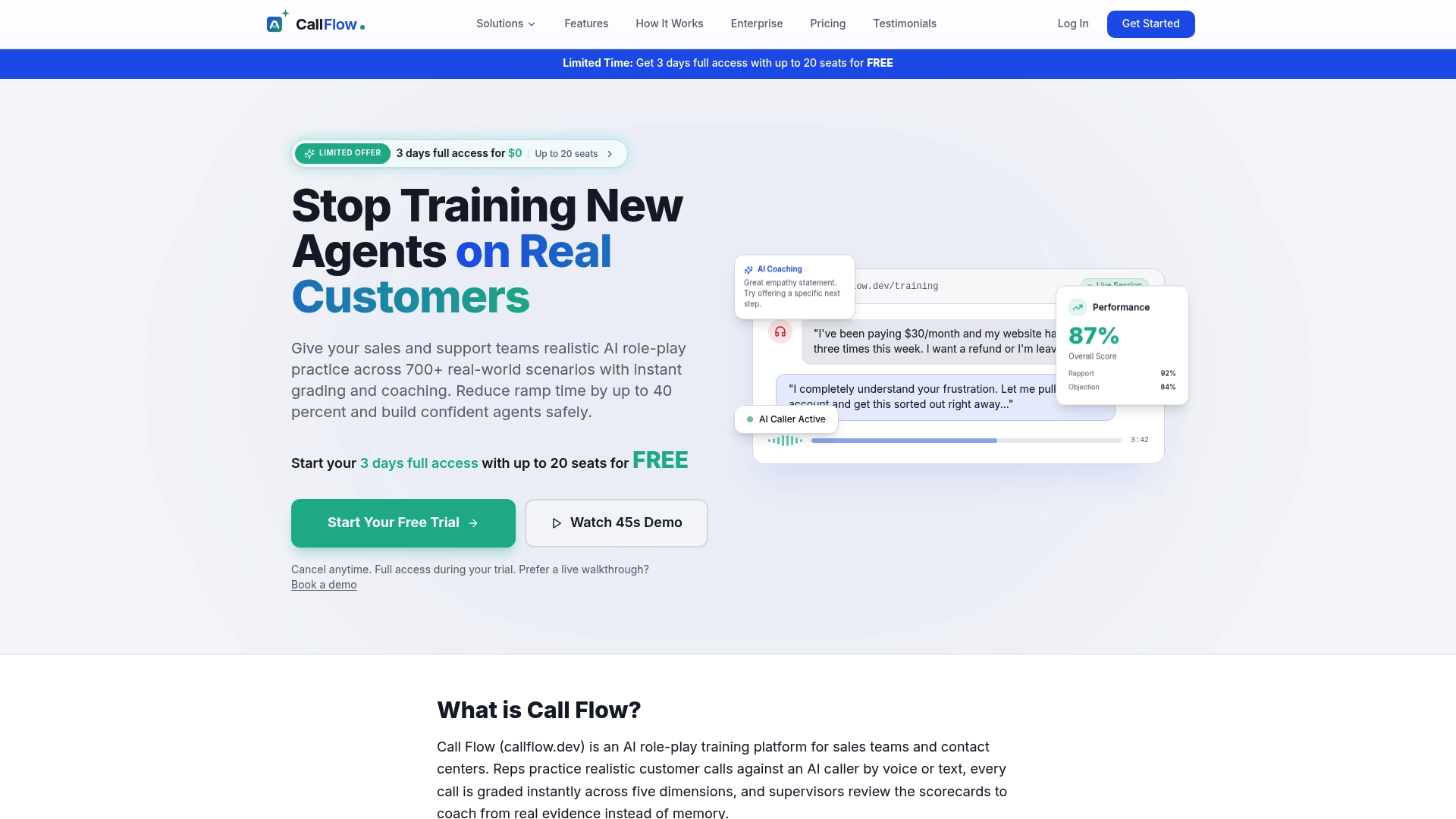
The platform connects to your existing stack. SSO, CRM data feeds, and role-based reporting endpoints are standard, so your gamification data lives alongside the field metrics you already track. Scenario configuration is fast: set the customer persona, the objection type, and the scoring rubric, and the platform handles the rest.
Callflow's vendor-reported results include 147% faster ramp time and 129% improvement in resolution rates. Start with a risk-free trial and run your first scored scenario in under an hour. Teams that want to see the full AI sales coaching feature set can explore it before committing to a plan.
Sources
- Gamification meta-analysis (Springer)
- Does Gamified Training Get Results? (Harvard Business Review)
- Leveling up in corporate training: Unveiling the power of gamification (ScienceDirect)
- How to use gamification in sales training | Implement
- Sales Gamification 2026: Definition, Examples, and Mistakes (Incenteev)
- 7 Sales gamification ideas + Why gamification works (Plecto)
- Managerial role in gamified training adoption (HBS working paper)