

To reduce ramp time, define what "ramped" means, set milestones for each stage, and give new reps practice before they talk to real customers. Then measure progress every week. Teams that do this stop guessing and start fixing the slowest step.
This guide covers the definition, the numbers, a plan you can copy and the metrics to track. It is written for sales managers, contact center leaders and training directors.
TL;DR
- Ramp time is the time from a rep's start date to a defined level of productivity. Write that level down before you hire.
- Ramp length depends on segment. Plan quotas to match it.
- Use milestone gates. A rep moves on when a skill is shown, not when a week ends.
- Add safe practice with scored feedback. It is the fastest way to build call skills before live calls.
- Track leading signals every week: first meeting, first opportunity, first deal, plus practice scores.
Table of Contents
- What ramp time means
- How to calculate ramp time
- How long ramp should take
- Set quotas that match the ramp
- Build a ramp plan with milestone gates
- Add practice before live calls
- Coach on a schedule
- Metrics that show ramp is working
- Our perspective
- Try it with your team
- Common ramp mistakes
- FAQ
- Sources
What ramp time means
Ramp time is the elapsed time from a new rep's start date until the rep reaches a defined level of consistent productivity. Lusha's glossary describes common evidence as quota attainment, pipeline creation, closed-won revenue or other role-specific output. OutSales gives the same definition and ties it to a target quota or output level.
The key word is "defined." If your team has no written threshold, ramp time cannot be measured. It also cannot be shortened.
For contact centers the idea is the same. The threshold is different. It might be a target for first-call resolution, handle time, quality score or customer satisfaction. Pick one or two and write them down.
Pick one clear finish line
Use a finish line that a rep can see and a manager can check. Good examples:
- 80% of quota for three months in a row.
- A quality score at the team average for four weeks.
- A first-call resolution rate that matches tenured agents.
Phi Consulting says the most defensible measure is time to sustained performance, not one good result. It recommends recording monthly results against the ramp quota. It also recommends reporting the median by role and hiring cohort.
One lucky deal in month two does not mean a rep has ramped. Look for the first period where results hold.
How to calculate ramp time
There are a few simple ways. Pick one and keep it the same over time.
- Quota attainment. Find the time it takes a rep to reach 100% of quota. Average it across a cohort. Xactly describes this as the most common method.
- Sales cycle plus buffer. Xactly also describes a practical formula: average sales cycle length plus a 90-day buffer. A team with a 60-day cycle would plan for about 150 days.
- Milestone dates. Record the date of each rep's first meeting, first opportunity, first qualified pipeline and first closed deal. Pulse RevOps lists these as indicators of ramp progress.
Use the median, not the average, if one rep took far longer than the rest. Split results by role and by hire month.
Defining and measuring progress works best when sales and marketing agree on what a qualified lead is. A sales and marketing SLA for revenue leaders shows how to write that agreement down. New reps then know what a good lead looks like on day one.

How long ramp should take
It depends on the role. Novo Insights reports observed examples from about one month to 24 months, with six months or one year common across organizations.
By segment, one ramp-up guide gives these typical ranges for account executives:
| Segment | Typical ramp |
|---|---|
| SMB | 4 to 5 months |
| Mid-Market | 6 to 7 months |
| Enterprise | 9 to 12 months |
Treat these as starting points. Your own cohort data is a better guide than any benchmark.
What changes the number
Lusha lists these factors:
- Role complexity.
- Sales cycle length.
- Onboarding quality.
- Territory and lead flow.
- Data and tooling.
- Product and pricing clarity.
Some of these you cannot change fast. Sales cycle length is one. Others you control this quarter: onboarding quality, practice and tooling.
Tooling matters more than it seems. If new reps wait for leads to be sorted or follow-ups to be sent, they lose selling time. Articles on lead qualification automation show how automated qualification and follow-up can free time for the work only a person can do.
Set quotas that match the ramp
A full quota on day one sets a new rep up to fail. It also hides your real ramp problem.

Axe Recruiting suggests matching ramp quotas to segment and deal complexity. In its model, SMB account executives reach 80 to 100% of quota by months 4 and 5. Mid-Market reps get there by months 6 and 7. Enterprise reps get there by months 10 to 12.
A simple ramp quota ladder for a six-month ramp might look like this. These are example numbers for planning, not a benchmark:
| Month | Share of full quota |
|---|---|
| 1 | 0% |
| 2 | 20% |
| 3 | 40% |
| 4 | 60% |
| 5 | 80% |
| 6 | 100% |
Plan capacity with it. Revcast makes the point that ramping reps contribute less than fully productive reps. Longer ramps mean you need to hire earlier and model expense and quota capacity. OutSales adds that ignoring ramp in capacity plans can lead to hiring too late and missing targets.
Build a ramp plan with milestone gates
A calendar does not make a rep ready. A skill check does.
Pulse RevOps recommends milestone-based gates before a rep moves to the next onboarding phase. Examples include a product certification, a role-play demo or a forecasting defense.
Here is a plan structure you can adapt. It follows a 30-60-90 pattern.
Days 1 to 30: learn the basics
- Product, pricing and customer types.
- Your sales or service process, step by step.
- Shadow calls with notes.
- Gate: pass a product check and a first role-play of a standard call.
Days 31 to 60: practice and start live work
- Daily short practice on common call types.
- Live calls with a manager or peer listening.
- First meetings booked, or first live contacts handled.
- Gate: reach a set score on objection handling and discovery in practice.
Days 61 to 90: own the work
- A full workload at a reduced target.
- Weekly review of two or three recorded calls.
- First opportunities, deals or resolved cases.
- Gate: hit the first-deal or resolution milestone and pass a final scored scenario.
We have written longer versions. See our 30, 60, 90 new hire ramp plan with checkable goals, and the manager's 30-60-90 playbook for shortening sales onboarding. Contact center managers can use the 90-day agent onboarding checklist.
Add practice before live calls
Most ramp time is lost in one place. A new rep knows the product but has not said the words out loud to a hard customer.
Role-play fixes that. It lets a rep try a price objection, an angry caller or a tough discovery call with no cost if it goes wrong. The rep can repeat it until it feels normal.
Traditional role-play has two limits. Managers do not have time to run it every day. Peers are polite. AI role-play removes both limits. The rep practices alone, at any hour, and gets scored feedback right away.
A good practice program has these parts:
- Realistic scenarios that match your real customers and call types.
- Clear scoring on a few dimensions, so reps know what to fix.
- Short sessions of 10 to 15 minutes, done often.
- Manager review of scores, so coaching goes to the reps who need it.
- A repeat rule: a rep tries again until the score meets the gate.
For a deeper look at how to set this up, read our guide to AI sales training for managers. If you want a first test, our post on piloting sales call simulation in one week shows how to collect baseline scores. Contact center teams can read how AI role play in call center onboarding fits into a program.
Coach on a schedule
Practice scores tell you where to coach. Without coaching they only tell you who is behind.
A simple weekly rhythm works:
- Monday: review each new rep's practice scores from last week.
- Midweek: a 15-minute one-to-one on the single lowest dimension.
- Friday: the rep reruns the scenario tied to that skill.
Keep each coaching session to one skill. Reps can fix one thing a week. They cannot fix six.
For live calls, a coaching pilot can help too. Our guide to a 4 to 8 week real-time call coaching pilot lays out the steps.
Metrics that show ramp is working
Quota attainment arrives late. By then a slow ramp has already cost you. Track leading signals as well.
| Metric | What it tells you |
|---|---|
| Practice score trend | Skill growth before live calls |
| Days to first meeting or first live call | Early activity |
| Days to first opportunity | Discovery quality |
| Days to first closed deal or first resolved case | Real output |
| Quota or quality attainment by month | The ramp curve |
| Median ramp time by cohort | Whether changes work |
The first four match the milestone list from Pulse RevOps. Compare each new cohort to the last one. If the median drops, your changes work.
For contact centers, add first-call resolution, quality score and customer satisfaction. New agents who handle calls well tend to score higher on all three.
Ramp and turnover
Ramp time and attrition are linked. Factor 8 says people who feel successful at work are more likely to stay. A rep who feels lost in month three is a rep who may leave in month six.
Early wins build that feeling. Small gates, quick feedback and visible progress give new hires proof that they are getting better. For more on how early success connects to retention, see this piece on building a high-performing sales team.
Our perspective
Most ramp problems are practice problems. A new rep reads the playbook, watches a few calls and then meets a real customer for the first time. That first live call is the practice session. It is a costly place to practice.
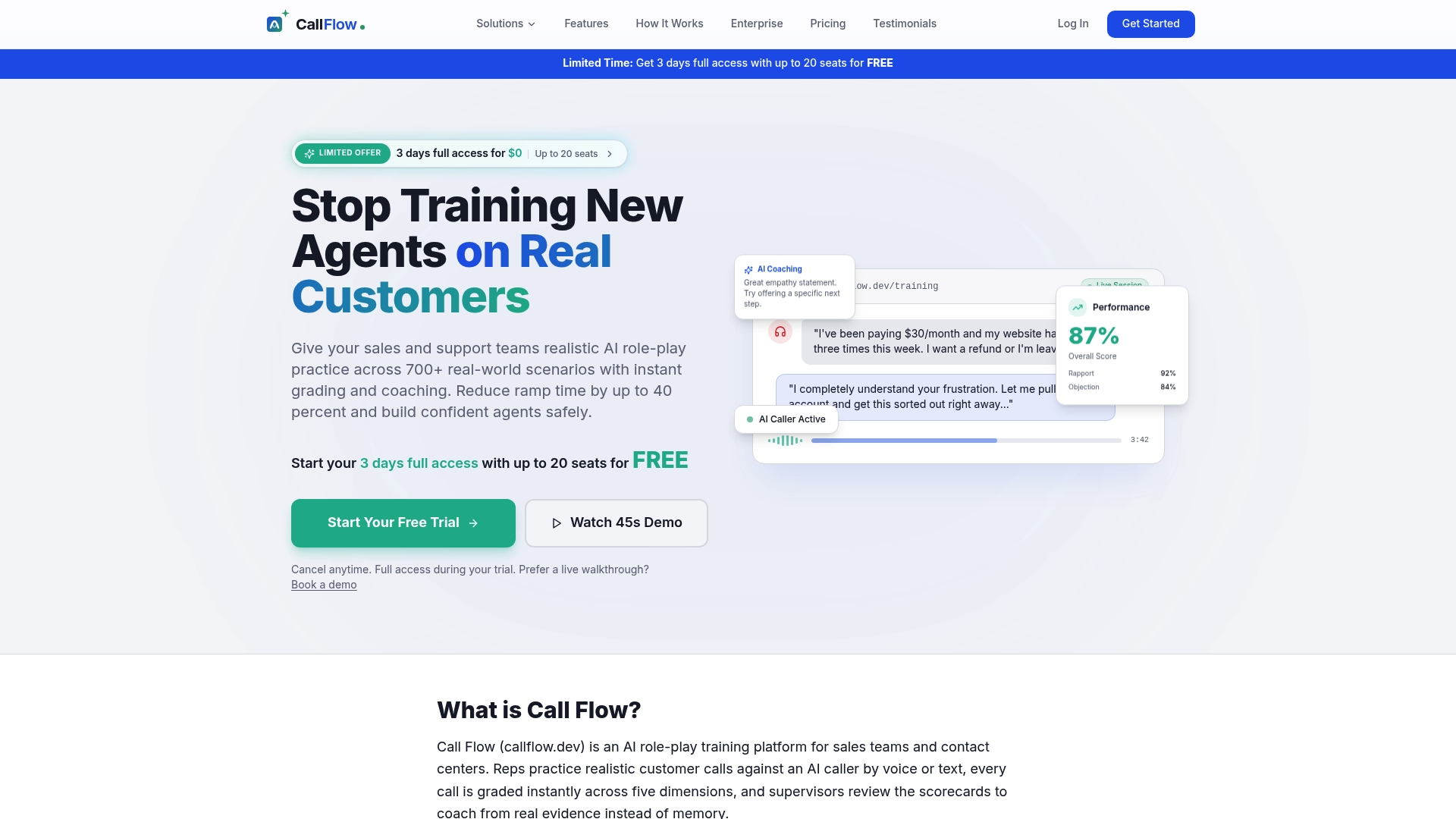
We built Call Flow to move that practice earlier. Reps run realistic sales and support scenarios in voice or text. They get instant grading across five performance dimensions and coaching they can act on in the same sitting. Managers see the scores in a supervisor dashboard, review them and override them when needed.
Our scoring is designed to align with the QA standards a team already uses. That way practice scores and live call scores speak the same language. Teams can also build their own scenarios, so practice matches their customers.
We report a 147% faster ramp time and a 129% improvement in resolution rates in our results. Read how in our write-up on simulation-based learning. Our advice: gate each stage with a scored scenario, coach one skill per week and measure each cohort against the last.
Costa
Try it with your team
Call Flow is an AI role-play platform for sales teams and contact centers. It has configurable scenarios, voice and text modes, instant AI grading, supervisor dashboards, skill analytics and custom scenario tools. You can start with a free, full-feature trial and set it up yourself.
Plans on the pricing page:
| Plan | Monthly | Annual |
|---|---|---|
| Starter | $7.42 per month | $89 per year |
| Growth | $14.92 per month | $179 per year |
| Scale | $33.25 per month | $399 per year |
Business and Enterprise plans have no published price. See the enterprise page for details.
Start with one cohort. Set the gates, run the scenarios and compare your next ramp to the last one.
Common ramp mistakes
- No written finish line. Without one, nobody knows when a rep has ramped.
- One quota for all. Ramp quotas should match segment and rep tenure.
- Time-based onboarding. A rep who passes the gate early should move on. A rep who fails should repeat.
- Practice only on live calls. Customers pay for each mistake.
- Too many coaching points. Pick one skill a week.
- Reporting averages only. One slow hire hides a good process. Report the median by cohort.
- No capacity plan. Hire early enough to cover ramp, or targets slip.
FAQ
What does ramp time mean in sales?
It is the time from a new rep's start date until the rep reaches a defined level of consistent productivity. That level is often a quota or output target. Write the threshold down before you measure.
How long is a typical ramp-up period?
It varies by role. Examples range from about one month to 24 months, and six months or one year is common. Account executives in SMB sales often ramp in 4 to 5 months, and Enterprise reps in 9 to 12 months, according to the ranges cited above.
How can I reduce onboarding time without hurting quality?
Use milestone gates instead of fixed dates. Add daily scored practice before live calls and coach one skill a week. Reps who pass gates early move on, and reps who need more time get it.
Which metrics show that ramp training works?
Track practice scores, days to first meeting, first opportunity and first closed deal. Add quota or quality attainment by month. Compare the median ramp time of each new cohort to the last.
Sources
- Lusha: What Is Ramp Time?
- OutSales: Ramp Time (Sales)
- Phi Consulting: What is Rep Ramp Time?
- Xactly: Sales Ramp Up Time
- Pulse RevOps: Cutting New-Rep Ramp Time in Half
- Novo Insights: How Long Does It Take a Rep to Ramp?
- Remuner: What is a Ramp Up Period?
- Axe Recruiting: AE Ramp Planning
- Revcast: How to calculate the right ramp up periods
- Factor 8: How to Measure Sales Training ROI