

A new hire ramp plan is a structured timeline, usually 30, 60, and 90 days, that maps what a new employee must learn, practice, and prove before reaching full productivity. The goal is a shorter time-to-sustained-productivity, not just a fast first win. The best plans pair measurable milestones with a set manager coaching cadence and certification gates at each phase. Templates and measurement steps follow below.
TL;DR:
- Effective ramp plans set clear, checkable milestones at 30, 60, and 90 days, with measurable outcomes like certifications and specific activity targets.
- Most ramp times range from 2 to 9 months depending on the role, with structured onboarding significantly improving retention and productivity.
- Regular manager coaching, a tapered seeded pipeline, and simulation-based practice accelerate ramping without rushing skill development.
- Remote and hybrid teams require deliberate scheduling of shadowing, coaching, and peer interactions to replicate in-office learning opportunities.
- Focusing on manager time, certification gates, and seeded pipelines offers the most impact when implementing or scaling ramp strategies.
Table of Contents
- What ramp time and ramp curves actually mean
- A manager-ready 30-60-90 ramp plan template with checkable milestones
- How to measure ramp with the right metrics and dashboards
- Tactics that shorten ramp without cutting corners
- Preboarding and onboarding checklist from day zero to day 90
- What Call Flow's results show about simulation-based practice
- Making the ramp plan match company culture and values
- Setting clear expectations through better communication
- Adjusting the ramp plan for remote and hybrid teams
- Where to focus first when time is short
- A practical way to scale graded practice: Call Flow
- Sources
- FAQ
What ramp time and ramp curves actually mean
Ramp time is the number of weeks or months a new hire needs to reach full productivity in their role. The ramp curve is the shape of that climb, usually slow in week one, steeper by month two, and flattening out once the rep hits quota consistently. Ramp quota is the percentage of full quota a new hire is expected to carry during each ramp phase, often starting at 0% and building up.
Time-to-sustained-productivity matters more than time-to-first-deal. A new SDR can book one meeting through luck or a warm referral and still take months to generate pipeline on their own.
Investing in a real ramp plan pays off in retention and output. Employees who go through structured onboarding are 58 to 69% more likely to stay with an employer for up to three years, and formal onboarding correlates with roughly 50% higher productivity.
Typical ramp ranges by role, based on sales benchmarking:
- SDRs: 2 to 3 months
- SMB account executives: 3 to 4 months
- Mid-market account executives: 4 to 5 months
- Enterprise account executives: 6 to 9 months
Structured onboarding correlates with materially better retention and output, according to Gallup's research on manager involvement, which found active manager involvement makes employees 3.4 times more likely to report a successful onboarding experience.
A manager-ready 30-60-90 ramp plan template with checkable milestones
A ramp plan only works when every milestone is checkable. "Understand the product" is not checkable. Use this structure as a starting template and adjust the activity numbers to your role and market.
Days 1 to 30: foundation
- Complete systems and tool setup: CRM, dialer, email sequencer, knowledge base access.
- Finish product and persona training modules, verified by a quiz or manager sign-off.
- Shadow five customer calls and log observations in a shared document.
- Complete the first graded role-play session with a manager or coach.
- Meet the assigned buddy at least three times during the month.
Days 31 to 60: early execution
- Carry a ramp quota of 25 to 33% of full quota.
- Make a defined number of live calls or emails weekly, tracked against activity targets.
- Deliver a first live demo or customer call with a manager observing.
- Attempt the first certification exam covering objection handling or a full sales motion.
- Build an early personal pipeline alongside any seeded accounts.
Days 61 to 90: independent ramp
- Carry a ramp quota of 50 to 67%, rising toward 75% by day 90 depending on role.
- Manage pipeline independently with minimal seeded support.
- Pass a final certification covering the full sales cycle or support workflow.
- Hit activity targets without manager prompting.
- Complete a 90-day review comparing actual output against the original plan.
For SDRs, activity targets usually mean a set number of calls, emails, and meetings booked per week. For account executives, the equivalent is evidence-of-skill tasks: a recorded discovery call, a graded demo, or a completed proposal walkthrough. Manager check-ins should happen weekly for the first 30 days, then biweekly through day 90. Buddy meetings should happen at least weekly in month one, tapering afterward. A practical 30-60-90 playbook can help managers adapt these numbers to their own team's baseline.
How to measure ramp with the right metrics and dashboards
Tracking the wrong metric gives a false sense of progress. Prioritize five measures: time to first key outcome (first qualified meeting or first resolved ticket), weekly activity against target, pipeline coverage, attainment versus ramp quota, and time-to-sustained-productivity.
A simple dashboard should show, per rep, per week: activity completed versus target, current ramp quota percentage, actual attainment, and certification status. Review this weekly in manager 1:1s, review team dashboards weekly as a coaching group, and run a monthly cohort analysis comparing this quarter's new hires against prior cohorts. A training metrics dashboard guide walks through field selection in more detail.
Graduated ramp quota models work better than flat targets. A common structure moves from 0% in month one, to 25 to 33% in month two, 50 to 67% in month three, 75% in month four, and 100% by month five or six, based on role benchmarking from the CRO Report.
- Judge whether a ramp is too aggressive by watching attainment bands: consistent misses across a cohort signal the quota curve is too steep.
- Wait for cohort-level data, not a single rep's results, before changing a ramp quota model.
- Treat time-to-sustained-productivity as hitting a target percentage of quota and holding it for two consecutive periods, which avoids rewarding one lucky month.
Tactics that shorten ramp without cutting corners
Shortening ramp is not about rushing training. It is about removing friction and giving new hires more reps at the skills that matter.
Seed the pipeline responsibly. Hand new hires 3 to 5 warm opportunities at the start, with a clear plan to taper that support. The CRO Report recommends starting around 60% seeded pipeline and reducing that share steadily so reps still build prospecting skills.
Design the buddy program with structure, not good intentions. New hires who meet their buddy eight or more times in the first 90 days report faster perceived productivity, according to SHRM's reporting on onboarding and culture. Set an explicit meeting cadence, such as 30 minutes daily in month one, and recognize or compensate buddies for the time.
Use certification gates before customer-facing work. A simple rubric covering product knowledge, objection handling, and call structure, scored pass or fail, keeps standards consistent across hires.
Build a practice habit early. Call libraries of real (anonymized) conversations, scheduled role-play sessions, and regular manager call review all compress the learning curve faster than lecture-based training alone.
Pro Tip: Block at least five hours a week of manager coaching time during a new hire's first month. That investment has an outsized effect on how fast they ramp.

Preboarding and onboarding checklist from day zero to day 90
The gap between offer acceptance and start date is a common failure point. SHRM survey data found 76% of organizations report ineffective onboarding, and 24% have no formal onboarding program at all.
Preboarding (before day 1):
- Ship hardware and confirm account access before the start date.
- Send a welcome message with the first-week schedule.
- Assign the buddy and introduce them by email.
Day 1 and week 1:
- First meeting with the direct manager to review the 90-day plan.
- Buddy introduction call.
- First product training module and first graded role-play attempt.
30/60/90 checklist: track each milestone with a verification method (quiz score, manager sign-off, recorded call) and a named owner, usually the manager or the buddy. Standard agendas work well here: manager 1:1s should review activity numbers and blockers, while buddy check-ins should focus on day-to-day questions and team norms.
What Call Flow's results show about simulation-based practice
Folding graded role-play into the ramp plan gives new hires repeatable practice before they face a live customer. These are internal figures, so treat them as a starting hypothesis to validate against your own cohort data, not a guarantee.
A 30-60-90 framework only works when goals are checkable: each milestone needs a demonstrable output, not a vague behavior.
The practical pattern is straightforward: schedule graded role-play sessions at each phase of the ramp plan, have supervisors review and override scores where needed, and align the scoring rubric to existing QA standards so simulation grades mean the same thing as a live call review. A deeper look at simulation-based learning covers how teams structure this in practice.
Making the ramp plan match company culture and values
A ramp plan that only covers tools and quotas misses half the job. New hires are also learning how decisions get made, how feedback is given, and what the team actually rewards. If the stated values say "customer-first" but the ramp plan only tracks activity volume, the new hire learns the real priority is volume.
Build culture checkpoints into the same 30-60-90 structure used for skills. At 30 days, a new hire should be able to describe how the team handles a difficult customer situation, not just recite a script. At 60 days, they should have seen a manager model a values-based decision, such as walking away from a bad-fit deal. At 90 days, they should be contributing to team norms rather than just following them.
Recognition moments matter more than most ramp plans account for. Public acknowledgment of a first certification pass or a first closed deal reinforces what the team values, beyond the dollar figure attached to it. A piece on recognition ceremonies and culture building makes the case for building these moments into onboarding deliberately rather than leaving them to chance.
Culture alignment also shows up in who delivers the training. A buddy or peer mentor models team norms more credibly than a slide deck. Pairing the technical ramp plan with consistent, lived examples of team values closes the gap between what new hires are told and what they actually see.

Setting clear expectations through better communication
Most ramp plan failures trace back to unclear expectations, not lack of effort. A new hire who does not know what "on track" looks like at day 30 has no way to self-correct before day 60.
Share the full 30-60-90 plan on day one, in writing, including the specific numbers tied to each milestone. Vague goals invite vague progress. Tell a new SDR they need to book 15 meetings by day 60, not that they should "build pipeline."
Weekly 1:1s should follow a consistent structure: review what happened against the plan, name any gaps early, and agree on the next week's priorities together rather than handing down a verdict. Weekly feedback drives roughly three times higher engagement compared to infrequent check-ins, so cadence matters as much as content.
Written documentation beats verbal-only communication. A shared doc with the ramp plan, milestone dates, and owner names gives both manager and new hire a reference point when memory of a conversation gets fuzzy. It also makes the 90-day review faster, since progress is tracked against the same document from day one instead of reconstructed from memory.
Adjusting the ramp plan for remote and hybrid teams
A ramp plan built for an in-office team does not transfer directly to remote or hybrid new hires. Informal learning, overhearing a colleague's call, catching a hallway correction, does not happen on its own when a new hire works from home.
Replace that informal exposure with deliberate structure. Schedule shadow sessions as calendar invites rather than assuming a new hire will pick things up by proximity. Record live calls and build a shared library new hires can review on their own time, since remote hires often have fewer chances to listen in naturally.
Buddy meetings need to be scheduled, not assumed. In an office, a buddy relationship can run on casual check-ins. Remote, it needs a fixed slot on the calendar or it quietly stops happening. The same eight-plus meeting threshold tied to faster perceived productivity applies here, but it only holds if those meetings are actually booked.
Manager visibility also needs a substitute for walking by someone's desk. Short daily check-ins in the first two weeks, even five minutes, catch confusion before it compounds. A remote coaching checklist built around graded role-play gives managers a concrete way to keep practice and feedback consistent when the team is not in the same room.
Where to focus first when time is short
If you can only do three things, do these: protect manager coaching time, build real certification gates, and seed a modest, tapering pipeline. Everything else in a ramp plan supports those three.
When explaining the plan to stakeholders, frame it around time-to-sustained-productivity, not time-to-first-deal. A flashy early win can mask a rep who stalls at month four. Set the graduated quota model up front so leadership expects a slower first month in exchange for a shorter total ramp.
Start with one cohort. Run the 30-60-90 plan, track the metrics, and compare against your last unstructured hire before rolling it out team-wide.
— Costa
A practical way to scale graded practice: Call Flow
Certification gates and role-play are only as good as how consistently a team runs them. Call Flow is an AI role-play platform built for sales teams and contact centers, offering realistic practice scenarios with instant grading across several performance dimensions. For managers trying to run the certification and practice tactics covered above at scale, it is one way to operationalize that playbook rather than the only way.
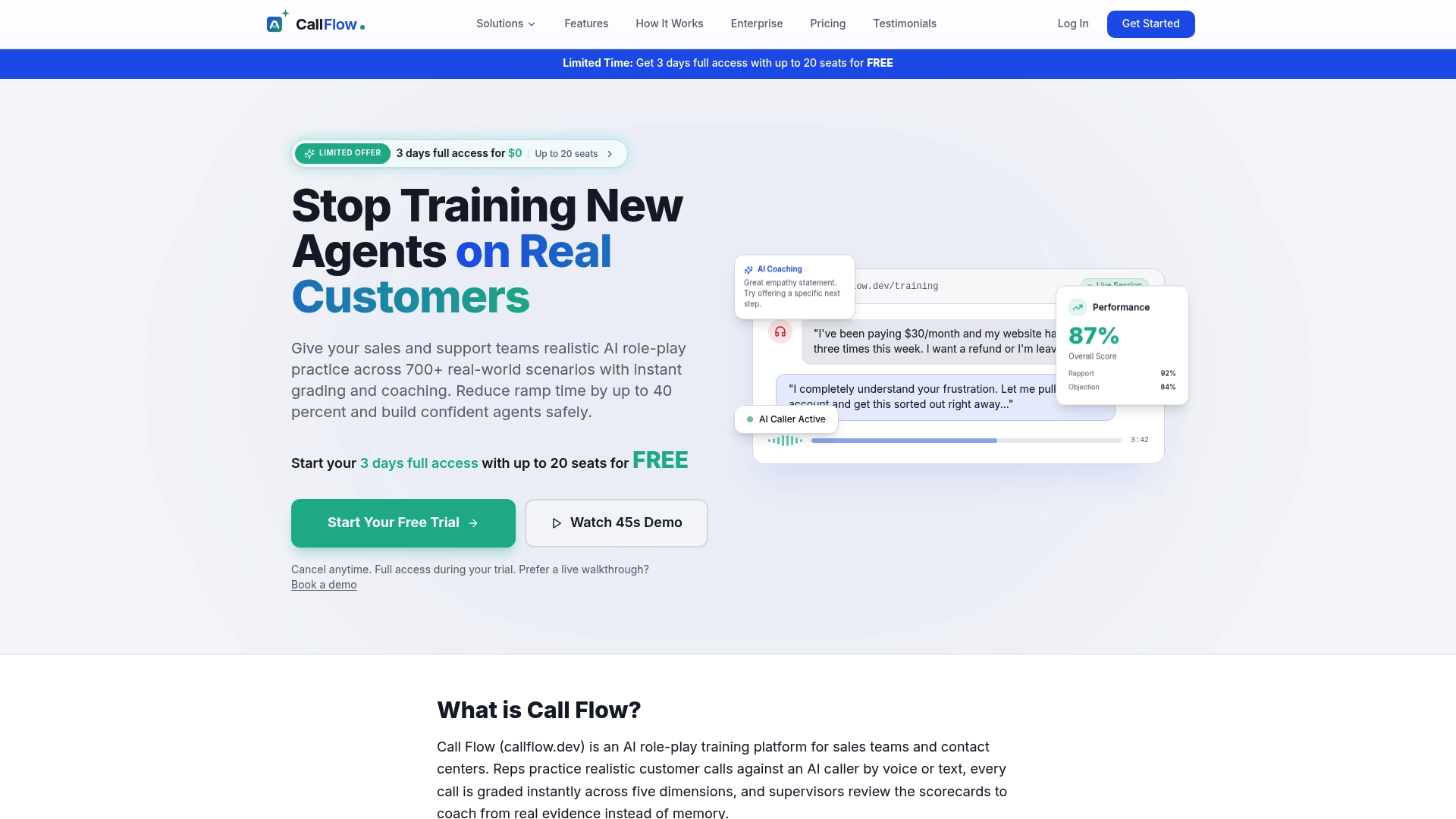
- Configurable scenarios map to each ramp phase, from basic objection handling at day 30 to full-cycle certification at day 90.
- Instant AI grading and supervisor override keep scoring consistent across a growing team.
- Plans start at $7.42 a month on the Starter tier, with Growth and Scale tiers available as teams expand.
Larger teams with custom rollout needs can review options on the enterprise page. Teams that want to test the approach before committing can start with a free trial and see how graded practice fits into an existing ramp plan.
Sources
- Practical tips for leaders to build better onboarding (Gallup)
- Sales onboarding ramp time (CRO Report)
FAQ
What is the 30-60-90 rule for a new job?
The 30-60-90 rule breaks a new hire's first three months into three phases, each with its own goals: foundation and training by day 30, early execution with a partial quota by day 60, and near-independent performance by day 90. Each phase should have checkable outputs, like a certification pass or a completed live call, rather than vague behavioral goals.
What does "new hire ramp up" mean?
Ramping up means the period a new employee spends building the skills and habits needed to reach full productivity in their role. It is measured by ramp time, the length of that period, and tracked using metrics like activity levels, pipeline coverage, and attainment against a graduated ramp quota.
How long does it take to ramp up in a new job?
Ramp time varies by role: SDRs typically ramp in 2 to 3 months, SMB account executives in 3 to 4 months, mid-market in 4 to 5 months, and enterprise roles in 6 to 9 months. The right benchmark depends on deal complexity and the length of the sales cycle involved.
What is the 90 day rule for new employees?
The 90-day rule generally refers to using the first 90 days as a structured evaluation and ramp window, with clear milestones at 30, 60, and 90 days rather than a single end-of-period review. By day 90, most ramp plans expect a new hire to manage their own pipeline or workload with minimal support and to have passed a final certification tied to their role.