

AI roleplay and instant coaching cut coaching time by shifting practice from scheduled manager sessions to on-demand, self-paced simulations with automated grading. An AI roleplay platform for sales and contact-center teams has documented significantly faster ramp time and notable improvement in resolution rates among teams that adopted this model. The rest of this guide breaks down the metrics, mechanisms, and rollout steps that make those numbers repeatable.
TL;DR:
- Teams report up to 147% faster ramp time and significant improvements in resolution rates when using AI roleplay for onboarding and practice.
- The main time savings come from removing scheduling bottlenecks, replacing manual grading with instant automated feedback, and focusing manager hours on strategic coaching.
- Measuring changes in ramp time, manager hours, practice volume, and key performance indicators is essential to validating the effectiveness of the AI training rollout.
- Building realistic, scenario-based practice from actual objection data and framing sessions as skill development rather than testing boosts adoption and reduces fatigue.
- A pilot typically lasts four to six weeks, during which baseline metrics are established and tracked to demonstrate tangible time and skill gains before scaling.
Table of Contents
- How Coaching Time Savings Translate Into Business Results
- Which Metrics Prove Coaching Time Savings?
- What Actually Cuts Manager Hours?
- How Do You Roll Out a Pilot Without Losing Weeks?
- Why Do Some Rollouts Stall Before They Save Time?
- What Do Call Flow's Ramp and Resolution Numbers Actually Mean?
- What Leaders Should Do With the Hours They Get Back
- Try Call Flow Risk-Free Before You Commit
- Sources
- FAQ
How Coaching Time Savings Translate Into Business Results
Coaching time savings show up first in ramp time, the number of days or weeks it takes a new hire to hit full productivity. When new reps practice objection handling and discovery calls on their own schedule, managers stop burning hours on live roleplay that only covers one rep at a time. Forrester frames this shift plainly: manager-led roleplay doesn't scale, while AI-driven practice gives every rep consistent, judgment-free repetition regardless of manager availability.
That freed time doesn't disappear. It moves to higher-value work: coaching a rep through a stalled enterprise deal, reviewing a tough escalation, or building bench strength for promotion. Reps who practice more also tend to sound more consistent on calls, and that consistency shows up downstream in first-call resolution and customer satisfaction scores, according to Training Industry's analysis of AI-powered simulations.
Four outcomes repeat across teams that make this shift in sales recruiting process:
- Faster ramp: New hires reach quota-ready status weeks sooner, which adds selling capacity without adding headcount.
- Manager hours reclaimed: Time once spent grading and scheduling roleplay goes toward strategic coaching instead.
- Higher practice volume: Reps can run five or ten scenarios in the time it used to take to schedule one live session.
- Better FCR and CSAT: Agents who rehearse difficult calls beforehand handle them more cleanly on the first attempt.
One case study puts a number on the ramp-time gain: enterprise pilots that embedded AI roleplay into onboarding reported some cohorts reaching their first services meeting up to 6 times faster when practice ran in short, repeatable modules rather than occasional live sessions.
Which Metrics Prove Coaching Time Savings?
You can't manage what you don't measure, and coaching time savings need a baseline before they need a dashboard. Track these in order:
- Ramp time percent change. Formula: (baseline days to full productivity minus current days) divided by baseline days. Training Magazine documented a 50% reduction in time-to-ramp after teams added AI roleplay with automated feedback.
- Manager hours saved. Compare hours spent on live roleplay before rollout against hours spent reviewing AI-generated coaching summaries after.
- Practice volume per rep. Count completed scenarios per week; most teams see this multiply once scheduling friction disappears.
- QA rubric scores, FCR, and CSAT. Track these against your pre-pilot baseline to confirm skill gains carry into live calls.
- Early pipeline conversion. For sales teams, watch whether reps who practiced more convert first meetings at a higher rate.
Measure weekly during a pilot and run it for at least 4 to 6 weeks. Shorter windows rarely produce enough call volume to separate signal from noise.
What Actually Cuts Manager Hours?
The time savings come from four specific operational shifts, not from AI as a general concept.
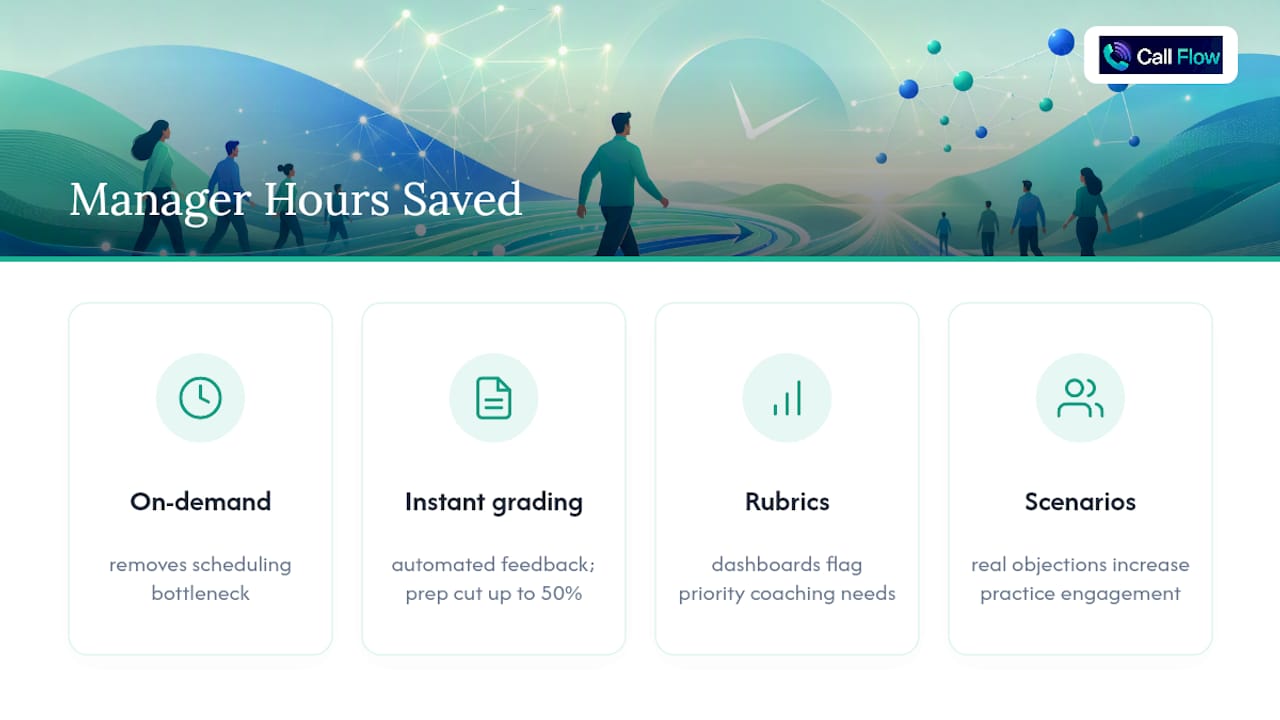
On-demand practice removes the scheduling bottleneck. A rep no longer waits for a manager's calendar to open or a peer to be free. That single change often accounts for the biggest jump in practice volume, since availability was the real constraint all along.
Instant grading replaces manual review. Instead of a manager sitting through a recorded call and scoring it by hand, the system returns structured feedback across performance dimensions immediately after the session ends. Microsoft's internal rollout of AI coaching tools found some teams cut prep time by as much as 50%, with employees describing sessions that used to take hours now taking minutes.
Objective rubrics tell managers where to spend their remaining hours. Dashboards flag which reps are struggling with which specific skills, so managers stop guessing and start prioritizing the highest-leverage conversations.
Scenario realism keeps reps engaged. Generic, repetitive prompts cause reps to disengage fast. Scenarios built from real objection patterns and pricing scenarios feel like actual work prep, not busywork.
Pro Tip: Pull your last quarter's lost-deal notes and turn the top five objections into practice scenarios. That single step does more for adoption than any feature announcement.
Explore how this works in practice through AI roleplay training built for sales and contact centers.
How Do You Roll Out a Pilot Without Losing Weeks?
A tight, sequenced rollout keeps a pilot from stalling in procurement or IT review:
- Pick a pilot cohort and baseline your KPIs. Choose one team, capture current ramp time, manager hours logged, and QA scores before you change anything.
- Build 3 to 5 scenarios tied to real pipeline outcomes, not generic sales theory. Use actual call transcripts where possible.
- Connect your data sources. Link the platform to your LMS, QA system, and CRM so pre and post metrics line up automatically. Review scenario design guidance before building your first set.
- Assign a review cadence. Name who checks dashboard trends weekly and who owns reallocating freed manager hours, and follow a training manual template to keep the pilot structured.
Why Do Some Rollouts Stall Before They Save Time?
Two failure patterns show up repeatedly, and both are fixable before they cost you the pilot.
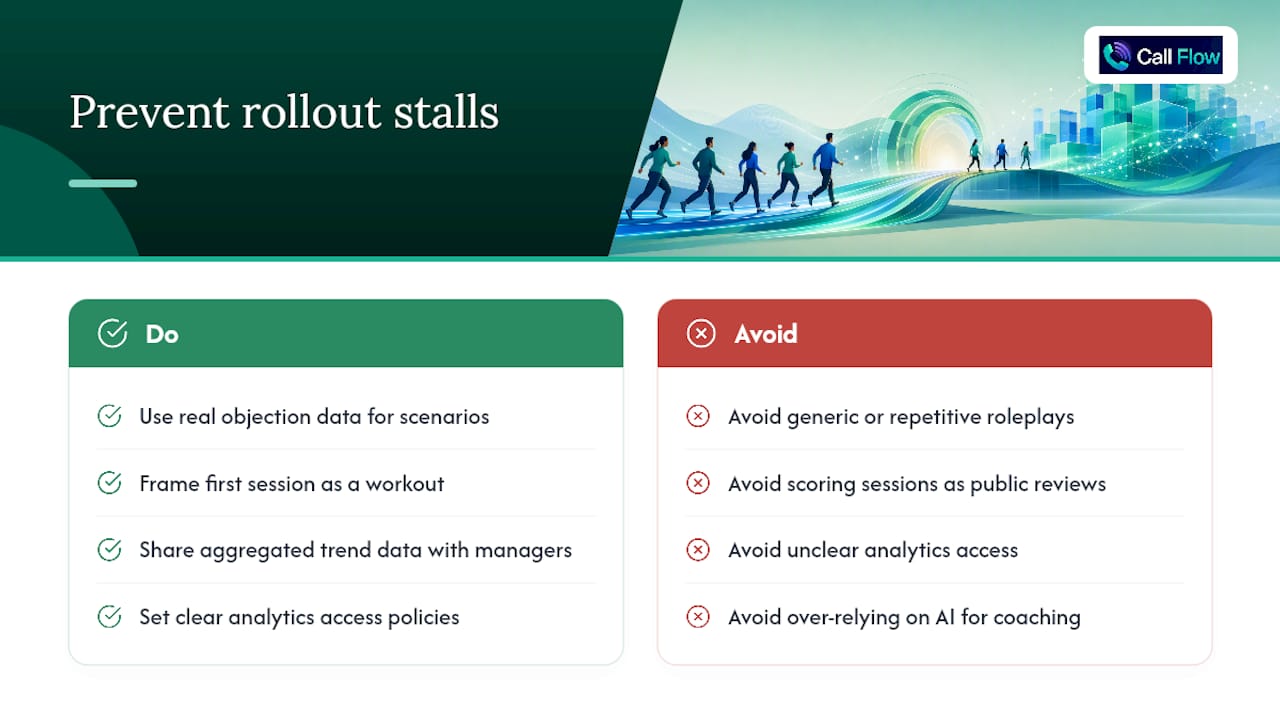
Roleplay fatigue sets in when scenarios feel generic or repeat too often. The fix is building scenarios from actual objection data rather than stock templates, an approach Microsoft's coaching rollout leaned on heavily to keep practice sessions from feeling like busywork.
Scoring anxiety makes reps avoid the tool entirely if they think every session is being watched. Frame early sessions as private development reps, not performance reviews, and share aggregated trend data with managers rather than individual scores during the first weeks.
Data governance gaps and over-relying on AI for nuanced, high-stakes coaching round out the common pitfalls. Set clear policies on who sees analytics, and keep complex mentorship conversations with a human.
Pro Tip: Tell reps explicitly, "This is a workout, not a test," before their first session. That framing alone reduces avoidance more than any technical fix.
What Do Call Flow's Ramp and Resolution Numbers Actually Mean?
Call Flow's published outcomes give a concrete anchor for what these mechanisms produce at scale. Teams using the platform's AI-powered simulation and instant grading reported 147% faster ramp time and a 129% improvement in resolution rates.
A rep who used to need eight weeks to reach full productivity reaching that mark in roughly three shows exactly what a 147% ramp-time gain means on the ground: more selling weeks per hire, per year, without adding a single manager hour to onboarding.
A resolution-rate jump of that size points to fewer callbacks and shorter handle times, both of which map directly to manager hours freed from firefighting escalations. If you're building a pilot business case, use these figures as an upper-bound reference point, then measure your own cohort against the KPI framework above before reporting results to leadership.
What Leaders Should Do With the Hours They Get Back
The mistake I see most often isn't skepticism about AI roleplay. It's treating freed manager hours as a bonus instead of a reinvestment. If instant grading removes the grading work, that time belongs in individualized coaching, complex deal reviews, and mentoring conversations a machine can't run.
Normalize practice sessions as skill development from day one, not as a monitoring tool, and publicize early wins fast. Teams that broadcast a ramp-time improvement in week three build momentum that carries the rollout past the skeptics.
— Costa
Try Call Flow Risk-Free Before You Commit
Callflow gives training leaders a way to prove coaching time savings before signing a long-term contract. Rather than committing budget on projected ROI alone, you run a pilot on your own team, with your own scenarios, and measure ramp time and manager hours against your baseline.
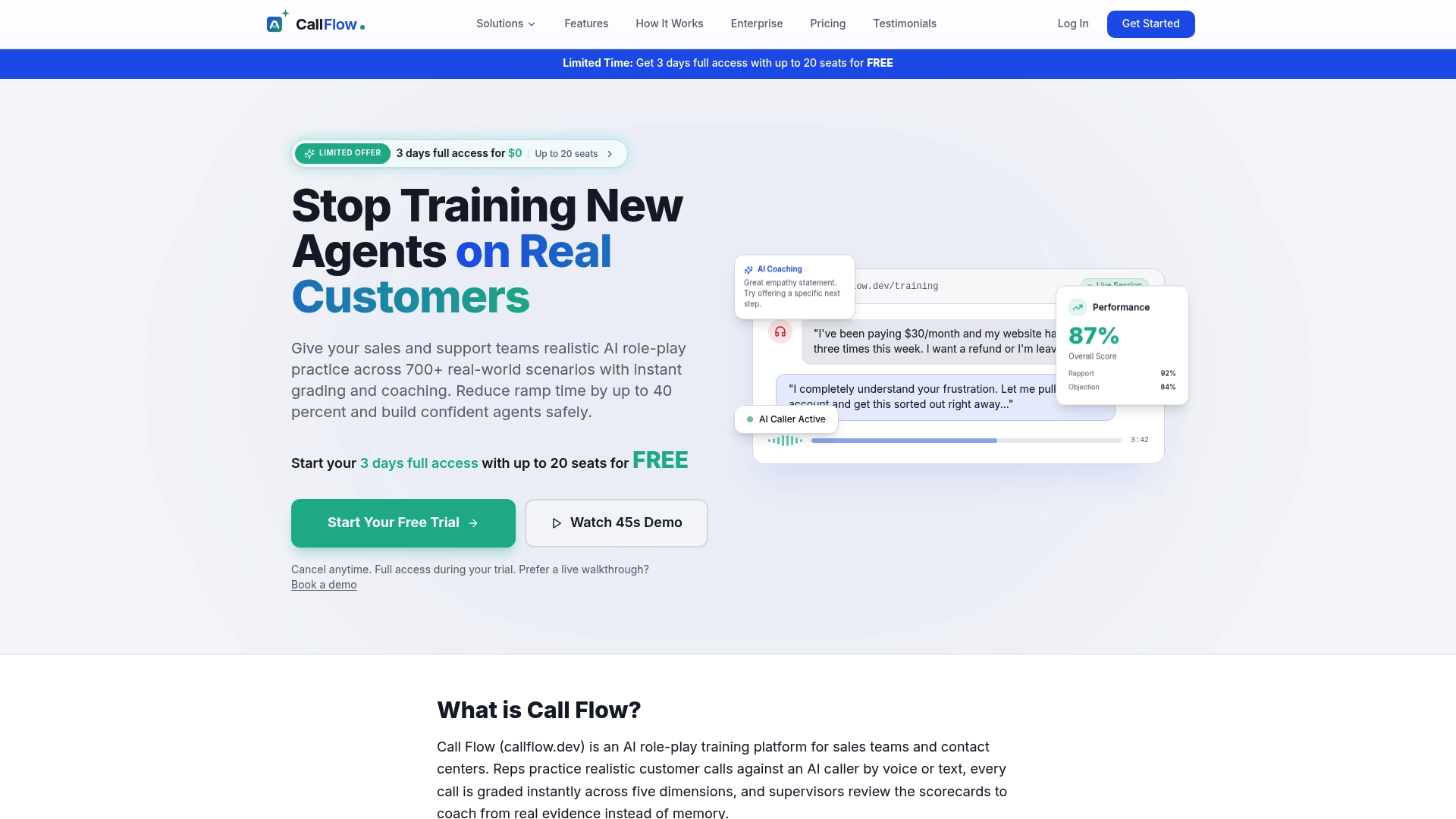
The platform is offered as a subscription, with tiered plans by team size, and includes full platform access during a risk-free trial period. A typical pilot runs four to six weeks: you pick a cohort, load a handful of scenarios built from real objections, and track ramp time and QA scores against what your team saw before. If the numbers hold up, scaling to the rest of the floor is a plan change, not a new procurement cycle. Start a risk-free trial and see what your own ramp-time and resolution numbers look like after the first pilot cycle.
Sources
- Stop running batting practice in sales: AI role-play is the new pitching machine
- Why AI-powered role play belongs in sales enablement
- Why AI Role-Play Is the Future of Sales and Service Training
FAQ
What Is Coaching Time Savings in Sales Training?
It refers to the reduction in manager and coaching hours needed to develop reps to full productivity, typically achieved through AI roleplay and instant, automated feedback rather than live, one-on-one sessions.
How Much Faster Can Ramp Time Get With AI Roleplay?
Reported gains range widely by organization. Training Magazine documented a 50% reduction, while some teams have reported up to 147% faster ramp time.
How Do You Measure Manager Hours Saved?
Compare the hours managers logged on live roleplay and manual call review before rollout against the hours spent reviewing AI-generated coaching summaries after, using at least a 4 to 6 week pilot window.
Does AI Roleplay Replace Human Coaching Entirely?
No. It removes repetitive grading and scheduling work so managers can spend their remaining hours on complex deal reviews and individualized mentoring that AI cannot replicate.
What Causes Roleplay Adoption to Fail?
Generic scenarios that feel disconnected from real calls cause fatigue, and treating scores as performance reviews instead of private development creates anxiety that suppresses usage.