

An agent readiness score is a single, auditable metric that shows whether an agent is prepared for live customer interactions. It combines QA rubrics, call transcripts, and role-play results into one number, then functions as a documented graduation gate rather than a manager's gut call. Built correctly, it also flags exactly which skills need more coaching, and it holds up when someone asks why an agent went live.
TL;DR:
- An agent readiness score relies on observable proxies across key categories, with thresholds set based on multiple consistent post-training batches.
- AI scoring can reverse its judgment on the same transcript in about 1 out of 8 to 19 cases, necessitating calibration and supervisor oversight before use in high-stakes gating.
- Thresholds for passing should typically involve minimum tenure, consistent scores across batches, and supervisor sign-off, with routing restrictions until agents meet all criteria.
- Automated scores must be regularly calibrated with human ratings to prevent judgment reversals, and overrides should be logged to ensure accountability.
- Clear, targeted coaching based on specific failure dimensions improves quality faster than broad retraining, with reassessment across multiple batches ensuring sustainable improvement.
Table of Contents
- What Does an Agent Readiness Score Actually Measure?
- How to Design a Reliable Readiness Score
- Turning the Score Into a Graduation Decision
- Can You Trust an Automated Readiness Score?
- From Score to Coaching: What Happens After a Failed Dimension?
- Why Most Readiness Gates Fail Before They Start
- Get Your Team Score Ready Before They Go Live
- Sources
- FAQ
What Does an Agent Readiness Score Actually Measure?
A readiness score is only as good as the behaviors it counts. Most functional scorecards track six categories: greeting and compliance language, active listening, problem resolution, empathy proxies, close and follow-through, and system or CRM competency. Each category needs an observable proxy, not a subjective label. "Was empathetic" is unscorable. "Restated the customer's issue in their own words within the first 90 seconds" is checkable by a supervisor and by an AI grader, which is why scorecards built on observable proxies reduce reviewer disagreement dramatically.
The inputs feeding the score usually come from three places:
- QA rubric scores from live-call monitoring, scored against the same criteria every time.
- Call transcripts, either from real customer interactions or supervised practice sessions.
- AI role-play attempts, which let an agent rehearse a scenario before it ever touches a real customer.
An agent who nails resolution but skips the compliance disclosure still fails the call, because compliance often carries an automatic override regardless of the total score.
How to Design a Reliable Readiness Score
Building a rubric that survives an audit takes more than picking criteria you like. Follow this sequence:
- Define the outcome per call type. A billing dispute and a cancellation save have different definitions of "resolved." Map behaviors to that specific outcome instead of a generic template.
- Write behavioral anchors at both ends. For each criterion, describe what exemplary and deficient look like in plain language, so two different reviewers land on the same score.
- Collect a baseline. Score 20 to 30 calls per agent, or a comparable batch before training, to know where the team actually stands before you set a bar. Post-training scorecards that skip this step have nothing to measure improvement against.
- Set thresholds across two batches, not one. A single strong batch can be luck. Consistency across two comparable post-training batches is what separates a ready agent from a lucky one.
- Limit auto-fails to 3 to 6 items. Reserve them for legal, compliance, or trust violations, not minor phrasing misses. A 10 to 15 criterion rubric with a short auto-fail list keeps the score meaningful.
- Document ownership and evidence. Name who signs off (usually Training, QA, and Operations) and what evidence counts as a pass.
Pro Tip: Write your rubric so a competent stranger, with no context on your team, could read a transcript and land on the same score. If they can't, the criterion is too vague to survive an audit.
Turning the Score Into a Graduation Decision
A number on a dashboard does nothing until it triggers a decision. The most defensible setups use a three-key graduation gate: minimum tenure in training, a consecutive QA baseline score across two batches, and a practical competency sign-off from a supervisor who watched live or simulated calls. Requiring all three closes the loophole where one strong metric masks a real gap. This structure replaces the informal "I think they're ready" call that tends to embed performance problems into production instead of catching them early.

Score deltas, comparing pre-training to post-training batches, tell you whether the training itself worked, separate from whether any individual agent is ready. Track this at the team level to spot a coaching program that's underperforming across the board, not just one struggling agent.
Operationally, the score should govern routing until an agent clears the gate:
- Route agents below threshold to simpler call types (billing lookups, not retention saves).
- Restrict complex or high-value interactions to agents with a documented pass.
- Require a supervisor override, logged with a reason, for any exception to routing rules.
- Review override logs monthly to check whether exceptions are becoming the norm.
That override log matters more than most teams realize. When someone disputes a readiness decision six months later, the log is the only record of why an exception happened.
Can You Trust an Automated Readiness Score?
Not without checking it first. A 2026 ACL study of large language models scoring 3,000 contact-center transcripts found judgment flip rates between 5.4% and 13.0%, climbing to 16.4% when transcripts included contextual priming. That means an AI grader can reverse its own verdict on the same call depending on framing alone, which is disqualifying for a high-stakes gate until it's audited.
The number that should worry you: an automated scorer can flip its verdict on the identical transcript in roughly 1 out of every 8 to 19 cases, depending on how the call is framed.
Calibration is the fix, not a reason to abandon automated scoring. Run these checks:
- Test representative scenarios weekly during launch, then monthly once stable, per scorecard calibration guidance.
- Sample human and AI ratings on the same calls and track disagreement percentage.
- Monitor subgroup score distributions, since fairness does not follow automatically from accuracy.
- Investigate any large disagreement and write down the ruling so future reviewers converge on the same interpretation.
Keep a human supervisor override in place for any score near the readiness threshold. No automated system should have the last word on whether someone works unsupervised with customers.
From Score to Coaching: What Happens After a Failed Dimension?
A low score is only useful if it points to a specific fix. Map each failed dimension to a targeted practice instead of generic retraining:
- Weak empathy proxy scores call for de-escalation role-play, not a lecture on customer service philosophy.
- Poor system navigation calls for shadowing a tenured agent on the exact workflow that tripped them up, not a slide deck.
Mapping the failure to the fix rather than defaulting to a broad refresher course is what actually moves the number. Use AI role-play as the rehearsal step before an agent faces a live customer again, then re-score real calls in two batches spaced two to four weeks apart. Define success up front: consistent scores above threshold across both batches, not a single good day.
Dashboards matter here because a snapshot hides regressions. Tracking an individual agent's trajectory over several batches shows whether an improvement held under pressure or quietly slipped after the coaching attention faded.
Pro Tip: If an agent passes the reassessment but only on easy call types, don't call it a full pass. Note the limitation and keep the routing restriction until they clear a harder batch.
Why Most Readiness Gates Fail Before They Start
The biggest mistake I see isn't a bad rubric. It's skipping the gate entirely and relying on a supervisor's impression of who feels ready. That approach offers zero protection when a customer complaint traces back to an agent who never should have gone live unsupervised.
The cultural fix matters as much as the technical one. Show agents their own rubric before the first evaluation. A readiness score used only to gatekeep breeds resentment; one used transparently for development becomes a tool agents actually want to improve against.
This is where structured practice earns its place in the pipeline. Role-play scenarios with instant, multi-dimension grading give agents a low-stakes way to fail, learn, and retry before a real customer ever hears the mistake.
— Costa
Get Your Team Score Ready Before They Go Live
Callflow is the practical way to put every step in this article into motion without building your own scoring infrastructure from scratch. The platform runs configurable role-play scenarios across voice and text, grades every attempt instantly across five performance dimensions, and hands supervisors a dashboard to review, override, and audit scores before anyone touches a live call.
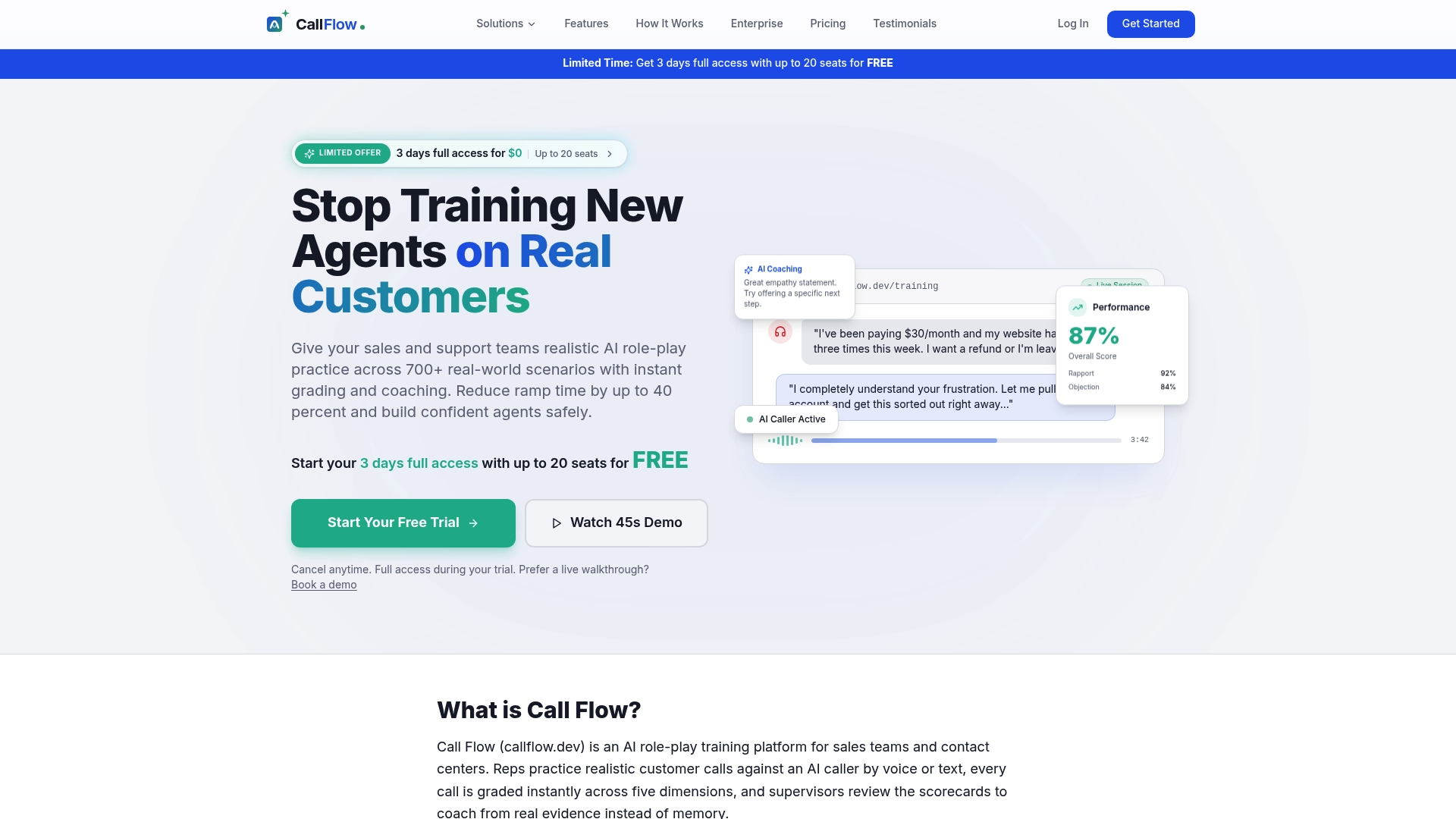
Callflow reports that teams using the platform see 147% faster ramp time and a 129% improvement in resolution rates, by its own measurement. That kind of gain comes from catching gaps in practice, not on a customer's call. If you're building a graduation gate like the one described above, start with the Starter plan at $7.42 a month, or look at the enterprise option if you're scoring a larger team. Every plan includes full access during a risk-free trial, so you can test the grading against your own rubric before committing.
Sources
- ACL 2026 findings on model judgment reversals
- How to quantify agent readiness with post-training scorecards — Insight7
- What is a call scoring rubric? — Call Coach IQ
- Call center scorecard templates and guidance — Voxjar
FAQ
What Is a Good Agent Readiness Score Threshold?
There's no universal number, since thresholds depend on your call types and risk tolerance. Most teams set the bar using two comparable post-training batches and require consistency across both, not a single high score.
How Many Calls Do You Need for a Baseline?
A baseline of 20 to 30 calls per agent is the practical standard cited in post-training scorecard guidance. Fewer calls make the baseline too sensitive to one unusual interaction.
Can AI Reliably Score Readiness on Its Own?
Not without calibration. A 2026 ACL study found judgment flip rates ranging roughly from 5% to 13% on identical transcripts, so any automated score needs regular human agreement checks and a supervisor override before it gates live work.
How Does Callflow Fit Into a Readiness Program?
Callflow provides the AI role-play practice and instant multi-dimension grading that feeds directly into a readiness rubric, plus supervisor dashboards for the override and audit steps. Pricing starts at $7.42 a month on the Starter plan, with a risk-free trial for teams that want to test it first.
What Should Trigger an Auto-Fail Instead of a Low Score?
Auto-fails should be reserved for 3 to 6 serious items, typically compliance disclosures, legal language, or trust violations, according to call-scoring rubric guidance. Minor phrasing misses belong in the regular scoring weights, not the auto-fail list.