

Automated call scoring evaluates every call against a manager-defined scorecard so you can coach at scale instead of sampling 2% of calls and hoping their representative performs well. The technology transcribes calls, grades them against your rubric, and attaches evidence quotes to every score. The immediate next step: pilot a hybrid scorecard on one team and calibrate it against a moderate set of manually scored calls before you trust it for coaching.
TL;DR:
- Automated call scoring evaluates every call against a standardized rubric, attaching evidence quotes to improve coaching accuracy and consistency.
- Hybrid architectures combining rule-based checks with AI and LLM judgments outperform either approach alone in accuracy and cost-efficiency.
- Calibration with manual scoring and ongoing audits are critical to trust and validate AI scores, preventing drift and false positives.
- Scoring dimensions should be limited to 8-12, with stage-aware weighting and a mix of objective and subjective criteria to avoid noise and bias.
- Piloting on a small team, setting appropriate flag thresholds, and tracking coaching lift are essential steps to ensure effective implementation and measurable ROI.
Table of Contents
- What Is Automated Call Scoring, and Where Does It Fit in QA?
- Rule-Based, AI, or Hybrid: Which Scoring Architecture Actually Works?
- How Does Automated Call Scoring Work From Recording to Coaching Feed?
- What Should a Call Scoring Rubric Actually Measure?
- Can You Trust the Scores? A Calibration and Validation Checklist
- What Are the Real Benefits and Failure Modes of Automated Scoring?
- How Do You Pilot Automated Call Scoring Without Disrupting Your Team?
- How Call Flow's AI Role-Play Connects Simulation Scoring to Live Calls
- A Manager's Checklist for Adopting Automated Scoring
- Sources
- FAQ
What Is Automated Call Scoring, and Where Does It Fit in QA?
Automated call scoring is the practice of grading recorded or live calls against a standardized scorecard using software rather than a human listening to each one. It sits at the center of modern call quality assessment, replacing the old model where a QA analyst sampled a handful of calls per rep per month and called it coverage.
The pipeline runs in a predictable order: audio comes in, gets transcribed into text, then gets measured against a scorecard question by question. Each question produces a score, and the system rolls those up into an aggregate call score, alongside the exact transcript line that justifies each rating.
That last part, the evidence quote, is what separates real automated call evaluation from a black-box number. A manager who sees "Score: 2/5 on discovery questions" learns nothing. A manager who sees the same score next to "Rep said 'so what's your budget' 40 seconds into the call" can coach that specific moment.
Sales and support scoring diverge here. A sales scorecard cares about discovery depth, objection handling, and next-step commitment. A support scorecard cares about resolution accuracy, empathy language, and adherence to disclosure scripts. Both benefit from stage-aware rubrics, meaning the questions that apply to a discovery call shouldn't apply to a closing call, and a billing dispute shouldn't be graded on the same empathy weight as a simple password reset.
The workflow shift matters more than the technology itself:
- Every call gets scored, not just the ones a QA analyst had time to pull.
- Low scores automatically flag calls for manager review instead of managers guessing which reps need attention.
- Coaching conversations start from a transcript excerpt, not a manager's memory of a call from three days ago.
- Criterion-level trends (not just overall scores) show whether a rep struggles with one specific skill across dozens of calls.
Rule-Based, AI, or Hybrid: Which Scoring Architecture Actually Works?
Three architectures dominate the market, and they solve different problems.
Keyword and rule-based scoring checks for the literal presence of required phrases, like a mandatory disclosure or a specific greeting. It's fast, cheap, and deterministic. It's also easy to game: a rep who says "I understand your frustration" without meaning it still passes the empathy check.
AI and LLM-based evaluation reads the full transcript and judges subjective qualities like tone, rapport, or how well a rep handled an unscripted objection. This is where ai call scoring earns its name, because it can catch nuance that keyword matching misses entirely. The tradeoff is cost per call and a small risk of scoring drift if the underlying model changes without your team noticing.
Hybrid architectures split the work: deterministic rules handle objective, countable things (talk-to-listen ratio, whether a required disclosure was spoken, question count), while an LLM handles subjective judgment calls (did the rep actually listen, was the close natural or forced). This partition is why hybrid approaches that combine deterministic rules with LLM evaluation tend to outperform either approach alone on both accuracy and cost.
- Rule-based: fast, cheap, auditable, but gameable and blind to context.
- Pure AI/LLM: nuanced and context-aware, but costlier and harder to audit line by line.
- Hybrid: matches each rubric dimension to the cheapest method that scores it reliably.
Pro Tip: Don't default every dimension to the expensive method. Run a quick audit of your rubric and ask which questions have a clear yes/no answer. Those go to rules. Everything that requires judgment goes to the LLM.
How Does Automated Call Scoring Work From Recording to Coaching Feed?
The mechanics matter because a weak link anywhere in this chain produces bad scores that erode manager trust fast.
- Transcription. The engine converts audio to text and separates speakers. Accuracy here is the ceiling for everything downstream. A transcription engine that confuses rep and customer speech, or that mangles industry jargon, will corrupt every score built on top of it. Post-call transcription is generally more accurate than real-time transcription because it can process the full audio context, but real-time has value for live coaching prompts.
- Scorecard application. The transcript gets run against your scorecard, question by question. Questions are typically binary (yes/no), scaled (1 to 5), or weighted categories. Each answer generates a score plus a supporting quote pulled directly from the transcript.
- Aggregation. Per-question scores roll into a weighted total, usually output as a structured record (a per-call JSON object listing every dimension, its score, its evidence, and the overall result) that other systems can consume.
- Integration. That structured output feeds three places: your CRM (so the deal or ticket record shows the call quality), your QA dashboard (so trends are visible across the team), and a coaching feed (so managers see flagged calls without hunting for them).
- Manager review and override. Every credible system needs a path for a manager to disagree with a score and correct it. Without override capability, one mis-scored call can waste ten minutes of manager time chasing a false flag, and repeated false flags teach managers to ignore the system entirely.
The scorecard model that AI call scoring is built on depends on this evidence-attached structure. A number with no supporting quote is an opinion dressed up as data. A number with a quote is something a manager can actually act on in a coaching conversation.
A practical variant worth knowing: a two-pass hybrid pattern runs a lightweight deterministic check live, during the call, for immediate signals like talk ratio, then runs the fuller hybrid evaluation, including the LLM-based subjective pass, after the call ends. This keeps live coaching prompts fast while preserving accuracy where it counts.
What Should a Call Scoring Rubric Actually Measure?
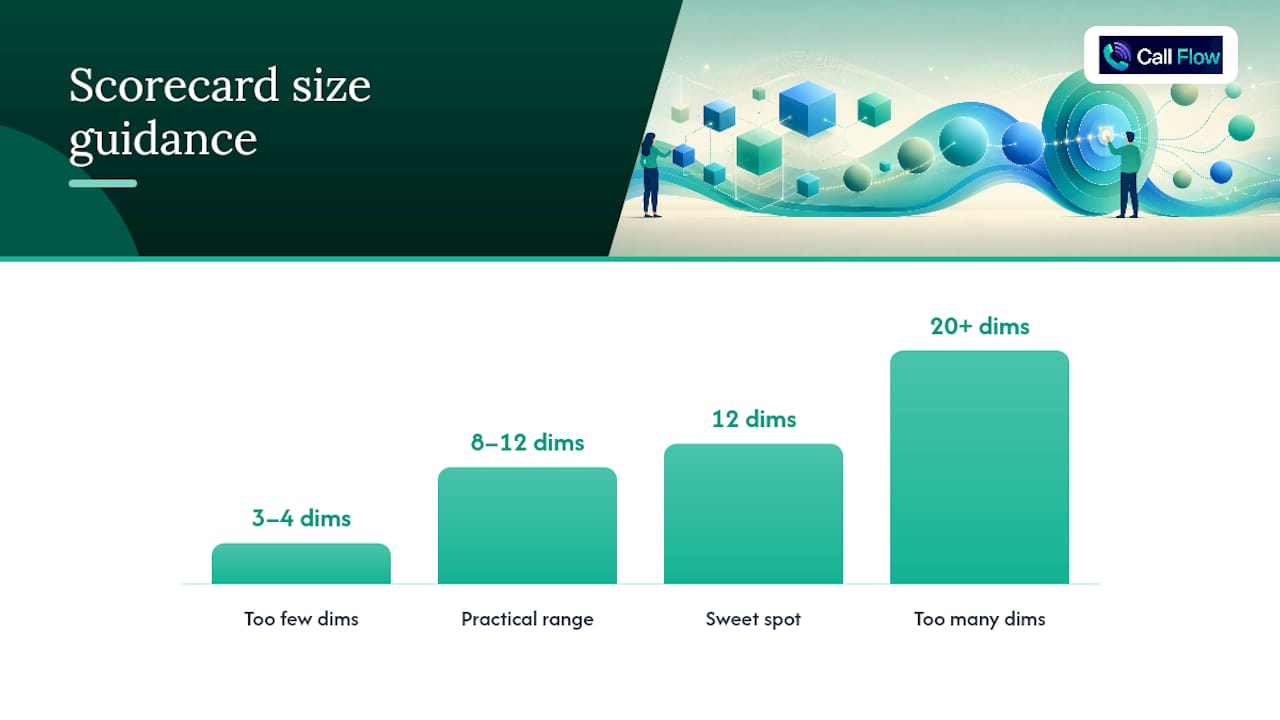
Most teams overbuild or underbuild their first scorecard. Too few dimensions (3 or 4) miss real skill gaps. Too many (20-plus) create noise and slow down manager review of the evidence.
Vendor guidance and platform documentation consistently converge on 8 to 12 dimensions as the practical range for a working scorecard, with 12 often the sweet spot for teams that need to separate sales stages or support ticket types without drowning managers in categories.
A sample sales rubric might include:
- Opening and rapport (binary: did the rep introduce themselves and the call purpose?)
- Discovery question count and depth (scaled)
- Active listening indicators, like referencing something the customer said earlier (LLM-judged)
- Objection handling quality (LLM-judged)
- Value proposition alignment to stated customer needs (LLM-judged)
- Next-step commitment and clarity (binary)
- Talk-to-listen ratio (rule-based)
- Required disclosure or compliance language (rule-based)
A support rubric swaps discovery and closing dimensions for resolution accuracy, empathy language, first-contact resolution likelihood, and adherence to required disclosures.
Stage-aware weighting matters as much as dimension choice. A discovery call shouldn't be weighted the same way on "next-step commitment" as a closing call. Support scorecards need rubrics that flex by ticket type, since a billing dispute and a technical outage call require different empathy and resolution weighting.
Three design rules keep a scorecard honest: prefer binary checks wherever a clear yes/no exists, since they're cheapest and most auditable; reserve LLM judgment for genuinely subjective dimensions like tone or rapport; and never let one dimension carry more than roughly 20% of the total weight, or a single strong or weak moment will swing the whole score.
Can You Trust the Scores? A Calibration and Validation Checklist
Trust in automated scoring is earned through calibration, not assumed from a vendor demo.
- Run a paired comparison. Have a QA analyst manually score 20 to 30 calls using the same rubric the system uses, then compare the two sets of scores side by side. This is the calibration step vendors themselves recommend before any team relies on automated scores for coaching decisions.
- Measure agreement, not just averages. Two systems can produce the same average score while disagreeing wildly on individual calls. Look at per-call score gaps, not just whether the team-wide average matches.
- Set coaching thresholds to match manager bandwidth. If a threshold flags 40% of calls for review and each manager can realistically review 10 flagged calls a week, you'll drown the queue. Tighten the threshold until flagged volume matches actual review capacity.
- Keep auditing after launch. Pull a random sample of scored calls each month, even after calibration looks solid, to catch drift before it compounds.
Enterprise deployments of AI-assisted service tools show measurable gains in satisfaction and productivity, but those gains consistently depend on the integration being validated and the workflows around it being managed, not on the AI alone. A calibration protocol is the difference between a tool that earns trust and one that gets quietly ignored by week three.
What Are the Real Benefits and Failure Modes of Automated Scoring?
The upside is straightforward: every call gets evaluated instead of a sample, scoring stays consistent across reps and shifts, and managers get feedback within hours instead of the following week's QA cycle. Criterion-level trends also let you spot that a rep is strong on rapport but consistently weak on next-step commitment, a pattern a single spot-check would never reveal.
The failure modes are just as real and worth planning for before launch:
- Keyword gaming. Reps who learn the rubric can start saying required phrases without meaning them, especially on rule-based checks.
- Missing context. A system can misread sarcasm, industry-specific phrasing, or a customer who's joking, and score the moment wrong.
- Model drift. An LLM's judgment can shift subtly over time as the underlying model updates, changing scores without any change in actual call quality.
- False positives at scale. A single rubric flaw, once automated, generates the same mistake on every call it touches, unlike a human error that's usually isolated.
The mitigation pattern that shows up across nearly every serious implementation is the same: keep the hybrid split between rules and LLM judgment, require evidence quotes on every score, run periodic manual audits, and keep automated scores out of punitive pay or termination decisions by default. Scores should drive coaching conversations, not performance-review ultimatums, at least until a team has months of calibrated data behind them.
Pro Tip: If a rep contests a score, pull the evidence quote first. Half of disputes resolve the moment both sides look at the actual transcript line together.
How Do You Pilot Automated Call Scoring Without Disrupting Your Team?
A focused pilot beats a full rollout every time, because it lets you catch rubric problems before they touch every rep's coaching record.
- Scope one team. Pick a single team of 5 to 15 reps rather than the whole floor.
- Select 4 to 8 starter dimensions. Don't launch with your full 12-dimension rubric on day one. Start narrow, prove the workflow, then expand.
- Collect baseline calls. Pull 30 to 50 recent calls to run through the system before it touches anything live.
- Run calibration. Compare AI scores to manual scores on that baseline set and adjust the rubric or weighting where they diverge.
- Set your review threshold. Match the flag rate to what managers can actually review in a week.
- Define review cadence. Weekly one-on-ones anchored to flagged calls work better than monthly batch reviews.
Track a small set of metrics from week one: coverage (percent of calls scored), average score by rep, criterion-level trends over time, and coaching lift, meaning the change in a specific criterion's score before and after a coaching conversation about it. That last metric is the one most teams skip, and it's the one that proves the whole system is worth the subscription cost. Independent analysis of AI-driven productivity gains backs this pattern: the payoff shows up when teams measure impact, not just adoption.
The workflow that makes this stick: automated flag surfaces a call, manager reviews it alongside the evidence quote, manager delivers coaching on that one specific behavior, and the next week's score on that same criterion shows whether it landed.
- Coverage: percent of total calls scored automatically.
- Average score by rep and by criterion, tracked over time.
- Coaching lift: score change on a specific dimension following a targeted coaching session.
How Call Flow's AI Role-Play Connects Simulation Scoring to Live Calls
Automated scoring tells you what happened on a real call. AI role-play training tells you whether a rep is ready before that call happens, and Call Flow builds its platform around closing that gap. The platform runs realistic role-play scenarios for sales and support conversations, then grades each simulated call instantly across five performance dimensions instead of making reps wait days for feedback.
Call Flow reports 147% faster ramp time and a 129% improvement in resolution rates among teams using its simulation and instant grading system, figures the company attributes to closing the feedback loop between practice and live performance.
The practical tie-in for QA teams: build your role-play scenarios around the same rubric dimensions you use for live-call scoring. Run new hires through simulated calls scored on that shared rubric before they touch a live customer, then compare their simulation scores to their actual call scores once they're live. That comparison tells you whether your training scenarios actually predict real-call performance, or whether your rubric needs adjusting on either side.
- Use the same scorecard dimensions in role-play and live scoring for a direct comparison.
- Run a role-play baseline before ramp, then re-score after 30 days of live calls.
- Feed persistent weak spots from live scoring back into new role-play scenarios.
A Manager's Checklist for Adopting Automated Scoring
Start small: pick one team, calibrate against 20 to 30 manually scored calls, and attach evidence quotes to every score before you trust a single number. Coach on the specific transcript line, not the aggregate score. The strongest programs treat AI scoring as the thing that finds the moment worth coaching, while the manager still decides what to say about it. Automated grading scales attention. It doesn't replace judgment, and any team that tries to make it do so will lose rep trust within a quarter.
— Costa
Sources
- AI service agents improve customer satisfaction (Salesforce)
- What is AI call scoring and what surfaces from every call? (Aircall blog)
FAQ
How do you score calls automatically?
You transcribe the call, run the transcript against a manager-built scorecard using rules for objective checks and an LLM for subjective judgment, then output per-question scores with evidence quotes attached.
What is AI call scoring, exactly?
It's the use of artificial intelligence, usually paired with deterministic rule checks, to grade a call transcript against a fixed rubric and produce scores backed by transcript evidence, as described in Aircall's breakdown of the model.
Can automated call scoring replace manual QA entirely?
No. Manual spot-checks and periodic audits stay necessary to catch drift and validate that the automated scores still match reality, even after a successful calibration.
What is scoring in AI, broadly speaking?
In AI systems generally, scoring means assigning a numeric or categorical value to an input based on a trained or rule-based model's evaluation. In call scoring specifically, that input is the call transcript and the output is a performance grade tied to a rubric.
How is automated call scoring different from lead scoring?
Lead scoring ranks prospects by likelihood to convert based on firmographic and behavioral data, while automated call scoring grades the quality of a conversation itself against a rubric. Both use similar AI evaluation techniques, but they answer different questions: one asks "how good is this lead," the other asks "how good was this call."