

The best gamification rewards are small, fair and tied to skills you want more of. Think recognition, choice of prize, time off, team goals and learning perks. Pay them for practice and quality, not only for volume. That is how you cut ramp time and lift customer satisfaction without creating stress or gaming.
This guide is for managers who run sales or support teams. It lists reward ideas, shows how to choose them, and explains how to measure whether they work.
TL;DR
- Mix reward types: recognition, prizes of choice, time off, team rewards and learning perks. One type rarely fits a whole team.
- Fairness matters more than prize size. Rewards that feel unfair demotivate, according to a CIPD evidence review.
- Reward practice and quality, not just speed. Rewarding short handle time alone can push agents to drop hard calls.
- Ask your agents what they want, review games monthly, and rotate goals so everyone gets a chance to win.
- Reward scored role-play practice for new hires. It speeds ramp-up and gives you clean data.
Table of Contents
- What gamification rewards are
- Reward ideas that work for sales and contact center teams
- How to choose rewards that stay fair
- Reward practice, not just results
- Where Callflow fits
- How to launch a reward program in six steps
- How to measure whether rewards work
- Pitfalls to avoid
- Our view
- FAQ
- Sources
What gamification rewards are
Gamification adds game elements to normal work. Agents earn points, climb levels, finish challenges and see a scoreboard. A reward is what they get for it.
Rewards fall into two groups:
- Virtual rewards: badges, levels, titles, avatars, leaderboard places.
- Real rewards: gift cards, merchandise, paid time off, breaks, team events, learning access.
Most working programs use both. A badge costs nothing, but it has to mean something. A prize costs money, but it has to feel earned.
Only 15% of US contact centers used gamification in the 2024 ContactBabel decision-makers' survey, and another 8% planned to within 12 months. Most teams have room to do this well.
Reward ideas that work for sales and contact center teams
Recognition rewards
Recognition is cheap and fast. Use it every week.
- Badges for specific skills: active listening, clean call opening, objection handling, de-escalation.
- A weekly "most improved" title, not only "top performer".
- A shout-out in the team meeting with the exact call behavior named.
- Level-ups that unlock new scenarios or responsibilities, such as coaching a new hire.
The weekly most-improved idea matters. If the same top three agents win every time, everyone else stops trying. Rewarding improvement gives each person a path to a win.
Prizes your agents choose
Do not guess what people want. Ask them. In a March 2024 case study, a contact center outsourcer surveyed agents about preferred prizes. Its reward ladder for new hires ranged from gift cards to electronics, paid time off and breaks.
A simple version for your team:
- Send a five-question survey. Ask for the top three rewards.
- Group answers into tiers: small, medium, large.
- Give points for each action and let agents spend them on the tier they like.
- Refresh the menu each quarter.
A points store works well because it gives each person choice. One agent wants a gift card. Another wants an extra long lunch.
Time-based rewards
Time is often worth more than cash to agents on a tight schedule. Ideas:
- Paid time off for a month of sustained quality scores.
- An early finish on a quiet Friday.
- First pick of shifts or breaks for the week.
- A protected hour for a skill the agent wants to learn.
Make sure the schedule can carry it. A time reward that leaves the queue short creates resentment, not motivation.
Small cash and gift cards
Small, clear awards work when the goal is clear. A SHRM report describes a software company's sales development team that makes at least 80 calls a day. It awarded points for 400+ calls a week and for calls that led to demos that converted. The winner got a $50 Amazon voucher. The team's calls, opportunities and new customers all rose by more than 35%.
Note what that program did right. The winning criteria changed each week: most improvement, most demos, most product knowledge. That gave each person a different way to win.
Team rewards
Team goals build cooperation and reduce unhealthy rivalry.
- A team lunch when the group hits a CSAT target.
- A shared goal for first-call resolution, with a visible progress bar.
- Team-only contests between shifts or pods.
- A team event, such as a movie afternoon, when a monthly goal is met.
Research backs shared targets. An NBER working paper by Kuhn and Yu on 103 small retail sales teams found that attainable targets and thresholds shifted sales toward higher output, and the authors argue that shared thresholds can act as salient collective goals.
A public-sector contact center described in a vendor case study mixed team-only contests with daily and weekly games, monthly contests and special events. Agents earned coins through volume and quality measures and spent them on avatar rewards and branded merchandise. Mixing time frames keeps the program fresh.
Learning and career rewards
For new hires and ambitious agents, growth is a reward.
- Access to advanced scenarios after hitting a score.
- A chance to shadow a top agent or interview one for best practices.
- A lead role in a pilot, or in peer coaching.
- Support toward a certification.
This ties rewards to skill, not just output. It also helps retention, because people see a future in the job.
Reward ideas by goal
| Goal | Reward idea | Why it fits |
|---|---|---|
| Faster ramp-up | Badges for each completed practice milestone, then a small prize at day 30 | Rewards the behaviors that build skill early |
| Higher CSAT | Team lunch or time off when the team hits a CSAT target | Shared goal, no one is left behind |
| Better quality | Points for calls that score high on a QA scorecard | Rewards how the call went, not only how fast |
| Consistent practice | Weekly streak badge for completing role-plays | Builds a habit |
| Retention | Level-ups that unlock mentor or trainer roles | Shows a career path |
| Sales activity | Weekly rotating winner: most improved, most demos, best objection handling | Many ways to win |
How to choose rewards that stay fair
Fairness decides whether a reward motivates or backfires. The CIPD review says managers should not avoid incentives out of fear of crowding out intrinsic motivation, but that incentives and recognition are likely to demotivate when they are seen as unfair or exploitative. It also advises balancing team-level incentives with individual recognition, because people value collective credit and still want their own work seen.
A peer-reviewed 2020 study by Saether points the same way. Rewards for creativity raised intrinsic motivation and creativity only when evaluation was seen as fair. Clear allocation rules alone had no significant effect.
Use these rules:
- Publish the criteria. Agents should know how points are earned before the game starts.
- Score the same way for everyone. Use one scorecard and one set of standards across supervisors.
- Give every role a path. A new hire and a ten-year agent should both have a realistic way to win.
- Pay for quality as well as quantity. Include customer outcomes in the points.
- Centralize the plan. In the same March 2024 case study, independent contests run by individual supervisors led to uneven game availability and earnings. The company moved planning to a central steering committee to equalize earning chances.
Reward practice, not just results
Most reward programs pay for results on live calls. That helps, but it leaves a gap. New agents cannot earn much until they are already good, and every live call is a risk to a real customer.
A better design also rewards practice. Give points for completing role-plays, for improving a score from one attempt to the next, and for hitting a skill target before going live. Then new hires have something to win from day one. Managers get a clear view of who is ready.
This fits how people learn. Simulation lets agents repeat hard conversations in a safe space. Our guide to simulation-based learning covers how this speeds ramp time, and our sales training gamification playbook shows how game mechanics support recall.
Practice rewards you can use:
- A badge for the first completed role-play.
- A streak reward for practicing three days in a row.
- Points for a higher score on the same scenario the next day.
- A "call-ready" title when a new hire hits the target on key scenarios.
- A team goal for total practice sessions in a week.
Good practice rewards share one trait: they reward learning, not the act of clicking. A training guide from Intellum makes the same point, advising rewards tied to learning objectives and stated upfront.
Where Callflow fits
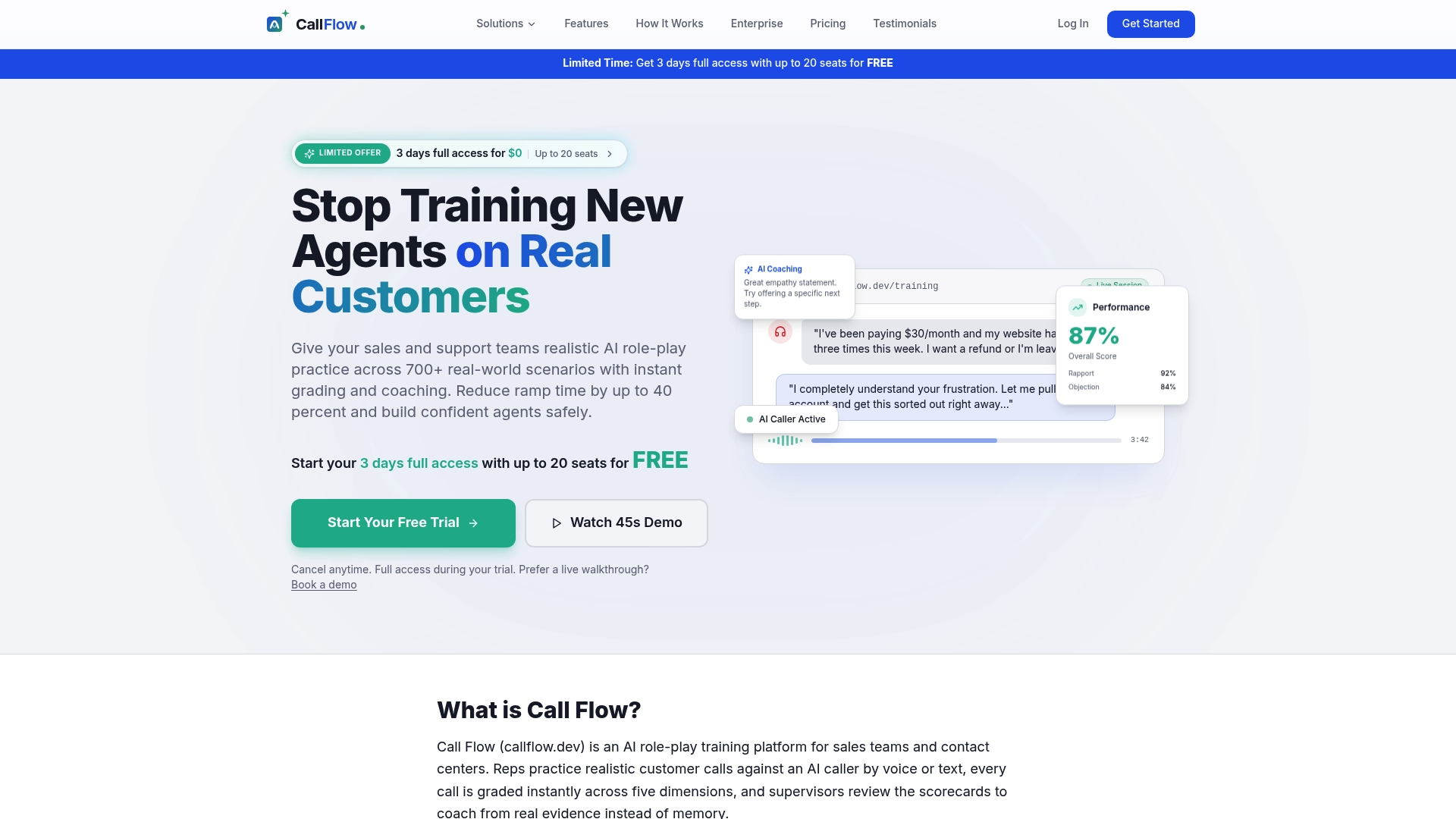
Callflow is an AI role-play platform for sales teams and contact centers. Agents practice realistic customer calls in voice or text. Each session gets instant AI grading across five performance dimensions, plus coaching feedback. Supervisors see dashboards and skill analytics, and gamification is built in. Teams can also create custom scenarios.
That gives you something concrete to reward: a score you can trust, on the same standard for every agent. Our scoring is calibration-aligned, so it matches the QA standards you already use.
Plans are billed per team, monthly or annually:
- Starter: $7.42 per month or $89 per year.
- Growth: $14.92 per month or $179 per year.
- Scale: $33.25 per month or $399 per year.
- Business and Enterprise have no published price. See the enterprise page.
You can start with a free, full-feature trial. See plans and pricing to pick the tier that fits your team.
How to launch a reward program in six steps
1. Pick one or two goals
Choose a few outcomes: shorter ramp time, higher CSAT, better first-call resolution, lower turnover. Too many goals dilute the game. For metrics, see our guide to call center performance metrics.
2. Map behaviors to points
List the behaviors that drive each goal. Then assign points. For a new-hire program, behaviors can include completing role-plays, hitting scenario scores and finishing required training. Aspect's 2025 guide also lists trackable new-hire items such as securing an ID badge and completing security and ethics training.
3. Ask agents what they want
Survey the team on rewards. Build a menu from the answers. Include at least one reward that costs nothing, such as recognition or a schedule perk.
4. Use a short game first
Run a pilot of two to four weeks. Give it a specific, measurable target, a set time frame, a visible scoreboard, named participants and a prize. Short games are easy to adjust.
5. Rotate goals
Change the winning criteria weekly or monthly. Rotation gives more agents a chance to win and slows the fade of novelty. The ContactBabel guide notes that novelty wears off and rewards must stay fresh and aligned to business goals.
6. Review monthly
Check agent feedback, engagement, performance and whether the behaviors persist after the game changes. The March 2024 case study reviewed its games monthly on exactly those lines.
How to measure whether rewards work
Track both output and learning. Microsoft's 2019 account of a call center gamification program evaluated calls per shift, sales attachment, absenteeism, agent knowledge and customer satisfaction. It reported 10% higher productivity and a 12% improvement in absenteeism. In the same account, 89% of agents acknowledged new information and showed they could apply it after an activity plus a simulation, against 23% awareness under the standard leadership-notification method.
These are one company's results. Use them as a pattern for what to measure, not as a promise.
A practical scorecard:
| Measure | What it tells you | How often |
|---|---|---|
| Days to full productivity | Ramp speed | Per cohort |
| Practice sessions per agent | Engagement | Weekly |
| Score change between attempts | Skill growth | Weekly |
| CSAT and first-call resolution | Customer outcome | Weekly or monthly |
| Absenteeism and turnover | Retention effect | Monthly or quarterly |
| Agent survey | Fairness and motivation | Monthly |
Compare a group in the program with a group before it started. Do not assume every gain comes from the game. For example, a vendor study on a telecom sales program found that inbound sales agents who reached level 15 sold nearly 70% more mobile lines than lower-level users. That is an association, not proof of cause. Better performers may simply play more.
For help with retention and CSAT measures, see our guides on how to improve CSAT and reduce call center turnover.
Pitfalls to avoid
Rewarding the wrong metric. ContactBabel warns that rewarding agents on average handling time could lead them to drop difficult calls. Pair speed with quality and resolution.
Public rankings that shame. SHRM cautions that gamification can backfire when poorly designed. It recommends designing for the target workers, giving everyone a chance to win and supporting personal growth. A leaderboard alone is not enough. As one expert quoted there warns, ignoring personal growth creates stress and backlash.
Stale rewards. The same prize every month loses pull. Refresh the menu and the games.
Uneven rules across supervisors. Different contests per supervisor create unequal chances. Plan centrally.
Rewarding clicks. If points come from simply finishing modules, agents will click through. Tie points to scores and to improvement.

Assuming age predicts response. Readers ask whether Gen Z likes gamification. The research does not give a simple answer. A 2026 study of 418 survey responses found a significant positive link between gamified HR practices and work engagement, with intrinsic motivation partly explaining it. Ask your own team instead of guessing by age.
Our view
We think rewards should follow skill, not only volume.
Most teams reward what is easy to count: calls, handle time, deals. Those numbers matter, but they come late. A new agent cannot earn much until the damage to a customer call is already done.
So we start earlier. Reward the practice. Score each role-play on the same standard your QA team already uses, and let agents see their scores rise. Instant grading across five performance dimensions gives each person a clear next step, and gives managers proof of readiness before the first live call.
Keep the rewards simple. Let agents choose. Make the rules public. Give everyone a way to win. Then watch ramp time, CSAT and turnover, and adjust each month.
The result is a program people join because it helps them get better, not because they are told to.
Costa
FAQ
What are good gamification reward ideas for a call center?
Start with agent-chosen prizes such as gift cards, paid time off and schedule perks. Add recognition badges, team lunches for hitting a CSAT goal, and learning rewards like advanced scenarios. Mix individual and team rewards so everyone has a path to win.
Should gamification rewards be cash?
Not only cash. Small cash or gift cards work for clear, short goals, as in the $50 voucher example above. Time off, choice of shift, recognition and growth opportunities often matter just as much. Ask your agents what they value.
How do I keep gamification rewards fair?
Publish the criteria, use one scorecard for every supervisor and give each role a realistic way to win. The CIPD review finds that fairness in both the outcome and the process drives how well rewards work. Rotating goals helps more people win.
How often should I change the rewards?
Review monthly and refresh the menu each quarter. Rotate the winning criteria weekly or monthly so novelty does not fade. Use agent feedback and performance data to decide what to keep.
Can gamification help new hires ramp faster?
Yes, when you reward practice and skill milestones, not only live results. Points for scored role-plays, streaks and score improvements give new hires early wins and give you data on readiness. Track days to full productivity for each cohort to see the effect.
Sources
- CIPD: Incentives and recognition, an evidence review
- SHRM: Be Careful: Gamification at Work Can Go Very Wrong
- ContactBabel: The 2024 US Contact Center Decision-Makers' Guide
- NBER: Kinks as Goals, working paper
- PMC: Creativity-Contingent Rewards, Intrinsic Motivation, and Creativity
- Frontiers in Psychology: Gamified human resource management and work engagement
- Microsoft: Using Gamified Performance and Learning to Drive Call Center Agents