

Training a new contact center agent in the US costs about $10,000 to $20,000 once you count training, recruiting and lost productivity during ramp-up. That is the range McKinsey reported in its 2018 survey of 320 US contact-center employees. The classroom is only part of it. Most of the money goes to wages paid while the agent cannot yet work alone. So the fastest way to cut training cost is to shorten ramp time. Role-play simulation does that. It lets agents practice before they take live calls.
This guide shows what the published numbers include, how to build your own estimate, and where a practice platform like ours fits.
TL;DR
- Expect $10,000 to $20,000 per new agent in total cost to proficiency, per McKinsey. Specialized or regulated roles run higher.
- Hard-dollar onboarding is a smaller slice. WFM Labs cites $1,500 to $5,000 per hire for it, and $5,000 to $15,000 fully loaded for standard roles.
- Trainee wages are usually the largest line. Time to proficiency drives the total.
- Ongoing training is a separate yearly cost. Turnover decides how often you pay for onboarding again.
- Practice before live calls is the lever that shortens ramp. Callflow plans start at $7.42 per month.
Table of Contents
- What contact center training costs per agent
- What goes into the number
- Why ramp time is the biggest cost driver
- Ongoing training is a yearly cost
- How to estimate your own training cost
- Where the money can be saved
- Measuring whether training pays back
- What Callflow costs
- Put practice in front of live calls
- Our view
- FAQ
- Sources
What contact center training costs per agent
Published figures differ because each source counts different things. Read the scope before you compare numbers.
| Scope | Published range | Source |
|---|---|---|
| Hard-dollar onboarding | $1,500 to $5,000 per hire | WFM Labs |
| Fully loaded, standard contact center role | $5,000 to $15,000 per hire | WFM Labs |
| Specialized or regulated roles | $15,000 to $50,000+ per hire | WFM Labs |
| Training, recruiting and ramp-up lost productivity | $10,000 to $20,000 per hire | McKinsey, 2018 |
| One center's full cost of training an agent | $13,622 | Contact Center Pipeline, June 2024 |
The $13,622 figure comes from one Indianapolis-based analysis. It is an example of a real total, not a national average. It sits inside the McKinsey range.
Use the low numbers to size a training budget. Use the high numbers to size the cost of a bad hire or an early exit.
What goes into the number
A training budget has more lines than most managers track. WFM Labs lists the training-phase costs this way:
- Loaded trainee salary. This is the largest single component.
- Loaded trainer time.
- Training materials, including curriculum and LMS platform costs.
- Training facility or virtual-platform costs.
The same reference adds technology provisioning. It puts workstations plus software licenses for workforce management, CRM, telephony and quality tools at $2,000 to $6,000 per seat.
Then come the costs that never get a budget line. During nesting, the first weeks on live calls with support, a coach spends hours helping instead of working. Handle times run longer. Some cases need rework. Our guide to the nesting period in a call center shows how it works and why it is hard to price.

A 2023 analysis of a 100-seat US center shows the gap. Training seven new hires for six weeks cost $35,244 in wages alone. With direct and indirect expenses it reached $45,660, or $6,523 per person, according to Cinareo's breakdown. Hidden costs added 30% over a wages-only estimate.
Why ramp time is the biggest cost driver
An agent who is not yet proficient still draws a full wage. Time to proficiency therefore sets the total more than any course fee does.
McKinsey's 2025 operations blog says new hires need about four to six months to reach peak proficiency. It puts the cost of that period at 5 to 10 percent of total agent cost allocation. It also notes that customized training is rare. Most agents get generic training based on tenure or business unit.
The 2018 McKinsey survey found the most common nesting period was one to two weeks, reported by 28% of respondents. Another 11% nested for more than two months.
What raises the cost:
- Long classroom phases before any live practice.
- Small cohorts. Trainer cost is spread over fewer agents.
- Complex queues. Technical or regulated work takes longer to learn.
- High turnover. You pay for onboarding again each time someone leaves.
What lowers it:
- Practice that starts in week one.
- Feedback after every practice call, not once a week.
- Scoring that matches your QA standards, so coaching is consistent.
For a deeper look, read our piece on how long it takes employees to reach proficiency.
Ongoing training is a yearly cost
Onboarding is paid once per hire. Ongoing training is paid every year for every agent. It covers product updates, process changes, compliance refreshers and quality coaching.
HiveDesk's formula gives a clean way to combine the two:
Annual training cost per agent = (new-hire training cost × turnover rate) + ongoing training cost
Its example uses $3,000 of new-hire training and 40% turnover. That gives $1,200 per agent per year for amortized onboarding. Add $500 of ongoing training and the total is $1,700 per agent position per year.
The formula shows why turnover matters so much. At 40% turnover, you re-pay for 40% of your onboarding every year. Our guide to a 90 day manager plan to reduce call center turnover covers the retention side.
How to estimate your own training cost
Published averages are a starting point. Your own number is the one that goes in the budget. Follow these steps.
- Count the days. Record days in classroom training, days of nesting, and days after nesting until an agent reaches full proficiency. Use real cohort data, not the plan.
- Price each day. Multiply by the loaded daily wage for the trainee. Add the loaded daily cost of every trainer and coach involved.
- Add systems. Include LMS, simulation, QA and workstation costs per seat.
- Add the hidden lines. Include coach hours diverted from their own work, longer handle times, escalations and rework during nesting.
- Add recruiting. Count it if you want a full cost per hire. McKinsey's total includes it.
- Convert to a yearly figure. Multiply the new-hire total by your turnover rate. Add ongoing training.
A quick scale check. Say you onboard 25 agents in a year. At McKinsey's range, that is $250,000 to $500,000 in total cost to proficiency. This is simple arithmetic on the published range, not a forecast for your center. If your own numbers land far outside it, find out which line is the cause.
As a planning share, one budget template suggests 3 to 5% of a contact center budget for training overall. Treat that as a sanity check against your own build-up.
Where the money can be saved
Cutting course fees saves little. Cutting ramp time saves a lot. The same 2025 McKinsey piece points to personalized, AI-supported learning as a way to shorten the road to proficiency.
Note one trap. Rushing nesting does not remove the cost. It moves it. The agent still learns the same lessons, but on real customers, with more errors and fewer coaching hours. Practice has to replace live-call learning, not skip it.
Here is what that looks like in a plan:
- Week one: agents run scenario calls before they touch a customer. Mistakes cost nothing.
- Weeks two to four: agents practice the exact call types they will take. Supervisors see scores by skill and assign extra practice where scores are low.
- Nesting: agents arrive with the basics done. Coaches spend their time on real edge cases.
- Ongoing: short practice sessions after every product or policy change.
Our 90 day agent onboarding checklist lays out the compliance and simulation steps. If you need documentation to go with it, start from the call center training manual template.
Measuring whether training pays back
A training budget needs a return you can defend. Track these before and after any change:
- Days to proficiency. The headline number. Measure from start date to the day an agent meets your QA and handle-time targets.
- First-call resolution (FCR) of new agents. One 2026 analysis puts new agents' FCR 10 to 18 percentage points below tenured agents during the 90 to 120 day ramp. The gap is your target.
- QA scores by skill. Aggregate scores hide which skill is weak.
- Early attrition. Count exits in the first 90 days.
- Coach hours per new hire. This shows whether training is freeing up supervisors.
Training is also a retention lever. In the McKinsey survey, training and nesting duration were among the factors that mattered most for retention, along with huddle frequency, social time and supervision quality. Agents who feel ready stay longer. That cuts the biggest repeat cost in the formula above.
For the ROI itself, divide the gain by the investment. If simulation cuts ramp by two weeks for 25 hires, price those two weeks of wages and coach time. Compare that with the plan cost.
What Callflow costs
Callflow is an AI role-play platform for sales teams and contact centers. Plans are billed per team, monthly or annually. These are the published prices:
| Plan | Monthly | Annual |
|---|---|---|
| Starter | $7.42 per month | $89 per year |
| Growth | $14.92 per month | $179 per year |
| Scale | $33.25 per month | $399 per year |
Business and Enterprise plans have no published price. See the enterprise page for those.
Compare those figures with the $1,500 to $5,000 hard-dollar onboarding cost per hire. A single week of ramp saved on a handful of hires is worth more than a year of the Scale plan.
Put practice in front of live calls
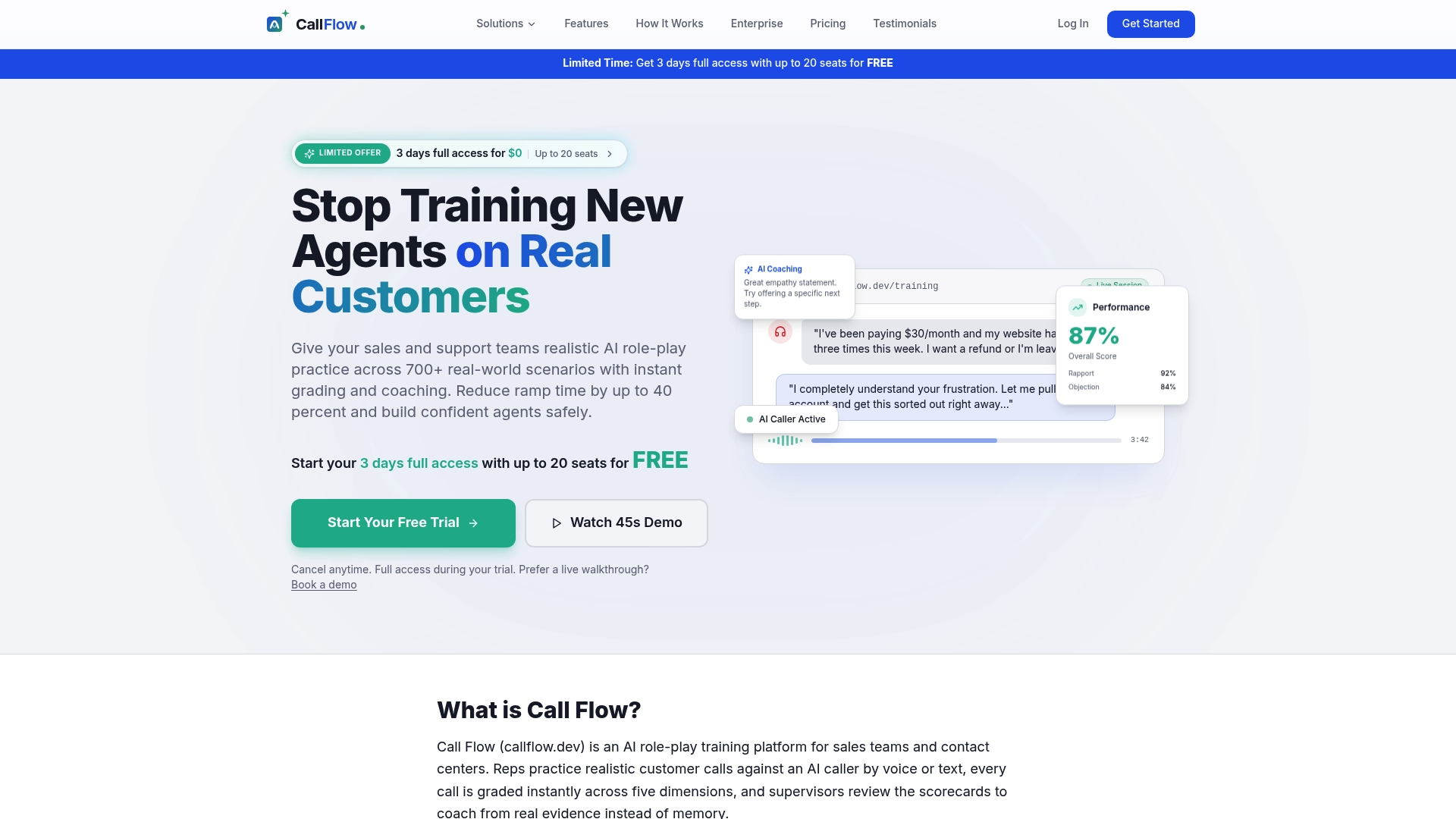
Callflow gives agents realistic practice calls with instant AI grading across five performance dimensions. Each call ends with coaching feedback. Agents can practice by voice or text. Supervisors get dashboards and skill analytics, and can review and override scores. Scoring is calibrated to match your existing QA standards. You can build custom scenarios for your own products and call types.
Our reported results: 147% faster ramp time and 129% improvement in resolution rates. Teams can try every feature during a risk-free trial.
See the plans and prices or start with free mock call practice. For the onboarding use case, read how to cut ramp with AI role play in call center onboarding.
Our view
Most teams budget for the course and miss the wage bill behind it. The cost sits in the weeks when an agent is paid but cannot yet handle the call.
We built Call Flow around that gap. An agent should make the first mistake in a practice call, not with a customer. Feedback should arrive when the call ends, not at the next review.
Scoring matters as much as speed. Our grading is calibrated to match the QA standards you already use. Supervisors can review and override it. Coaching stays consistent, and you can track skill growth in numbers.
Pricing should be easy to read, too. Our plans are flat and published. Training directors can put the number in a budget and compare it with what a week of ramp costs.
Start with one cohort. Measure days to proficiency. Then decide.
Costa
FAQ
How much does it cost to train a call center agent?
The range depends on scope. Hard-dollar onboarding runs about $1,500 to $5,000 per hire. Fully loaded cost for a standard role is $5,000 to $15,000, per WFM Labs. McKinsey's $10,000 to $20,000 includes recruiting and lost productivity. Our call center training budget guide goes through each line.
How long does call center training take?
McKinsey's 2018 survey found the most common nesting period was one to two weeks. Reaching peak proficiency takes about four to six months, per McKinsey's 2025 blog. Initial classroom training is usually shorter than that. Most of the cost sits in the gap between the two.
What percentage of a contact center budget goes to training?
One budget template suggests 3 to 5% for initial onboarding, ongoing upskilling, LMS, nesting and mentorship. Your own share depends on turnover and role complexity. Build it bottom-up with the steps above, then compare.
How do I calculate annual training cost per agent?
Multiply new-hire training cost by your turnover rate. Add ongoing training cost per agent. With $3,000 of onboarding, 40% turnover and $500 of ongoing training, the result is $1,700 per agent position per year.
Does training cost more for sales teams?
The drivers are similar: ramp time, coaching hours and turnover. Our guide to sales training costs covers the sales side.
Sources
- McKinsey: Boosting contact-center performance through employee engagement
- McKinsey: Gen-AI-powered frontline learning in call centers
- WFM Labs: Onboarding Costs
- Contact Center Pipeline: Navigating the Training Maze
- Cinareo: The cost to onboard and train is wage x hours
- HiveDesk: How to Calculate Labor Costs in BPO
- Globalify: Call Center Budget Planning Template
- BPO Insight Hub: BPO Agent Turnover and Service Quality in 2026