

Direct training delivery runs $1,200 to $4,500 per agent, but that number understates reality. Once you add supervisor hours, lost productivity, and ramp time, the loaded cost climbs to $3,200–$7,600. The true fully-loaded figure for a standard support role often lands between $10,000 and $20,000. The biggest driver isn't the training program itself. It's how long agents take to reach full proficiency, since every extra week of slow handle times and low first-call resolution adds hidden cost.
TL;DR:
- Most call center training costs between $10,000 and $20,000 per agent when including supervisor hours, lost productivity, and ramp time.
- Training delivery methods vary, with platform-based solutions like SaaS and AI coaching offering scalable, predictable costs, and instructor-led formats incurring higher expenses.
- The largest hidden cost in training often comes from the productivity drag during ramp-up, particularly the gap in handle time and first-call resolution.
- Reducing time-to-proficiency by about 20% can save thousands of dollars per batch of new agents, making speed to full proficiency the top budget priority.
- Platforms that emphasize high-volume practice and instant feedback can improve ramp speed by over 147%, significantly cutting overall training expenses.
Table of Contents
- How Much Does Call Center Training Cost by Delivery Type?
- What Line Items Belong in Your Training Budget?
- What Do Sample Training Budgets Look Like at Different Complexity Levels?
- How Do You Calculate Per-Agent Training Cost and ROI?
- How Should You Evaluate Call Center Training Programs and Vendors?
- What Does Call Flow's Data Show About Training Cost?
- What Should Training Managers Prioritize Next?
- Where to See Call Flow Pricing and Start a Trial
- Sources
- FAQ
How Much Does Call Center Training Cost by Delivery Type?
The per-agent number changes a lot depending on how you deliver training, and most managers underestimate the spread. Here's what each format typically runs, based on current market pricing.
- Classroom/instructor-led training (ILT): Traditional in-person cohorts run in the range covered by Business, with onsite full-day sessions often priced per cohort rather than per head. Cohorts of 10 to 20 trainees help spread trainer costs, but travel, venue, and materials add up fast if your center isn't centralized.
- E-learning and LMS licensing: Self-paced modules and platform licenses are typically quoted as annual per-seat fees, similar to the course pricing you'd find on marketplaces like Coursera. Divide the license cost by active seats to get a rough per-agent equivalent, and remember that LMS pricing rarely includes content creation.
- Virtual instructor-led training (VILT): Live remote sessions cut travel costs but still carry trainer fees per session. Amortize that fee across the cohort size to get a per-agent number, and expect it to sit below classroom ILT but above pure e-learning.
- SaaS and AI coaching platforms: Seat-based subscriptions, billed monthly or annually, typically include scenario libraries, automated grading, and coaching feedback baked into the price. These models trade a large upfront curriculum spend for a predictable, scalable line item.
- Role-play and simulation practice: Whether delivered live or through software, practice-based training scales differently than lecture-based content. Cost tends to track seat count rather than trainer headcount, which matters once you're training dozens of agents at once.
- Shadowing and nesting: This phase rarely shows up as a line item on any invoice, but it isn't free. It's almost entirely supervisor time, and that time pulls a second experienced agent off the floor for every trainee in the pipeline.
Most call center training budgets combine two or three of these formats. A common pattern is e-learning for onboarding basics, VILT or classroom for role-specific skills, and nesting to close the gap before an agent takes live calls solo.
What Line Items Belong in Your Training Budget?
The visible price tag on a training program is rarely the whole story. Here's what actually gets counted when you calculate the full cost of call center staff training expenses.
- Trainer and facilitator time. This includes delivery hours, prep time, and materials development, amortized across however many cohorts a curriculum gets reused for.
- Trainee wages during training. Every hour a new hire spends in a classroom or on the LMS is a paid hour with zero call output, and that wage cost belongs in your total.
- Supervisor time during shadowing and nesting. This is the line item most managers miss entirely. ScreenSteps notes that hidden supervisor hours during nesting often equal or exceed the direct trainer cost, because you're effectively double-paying for one seat's worth of output.
- Curriculum design and development. Building scenarios, scripts, and assessments is a one-time cost that should be spread across every cohort that uses the material, not charged against a single group of trainees.
- LMS or platform licensing and IT integration. Software fees, single sign-on setup, and any custom integration work with your existing systems add a recurring cost layer beyond the training content itself.
- Assessment, QA calibration, and ongoing coaching. Scoring calls, calibrating quality assurance standards, and providing feedback after go-live all continue well past the formal training period.
- Productivity drag during ramp. New agents handle calls slower and resolve fewer of them on the first try. That gap between a trainee's output and a tenured agent's output is a real cost, even though it never appears as a training invoice.
Pro Tip: Track average handle time and first-call resolution separately for agents in their first 90 days versus tenured agents. The gap between those two numbers, multiplied by call volume, is often the single largest hidden line item in your training budget.
Including productivity drag is what separates a delivery estimate from a true cost. Stealth Agents' benchmark work puts the fully loaded cost of bringing a mid-complexity support agent to full proficiency at $10,000 to $20,000, and technical or regulated roles routinely land higher.
What Do Sample Training Budgets Look Like at Different Complexity Levels?
Numbers mean more when you see them applied. Here's how three common scenarios shake out, using industry benchmark ranges rather than any single vendor's pricing.
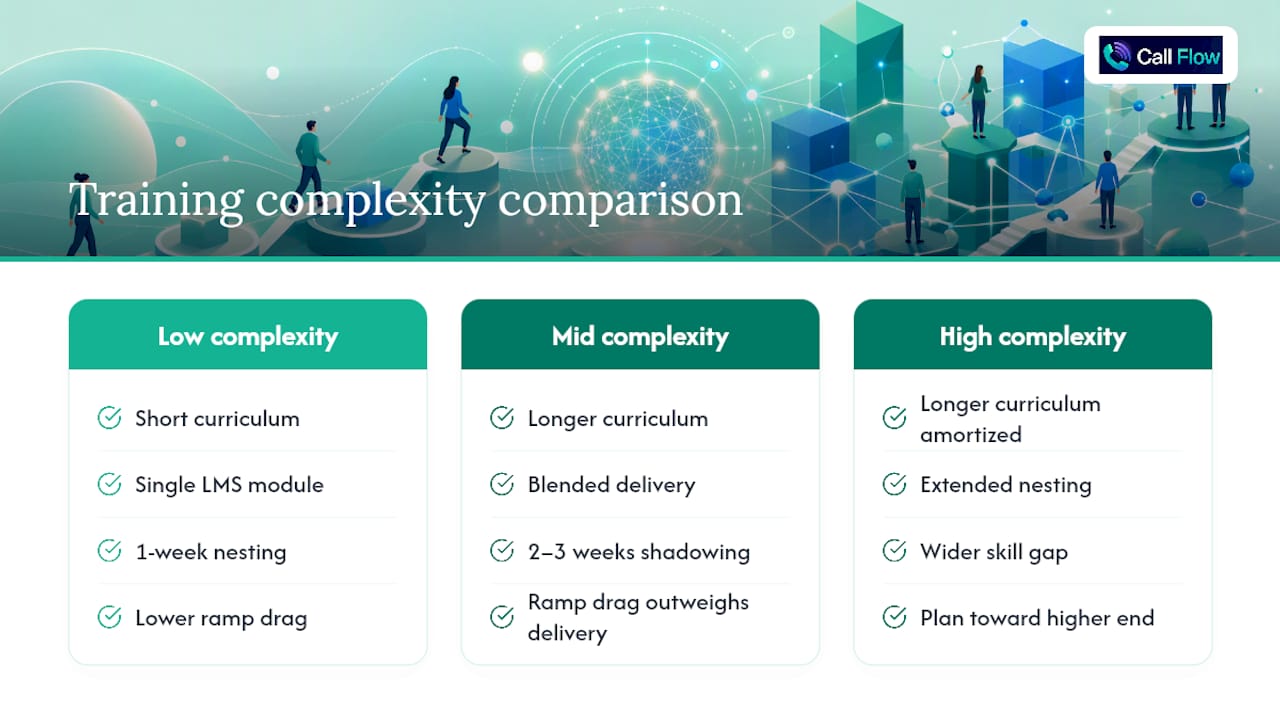
The low-complexity example assumes a short curriculum, a single LMS module, and a one-week nesting period. Add blended delivery, a longer curriculum, and two to three weeks of shadowing, and you're in the mid-complexity range, where ramp drag starts outweighing the delivery cost itself.
The high-complexity scenario reflects what Stealth Agents' analysis describes for technical or regulated roles: longer curriculum amortization, extended nesting, and a wider skill gap between new and tenured agents. If your product line involves compliance requirements or technical troubleshooting, plan your budget toward the higher end of each range rather than the midpoint.
Adjust these numbers against your own wage rates, average handle time, and call volume before locking in a budget. A center with high call volume and thin staffing will feel productivity drag more acutely than a center with slack capacity to absorb slower new agents.
How Do You Calculate Per-Agent Training Cost and ROI?
Building your own model doesn't require anything fancier than a spreadsheet. ScreenSteps' checklist approach works well as a starting structure.
- Collect your inputs. Gather days spent in classroom or LMS training, days in nesting/shadowing, trainee daily wage, trainer daily wage, supervisor daily wage during nesting, and any LMS or software fees.
- Calculate direct training cost. Add trainer time, materials, and platform fees, then divide by the cohort size to get a per-agent delivery cost.
- Add loaded costs. Include trainee wages during non-productive training days and supervisor wages during nesting, since a supervisor pulled off the floor to mentor a trainee is effectively an unbudgeted second salary.
- Apply the productivity drag multiplier. Estimate the average handle time gap and resolution rate gap between new and tenured agents, multiply by call volume during the ramp period, and convert that into a dollar figure using your average revenue or cost per call.
- Calculate ROI on any ramp-reduction investment. ROI equals the dollar savings from a faster ramp divided by the additional training investment required to achieve it.
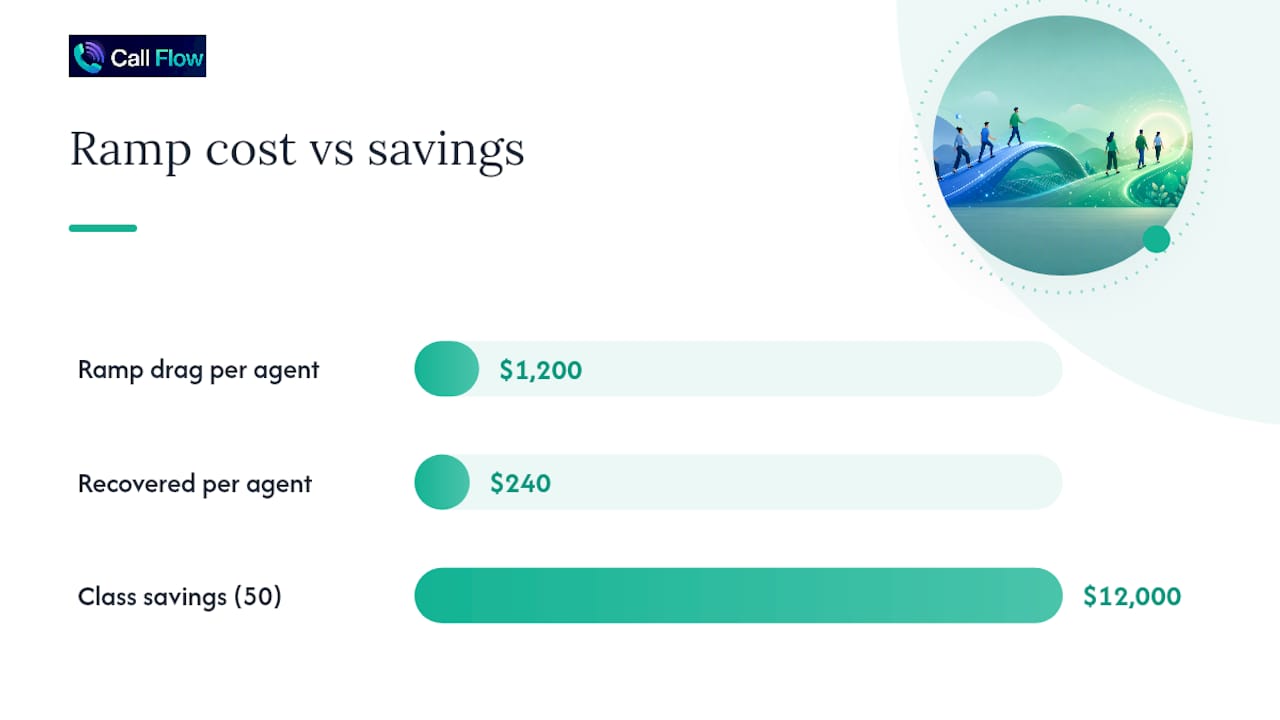
Here's a quick illustration. Say a mid-complexity agent normally takes 8 weeks to reach full proficiency, and during that window handles calls 20% slower than a tenured agent. If that gap costs $150 per week in lost throughput, the 8-week ramp costs $1,200 in productivity drag alone. Shorten the ramp by 20 percent, roughly 1.6 weeks, and you recover about $240 per agent. Multiply that across a hiring class of 50, and a modest ramp reduction saves $12,000, often for less than the cost of one additional software seat.
Tracking time-to-proficiency as a standalone metric makes this calculation far easier to repeat every quarter.
How Should You Evaluate Call Center Training Programs and Vendors?
Price alone tells you almost nothing about whether a training program is worth the money. Judge proposals against outcomes first, cost second.
- Time-to-proficiency. Ask any vendor for expected weeks to full proficiency, not just training duration, since those are rarely the same number.
- First-call resolution and CSAT lift. A program that shortens ramp but doesn't move quality metrics isn't actually cutting cost, it's just moving it downstream.
- QA alignment. Confirm the curriculum's scoring rubric matches your existing quality assurance standards, or you'll spend months reconciling two different definitions of a "good call."
- Pricing transparency. A quote should spell out what's included: content licensing, setup, support, and any per-seat minimums, not just a single bundled number.
- Scalability and content ownership. Ask who owns the scenarios and curriculum if you switch vendors later, and whether pricing holds steady as your headcount grows or shrinks seasonally.
Business on vendor quotes is worth following closely: insist on seat-based total cost of ownership examples that include projected supervisor-hours saved, not just a licensing fee. That's the only way to compare a SaaS platform against instructor-led delivery on equal terms.
Pro Tip: Watch for seat minimums and per-evaluation fees buried in vendor contracts. A platform priced attractively per seat can cost far more than advertised if it charges separately for every graded scenario or requires a minimum of 50 seats to unlock standard features.
A SaaS or AI coaching platform tends to beat instructor-led delivery on ROI specifically when practice volume matters more than lecture content, which is most of the time in a call center.
What Does Call Flow's Data Show About Training Cost?
Callflow's platform data offers a concrete look at what happens when practice volume replaces lecture time. Teams using the platform have seen 147% faster ramp time and 129% improvement in first-call resolution, numbers that directly attack the two cost drivers this guide has spent the most time on: time-to-proficiency and productivity drag.
A 147% improvement in ramp speed doesn't just mean agents get to full productivity faster. It means fewer weeks of supervisor time spent nesting new hires, fewer weeks of below-average handle times dragging on team metrics, and a training budget line that shrinks even as your program scales.
The line items this kind of platform reduces are specific: supervisor hours during nesting, repeated live-call coaching sessions, and QA bandwidth spent grading calls that could have been caught in team task collaboration first. If you want a repeatable model for testing this before a full rollout, running one cohort through additional role-play scenarios against a matched control group gives you a clean comparison on time-to-proficiency and FCR.
What Should Training Managers Prioritize Next?
If you take one thing from this guide into your next budget cycle, make it this: fund whatever shortens time-to-proficiency first, before you touch curriculum rewrites or new LMS contracts. That single metric drives more of your loaded training cost than any line item on an invoice.
Pilot scalable practice, like role-play or simulation tools, on one cohort before committing budget to a full rollout. Then track three numbers quarter over quarter: time-to-proficiency, first-call resolution, and training cost per agent. Everything else in a training budget is negotiable. Those three numbers tell you whether the money is working.
— Costa
Where to See Call Flow Pricing and Start a Trial
Callflow is the alternative to open-ended instructor-led budgets: instead of paying trainer day rates and pulling supervisors off the floor for weeks of nesting, you get a flat-rate seat subscription that puts unlimited AI role-play practice directly in front of agents, with instant grading across five performance dimensions replacing hours of manual QA review.
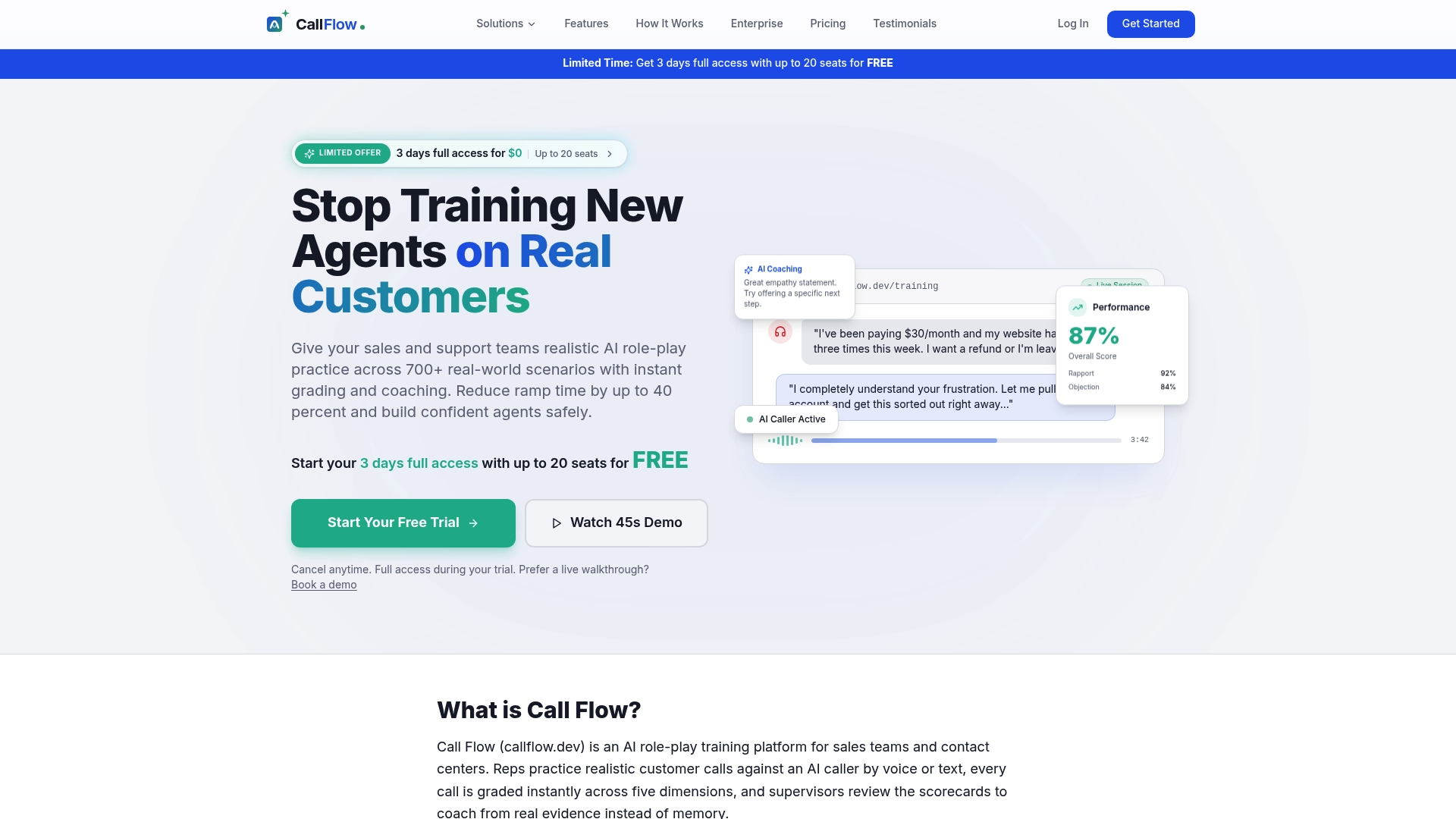
That shift matters most in the line items this guide flagged as hardest to control: supervisor time, repeated coaching sessions, and QA bandwidth. Callflow's plans start at $7.42 per month for Starter, scaling up through Growth and Scale tiers, with Business and Enterprise options available for larger deployments that need custom terms. Every tier includes full-feature access during a risk-free trial, so you can pilot one cohort against your current nesting process before committing budget. Check current pricing and start a trial at Callflow.
Sources
The figures in this guide draw on published industry benchmarking rather than a single source.
- Support Agent Training Cost: $1,200-$7,500 | Stealth Agents
- The True Cost of Training a New Agent in the Call Center | ScreenSteps
- Business
FAQ
How long does call center agent training usually take?
Formal instruction typically runs 3 to 6 weeks, followed by 2 to 4 weeks of nesting or shadowing before an agent handles calls independently. Full proficiency, meaning handle times and resolution rates that match tenured staff, usually takes longer than the formal training period itself.
Are call centers still profitable given rising training costs?
Yes, call centers remain profitable, and training investment is one of the strongest levers for protecting that margin rather than eroding it. Centers that shorten time-to-proficiency recover training costs faster through improved first-call resolution and lower turnover, and customers pay a premium for better service experiences, which ties training quality directly to revenue.
Are customer service training courses worth the cost?
They're worth it when the curriculum ties directly to measurable outcomes like first-call resolution and time-to-proficiency, not just completion rates. A course that shortens ramp by even a few weeks typically pays for itself through reduced productivity drag, as outlined in the ScreenSteps cost model.
What is the best training program for call center agents?
The best program combines structured curriculum with high-volume practice, since lecture-based content alone rarely closes the gap between new and tenured agent performance. Platforms like Callflow that pair scenario practice with instant grading have shown 147% faster ramp time and 129% FCR improvement, making practice volume a measurable lever rather than a guess.
How much does call center training cost per agent on average?
Direct delivery costs typically run $1,200 to $4,500 per agent, while the fully loaded cost, including supervisor time and productivity drag, commonly reaches $10,000 to $20,000 for standard support roles. The exact number depends heavily on role complexity and how long agents take to reach full proficiency.