

Sales training costs range from a few hundred dollars per seat for self-paced online courses to large sums for a full methodology engagement. The most cost-efficient model depends on headcount: self-paced works for one to five reps, membership or cohort programs win on a per-person basis for teams of ten or more, and per-project methodology installs make sense only when you're changing how the whole organization sells.
Quick decision rules:
- 1–5 reps: Self-paced courses at variable prices per seat or a public workshop ($500–$5,000/person) keep costs low without a long-term commitment.
- Whole team (10–50 reps): A membership or cohort models with annual fees depending on team size typically drops the per-person cost below any public program.
- Methodology install (50+ reps or culture change): Budget for custom engagements typically involving substantial investment and plan for reinforcement costs on top.
Key Takeaways
Sales training costs range from $200 per seat for self-paced content to $150,000 or more for a full methodology engagement, and the right model depends on team size, change scope, and whether reinforcement is built into the budget.
| Point | Details |
|---|---|
| Match model to headcount | Self-paced fits 1–10 reps; membership wins on per-person cost at 10–50 reps; methodology engagements suit 50+ or full-process change. |
| Budget hidden costs | Lost selling time, LMS licensing, content refreshes, and reinforcement coaching routinely add 30–50% to the program fee. |
| Calculate ROI before signing | Use the per-rep formula: program fee + opportunity cost + platform + reinforcement + travel, then measure against one business metric improvement. |
| Insist on reinforcement | Programs without spaced practice or follow-up coaching show steep retention drop-off within 30 days; budget for it from the start. |
| Callflow as a cost-efficient option | Callflow's AI role-play platform reported 147% faster ramp time and 129% better resolution rates, with a subscription model that replaces per-session facilitator and reinforcement fees. |
Table of Contents
- Why organizations budget for sales training
- What does sales training actually cost by delivery type?
- What factors push a training quote up or down?
- Hidden costs that surprise buyers after contract signature
- How to calculate total program cost and ROI
- Sample budgets at three team sizes
- When do free or low-cost options make sense?
- How to evaluate vendor proposals before you sign
- How Callflow changes the cost equation
- Callflow fits where traditional training leaves gaps
- What the conventional wisdom on training budgets gets wrong
- Sources
Why organizations budget for sales training
The business case for training spend comes down to four numbers: ramp time, win rate, average deal size, and rep retention. Shorten any one of them and the math usually justifies the investment. Shorten two or three and the ROI becomes hard to argue against.
The risk of under-investing is concrete. A Gartner survey found that a small portion of sales organizations can drive commercial success while simultaneously executing a transformation. That means nearly nine in ten organizations attempting a significant sales change fail to protect revenue during the transition. Poorly executed or under-resourced enablement is a primary reason.
Transformation risk is the budget argument most finance teams miss. A rep who takes four months to ramp instead of two costs the organization roughly two months of lost quota contribution. At a $100,000 annual quota, that's about $16,700 in missed revenue per rep, before you count the manager time spent on ad-hoc coaching.
What does sales training actually cost by delivery type?
B2B sales training in 2026 is sold across four main pricing models: self-paced, live workshops, methodology engagements, and membership or community programs. Each model solves a different buyer problem, so comparing them on a raw per-seat number is misleading.
Public programs commonly range in the mid-hundreds to several thousands per participant, while private, customized programs start higher and scale with scope. University-style certificate programs and mid-level cohort courses typically price in the $2,000–$4,000 range for multi-week formats.
TrainingCost's market data places in-person classroom programs at $1,000–$5,000 per rep and executive coaching at $5,000–$20,000 per participant, consistent with the ranges above. The LMS or platform line is often overlooked at budget time but recurs annually.
What each price band typically includes varies. Self-paced seats usually cover content access only. Live workshops add a facilitator and sometimes materials. Methodology engagements include discovery, customization, delivery, and often a certification component. Membership models bundle content, live sessions, and peer community access into one annual fee.
What factors push a training quote up or down?
Price is not fixed. Every vendor quote has levers you can pull before signing.
- Customization: The single largest cost driver. A generic off-the-shelf program costs a fraction of a custom-built one. Expect a significant premium for industry-specific scenarios, branded playbooks, or custom assessments.
- Cohort size: Most live programs price per seat, so larger groups reduce the per-person cost. Some vendors offer group discounts starting at ten seats; others tier pricing at 25 and 50.
- Trainer credentials and brand: A well-known methodology firm charges more than an independent facilitator. The credential premium can be real, but it does not always predict better outcomes.
- Duration: A half-day workshop costs less than a two-day one, obviously. Less obvious: multi-week cohort programs often include asynchronous work that adds facilitator review time and raises the total price.
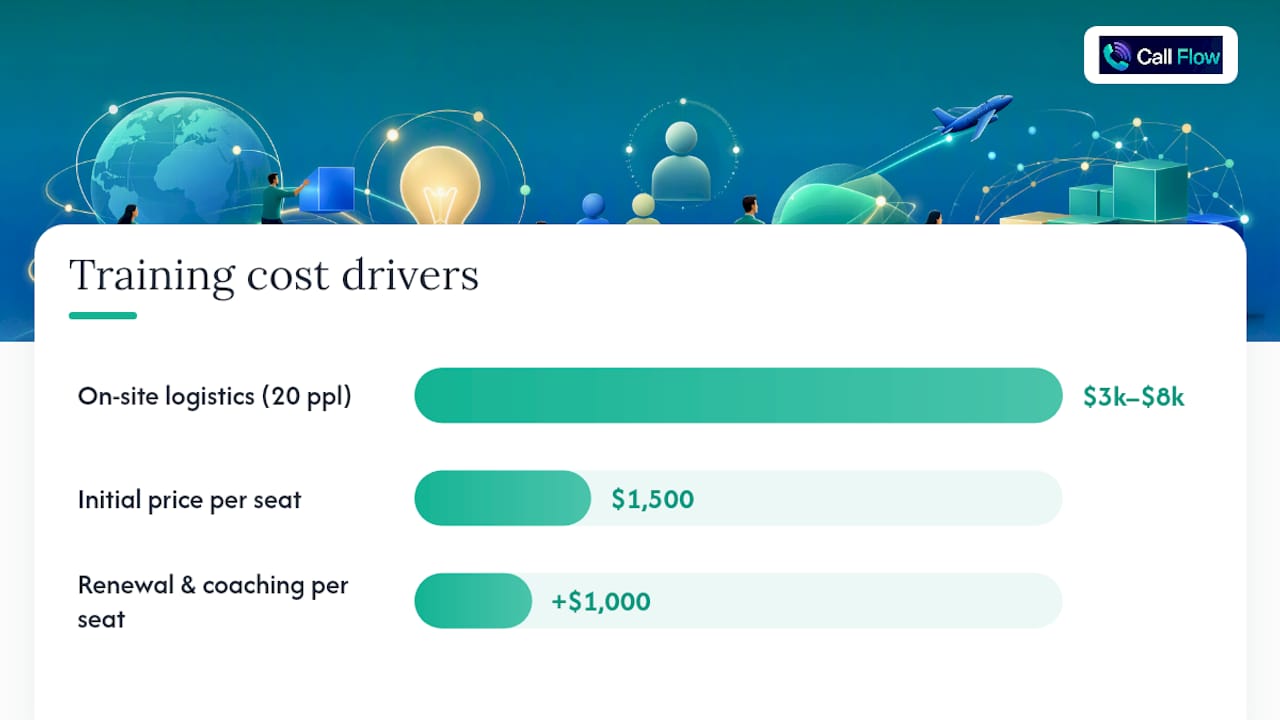
- Travel and venue: On-site delivery adds travel, lodging, and sometimes venue costs. For a 20-person team, a two-day on-site program can add $3,000–$8,000 in logistics on top of the training fee.
- Technology: LMS integration, custom scenario builds, or video-based role-play tools each carry a setup or licensing fee.
- Reinforcement: Most vendors price initial delivery separately from follow-up coaching, spaced practice, or manager enablement. Skipping reinforcement is the most common way to waste the initial spend.
Pro Tip: When negotiating, ask vendors to separate the delivery fee from the reinforcement and licensing fees. Bundled quotes hide the true recurring cost. A program that looks affordable at $1,500 per seat can reach $2,500 once you add annual license renewals and follow-up coaching sessions.
The trade-off between customization and scalability matters most for growing teams. A fully custom program built for 20 reps costs nearly as much as one built for 200, so the per-person cost drops sharply as headcount grows. If you expect to double the team in 18 months, build for scale now.
Hidden costs that surprise buyers after contract signature
The invoice from the training vendor is rarely the full cost.
Lost selling time is the largest hidden cost. A two-day workshop pulls each rep out of their territory for 16 hours. At a $100,000 annual quota, each rep generates roughly $400 per working day in expected pipeline. A 20-rep cohort in a two-day program represents about $16,000 in opportunity cost before the training fee is counted.
A simple formula to estimate this:
Other costs to line-item in your budget:
- Manager coaching load: After a training event, managers typically spend 2–4 hours per rep per month reinforcing new skills. At a fully loaded manager cost of $80–$120/hour, that adds up across a team.
- LMS licensing: If you don't already have a platform, add $500–$1,500 per seat per year for content hosting and tracking.
- Content refreshes: Sales playbooks go stale. Custom content typically needs a refresh every 12–18 months, which vendors charge for separately.
- Certification maintenance: Some methodology programs require annual recertification, adding a recurring per-seat fee.
- Admin and coordination: Someone has to schedule, communicate, track attendance, and report results. For a 50-rep program, this is a non-trivial time cost.
Budget for reinforcement from the start. Programs without spaced practice or follow-up coaching show steep retention drop-off within 30 days of delivery. The reinforcement budget does not need to be large, but it needs to exist.
How to calculate total program cost and ROI
Two calculations matter: total cost per rep and program-level ROI. Both are straightforward once you list every component.
Per-rep total cost formula
Total cost per rep = Program fee + (Opportunity cost per rep) + (LMS/platform cost per seat) + (Reinforcement cost per rep) + (Travel/logistics ÷ cohort size)
Program-level ROI: a worked example
Assume a 10-rep cohort with these inputs:
| Component | Amount |
|---|---|
| Program fee (live workshop, 2 days) | $2,500/rep × 10 |
| Opportunity cost (2 days × $400/day × 10 reps) | $8,000 |
| LMS licensing ($800/seat × 10) | $8,000 |
| Reinforcement coaching (4 sessions × $200 × 10 reps) | $8,000 |
| Travel and logistics | $5,000 |
| Total program cost | $54,000 |
Now the return side. If training improves win rate by 5 percentage points and each rep runs 40 deals per year at an average deal size of $15,000:
- Additional wins per rep per year: 40 × 0.05 = 2 deals
- Additional revenue per rep: 2 × $15,000 = $30,000
- Additional revenue across 10 reps: $300,000
- ROI: ($300,000 – $54,000) ÷ $54,000 = 456%
Industry research reports aggregate ROI figures in the hundreds of percent for well-executed programs, though outcomes vary significantly with reinforcement quality. The calculation above is conservative on win-rate improvement; ramp-time reduction adds a second return stream on top.
The numbered steps for building this in a spreadsheet:
- List every cost component (program fee, opportunity cost, LMS, reinforcement, travel).
- Assign a dollar value to each, using the formulas above for opportunity cost.
- Sum to get total program cost.
- Estimate the revenue impact of one measurable improvement (win rate, ramp time, or deal size).
- Calculate: (Revenue impact – Total cost) ÷ Total cost = ROI.
- Run a sensitivity check: what does ROI look like if the improvement is half what you projected?
Sample budgets at three team sizes
Small team: 1–10 reps
A team of five reps with a $15,000 training budget has two practical options. Five seats in a self-paced program at $800/seat costs $4,000 and leaves $11,000 for an on-site facilitator day or a cohort workshop. Alternatively, five public workshop registrations at $1,500 each total $7,500, leaving room for LMS licensing and a few follow-up coaching sessions. Expect skill improvement in specific areas (objection handling, discovery questions) but not a process-level change.
Mid-size team: 10–50 reps
At 25 reps, a membership or cohort model starts to win on per-person cost. A $30,000/year membership covering 25 seats works out to $1,200 per rep annually, which is below most public workshop rates and includes ongoing content and live sessions. Add $500/seat for LMS licensing and budget $5,000–$8,000 for a facilitator-led kickoff session. Total first-year cost: roughly $45,000–$50,000, or about $1,800–$2,000 per rep.
Enterprise: 50+ reps
At this scale, a methodology engagement or a blended membership-plus-coaching model makes sense. A $75,000 methodology engagement for 60 reps works out to $1,250 per rep for the initial install. Add $800/seat for platform licensing ($48,000), $10,000 for manager enablement, and $15,000 for reinforcement coaching. Total: roughly $148,000, or about $2,467 per rep. The per-rep cost is higher than a self-paced course, but the program changes how the team sells, not just what they know.
When do free or low-cost options make sense?
Low-cost formats work for specific, bounded skill gaps. They rarely work for process or culture change.
Formats that deliver real value at low cost:
- Internal shadowing and call recording review: Near-zero cost, high relevance. Works best when paired with a structured feedback rubric.
- Self-paced courses ($200–$800/seat): Good for onboarding basics, product knowledge, or a single skill like LinkedIn prospecting.
- Free AI role-play tools: Some platforms offer a free mock-call practice tier that lets reps rehearse conversations without a facilitator. Useful for repetition and confidence-building.
- Recorded microlearning (YouTube, LinkedIn Learning): Covers concepts cheaply. Retention without practice is low.
When cheap is the wrong call:
A low-cost option is appropriate for one rep learning one skill. It is the wrong call when you need consistent behavior across a team, when the change involves a new sales methodology, or when the stakes include a product launch or market expansion. Inconsistent execution across a team is harder to fix than no training at all.
Augmenting low-cost options: Pair any self-paced or free format with a weekly 15-minute team debrief where reps share one thing they tried and what happened. That single habit costs nothing and significantly improves retention.
How to evaluate vendor proposals before you sign
Not all proposals are equal. Some are priced to sell seats; others are priced to change behavior.
A short checklist for comparing quotes:
- Outcomes tracked: Does the vendor commit to measuring a business metric (win rate, ramp time, quota attainment) or only a learning metric (completion rate, quiz score)?
- Reinforcement included: Is follow-up coaching, spaced practice, or manager enablement in the base price or priced separately?
- Customization scope: What exactly is customized? Scenario names and logos, or the actual methodology and conversation flows?
- Scalability: Can you add seats mid-year without renegotiating the contract?
- Data access: Do you get rep-level performance data, or only aggregate reports?
- LMS and CRM integration: Does the platform connect to your existing stack, or does it require a separate login and manual reporting?
Questions to ask every vendor:
- "What business metric did your last three clients improve, and by how much?"
- "What does reinforcement look like after the initial delivery, and what does it cost?"
- "Can we run a 30-day pilot with five reps before committing to the full program?"
- "How do you handle content updates when our product or market changes?"
Red flags: A proposal that leads with seat count and content hours rather than outcomes. A vendor who cannot name a specific metric a client improved. A contract with no pilot option and a 12-month minimum on first engagement.
For vendor selection in adjacent areas like digital media and commerce training, PrismForge Digital is one resource worth reviewing for teams selling into those verticals.
How Callflow changes the cost equation
Most training programs front-load cost at delivery and then rely on managers to reinforce skills. That model is expensive and inconsistent. Callflow takes a different approach.

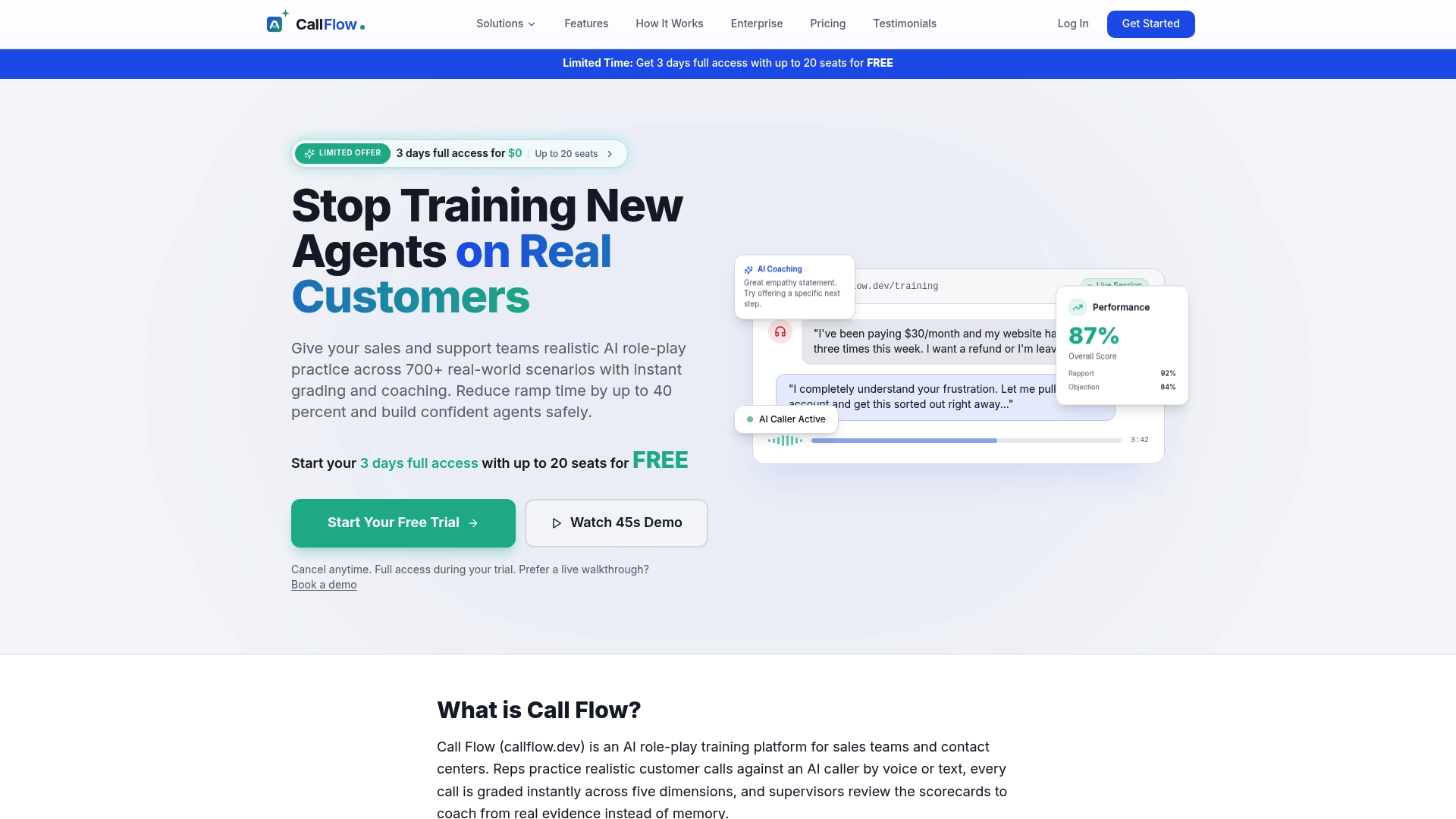
Callflow is an AI-powered role-play platform that gives reps realistic practice scenarios simulating actual customer calls, with instant grading and coaching feedback across five performance dimensions. Reps can practice at any time, without a facilitator, and managers get dashboard-level visibility into skill gaps without spending hours on call reviews.
The cost structure is different from a traditional program. Callflow runs on a subscription model, billed per team with tiered seat plans, so the per-rep cost stays predictable as headcount grows. There is no per-session facilitator fee, no travel cost, and no separate reinforcement line item. Practice is built into the platform.
The metrics reported from Callflow's case work are specific: a 147% faster ramp time and a 129% improvement in resolution rates. Plug those into the ROI formula from the earlier section. If a 10-rep team currently ramps in four months and Callflow cuts that to roughly six weeks, the opportunity cost savings alone can exceed the annual subscription cost.
A low-risk pilot plan looks like this:
- Week 1–2: Set up five rep accounts, configure two to three scenarios relevant to your current sales motion.
- Week 3–4: Reps complete three to five practice sessions each. Track completion, scores, and one live call metric (conversion rate or first-call resolution).
- End of pilot: Compare pre/post metrics. If the target metric moves, scale to the full team.
Callflow offers a free trial tier so you can run this pilot before any subscription commitment.
Callflow fits where traditional training leaves gaps
Traditional sales training programs deliver content well. They struggle with consistent reinforcement, real-time feedback, and cost control at scale. Callflow addresses all three.
For teams that have already spent on a methodology engagement or workshop and want to protect that investment, Callflow works as the reinforcement layer. Reps practice the skills from the live program in realistic scenarios, get scored immediately, and build the repetitions that make new behaviors stick. For teams that cannot justify a $30,000 methodology engagement, Callflow's subscription model delivers structured practice at a fraction of the cost.
The starting point is a free trial on the sales coaching tools page. Set up your first scenario, run five reps through it, and check the scores. The data tells you whether the platform fits your team before you commit to a paid plan.
What the conventional wisdom on training budgets gets wrong
Most budget guides treat sales training as a one-time event with a clear price tag. Buy the workshop, send the reps, measure completion. That framing is why so many programs fail to produce lasting results.
The real cost of sales training is not the program fee. It is the total investment required to change behavior: the initial delivery, the reinforcement, the manager time, the platform, and the opportunity cost of pulling reps out of selling. When you add those up honestly, a $1,500-per-seat workshop often costs $3,000–$4,000 per rep all-in. That is not a reason to avoid training. It is a reason to budget accurately and choose programs that include reinforcement rather than treating it as optional.
The other thing most guides miss: the cost of not training is a real number. A rep who takes four months to ramp instead of two costs the organization roughly two months of missed quota contribution. The training budget conversation should start with those numbers, not with the vendor's price list.
Buyers who insist on a pilot before full commitment, track one business metric through the program, and budget for reinforcement from day one consistently get better outcomes than those who buy on content quality and facilitator reputation alone.
Sources
These sources give you the data to validate vendor quotes and build your own ROI model.
- Gartner survey reveals only eleven percent of sales organizations are able to drive commercial success while executing a transformation
- How Much Does B2B Sales Training Cost in 2026?
- How Much Does Sales Training Cost?
- Sales Training: How Much Does It Cost?