

A good sales certification proves that a rep can do the job on a live call. It does not prove that the rep finished a course. To design one, pick 5 to 8 observable competencies. Write a scoring rubric. Assess reps in realistic scenarios. Set the pass mark before anyone is tested. Calibrate your graders. Give a clear path to retake. Role play with instant scoring is the practical way to run those assessments at scale, and it is what we built Callflow to do.
This guide is for sales managers, contact center leaders, training directors and HR teams. You will get a design you can start this quarter, with the traps at each step.
TL;DR
- A certification is a pass or fail decision based on observed behavior. A course certificate only shows attendance.
- Start with 5 to 8 competencies, a rubric with 3 or 4 levels, and a pass mark fixed in advance.
- Test in live scenarios, not multiple choice. Calibrate graders so two people give the same call the same score.
- Plan retakes, a development plan for those who fail, and yearly recertification.
- Measure the program against ramp time, first-call resolution, customer satisfaction and turnover, with a baseline taken first.
Table of Contents
- What a sales certification is, and what it is not
- Why design your own
- Step 1: Define the competencies
- Step 2: Set the standard from real calls
- Step 3: Choose how you assess
- Step 4: Fix the pass mark before testing
- Step 5: Calibrate the graders
- Step 6: Plan for failing, retaking and renewal
- Step 7: Measure whether it works
- A 90-day launch plan
- How Callflow fits the design
- Our view on certification design
- FAQ
- Sources
What a sales certification is, and what it is not
People search "sales certification" and find two different things. The first is an outside credential a rep earns on their own. The second is an internal program a company runs to confirm its own people meet its own standard. This article is about the second.
Outside credentials usually come as a package. According to Salesforce's guide to sales certifications, most have three parts: a prep course, an exam and the certification itself. The same guide puts the cost of a course-and-certification combination at $400 to $3,000.
Forrester's 2023 report treats credentials as a spectrum. They range from badges to formal certifications and licenses. It describes them as a crucial part of a complete sales learning and development program.
Here is the difference in plain terms:
| Course certificate | Certification | |
|---|---|---|
| What it proves | The person attended or finished | The person showed a skill against a standard |
| How it is earned | Watch, read, quiz | Perform in scenarios, get scored |
| Pass mark | Often low or open | Fixed in advance |
| Expires | Rarely | Yes, renewed on a schedule |
| Value to a manager | Low | High, if the standard is real |
An outside credential tells you a rep knows general sales method. It cannot tell you whether they handle your product, your buyers and your call types well. That gap is why teams build their own.
Why design your own
External programs are priced and paced for individuals. The NASP Certified Professional Sales Person is listed at $795 over six weeks online, and the leader version at $895. SMEI lists a $150 exam registration fee for its Certified Professional Salesperson and Certified Sales Executive programs. The Certified Sales Management Professional runs about 20 hours of learning, with a fee of $950 for non-members.
Those are fair prices for what they teach. But none of them knows your pricing objections, your compliance script or your escalation path. An internal certification does.
McKinsey described a program where people did tailored work on specific customer accounts, role plays over three days and activities with real clients before they were certified. In one example, sales executives had to certify to qualify for incentive pay. The point was skill and on-the-job practice, not finishing a course.
That is the model to copy: certify what people do, in your context.
Step 1: Define the competencies
Start with a short list. A first version should hold 5 to 8 observable competencies. Observable means a grader can see it or hear it on a call. "Good attitude" is not observable. "Asks three open questions before presenting" is.
Typical sales examples are:
- Discovery and qualification
- Product demonstration tied to a business outcome
- Multi-threading and champion development
- Objection and pricing negotiation
- Mutual action plan construction
- Forecast hygiene and CRM discipline
Some of these depend on other tools and habits. For example, a mutual action plan is easier to keep alive when buyers have one shared page, as shown in these digital sales room use cases. Outreach discipline is a skill too, and these five sales sequence cadences show what a repeatable pattern looks like.
For contact centers, the list changes. JustCall describes five skill areas for agent training: product and process knowledge, soft skills such as active listening, empathy and de-escalation, system fluency, compliance and judgment under pressure. It puts time to full productivity at 8 to 12 weeks, depending on call complexity. Compliance items there include TCPA, DNC, PCI and HIPAA where they apply.
Where it goes wrong: too many competencies. Fifteen items cannot be graded consistently, and reps cannot practice them all. Cut the list until each item has a clear behavior behind it.
If you need a fuller framework, our guide to the sales competency model covers how to build, assess and scale one.
Step 2: Set the standard from real calls
Do not invent the standard in a meeting room. Pull recorded calls and listen. The suggested method is to take 15 to 25 recorded calls from your top quartile and the same number from your bottom quartile. Then write down what the top group does that the bottom group does not.
Those differences become the rubric. Use 3 or 4 behavioral levels per competency. For discovery, for example:
- Not yet: pitches within the first minute, asks closed questions only.
- Developing: asks some open questions but does not follow up on answers.
- Proficient: uncovers the problem, confirms it back, and ties the next step to it.
- Advanced: also surfaces the cost of doing nothing and involves a second stakeholder.
Each level describes what a grader would hear. No adjectives like "strong" or "weak" without a behavior behind them.
If you have no recorded calls in a usable state, a 30 day skill gap analysis from CRM calls is a way to find your gaps first.
Where it goes wrong: copying a standard from a book. A rubric that does not match how your best people sell will be ignored by those people.
Step 3: Choose how you assess
Multiple choice tests recall. A certification must test performance. Use live scenario demonstrations: the rep takes a realistic call and is scored against the rubric.
Good scenarios share four features:
- A realistic buyer or customer with a clear goal and a hidden objection
- A time limit close to a real call
- A scenario tied to one or two competencies, so scores mean something
- Several scenarios per rep, so one bad day does not decide the result
For service teams, the same logic holds. Our set of customer service role play scenarios gives trainers copy-ready situations such as refund disputes and angry callers.
A second layer is optional and useful for senior roles. After scenario passes, ask for evidence from live work: a mutual action plan from a real deal, or a reviewed call from a real queue. This follows the McKinsey pattern of activity with actual clients, and it keeps the certificate tied to results.
Where it goes wrong: scoring by gut. Without a rubric, a grader rewards the rep they like.
Step 4: Fix the pass mark before testing
Decide the threshold in advance. Write it down. A typical rule is a minimum level on each competency, plus an overall score. Do not allow a high score in one area to cover a failure in a critical one. A rep who skips a required compliance disclosure should fail regardless of charm.
Two cautions:
- Never move the mark after seeing results. If most reps fail, the fix is training or a better rubric, not a lower bar.
- Separate must-pass items from scored items. Compliance and disclosure steps are pass or fail. Skills like rapport are scored on levels.
Step 5: Calibrate the graders
A rubric is only as good as the people using it. Have your graders score the same 3 to 5 recorded assessments separately, then compare. Where scores differ by more than one level, discuss the behavior until you agree what it looks like.
Repeat this whenever you add graders or change the rubric. Without it, two managers give the same call different scores and reps notice fast. Trust in the program drops with it.
Step 6: Plan for failing, retaking and renewal
Some reps will fail. Decide what happens next before the first test.
- Give a targeted development plan tied to the failed competency, not a repeat of the whole program.
- Allow a retake after a set period of practice.
- Set recertification on a yearly schedule, as the suggested design does, so skills do not fade and new products or scripts get covered.
Your coaching framework is the bridge here. A failed assessment should lead straight into coaching on that gap, with a date to try again.
Step 7: Measure whether it works
A certification costs time. You need to show it pays back. Take baselines before launch, then track the same measures after.
| Measure | What it shows | Who cares |
|---|---|---|
| Days to first quota or full productivity | Ramp time | Sales managers |
| First-call resolution | Skill on service calls | Contact center leaders |
| Customer satisfaction score | Customer experience | Contact center leaders |
| Certified vs. not yet certified performance | Whether the standard predicts results | Training directors |
| Voluntary turnover in the first year | Whether prepared reps stay | HR |
Three habits keep the numbers honest:
- Compare like with like. Compare certified reps with similar reps by tenure and role, not with veterans.
- Check the standard against outcomes. If certified reps do not outperform, the rubric is measuring the wrong behaviors. Revise it.
- Review on a schedule. Look at the numbers monthly in the first quarter and quarterly after that.
For a one-week baseline, see how to pilot sales call simulation and get baseline scores. If your industry needs records for auditors, the compliance pilot guide covers audit-ready records over 4 to 6 weeks.
A 90-day launch plan
| Weeks | Work |
|---|---|
| 1 to 2 | Pull calls from top and bottom performers. Draft 5 to 8 competencies. |
| 3 to 4 | Write the rubric. Build scenarios. Set the pass mark. |
| 5 to 6 | Calibrate graders on recorded samples. Run a pilot group. |
| 7 to 10 | Fix the rubric from pilot results. Open practice to the full team. |
| 11 to 12 | Run the first formal assessments. Start development plans. |
Keep the first cohort small. Fix problems with ten people, not a hundred.
How Callflow fits the design
Most of the work above is assessment: running scenarios, grading them, and keeping scores consistent. That is where programs stall. Managers have no time to grade dozens of calls per rep.

Callflow is an AI role-play platform for sales teams and contact centers. Reps practice realistic customer calls in voice or text mode. Each call gets instant AI grading across five performance dimensions, with coaching feedback. Our scoring is calibration-aligned, so it matches the QA standards you already use. Supervisors can review and override scores in the same workflow, which keeps a human decision behind every certification. You can build your own scenarios, so the test matches your products and call types. Supervisor dashboards and skill analytics show who is ready and who needs practice.
Plans are billed monthly or annually. Starter is $7.42 per month or $89 per year, Growth is $14.92 per month or $179 per year, and Scale is $33.25 per month or $399 per year. See the pricing page for what each tier includes. Business and Enterprise plans have no published price, and you can ask about them on the enterprise page. Every plan starts with a free, full-feature trial.
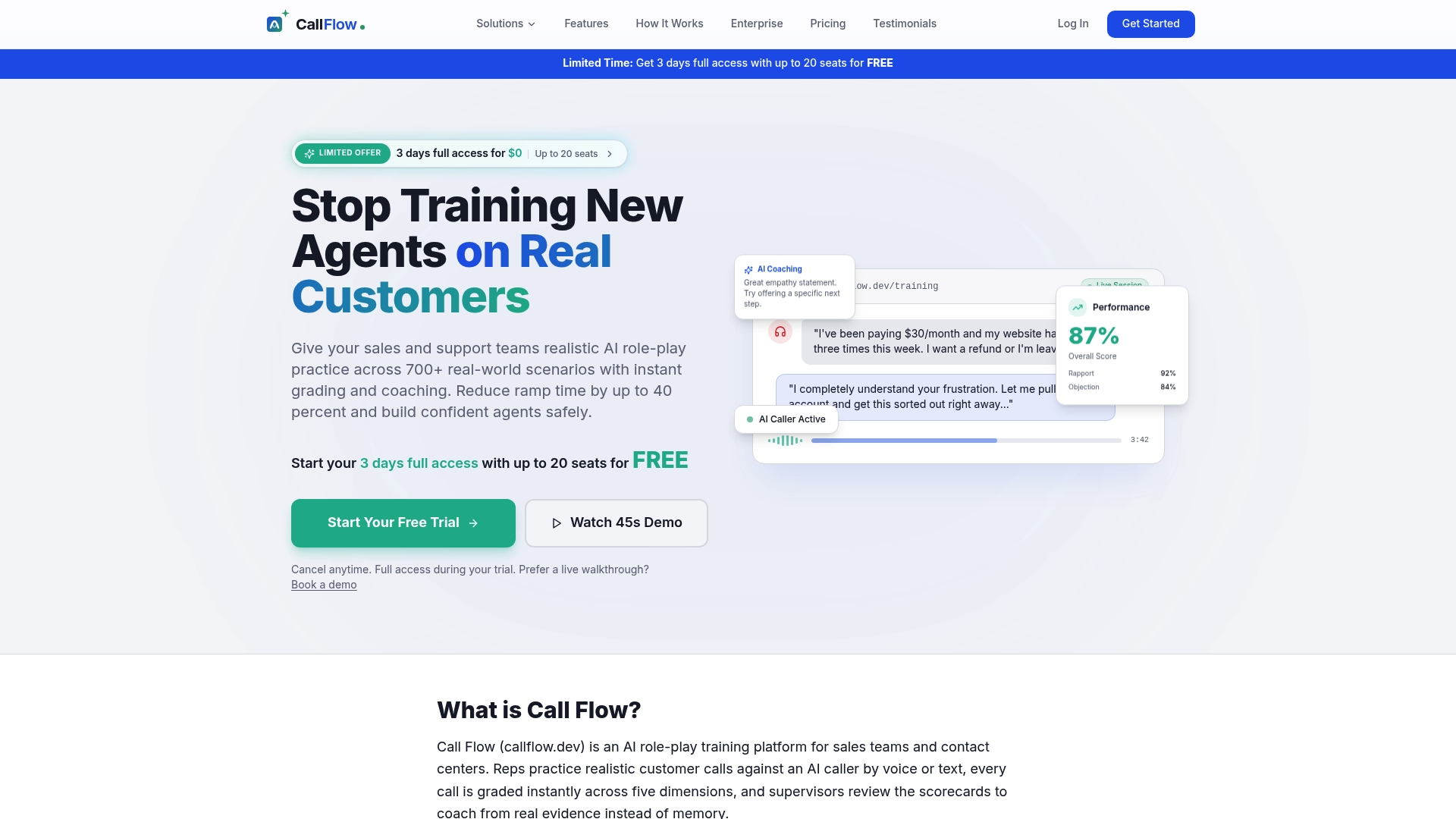
You can set up a pilot by yourself, with no sales call needed. Start with one competency and one scenario, then add more as your rubric settles. Our guide on AI sales training for managers shows how practice, coaching and measurement fit together.
Our view on certification design
Most certifications fail for one reason. They test what a rep knows, not what a rep does. A rep can pass a quiz and still lose the call.
We built Callflow around the idea that practice should look like the job. Reps run through realistic calls and get a score right away. The feedback comes while the call is fresh, which is when it changes behavior.
We also think the rubric matters more than the tool. Our scoring is aligned to the QA standards a team already uses, so a certification built on it reflects your own bar. Supervisors keep the final say through review and override.
Our results point the same way. Teams using the platform report ramp time that is 147% faster and a 129% improvement in resolution rates. Start small, certify one skill, and let the data show you where to go next.
Costa
FAQ
Is there any certification for sales?
Yes. Several bodies offer outside credentials, such as NASP and SMEI, and many software vendors offer product certifications. Costs run from free to a few thousand dollars. For your own team, an internal certification built on your standard shows whether reps can handle your calls.
How is a sales certification different from a course certificate?
A course certificate shows someone finished training. A certification shows they met a standard in an assessment, usually with a fixed pass mark and a renewal date. Managers should trust the second, because it is based on observed performance.
How many competencies should a certification cover?
Five to 8 for a first version. Each should be something a grader can observe on a call. A shorter list is easier to score, easier to practice and easier to improve later.
How often should reps recertify?
Once a year is a common starting point. Recertify sooner when you change products, pricing, scripts or compliance rules. A short scenario check is enough for most renewals.
How do I know the program is working?
Take baselines for ramp time, first-call resolution, satisfaction and early turnover before launch. Compare certified reps with similar reps, and review the numbers monthly at first. If certified reps do not do better, revise the rubric.
Sources
- What Are Sales Certifications? | Salesforce
- Do Sales Credentials And Certifications Matter? | Forrester
- Sales Certifications: Costs & Career Fit | Revenue.io
- Professional Sales & Marketing Certification | SMEI
- Certified Sales Management Professional (CSMP)
- The difference between good and bad sales training | McKinsey
- How do you implement a sales certification program | Pulse RevOps
- 17 Best Practices for Effective Call Center Agent Training | JustCall
- Digital Sales Room Use Cases for Teams on Attio | foyai
- Sales Sequences: Five Cadences and When to Use | Kingpin