

This article gives you 16 ready-to-run customer service role play scenarios with flexible scripts, a five-step session framework, debrief rubrics, and channel-specific adaptations for chat and social. These scenarios are built around real coaching patterns used in contact centers today. Every scenario is copy-ready: print it as a card, paste it into a training deck, or load it straight into a practice session.
TL;DR:
- Practice scenario effectiveness depends on debrief quality; skipping feedback limits skill development, especially with challenging calls.
- Tracking ramp time, first-call resolution, and customer satisfaction provides measurable benchmarks for training progress.
- Remote and written-channel scenarios require adaptation to pacing, visual cues, and clear escalation triggers to retain realism.
- Gradually increasing scenario difficulty builds agent confidence and skills, rather than exposing new hires immediately to complex interactions.
- Combining AI-based daily practice with in-person sessions for high-emotion issues accelerates skill growth and overall performance.
Table of Contents
- What Is Customer Service Role Play, and Why Does It Work?
- 16 Customer Service Role Play Scenarios and Scripts
- How Do You Run a Role-Play Training Session?
- Role-Play Best Practices and Mistakes That Waste Training Time
- Adapting Role Play for Chat, Social DMs, and AI Handoffs
- Debrief Prompts, Feedback Rubrics, and Micro-Coaching Templates
- Author and Callflow Perspective on Technology-Enabled Practice
- The 10-Minute Session Prep Checklist
- Callflow: A Faster Way to Run Practice at Scale
- Sources
What Is Customer Service Role Play, and Why Does It Work?
Customer service role play is a structured rehearsal method where one person plays the customer and another plays the agent, working through a realistic scenario before it happens on a live call. It's the industry-standard term for what most trainers just call "practice scenarios" or "mock calls," and it belongs in the same family as sales role play and mock customer service calls.
Adult learning research is consistent on one point: practice, reflection, and accountability change behavior more effectively than a slide deck or a lecture. Agents don't build judgment by watching a PowerPoint about de-escalation. They build it by handling a fake angry customer, getting told exactly what they did wrong, and doing it again.
That repetition matters more than most training calendars allow for. Vendor-reported outcomes from ecommerce-focused programs have shown a 16% CSAT increase and a 22% reduction in onboarding time tied to scenario-based practice, though those figures come from specific vendor case studies rather than controlled trials. Treat that number as a signal, not a guarantee. What it does confirm is the direction: teams that rehearse difficult calls before they happen tend to resolve them faster once they're real.
Three metrics are worth tracking whenever you run a role-play program:
- Ramp time — how many days or weeks until a new agent handles calls without close supervision.
- First-call resolution (FCR) — the percentage of issues solved without a callback or escalation.
- CSAT — the customer's own rating of the interaction, which reflects tone as much as outcome.
Most training programs fail for one of two common reasons: scripts are too rigid, causing agents to freeze when a customer goes off script, or the debrief is skipped entirely due to time constraints. Both mistakes are avoidable and frequently observed.
Pro Tip: If you only have time to fix one thing this quarter, fix the debrief. A rushed five-minute role play with a real ten-minute debrief teaches more than a perfect twenty-minute role play with no feedback at all.
16 Customer Service Role Play Scenarios and Scripts
Each scenario below lists the channel, a sample customer opening, a flexible agent script, the coaching focus, a difficulty rating, and a time estimate. These aren't lines to memorize. Flexible scripts that agents adapt to their own voice outperform verbatim scripts because customers rarely stick to the script either.
1. Angry customer (voice and chat) Channel: Phone, chat. Customer opens: "This is the third time I've called about this and nobody has fixed it. I want this handled today." Agent script: "I hear how frustrating this has been, and three calls without resolution isn't acceptable. Let me pull up your account right now so I understand exactly what happened before we talk about fixing it." Coaching focus: de-escalation and tone control under pressure. Difficulty: hard. Time: 8 minutes plus 5-minute debrief.
2. Refund request outside policy Channel: Phone, chat. Customer opens: "I know it's been past 30 days, but I just found the item broken and I want my money back." Agent script: "I understand the timing feels unfair when the issue only just came up. Our refund window closed, but let me check what options I do have, like a store credit or a manufacturer warranty claim." Coaching focus: holding a boundary without sounding robotic. Difficulty: medium. Time: 6 minutes plus 5-minute debrief.
3. Billing error Channel: Phone. Customer opens: "You charged me twice this month and I want to know why." Agent script: "Let's fix that right now. I can see two charges on the 3rd. Give me a second to check if that's a duplicate or two separate transactions." Coaching focus: accuracy under time pressure, verifying before promising. Difficulty: easy. Time: 5 minutes plus 4-minute debrief.
4. Wrong item received Channel: Chat, email. Customer opens: "I ordered the black one and you sent me gray. This is the second mix-up this year." Agent script: "That's on us, and I'm sorry for the repeat. I'll send the correct item today and set up a prepaid return label for the wrong one, no need to wait for it to arrive first." Coaching focus: fast resolution without excessive apology loops. Difficulty: easy. Time: 5 minutes plus 4-minute debrief.
5. Damaged product Channel: Chat, phone. Customer opens: "It arrived cracked. I want a replacement, not store credit." Agent script: "A cracked item shouldn't have made it out the door. I can send a replacement today, or if you'd rather have a refund, that's available too. Which works better for you?" Coaching focus: offering real choices instead of default answers. Difficulty: easy. Time: 5 minutes plus 4-minute debrief.
6. Late or missing delivery (WISMO) Channel: Chat, social. Customer opens: "Where is my order? It said it would be here three days ago." Agent script: "Let me check the tracking right now. I see it's stuck at the carrier facility, which isn't something you should have to chase down yourself. I'll escalate it and follow up with you by end of day." Coaching focus: proactive follow-up commitments, not just status lookups. Difficulty: medium. Time: 6 minutes plus 5-minute debrief.
7. Login or access problem (SaaS) Channel: Chat, phone. Customer opens: "I've been locked out for an hour and my whole team is waiting on me." Agent script: "Let's get you back in first, then figure out why it happened. Can you confirm the email on the account? I'll reset access now and we'll troubleshoot the root cause after." Coaching focus: sequencing urgency correctly, fix first, diagnose second. Difficulty: medium. Time: 6 minutes plus 5-minute debrief.
8. Subscription cancellation or save attempt Channel: Phone, chat. Customer opens: "I want to cancel. It's just not worth the cost anymore." Agent script: "I can process that for you. Before I do, can I ask what's driving the decision? If it's the price, there's a lower-tier plan that might still work for what you're using." Coaching focus: retention without pressure tactics. Difficulty: medium. Time: 7 minutes plus 5-minute debrief.
9. Technical troubleshooting Channel: Phone, chat. Customer opens: "The app keeps crashing every time I try to upload a file." Agent script: "Let's narrow this down. Are you on the mobile app or the desktop version, and does it happen with every file or just certain ones?" Coaching focus: structured diagnostic questioning instead of guessing. Difficulty: medium. Time: 7 minutes plus 5-minute debrief.
10. Chatbot handoff to a live agent Channel: Chat. Customer opens: "Your bot couldn't help me, I need a real person." Agent script: "I've got the details from the bot conversation already, so you won't need to repeat yourself. I can see you're asking about a refund on order 4482, is that right?" Coaching focus: seamless context transfer, no repeated questions. Difficulty: easy. Time: 5 minutes plus 4-minute debrief.
11. Social media complaint Channel: Social DM, public comment. Customer opens (public post): "Terrible service, been waiting a week for a response, never buying from this company again." Agent script (public reply): "We're sorry to hear this, and we'd like to make it right. Can you send us a DM with your order number so we can look into it directly?" Coaching focus: moving the conflict to a private channel fast, protecting brand tone in public. Difficulty: hard. Time: 6 minutes plus 5-minute debrief.
12. Chargeback threat Channel: Phone, chat. Customer opens: "If this isn't fixed today, I'm calling my bank and disputing the charge." Agent script: "I want to solve this before it gets to that point. Walk me through exactly what happened, and I'll tell you what I can do on my end right now." Coaching focus: staying calm under a financial threat, avoiding defensive language. Difficulty: hard. Time: 8 minutes plus 5-minute debrief.
13. Customer asks for a manager Channel: Phone, chat. Customer opens: "I don't want to talk to you, I want your manager." Agent script: "I understand, and I can absolutely get a manager if that's what you'd prefer. Can I ask what outcome you're hoping for first? There's a chance I can resolve it right now without the wait." Coaching focus: not taking the request personally, offering a path without gatekeeping. Difficulty: hard. Time: 6 minutes plus 5-minute debrief.
14. Product doesn't meet expectations Channel: Chat, email. Customer opens: "This isn't what I thought I was buying. It doesn't do what the page said." Agent script: "I want to understand the gap between what you expected and what you got. What were you hoping it would do?" Coaching focus: separating a marketing mismatch from a product defect. Difficulty: medium. Time: 6 minutes plus 5-minute debrief.
15. Asking for an exception or discount Channel: Phone, chat. Customer opens: "I know it's against policy, but can you just make an exception for me this once?" Agent script: "I get why you're asking. Here's what I can actually do within policy, and here's why the exception isn't something I have the authority to grant." Coaching focus: saying no without sounding dismissive. Difficulty: medium. Time: 6 minutes plus 5-minute debrief.
16. When the agent doesn't know the answer Channel: Phone, chat. Customer opens: "So what's the actual answer? You've been quiet for a while." Agent script: "I don't want to guess and give you the wrong information. Let me check with someone who handles this specifically and get back to you within the hour, does that work?" Coaching focus: comfortable honesty instead of bluffing. Difficulty: easy. Time: 5 minutes plus 4-minute debrief.
Real call recordings make excellent seeds for new scenarios, especially the messy ones where the customer interrupted the script entirely. If your team has a call library, pull three calls a month and turn the trickiest moment from each into a fresh scenario card.
How Do You Run a Role-Play Training Session?
A role-play session works the same way whether your team sits in one room or logs in from four time zones. The five steps below take roughly 30 to 45 minutes total. Scenario cards included:
- Set the objective and pick the scenario. Match the scenario to an actual skill gap, not a random pick from the list. If last week's QA scores flagged weak de-escalation, run scenario 1 or 12, not scenario 3.
- Prepare the context. Give both the "customer" and the "agent" the account details, purchase history, or persona notes they need. A role play with no backstory turns into guesswork, not practice.
- Run it with a timebox. Cap each round at 5 to 8 minutes. Rotate who plays the customer and who plays the agent so everyone gets both perspectives. Assign one observer per pair to take notes on specific behaviors, not general impressions.
- Debrief with structure. Use guided prompts and the short rubric covered later in this article. Skipping this step is the single most common way training time gets wasted.
- Assign reinforcement practice. One role play rarely sticks. Schedule a follow-up rep on the same scenario within a week, and track whether the metric it targets (ramp time, FCR, CSAT) actually moves.
For remote sessions, use breakout rooms for the pairs and a shared doc for observer notes so the debrief has something concrete to reference instead of memory.
Pro Tip: Assign the observer role deliberately. New hires learn almost as much watching a skilled peer handle a hard scenario as they do running it themselves.
Role-Play Best Practices and Mistakes That Waste Training Time
Psychological safety comes first. If agents feel like a role play is a test they can fail in front of peers, they'll play it safe instead of practicing the hard version of the conversation. State the judging criteria out loud before the round starts, so nobody's guessing what "good" looks like.
Scripts should teach a direction, not a transcript. Word-for-word scripts break the moment a customer says something unexpected, which is most of the time. Training toward flexible responses instead of memorized lines builds agents who can adapt when the conversation goes off the rails.
Common pitfalls to watch for:
- Running every scenario at the same difficulty, so agents never build up to the hard conversations.
- Skipping the debrief when the session runs long, which erases most of the learning value.
- Using invented scenarios instead of pulling from real call recordings, which makes practice feel disconnected from the job.
- Grading on personality ("be more friendly") instead of specific, observable behavior.
- Treating a single role play as complete training instead of the first rep in a series.
Graduating scenario difficulty across sessions, rather than throwing new hires straight into a chargeback threat, builds composure the same way strength training builds muscle: through progressive load, not a single hard set.
Pro Tip: Measure ramp time and FCR before and after a role-play program starts. Without a baseline, you'll have no way to know if the training actually moved the numbers.
Adapting Role Play for Chat, Social DMs, and AI Handoffs
Written channels behave differently than phone calls, and your role play needs to reflect that. Chat and social scenarios call for shorter messages, tighter pacing, and language that reads as empathetic in text rather than relying on vocal tone to carry warmth.
A few adjustments make written-channel practice realistic instead of theoretical:
- Simulate character limits and typing indicators so agents learn to write complete thoughts in short bursts, not paragraphs.
- Practice multi-threading: have the "customer" send a second, unrelated message mid-conversation and see how the agent manages both.
- Include attachments in the scenario (a screenshot, a receipt photo) so agents practice referencing visual evidence in a reply.
- Rehearse chatbot handoffs specifically, with the trainer playing the bot for the first few lines before "escalating" to the human agent.
- Set a clear, written escalation trigger (a keyword, a repeated complaint, a threat to cancel) so agents know exactly when to bring in a supervisor instead of guessing.
Empathy in writing needs its own vocabulary. Phrases like "that sounds frustrating" or "I can see why that's confusing" do the work that tone of voice does on a call.
Debrief Prompts, Feedback Rubrics, and Micro-Coaching Templates
A structured debrief sequence, sometimes called Hear, Empathize, Diagnose, turns a role play from a performance into an actual lesson. Ask what the agent heard the customer say, how they read the emotion behind it, and what they'd diagnose as the real issue before jumping to a fix.
Keep the scoring rubric on one page. Each line should map to a coaching cue a trainer can say out loud in 20 to 40 seconds, not a paragraph of notes nobody rereads.
| Rubric item | What "strong" looks like | Quick coaching cue |
|---|---|---|
| Empathy | Acknowledges emotion before offering a fix | "Name the feeling before you name the solution." |
| Clarity | Explains next steps in plain, short sentences | "Cut that sentence in half." |
| Accuracy | Verifies account details before promising anything | "Check first, promise second." |
| Escalation judgment | Recognizes when to involve a supervisor, and when not to | "Was that yours to solve, or theirs?" |
| Resolution action | Ends with a concrete next step and a timeframe | "What did you actually commit to, and by when?" |
For micro-coaching, keep feedback to two minutes: one specific thing that worked, one specific thing to change next time, and one line the agent can try in the next rep. Log scores after every session so you can track a rubric line across weeks, not just a single round. A monthly review of the trend, not just the last score, tells you whether the training is actually closing the gap.
Author and Callflow Perspective on Technology-Enabled Practice
This guide is authored by Costa, in collaboration with Callflow, an AI role-play training platform built for sales teams and contact centers. The scenarios and rubrics above reflect coaching patterns used across live training programs, not theory pulled from a textbook.
Callflow's own data points support one specific claim worth taking seriously: instant, structured feedback accelerates the gap between practicing a scenario and performing it live. Teams have reported substantially faster ramp times and significant improvements in resolution rates based on internal data.
The honest guidance on when to use a platform versus in-person practice: AI systems excel at volume and objective scoring, while in-person sessions excel at nuance and team cohesion. Use both. Reserve live sessions for high-emotion scenarios like chargeback threats, and let AI-enabled repetition handle daily reps on easier scenarios like billing errors.
The 10-Minute Session Prep Checklist
Print this before your next session and fill in the blanks:
- Objective: the one skill this session targets.
- Scenario: pulled from the list above or a recent real call.
- Participants: who plays customer, who plays agent, who observes.
- Timebox: 5 to 8 minutes per round, 5 minutes for debrief.
- Observer notes: one behavior to watch for, written down in advance.
- Debrief prompts: what did you hear, how did you read it, what would you diagnose.
- Follow-up task: the same scenario, repeated within a week.
For remote setups, share the scenario card in the chat before the round starts, and use a shared doc instead of a whiteboard so observer notes survive after the call ends.
— Costa
Callflow: A Faster Way to Run Practice at Scale
Everything in this article works with a whiteboard, a timer, and two willing colleagues. But running 16 scenarios across a full team, every week, with consistent scoring, is a scheduling problem most trainers never fully solve by hand. Callflow removes that constraint: agents get a scenario library and instant grading across five performance dimensions, so practice happens daily instead of once a quarter.
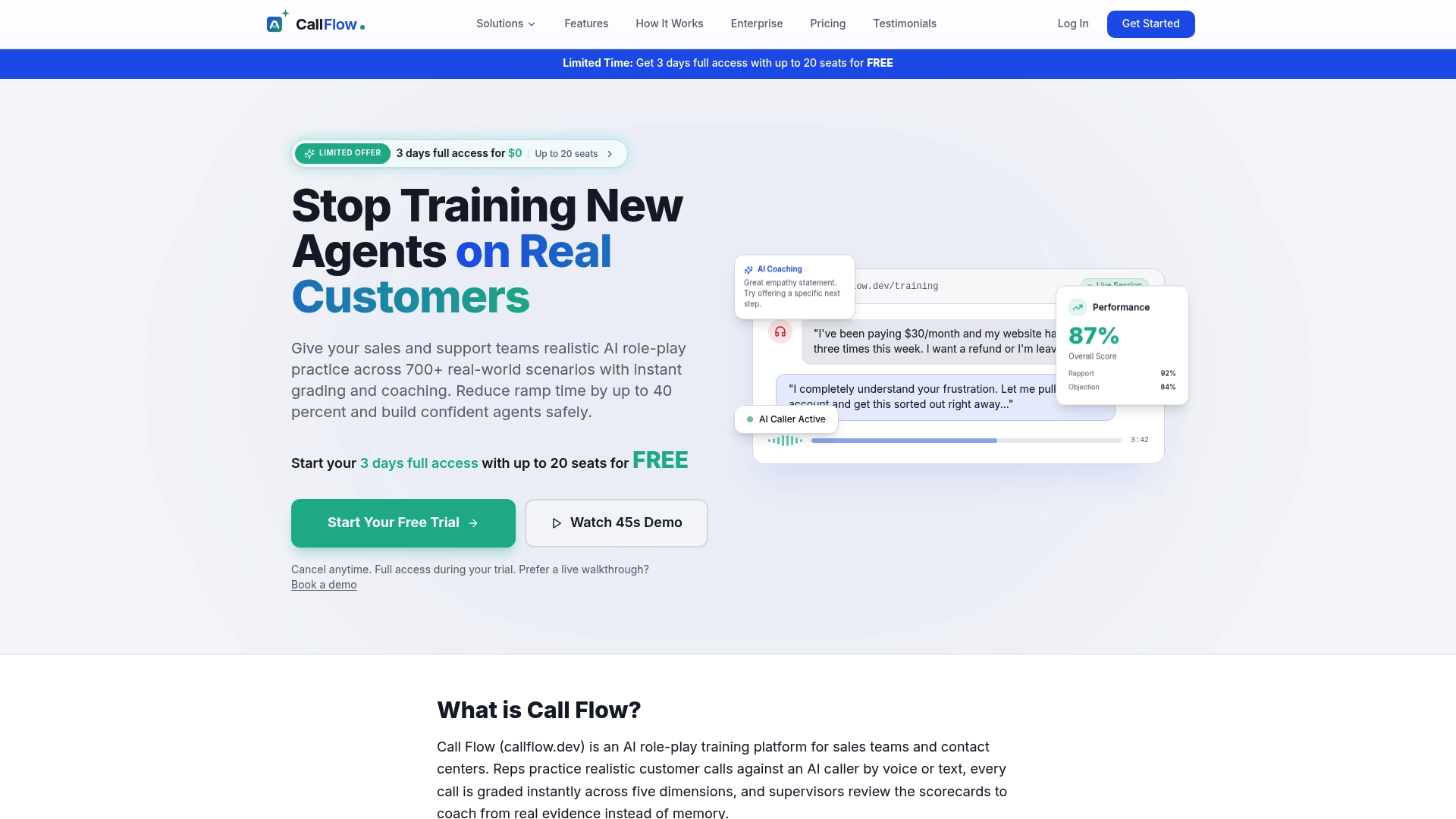
In-person role play still wins for high-emotion scenarios like chargeback threats or a customer demanding a manager, where tone, hesitation, and team dynamics matter more than a score. But for the bulk of your scenario library, the login problems, the billing errors, the WISMO tickets, an AI platform gives every agent unlimited reps without pulling a manager into the room each time. If you're building out a full 30-60-90 training plan, pairing live sessions with daily platform practice covers both the nuance and the volume.
Start a risk-free trial at Callflow and load your first scenario today.
Sources
- Customer service training activities toolkit
- Comm100 — 50 customer service training activities (PDF)
- 15 customer service scenarios for role play (ecommerce, chat-first)
- Role of AI in consultant team training: 2026 guide