

Sales training compliance means teaching and proving that every sales interaction follows law and policy. The immediate step is a risk-based training pilot that pairs scenario practice with auditable records. Regulators like the FTC and the SEC expect this, and tools like Call Flow can help teams build the practice and the proof together.
TL;DR:
- Maintaining thorough records of call details, transcripts, emails, and chat logs is essential to demonstrate compliance during audits and prevent enforcement penalties.
- Regular, role-based training that incorporates scenario practice and supervisor sign-off reduces legal risks and builds applied knowledge, not just policy awareness.
- Using AI-driven tools for instant performance feedback and consistent assessment helps reinforce correct behaviors and identify knowledge gaps efficiently.
- Policies should address off-channel messaging and personal device use, supported by restrictions, endpoint audits, and clear contractual obligations for third-party communication vendors.
- Monitoring key performance indicators such as audit exception rates and time-to-remediation is crucial for measuring the effectiveness of compliance programs over time.
Table of Contents
- What sales compliance covers and why it matters
- Regulatory framework and recordkeeping expectations
- Core elements of an effective compliance program
- Designing training that sticks
- Technical controls for call recording and off-channel risk
- Measuring effectiveness with KPIs and audits
- Evidence and outcomes: AI role-play in practice
- What matters most in practice
- Run a pilot with Call Flow
- FAQ
- Sources
- Primary sources to consult
What sales compliance covers and why it matters
Sales compliance has two parts. One is legal: following rules set by regulators. The other is ethical: treating customers fairly even when no rule directly applies. Both parts show up in daily sales work, not just in annual policy documents.
Common risk areas include:
- Misstatements about product features, pricing, or guarantees made during live calls.
- Incentive structures that push reps toward quantity over accuracy.
- Off-channel messaging, such as texting a customer from a personal phone.
- Gifts or entertainment offered to win business without proper disclosure.
Enforcement has consequences beyond fines. A team that fails an audit often faces reputational damage with customers and partners, plus the internal cost of remediation. Sales managers and compliance officers need to work together here. A manager knows which scripts and incentives drive behavior. A compliance officer knows which behaviors create legal exposure. Training programs built by only one side tend to miss real risks.
Regulatory framework and recordkeeping expectations
Several rules shape what sales training must cover and what records a team must keep.
The Telemarketing Sales Rule requires detailed recordkeeping for telemarketing and commercial messaging. The FTC expects firms to retain call detail records and copies of unique prerecorded messages, including those generated by soundboard technology. The CAN-SPAM Act sets separate rules for commercial email: accurate headers, no deceptive subject lines, a physical postal address, and a working opt-out link.
For firms subject to SEC oversight, Rule 17a-4 requires business communications to be stored in non-erasable formats and produced promptly when examiners ask. Retention periods under this rule and related guidance often run three to six years.
Recent enforcement shows the stakes. The SEC announced penalties exceeding $88 million against eleven firms for widespread recordkeeping failures, many tied to employees using unapproved messaging apps.
Records sales teams should preserve include:
- Call detail records and unique prerecorded message copies.
- Emails with intact headers and metadata.
- Chat logs from approved business messaging platforms.
- Supervisor review notes tied to specific interactions.
Regulators look past the paperwork, too. The DOJ and SEC FCPA Resource Guide notes that culture and documented follow-through matter as much as the policy itself.
Core elements of an effective compliance program
A training program that actually reduces risk needs several pieces working together, not a single annual course.
- Written policies with clear thresholds. Define gift limits, discount approval levels, and travel rules, and require documented sign-off for exceptions.
- Role-based curricula. A new account executive needs different training than a senior rep who negotiates custom contracts.
- Scenario-based practice. Reps should work through realistic call situations, not just read policy text.
- Escalation and reporting paths. Reps need a clear process for flagging a questionable request from a customer or manager.
- Recordkeeping of training itself. Keep participation logs, assessment scores, and signed policy acknowledgements.
Pro Tip: Tie every policy threshold to a specific example a rep might face that week, not an abstract rule.
Supervisor sign-off closes the loop. When a rep escalates a gray-area situation, a documented decision protects both the rep and the company later. Skipping this step is one of the most common gaps auditors find.
Designing training that sticks
Start with a risk assessment. Rank sales roles and topics by how often they touch regulated activity, then prioritize training hours accordingly. A team selling regulated financial products needs more frequent refreshers than one selling general merchandise.
A workable design pattern looks like this:
- Baseline assessment to find existing knowledge gaps.
- A core module covering policy and law in plain language.
- Scenario practice where reps apply the policy to a realistic call.
- Spaced reinforcement over the following weeks, not a one-time session.
- Recertification on a set schedule tied to role risk level.
Assessment mechanics matter as much as content. Use a scoring rubric, set a clear pass threshold, and have supervisors calibrate scores against each other so grading stays consistent. Build a remediation path for reps who fail, with a retake date and extra coaching.
Pro Tip: Mix delivery formats: short e-learning for policy basics, live sessions for discussion, and simulation-based role-play for applied practice. Spaced reinforcement through brief follow-up exercises keeps the material from fading after the initial session.

Technical controls for call recording and off-channel risk
Policy only works when the underlying records exist and can be found. Capture and preserve the following:
- Call recordings and detailed call records.
- Transcripts generated from recorded calls.
- Email headers and full message content.
- Chat logs from approved platforms, with metadata intact.
Store these in non-erasable, indexed formats with restricted access, so a specific record can be pulled quickly during an audit. Off-channel communication, meaning reps using personal texting or messaging apps for business, is a recurring root cause in enforcement actions. Address it with a clear policy, device or app restrictions where feasible, and periodic endpoint checks tied to HR and compliance review. Any third-party vendor handling communications should have a contract clause guaranteeing record access on request.
| Control area | What to capture | Storage requirement |
|---|---|---|
| Phone calls | Recordings, call detail records | Non-erasable, indexed, access-restricted |
| Headers, full content, attachments | Multi-year retention per applicable rule | |
| Chat and messaging | Logs from approved platforms only | Archived with metadata intact |
| Off-channel use | Policy acknowledgement, periodic endpoint audit | Documented review cycle |
Tools built for customer communication tracking can help centralize this capture, which simplifies the handoff between IT and compliance teams when an audit request comes in.
Measuring effectiveness with KPIs and audits
A training program needs numbers attached to it, not just a completion checkbox.
- Certification pass rate by role and cohort.
- Audit exception rate found during periodic record reviews.
- Off-channel incident frequency reported or detected.
- Time-to-remediate after a flagged issue.
- Training-to-performance linkage, such as fewer escalations after a module launch.
Design audits around the records regulators actually ask for: training logs, assessment scores, and call or message samples tied to specific reps. Use failure patterns to revise curriculum. If one scenario produces repeated failures across cohorts, the training module needs a rewrite, not just more repetitions of the same content.
Evidence and outcomes: AI role-play in practice

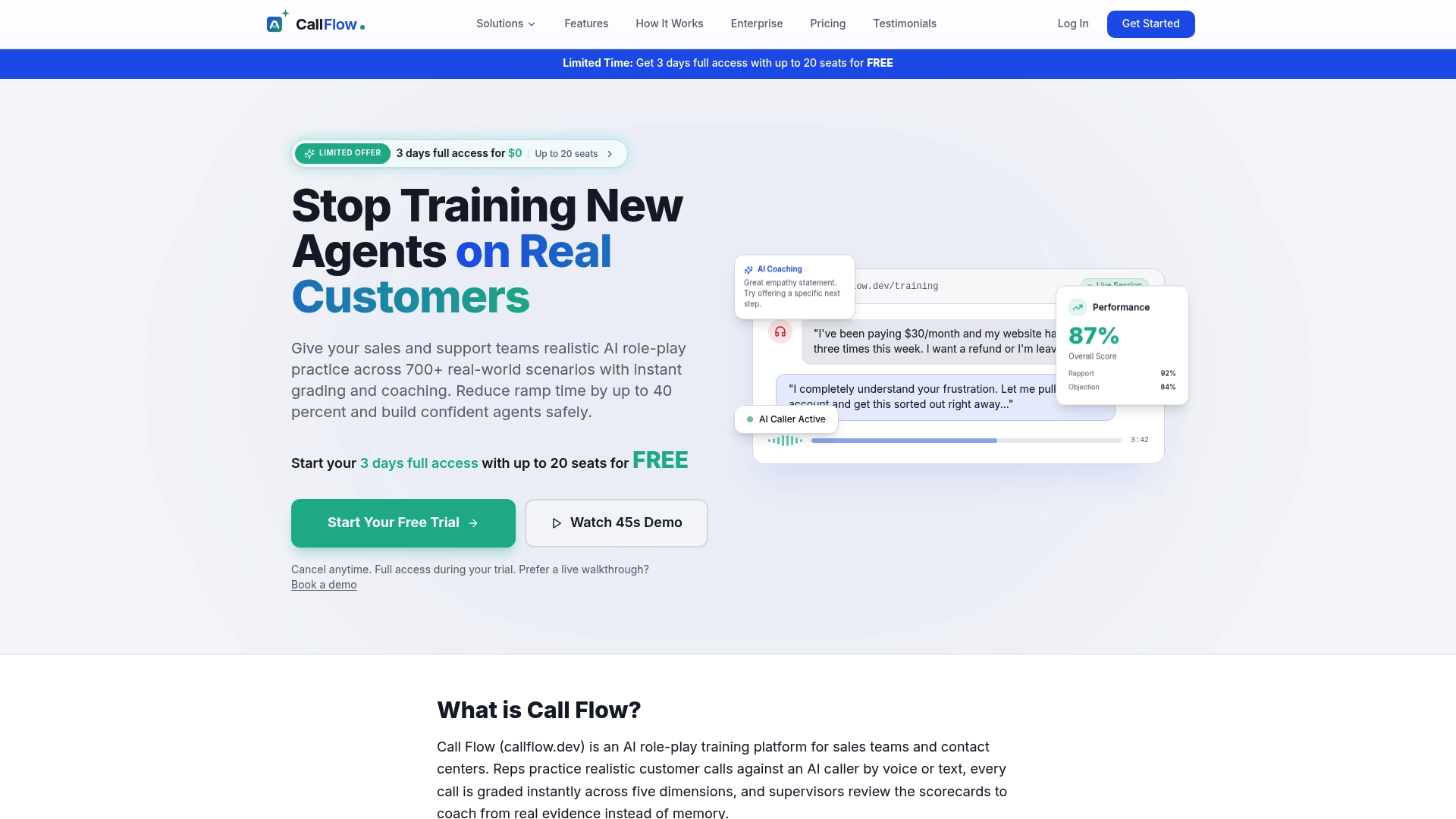
Scenario practice works better when it is measured and repeatable. Call Flow is an AI role-play platform built for sales and contact center teams, offering configurable practice scenarios with instant grading across several performance dimensions.
A focused pilot can test this quickly:
- Define the scope: one role, one risk area, four to six weeks.
- Build a scoring rubric tied to compliance-relevant behaviors.
- Calibrate supervisor scoring before the pilot starts.
- Retain every assessment artifact for the eventual audit package.
What matters most in practice
Culture and recordability beat checkbox training every time. A completion certificate proves nothing if the rep cannot handle the actual scenario on a live call.
Three priorities stand out: secure record capture first, because without it nothing else is provable. Build scenario practice second, because policy knowledge without applied practice does not change behavior. Measure and audit third, because a program that never gets reviewed will drift from its original design. Start with one module, one role, and one audit cycle before expanding further.
— Costa
Run a pilot with Call Flow
We built Call Flow around a simple idea: sales reps improve faster when they practice realistic scenarios and get instant feedback, not vague notes from a supervisor days later. Our AI role-play scenarios grade performance across multiple dimensions right after each session, and supervisor dashboards give compliance officers the review and override controls needed to keep assessment records audit-ready.
Plans start with Starter at $7.42 per month or $89 per year, scaling up through Growth and Scale plans for larger teams. Larger organizations needing custom terms can review Business and Enterprise options. A one-week pilot with baseline scoring is the fastest way to see if this fits your compliance workflow. Start a trial and run your first scenario today.
FAQ
What are compliance trainings?
Compliance trainings teach employees the laws, regulations, and internal policies that apply to their job function, along with how to recognize and report violations. For sales teams, this typically covers disclosure rules, recordkeeping requirements, and ethical conduct around incentives and customer communication.
What are the types of sales training?
Sales training generally falls into product knowledge, skills training such as negotiation or objection handling, and compliance training covering legal and ethical requirements. Many programs also include onboarding training for new hires and ongoing certification for existing reps tied to role-specific risk.
What is the 3-3-3 rule in sales?
Definitions of the 3-3-3 rule vary across sales organizations, and no single regulator or standards body defines it. A common informal version refers to a prospecting cadence, such as three touches across three channels over three days, rather than a compliance standard.
What does sales compliance mean?
Sales compliance means ensuring every sales interaction follows applicable law and internal policy, covering areas like truthful marketing claims, proper recordkeeping, and fair treatment of customers. It combines legal obligations, such as those outlined by the FTC, with a company's own ethical standards.
Sources
- Complying with the Telemarketing Sales Rule (FTC)
- A Resource Guide to the U.S. Foreign Corrupt Practices Act (DOJ/SEC)
Primary sources to consult
For deeper detail on legal requirements, these primary sources are worth reviewing directly rather than relying on summaries.
The DOJ and SEC FCPA Resource Guide lays out the hallmarks of an effective compliance program, including risk-based design, senior management commitment, and remediation after failures. It also explains how self-reporting and cooperation factor into enforcement decisions.
The FTC's Telemarketing Sales Rule guidance covers recordkeeping obligations for telemarketing and prerecorded messages, while the CAN-SPAM compliance guide sets the standard for commercial email practices.
On the recordkeeping side, the SEC's Rule 17a-4 final rule details storage and production requirements for business communications. A recent SEC press release on recordkeeping penalties shows what enforcement actually looks like when firms fall short, including the role self-reporting played in reduced penalties.