

A validated sales skills assessment shortlists candidates and cuts ramp time. Run a 10–30 minute role-play or aptitude screen as your first filter. The best options for most teams right now:
- Callflow AI role-play — configurable scenarios, instant grading across five performance dimensions, voice and text modes. Best for final-stage hiring and ongoing development.
- Short aptitude/skills test (10–30 minutes) — screens for cognitive ability, situational judgment, and communication before you invest interview time.
- Psychometric profile (Caliper Profile, SalesGenomix, DriveTest) — measures behavioral traits and motivational fit. Best paired with a skills screen, not used alone.
- Scorecard/template (HubSpot Sales Scorecard) — a low-friction starting point for standardizing interview ratings across your panel.
Next step: Add a 10–30 minute aptitude screen or role-play to your next hiring batch. Request a sample report or demo from any vendor before you buy.
Pro Tip: Run the aptitude screen before the first live interview. You cut scheduling time and arrive at the interview with data, not guesses.
Key Takeaways
A validated sales skills assessment combines a short aptitude screen, a role-play or simulation, and a calibrated scorecard to predict performance before you hire and accelerate development after.
| Point | Details |
|---|---|
| Start with a short screen | Run a 10–30 minute aptitude test before any live interview to filter on cognitive ability and situational judgment. |
| Add a role-play at the final stage | AI role-play (Callflow) scores real behavior across five dimensions and is harder to game than self-report formats. |
| Verify vendor validity claims | Ask for a published validity study, a reliability coefficient, and a sample report before signing any contract. |
| Track pilot metrics from day one | Measure ramp time, coaching conversion, and score improvement; Callflow reports 147% faster ramp time from AI role-play training. |
| Callflow combines assessment and training | One platform handles scenario-based assessment, instant grading, and ongoing coaching development. |
Table of Contents
- How do the main assessment formats compare?
- How do you choose the right assessment for your team?
- What types of assessments measure sales skills?
- What competencies should a sales assessment measure?
- How do you verify a vendor's psychometric claims?
- How does AI role-play assessment work, and what results can you expect?
- Callflow gives you role-play assessment and coaching in one place
- Sources
How do the main assessment formats compare?
Different formats answer different questions. An aptitude test tells you what a candidate can do. A psychometric profile tells you how they tend to behave. A role-play shows you what they actually do under pressure. Use them in sequence, not as substitutes.
Quick pros and cons:
- AI role-play: Hardest to game, most realistic signal, requires scenario setup time. Request a Callflow demo to see a sample graded call.
- Aptitude test: Fast, scalable, legally defensible when validated. Ask vendors for predictive validity data tied to quota attainment.
- Psychometric profile: Rich narrative output, but measures traits not skills. Pair with a skills screen for hiring decisions.
- Scorecard: Free and fast to deploy, but inter-rater reliability depends on calibration. Use the HubSpot Sales Scorecard as a starting template.
- SJT/simulation: Strong for onboarding gap analysis. Richardson's SkillGauge and Action Selling's assessment both produce module-level gap reports.
- Knowledge test: Good for certification and onboarding, weaker as a standalone hiring filter.
How do you choose the right assessment for your team?
Start with the job. A high-volume SDR role needs a fast, scalable screen. An enterprise AE role needs a deeper behavioral and skills signal. The format follows the decision you need to make.
Decision checklist
Before you evaluate any vendor, confirm the assessment meets these criteria:
- Job relevancy — does it measure skills the role actually requires, not generic sales ability?
- Predictive validity evidence — does the vendor have data linking scores to quota attainment, ramp time, or retention?
- Format match — does the format fit your hiring stage (screen vs. final round) and candidate volume?
- Candidate time commitment — is it under 30 minutes for a screen? Longer assessments increase drop-off.
- EEOC/legal defensibility — is the assessment validated against adverse impact? Legally defensible tests are short, job-relevant, and backed by validation data.
- Reporting that maps to coaching — can a manager act on the output, or is it a score with no context?
Questions to ask vendors in demos
- Can you show a sample report for a candidate who scored in the bottom quartile?
- What is your reliability coefficient (Cronbach's alpha or test-retest)?
- How was the scoring rubric calibrated to top performers in my industry?
- Do you have multilingual support for my candidate markets?
- What integrations do you support (ATS, CRM, HRIS)?
- How long is candidate data retained, and who owns it?
- Do you have a published validity study I can review?
Typical timelines and pricing
Most per-candidate assessments run $15–$75 per seat for aptitude and knowledge tests. Psychometric profiles (Caliper, SalesGenomix) are typically custom-quoted and higher per seat. Subscription platforms (Callflow, TestGorilla) bundle volume at a flat monthly or annual rate. A pilot typically takes two to four weeks to set up, run on a sample cohort, and review results.
Red flags
- No published validation data or a vendor who says "our tool is validated" without a study to share.
- Opaque scoring where you cannot see how a score was derived.
- Candidate time over 45 minutes for a screening stage.
- No sample report available before purchase.
- No audit trail for scores (a legal risk in regulated hiring environments).
Pro Tip: Ask every vendor for a sample report before the demo ends. A vendor who cannot produce one on the spot has not run enough assessments to have a real output to show you.
What types of assessments measure sales skills?
The main formats differ in what they can prove, how fast they run, and how easy they are to fake.
Short aptitude tests cover cognitive ability, situational judgment, written communication, CRM discipline, and AI readiness. They are the fastest volume filter you have. TestGorilla's sales aptitude test, for example, runs in 10–30 minutes and covers communication, persuasion, resilience, and problem-solving.
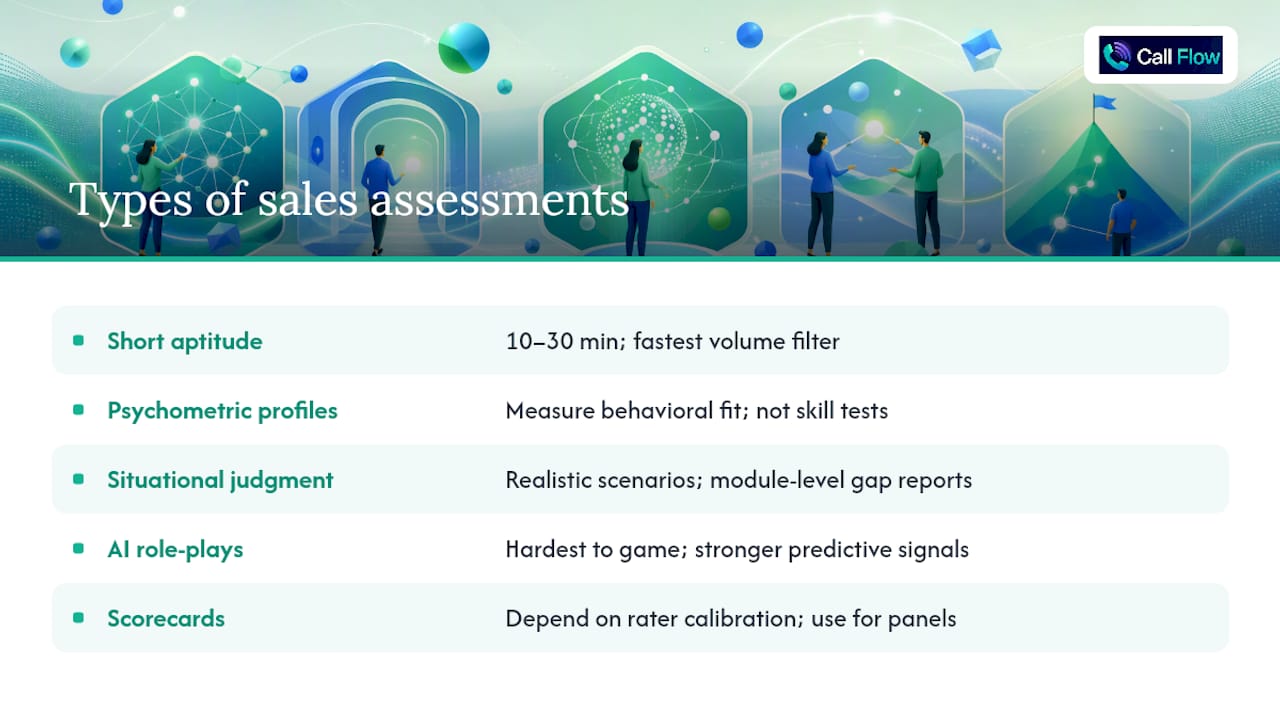
Psychometric profiles (Caliper Profile, SalesGenomix, DriveTest/SalesDrive) measure behavioral tendencies and motivational fit. Caliper maps traits to role requirements. SalesGenomix focuses on sales-specific DNA. DriveTest screens for the need-for-achievement drive that correlates with top sales performance. These are not skills tests. They tell you how someone is wired, not what they know.
Situational judgment tests put candidates in realistic scenarios and ask what they would do. Action Selling's assessment and Richardson's SkillGauge both use SJT-style items tied to a defined sales process. They produce module-level gap reports that are useful for onboarding.
AI role-plays and simulations are the hardest format to game. Assessments that combine situational judgment, audio roleplay, and free-response analysis scored against rubrics calibrated to top performers give stronger predictive signals than self-report tests alone. Callflow operates in this category.
Scorecards (HubSpot's free template is a practical starting point) standardize interviewer ratings but depend entirely on rater calibration. Use them to structure panel interviews, not as a standalone hiring filter.
What competencies should a sales assessment measure?
Most validated assessments converge on the same core skill set. The weighting changes by role.
Core competencies measured across vendors:
- Discovery and questioning (uncovering needs, active listening)
- Objection handling (reframing, staying composed)
- Call planning and preparation
- Presentation and positioning (value articulation)
- Closing and gaining commitment
- Relationship building and follow-through
- Written outreach (email quality, personalization)
- CRM and process discipline
- AI/tool fluency
- Coachability (response to feedback, self-correction)
Sample scorecard you can copy
Use this in structured interviews or alongside a role-play. Score each competency 1–4 (1 = below standard, 2 = developing, 3 = meets standard, 4 = exceeds standard).
How to calibrate: Before your first scored interview, have two interviewers independently score the same recorded role-play. Compare ratings. Where they diverge by more than one point, align on the behavioral anchor for that score level. Do this once per quarter as your team or rubric changes.
A rep who scores a 3 on discovery but a 4 on coachability will outperform a rep who scores a 4 on discovery and a 2 on coachability within six months.*
How do you verify a vendor's psychometric claims?
Vendors use "validated" loosely. Here is what the term should actually mean and how to check it.
Key terms to know:
- Predictive validity — does the score predict job performance (quota attainment, ramp time)? This is the number that matters most for hiring.
- Concurrent validity — does the score correlate with current performance in an existing employee sample? Easier to produce than predictive validity, but less useful for hiring.
- Reliability (Cronbach's alpha) — does the test produce consistent scores? A coefficient above 0.70 is the floor; above 0.80 is solid.
- Norming sample — what population was the test calibrated against? A B2B SaaS sales norm is more useful than a generic sales norm.
- Adverse impact — does the test produce disparate pass rates across protected groups? A legally defensible test has been analyzed for this and adjusted.
Vendor evidence checklist
- Published validity study (not a white paper, an actual study with methodology and sample size)
- Reliability coefficient available on request
- Sample report showing score derivation, not just a final number
- Real-world case studies with before/after performance data
- Ability to calibrate scoring rubrics to your top performers
- Clear data retention and candidate transparency policy
What to ask for: Request a sample test item, a scoring rubric, and a completed sample report before you sign anything. A vendor who has run thousands of assessments will have all three ready. If they hesitate, that tells you something about the depth of their validation work.
Pairing assessment scores with live CRM data (quota attainment, pipeline conversion, ramp time) closes the validation loop. Tracking post-hire performance against pre-hire scores is the only way to confirm a test is actually predicting what it claims to predict. Build that tracking into your pilot from day one.
How does AI role-play assessment work, and what results can you expect?
Callflow runs as a configurable role-play platform. Here is the flow from setup to coaching action:
- Scenario creation — build a call scenario (cold call, discovery, objection, renewal) using Callflow's scenario editor. Set the customer persona, objection type, and success criteria.
- Candidate or rep role-play — the participant takes the call in voice or text mode, responding to the AI customer in real time.
- Instant AI grading — Callflow scores the call across five performance dimensions immediately after the session ends.
- Dashboard and coaching actions — supervisors see per-rep scores, trend lines, and flagged coaching moments. Reps see their own feedback without waiting for a manager review cycle.
Callflow's published outcomes from AI role-play training include 147% faster ramp time and a 129% improvement in resolution rates. Those are the metrics to track in your pilot.
Role-play assessments that force real behavior are harder to game than self-report formats. Audio roleplay and free-response analysis scored against rubrics calibrated to top performers produce stronger predictive signals. Callflow operates on that principle. The AI grades against a rubric, not a feeling.
30-day pilot plan
- Cohort size: 8–15 reps or candidates (enough to see variance, small enough to manage)
- Setup: Configure two to three scenarios relevant to your sales motion (one cold call, one objection, one discovery)
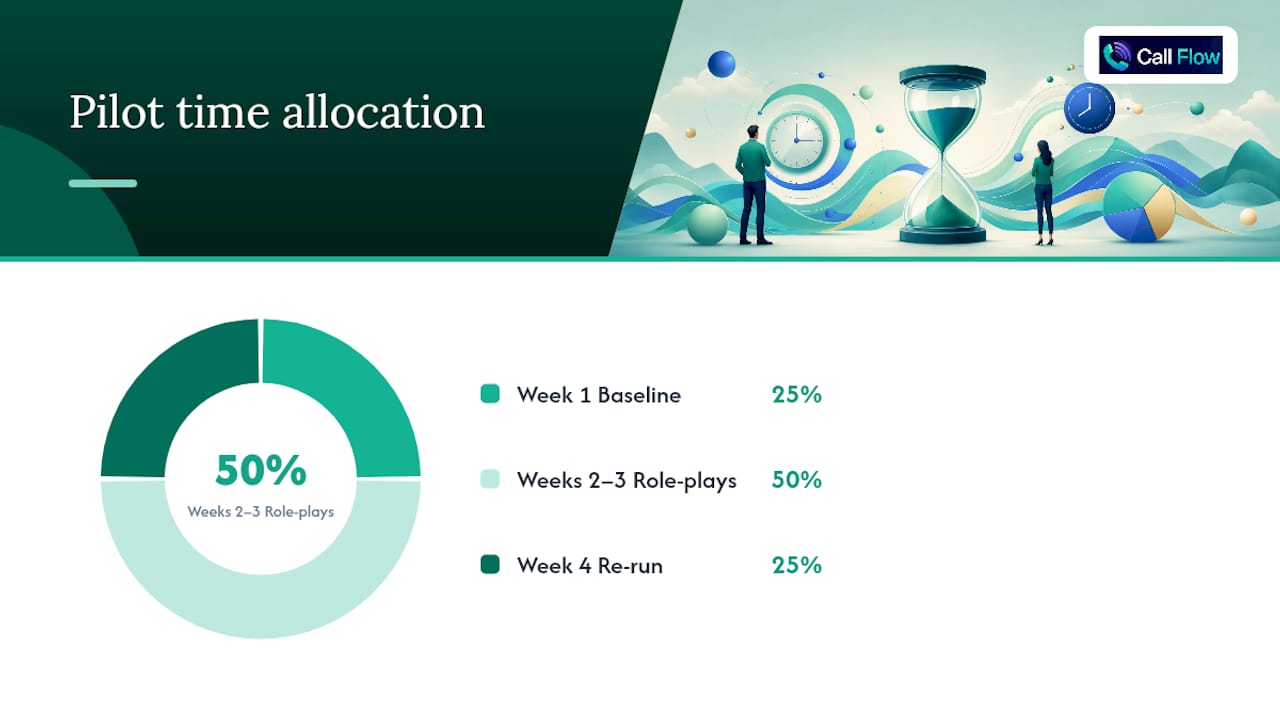
- Week 1: Baseline assessment. Every participant completes all three scenarios. Record scores.
- Weeks 2–3: Weekly role-play sessions with coaching feedback from the dashboard.
- Week 4: Re-run baseline scenarios. Compare scores to week 1.
- Success metrics to track: Score improvement per dimension, time-to-first-qualified-call for new hires, coaching conversation rate (did managers act on dashboard flags?).
Callflow's simulated failure approach lets reps practice difficult calls without the cost of a real lost deal. That is the core value for onboarding: reps arrive at their first live call having already handled the hard objections.
Pro Tip: In hiring, run the role-play in the final stage, after the aptitude screen has already filtered the pool. You spend Callflow credits on candidates who have already cleared the cognitive and communication bar.
What a practical hiring and development routine looks like
Pre-hire sequence:
- Aptitude screen (10–30 minutes) — filter for cognitive ability, situational judgment, and written communication before any live interview.
- Structured interview with scorecard — use the competency scorecard above. Two interviewers, independent ratings, calibration session after.
- Role-play in final stage (Callflow) — one cold call scenario and one objection scenario. Review AI scores before the debrief call.
Onboarding and development routine:
- Day 1–30: Two role-play sessions per week in Callflow. Focus on discovery and objection handling. Review dashboard scores weekly.
- Day 31–60: Add call planning and closing scenarios. Biweekly analytics review with the manager.
- Day 61–90: Full scenario set. Compare scores to baseline. Identify the bottom two competencies per rep and build a targeted coaching plan.
Checkpoints:
- 7 days: Has the rep completed at least three role-plays? Are scores trending up?
- 30 days: Is the rep hitting first-call resolution targets? Are coaching flags decreasing?
- 90 days: Compare ramp metrics (pipeline created, quota attainment) to pre-hire assessment scores. This is your validation loop.
Callflow gives you role-play assessment and coaching in one place
Most psychometric-only vendors give you a profile. Callflow gives you a scored call. That is a different kind of evidence, and it is the kind that maps directly to what your reps do every day.
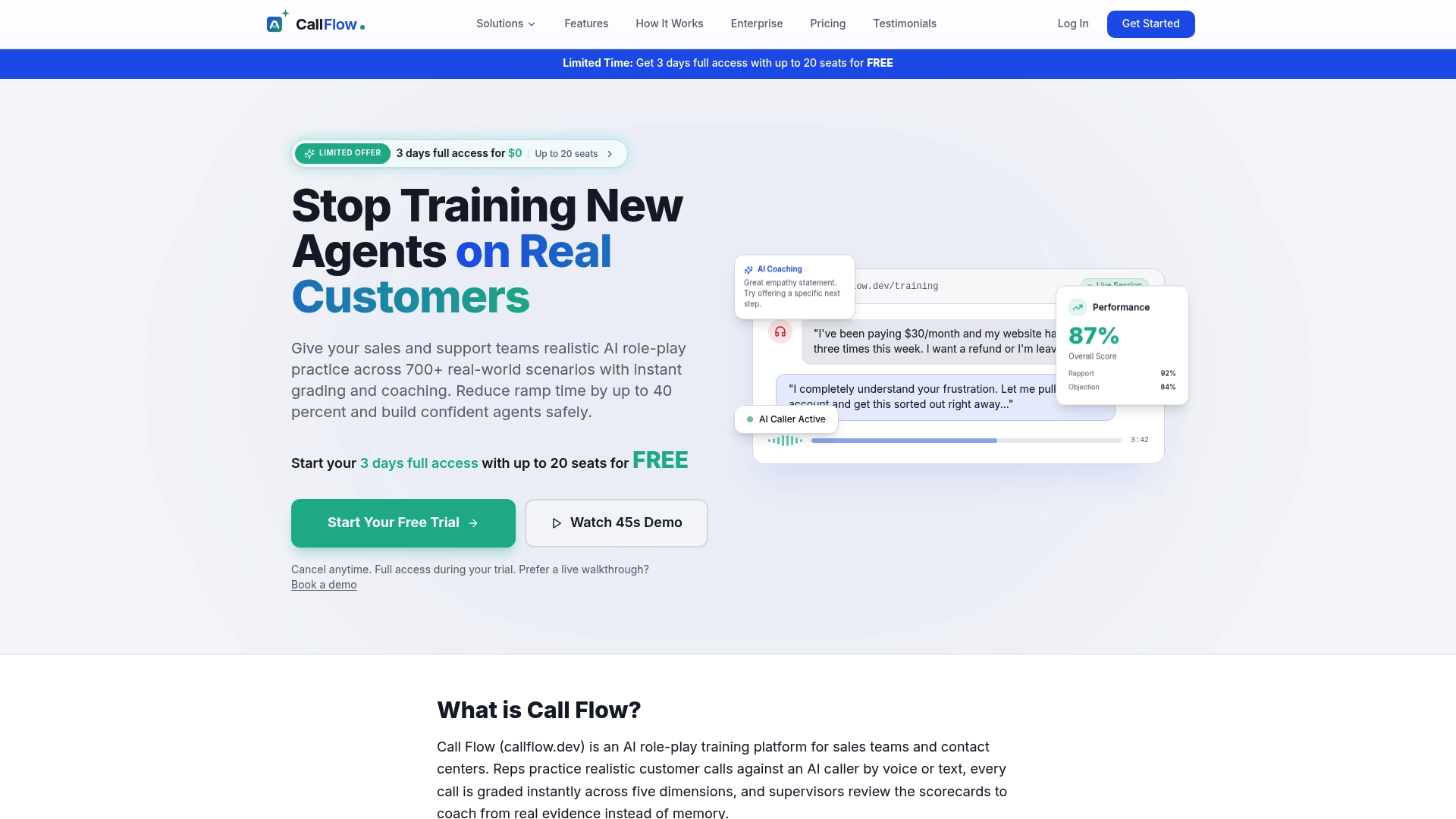
Callflow's AI mock call practice runs configurable scenarios, grades performance across five dimensions instantly, and surfaces coaching flags in a supervisor dashboard. You get assessment data and a training tool in the same platform. Psychometric-only vendors cannot do that.
For teams that want to pair a behavioral profile with a skills screen, use a Caliper or SalesGenomix profile for trait data, then run Callflow role-plays for skills validation. The two formats answer different questions and work well together.
Start with a free practice session to see how the grading works before you commit a full cohort. When you request a demo, ask to see a sample graded call report and the scenario editor. Those two things will tell you whether the platform fits your workflow.