
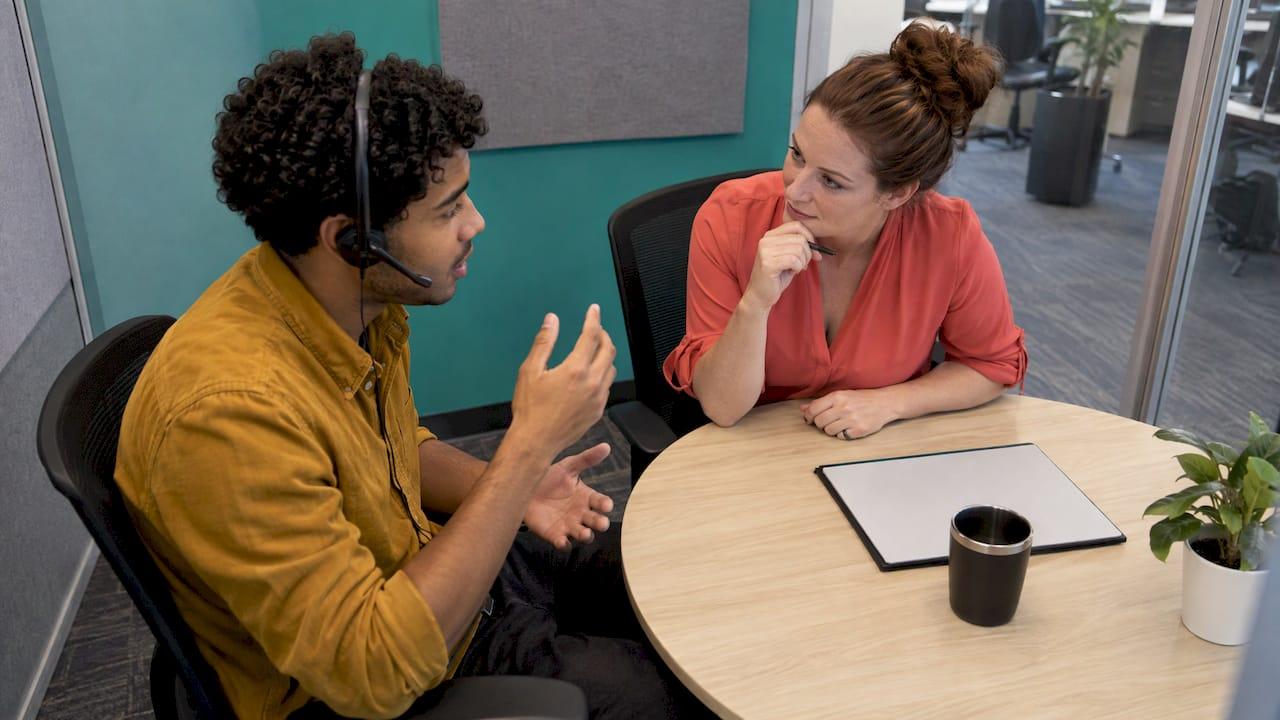
Quality assurance (QA) measures agent calls against a standard. Coaching helps the agent get better at meeting that standard. QA tells you what happened. Coaching changes what happens next. A contact center or sales team needs both, and each fails without the other.
This guide explains the difference in purpose, process, and timing. It shows how to turn QA scores into coaching that works. It also covers how to measure the result.
TL;DR
- QA is a measurement process: standards, scorecards, ratings, and calibration. Coaching is a development process: praise, instruction, and practice.
- QA finds the "what" and "where". Coaching works on the "why" and "how".
- A score alone does not change behavior. Pick one or two observed behaviors from the scorecard and coach on those.
- Coach soon after the call, agree on one action, and check it in later reviews.
- Role play gives agents a safe place to practice the behavior before the next live call.
Table of Contents
- What quality assurance means in a contact center
- What coaching means
- Quality assurance vs coaching: the differences
- Why a QA score is not coaching
- How to turn QA results into coaching
- Common mistakes when combining QA and coaching
- How to measure whether it works
- Where AI role play fits
- Try the loop with Call Flow
- FAQ
- Sources
What quality assurance means in a contact center
QA is a structured process. Reviewers evaluate agent interactions against defined service standards. The goal is to find where agents meet the standard and where they do not. Zoom's contact center guide describes it this way.
A working QA program has a few parts. ICMI's quality management toolkit links them in one program: performance standards, monitoring, calibration, coaching, and communication with employees. In practice that means:
- Written standards that say what a good call is.
- A scorecard with a rating system.
- A sample of calls, chats, or emails that reviewers score.
- Calibration, so different reviewers give the same call the same score.
QA is about the process and the standard. It is a general quality discipline, not only a call center one. A quality assurance glossary entry gives the wider definition: QA sets up the processes that make good results repeatable.
If you need a starting point for the scorecard, see our QA scorecard templates for call centers.
What coaching means
Coaching is the manager-to-agent process that turns observed performance into improvement. ICMI describes it as timely praise, instruction, and practice after interactions are monitored.
A good coaching session follows a simple path:
- The coach reviews evidence from real interactions.
- The coach and agent talk about strengths and gaps.
- The coach demonstrates better behavior, or the agent practices it.
- They agree on an action goal.
- The coach follows up.
Coaching is personal. It deals with one agent, one behavior, and one next step. It needs trust. A scorecard cannot supply that.
For a full template, read our call center coaching plan.
Quality assurance vs coaching: the differences
The two share data, but they do different jobs.
| Quality assurance | Coaching | |
|---|---|---|
| Purpose | Measure performance against a standard | Develop the agent's skills |
| Main question | What happened, and where? | Why did it happen, and how do we improve it? |
| Owner | QA analyst or QA team | Team leader or manager |
| Output | Scores, trends, patterns | Action plan, practice, follow-up |
| Timing | Ongoing sampling and reporting | Soon after the monitored interaction, then on a regular cadence |
| Focus | The standard, the form, the rating | The person and the observed behavior |
| Risk if used alone | Scores with no change | Opinions with no evidence |
TechClass puts the split plainly in its QA and coaching article: QA finds the "what" and "where" through data, and coaching explores the "why" and "how" through guidance for people.
ICMI's toolkit draws the same line. QA sets program goals, performance standards, rating systems, and calibration. Coaching works on observed behaviors and an action plan.
Purpose
QA protects consistency. It tells you if the whole team meets the standard. Coaching builds ability. It helps one agent do better next time.
Process
QA is a system. It runs on forms, samples, and rules. Coaching is a conversation. It runs on evidence, questions, and practice.
Timing
QA reviews can run in batches. Coaching should not wait. ICMI recommends coaching after monitored interactions, while the call is still fresh. Delayed feedback is one of the challenges ICMI names for quality programs.
Coaching also has to be ongoing. SHRM explains in its piece on feedback and feedforward that feedback on past performance shows where someone was. Frequent feedforward gives direction and support for the next cycle.
Why a QA score is not coaching
Many teams send agents a score and call it feedback. That is QA without coaching.
A score says 82%. It does not say what to do on the next call. The agent may not know which part of the call cost points. The agent may not agree with the score at all.
The opposite problem also happens. A manager coaches from memory or from gut feeling. The agent argues, because there is no standard and no evidence. That is coaching without QA.
The fix is simple. QA supplies the evidence. Coaching supplies the change.
Leaderly makes a related point about feedback that drives performance: evaluation only matters when it leads to ongoing improvement.
How to turn QA results into coaching
Use this process each time you coach from a scorecard. It follows the guidance from ICMI and from unitQ's agent coaching preparation guide.
1. Pick one or two behaviors
Do not coach the total score. Look at the score by skill on the rubric. Choose one or two behaviors you can observe, such as confirming the issue before offering a fix, or summarizing next steps at the close.
An agent who leaves with eight goals leaves with none.
2. Bring real evidence
Pick a few representative calls or transcripts. Do not rely on one bad call. One call may be an outlier. Several calls show a pattern.
3. Include a strength
Add one call where the agent did the behavior well. This shows the agent can do it. It also gives you something to build on.
4. Ask for a self-assessment
Let the agent score the call first. Then compare. Gaps between the agent's view and the reviewer's view are where the real talk starts.
5. Practice
Do not stop at talking. Have the agent try the better behavior. A short role play in the session is enough. Practice is the step that most teams skip.
6. Agree on one measurable action
Write it down. Say what the agent will do, on which kind of call, and by when.
7. Follow up
Check the coached behavior in later QA reviews. If it did not change, the coaching needs to change.
A simple time split
Coach Elise C. Alley suggests a 30-minute check-in in her coaching cadence post. Spend 20% on connection, 20% on QA data and root cause, and 60% on solutions, skills, role play, and goals. The exact split can vary. The principle holds: most of the session is practice and planning, not reviewing the score.
For wording that managers can reuse, see our guide to writing coaching notes.
Common mistakes when combining QA and coaching
Inconsistent scoring. If two reviewers score the same call differently, agents stop trusting the score. ICMI lists inconsistent evaluator scoring as a core challenge and recommends calibration. Our guide to call calibration best practices shows how to run sessions.
Late feedback. Coaching a call from three weeks ago feels like criticism, not help. Coach soon after monitoring.
A scorecard that misses what customers value. If the form rewards steps customers never notice, high scores will not mean happy customers. Build the scorecard around behaviors that matter to the customer, such as a clear explanation and a resolved issue. Our post on call quality standards shows how to align scoring with a standard.
More reviews, not better reviews. More QA volume does not by itself improve performance. What counts is the design of the evaluation and how findings turn into coaching. Review fewer calls with a sharper form before you add reviewers.
No communication. Tell agents how the program works, what is scored, and why. ICMI recommends communicating program details to employees. Surprise scores damage trust.
Score as the lesson. Managers read out the number and move on. Always turn the number into a behavior.

How to measure whether it works
Do not only track QA scores. Track whether the coached behavior changes in later interactions. Then link that change to outcomes the customer feels.
Useful measures include:
- Accuracy of information given.
- First-contact resolution.
- Customer satisfaction.
- Repeat contacts.
- Escalations.
BenchmarkPortal's long-standing guidance treats customer perception as a main quality input. Internal compliance scores can miss what drives satisfaction. If your QA score rises and customer satisfaction does not, the scorecard is the first thing to check.
A simple loop works well:
- Coach one behavior.
- Watch that behavior in the next five to ten reviews.
- Compare first-contact resolution and satisfaction for that agent before and after.
- Keep, change, or drop the coaching focus.
Our call center performance metrics guide covers how to protect first-contact resolution and satisfaction while you do this.
Where AI role play fits
QA finds the gap. Coaching explains it. Practice closes it. Practice is where most teams run short on time.
Managers cannot sit with every agent for an hour a week. New hires need many repetitions before they take live calls. Agents with a weak spot need to try the behavior again and again, without a customer on the line.

AI role play fills that space. The agent runs a realistic customer scenario by voice or text. The system grades the call right away. The agent sees the result, tries again, and gets better before the next live call.
This also keeps QA and coaching linked. If the AI grading follows your existing scorecard, the practice call and the live call are judged by the same standard. Read more in our guides to AI role play for remote sales coaching and empathy training scored like live calls.
Our perspective on QA and coaching
We see QA and coaching as one loop, not two programs. QA is the measurement half. Coaching is the change half. Most teams do the first and run out of time for the second.
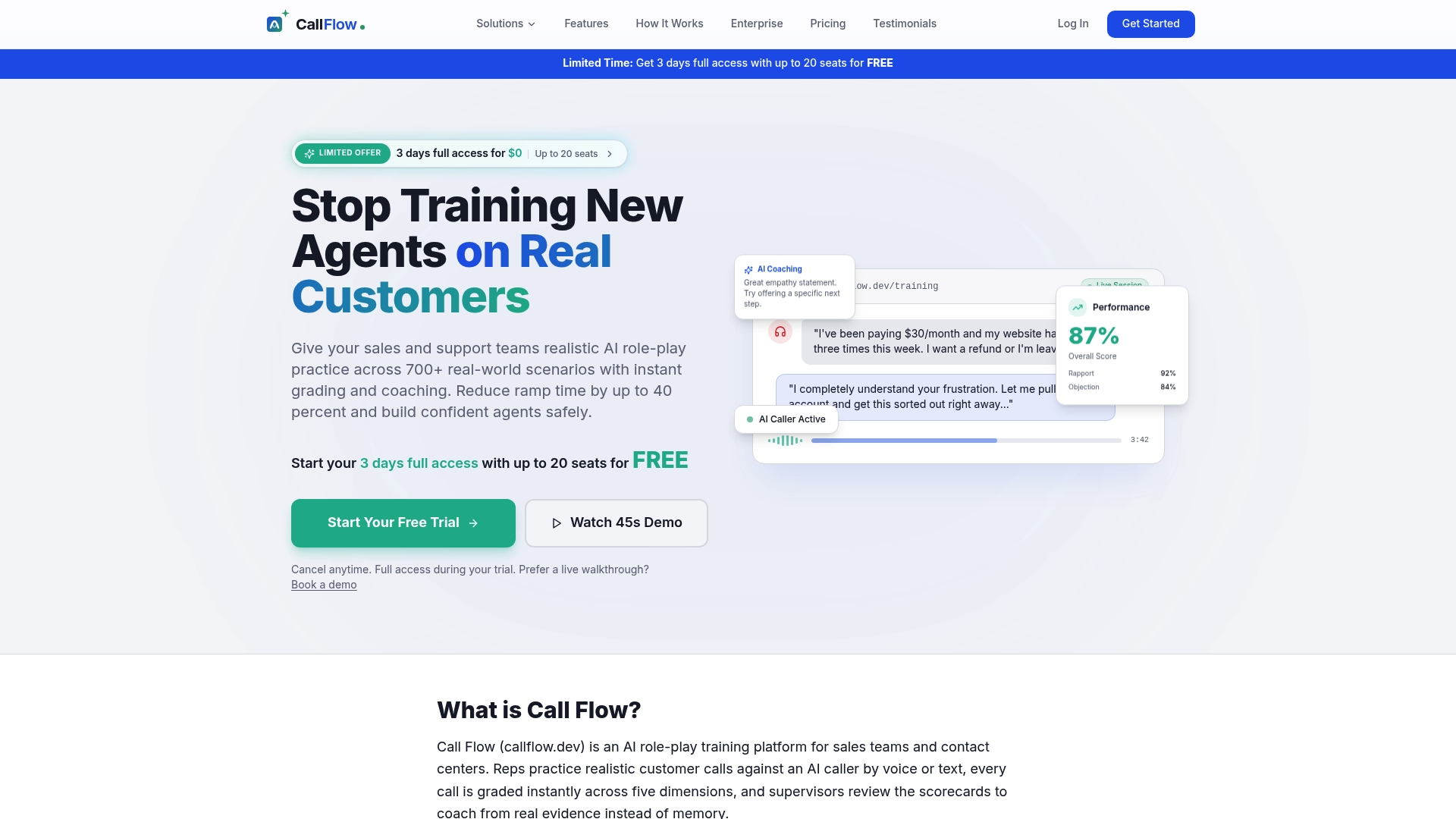
We built Call Flow to close that gap. The platform grades practice calls instantly across five performance dimensions. It gives actionable coaching feedback with each grade. Agents can repeat a scenario until the behavior sticks. Supervisors can review and override scores, so the manager stays in charge of the standard.
We also design scoring to align with your existing QA standards. A score from practice should mean the same thing as a score from a live call. That is what makes coaching believable to the agent.
Our view is simple. Measure the call. Coach the behavior. Practice it before the next customer. Then measure again.
Costa
Try the loop with Call Flow
Call Flow is an AI role-play training platform for sales teams and contact centers. It offers voice and text simulation, instant grading across five performance dimensions, coaching feedback, supervisor dashboards, skill analytics, and custom scenario tools. Call Flow reports faster ramp times and better resolution rates among its customers.
Plans are billed per team, monthly or yearly. Starter costs $7.42 per month or $89 per year. Growth costs $14.92 per month or $179 per year. Scale costs $33.25 per month or $399 per year. Business and Enterprise plans are priced on request.
A free full-feature trial is available. See the pricing page for plan details, or the Business and Enterprise options for larger teams.
FAQ
Is coaching part of quality assurance?
In a full quality program, yes. ICMI describes a quality program that links standards, monitoring, calibration, and coaching. QA produces the evidence. Coaching uses it to improve the agent. Many teams run them as separate jobs, which is why results stall.
Who should do QA and who should do coaching?
A QA analyst or QA team usually scores interactions and keeps the scorecard fair. The agent's team leader or manager usually coaches. The two should meet often. Calibration sessions keep scoring and coaching aligned.
How soon after a call should I coach?
As soon as you can. ICMI recommends coaching after monitored interactions. Fresh calls are easier to discuss. Delayed feedback is a known weakness in quality programs.
How many behaviors should I coach at once?
One or two. Choose observable behaviors from the scorecard, agree on one action, and check it in later reviews. Add a new focus only after the first one improves.
How do I know if my QA and coaching program works?
Check whether the coached behavior changes in later interactions. Then look at first-contact resolution, customer satisfaction, repeat contacts, and escalations. If QA scores rise but customer results do not, review the scorecard.
Sources
- Contact Center Quality Assurance: The Complete Guide, Zoom
- Quality Management in the Contact Center toolkit, ICMI
- Quality Assurance Meaning, glossary
- Effective QA & Coaching Strategies, TechClass
- Feedback, Feedforward and Frequency, SHRM
- Feedback is Critical to Improving Performance, Leaderly
- How to prepare for an agent coaching session, unitQ
- Beyond the Annual Review: The Coaching Cadence, Elise C. Alley