

Use microlearning for targeted knowledge and quick recall. Use role play for behavioral skill practice. A systematic review supports microlearning for knowledge gains, and practitioner guidance supports role play for skill transfer. For the strongest result, sequence microlearning first, then move into role-play practice.
TL;DR:
- A review of 40 studies found microlearning improved knowledge, retention, and motivation when each module focused on one clear objective.
- Build modules lasting a few minutes, add one interactive check, and test recall immediately and again a week later to measure retention.
- Role play needs an authentic scenario, safe ground rules, beginner scripts, rotating roles, and a structured debrief focused on observable behavior.
- When resources allow only one intervention, prioritize role play for behavior change; add short microlearning beforehand for grounding and later for reinforcement.
Table of Contents
- When to Choose Microlearning Versus Role Play
- Designing Microlearning: Duration, Objectives, Delivery, and Measurement
- Designing Role Play: Setup, Scripts, Group Structure, and Debrief
- Integrating Microlearning and Role Play Into a Training Flow
- Practical Examples: Microlearning Modules and Role-Play Scenarios
- Where to Focus When Time and Budget Are Tight
- Call Flow: Scale Role-Play Practice and Measurement
- FAQ
- Sources
When to Choose Microlearning Versus Role Play
Match the method to the learning goal. Do not force one tool to do both jobs.
- Knowledge and compliance topics fit microlearning: product facts, policy updates, regulatory steps, short process refreshers.
- Interpersonal and judgment-based skills fit role play: negotiation, objection handling, de-escalation, empathic interviewing.
- Mixed goals need both: learn the facts in a short module, then practice applying them under realistic pressure.
Use this checklist to pick a method for a given objective:
- Does the objective ask the learner to recall or recognize information? Choose microlearning.
- Does the objective ask the learner to respond to another person in real time? Choose role play.
- Does the objective require both steps? Sequence microlearning before role play.
A systematic review of 40 studies found microlearning improved knowledge acquisition, retention, and learner motivation when modules carried a single, clear objective. Role play works when the scenario is authentic and the debrief is structured, according to 2025 research on role-play design. Pick the method that matches what you are actually trying to change: what someone knows, or what someone does.
Designing Microlearning: Duration, Objectives, Delivery, and Measurement
Short modules work only when they stay narrow. A 2024 systematic review ties positive outcomes to modules with a single, clear objective delivered in a few minutes, not sprawling lessons cut into pieces.
Build each module with this sequence:
- State one learning objective per module.
- Chunk the content into small steps to reduce cognitive load.
- Add one interactive check (a question, a scenario pick, a short quiz).
- Personalize the example to the learner's role when possible.
- Space repeat exposure over days, not all at once.
Pro Tip: Write the module title as the objective itself, so learners know exactly what they'll walk away knowing.
Measure effectiveness with a short recall test right after the module, then a delayed check a week later to see what stuck. On-the-job proxies, like fewer policy questions routed to a supervisor, give a second signal. A 2022 scoping review notes rising adoption of microlearning in workplace settings alongside a continued need for better evidence on performance impact, which is a reason to track your own metrics rather than assume transfer happens automatically.
The common mistake: stacking three objectives into one module because it feels efficient. That single change, cutting each module to one objective, is often what separates a module that sticks from one that gets skipped.
Designing Role Play: Setup, Scripts, Group Structure, and Debrief
A role play only works if the setup earns trust first. A practitioner guide recommends building an authentic scenario, giving a short didactic briefing before practice starts, and running sessions in triads or dyads so everyone gets a turn.
- Give novices a scripted opening line or two; freeform practice is harder for beginners and raises anxiety.
- Set ground rules up front: no mockery, feedback is about behavior, not the person.
- Rotate roles (actor, recipient, observer) so each learner practices and watches.
- Calibrate difficulty by stage: easy scenarios early, harder objections once basics are solid.
Psychological safety determines whether anyone volunteers twice. Keep the room low-stakes early, and name the fact that a clumsy first attempt is part of the process. One technique worth borrowing: run a deliberately "bad" role play as an icebreaker, since 2025 research points to this as a way to normalize failure and lower pressure before real practice begins.
Pro Tip: Assign the observer a short notes sheet with two questions: what worked, what you'd try differently. It turns watching into learning.
Debrief with three steps: name the specific observable behaviors (not vague impressions), give feedback on one or two things to adjust, and close with an action the learner commits to trying next time. Design quality, not the medium, drives the result; a well-built scenario with a real debrief works whether it runs live in a room or inside a digital simulation.
Integrating Microlearning and Role Play Into a Training Flow
A practical sequence connects both methods instead of treating them as rivals:
- Pre-work micro-module: teach the core concept or policy in a few minutes.
- Knowledge check: a short quiz confirms the concept landed before practice starts.
- Structured role play: learners apply the concept against a realistic scenario.
- Debrief: observable feedback and one committed action per learner.
- Spaced micro refresher: a short follow-up module a week or two later reinforces the behavior.
Track KPIs at each stage: quiz scores after the micro-module, observed behavior ratings during role play, and ramp time or resolution rate once the skill moves to real calls.
Some teams report metrics showing faster ramp time and improvement in resolution rates from running this kind of sequence, figures the platform cites as its own performance claims.
This is where an AI role-play platform fits well into the flow. Scenario libraries let trainers assign relevant practice right after the knowledge check, instant grading gives feedback across performance dimensions without waiting for a live observer, and supervisor dashboards let managers see who needs more reps. Our AI role-play training approach is built around that exact handoff between teaching a concept and practicing it under pressure. Prompt-first scenario generation, the approach behind AI-generated practice scenarios, also helps keep difficulty and scoring consistent across a large team instead of varying session to session.
Practical Examples: Microlearning Modules and Role-Play Scenarios
Pair a short module with a matching scenario so the knowledge check leads straight into practice.
- Microlearning: refund policy basics. Objective: state the three refund conditions. Duration: 3 minutes. Delivery: mobile quiz card. Success metric: 90% quiz pass rate.
- Microlearning: objection types overview. Objective: name four common objection categories. Duration: 4 minutes. Delivery: short video plus tap-through quiz. Success metric: correct categorization on a follow-up check.
- Microlearning: de-escalation phrases. Objective: recall three calming phrases for an angry caller. Duration: 3 minutes. Delivery: flashcard app. Success metric: recall test one week later.
Matching role plays:
- Refund request, frustrated customer. Roles: agent, customer, observer. Prompt: customer wants a refund outside policy. Timing: 6 minutes plus 4-minute debrief. Debrief question: did the agent explain the policy without sounding defensive?
- Price objection, cold call. Roles: rep, prospect, observer. Prompt: prospect says the price is too high. Timing: 5 minutes plus debrief. Debrief question: did the rep ask a clarifying question before countering?
- Angry caller, service outage. Roles: agent, caller, observer. Prompt: caller is upset about a repeated outage. Timing: 7 minutes plus debrief. Debrief question: did the agent acknowledge the emotion before offering a fix?
Score each with a simple rubric: one point for acknowledging the issue, one for applying the policy correctly, one for closing with a clear next step. Our customer service role-play scenarios page has more ready-to-adapt prompts along these lines.
Where to Focus When Time and Budget Are Tight

Practice first when the goal is behavior change. A short knowledge module without practice rarely changes what someone does on a call, while a role play without any grounding wastes the session on confusion instead of skill. Microlearning earns its place as reinforcement: a quick refresher after the real practice, not a replacement for it.
If you can only run one intervention this quarter, run the role play. Add microlearning around it once the behavior starts to stick. Related examples on sales role-play games and scaling soft-skills role play show this prioritization in practice across different team sizes.
— Costa
Call Flow: Scale Role-Play Practice and Measurement
A structured flow needs a way to run practice at scale without a trainer in every session. Our platform gives every rep a scenario library, instant grading across performance dimensions, and coaching feedback the moment a call ends, so the role-play stage of your flow runs without waiting for a human partner to be free.
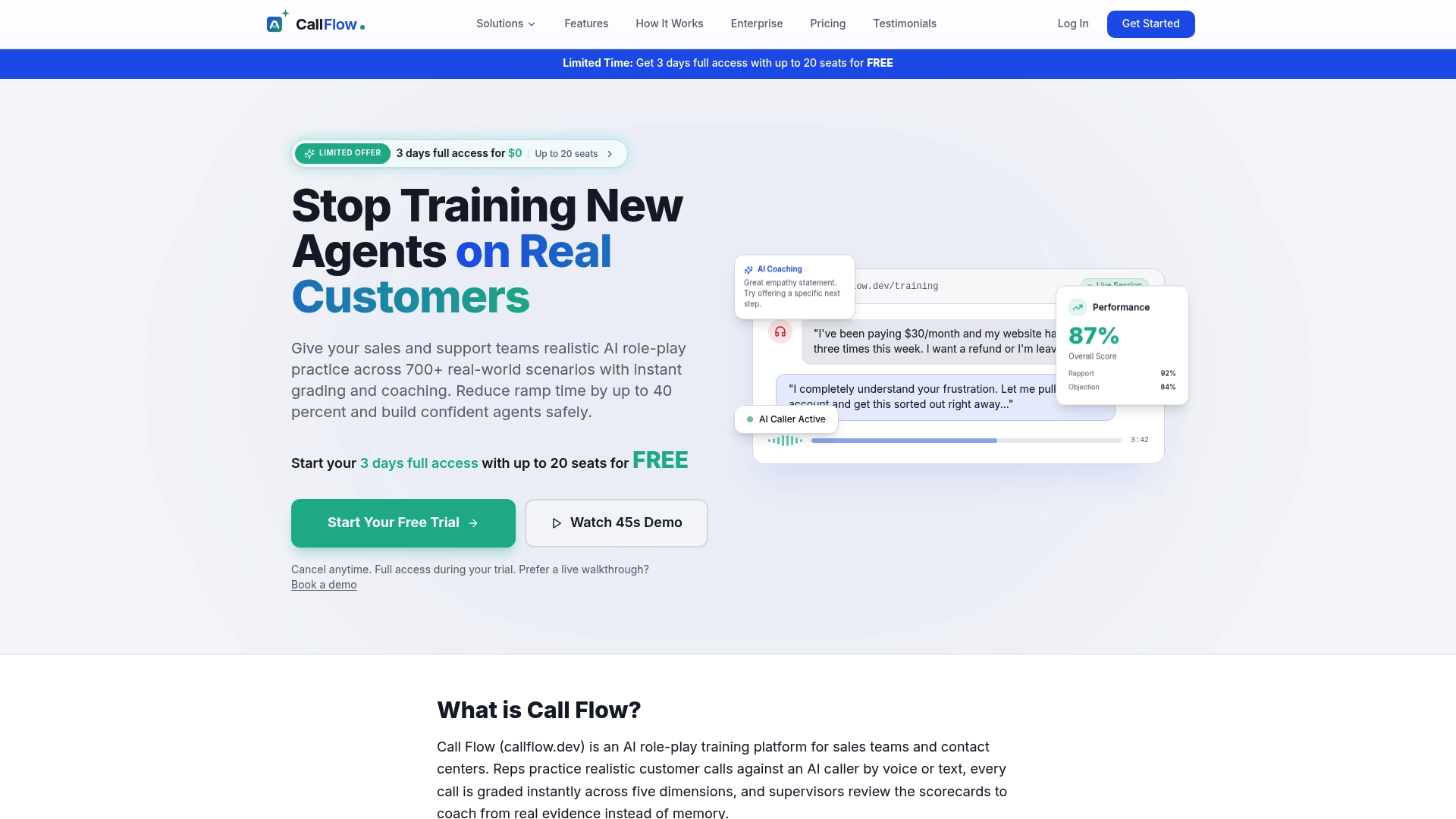
- Teams running this kind of AI-assisted practice report faster ramp time and improvement in resolution rates, according to data from the platform and insights from the AI Production Coach.
- Supervisor dashboards show exactly who needs another rep before a real call.
- A full-feature trial lets you test the scenario library and grading before committing.
Check pricing plans, starting with Starter at $7.42 per month, or review Enterprise options for larger teams.
FAQ
What is the definition of role play?
Role play is a training method where learners act out a realistic scenario, usually in pairs or small groups, to practice a skill in a simulated version of a real interaction. A practitioner guide frames it around authentic scenarios, scripted prompts for beginners, and a structured debrief afterward.
Is microlearning actually good?
Microlearning works well for knowledge gains, retention, and motivation when each module has a single, clear objective, according to a systematic review of 40 studies. It is not built to carry complex interpersonal skills on its own; pair it with practice like role play for that kind of goal.
What does the EYFS say about role play?
The EYFS framework is a UK early-years curriculum standard, and this article focuses on workplace and sales training rather than early-childhood education guidance. For EYFS-specific guidance on role play, check the official EYFS framework documentation directly.
What are some examples of role play activities?
Common examples include a refund dispute between an agent and a frustrated customer, a price objection during a cold call, and a de-escalation scenario with an upset caller, each run in a small group with one person observing. Our role-play scenario examples include a five-step scoring rubric to grade each one consistently.
Sources
- Microlearning beyond boundaries: A systematic review and a novel framework for improving learning outcomes
- The Effects of Microlearning: A Scoping Review, Educational Technology Research and Development, 2022-Apr
- A foolproof guide to running role plays
- Role-play study, 2025